


Who is this creator?
No community tags yet.
Showing 1 - 50 of 306
Recovery made simple
S&C coaches frequently complain that fatigue and recovery are difficult to understand. In reality, fatigue and recovery are straightforward when we use a physiological model. They are only complicated when we try and force physiological reality to fit into the general adaptation syndrome by insistin
Aug 24, 2026 0 7

Cooling effects on hypertrophy
In contrast to the effects of cold application on muscle damage repair, the effects of cold application on hypertrophy are relatively well-established. Multiple studies have now found that muscle growth is suppressed when muscles are cooled immediately post-workout. . #1. Hypertrophy is reduced when
Aug 17, 2026 0 7

Cooling effects on muscle damage recovery
While the practice of cold application immediately after muscle injury or exercise-induced muscle damage is a historically popular one, the literature presents a more confusing picture. Some studies have reported that cold application accelerates strength recovery while other studies suggest that it
Aug 10, 2026 0 7

Two phases of caloric restriction
As regards muscle mass retention, caloric restriction appears to function in two separate ways depending on the severity and duration of the caloric deficit. With a small deficit, the effect of caloric restriction is to reduce muscle protein synthesis (MPS) rates. With a large deficit, the effect of
Aug 3, 2026 0 8

Caloric restriction slows recovery
Many bodybuilders instinctively know that they recover from a workout more slowly when they are in a calorie restricted state compared to when they are in calorie balance. Yet, relatively little research has been devoted to this observation and to the underlying physiological mechanisms. . #1. Highe
Jul 27, 2026 0 10

Cortisol causes muscle loss
High levels of exogenous or endogenous glucocorticoids (including cortisol) cause atrophy. This observation is often ignored by hypertrophy researchers who have only just managed to free themselves from the incorrect belief that post-exercise hormones can affect muscle growth. Yet, the endogenous gl
Jul 20, 2026 0 9

Cortisol slows post-workout recovery
For centuries, both athletes and bodybuilders have known that their ability to recover from workouts is negatively affected by their stress levels and the quality of their sleep. Yet, there is only a limited amount of scientific literature devoted to this question. Fortunately, we can establish the
Jul 13, 2026 0 7
Elevated MPS rates do not ALWAYS guarantee hypertrophy
Since the time hypertrophy researchers started focusing most of their efforts on muscle protein synthesis (MPS) and myofibrillar protein synthesis (MYOPS) rates, they have started to exaggerate what can be deduced from that data. One incorrect claim that they persist in making is that elevated MPS a
Jul 6, 2026 0 11

Caloric restriction and atrophy
Caloric restriction is used to produce weight loss and the desired outcome is typically to reduce fat mass while retaining as much lean body mass as possible, usually by including a suitable strength training program into the weight loss plan. . #1. Does caloric restriction cause muscle atrophy? One
Jun 29, 2026 0 8
Fatigue resistance is not a hypertrophy bottleneck
Researchers appear desperate to link fatigue mechanisms with hypertrophy. Historically, many of them have argued that muscle damage and metabolite accumulation can directly stimulate the growth of muscle fibers. Recently, they have begun to form a new line of attack, by suggesting that achieving fat
Jun 22, 2026 0 12

Fatigue resistance adaptations
Fatigue is a temporary reduction in exercise performance that is caused by individual fatigue mechanisms. When adaptations take place as a result of exercise help us resist these fatigue mechanisms, muscular endurance increases. So which fatigue mechanisms are affected? . #1. How do we measure fatig
Jun 15, 2026 0 11

Insufficient sleep reduces adaptations
Sleep deprivation generally refers to one or more nights without any sleep. Partial sleep deprivation (also called sleep restriction) refers to one or more nights with substantially less than the normal amount of sleep. When either sleep deprivation or sleep restriction are carried out for more than
Jun 1, 2026 0 7
Age and peripheral adaptations
Younger and older people tend to display differences in respect of the rate at which certain peripheral adaptations occur in response to strength training programs. Researchers have assessed the effects of age on four peripheral adaptations: [1] muscle fiber hypertrophy, [2] sarcomerogenesis, [3] mu
May 25, 2026 0 11

Carbohydrate mouth rinsing
The effect of carbohydrate mouth rinsing is a very interesting phenomenon, because it produces an improvement in exercise performance that cannot be attributed to the traditional energy crisis model of fatigue. Rather, it must be interpreted within the new, psychobiological model of fatigue. Moreove
May 18, 2026 0 6

Fiber type-specific atrophy
Does fiber type affect the rate at which a muscle fiber atrophies during periods of mechanical unloading? Surprisingly, this has been a very troublesome question for researchers for many decades. Here, we might finally have an answer. . #1. Fast twitch fibers atrophy faster than slow twitch fibers d
May 11, 2026 0 8

Static stretching and flexibility
Static stretching is known to improve flexibility both immediately post-stretch (acutely) and also after multiple sessions of stretching per week for several weeks (chronically). Even so, the underlying mechanism by which flexibility is improved has historically been contentious and even now is not
May 4, 2026 0 7
Intent to move quickly
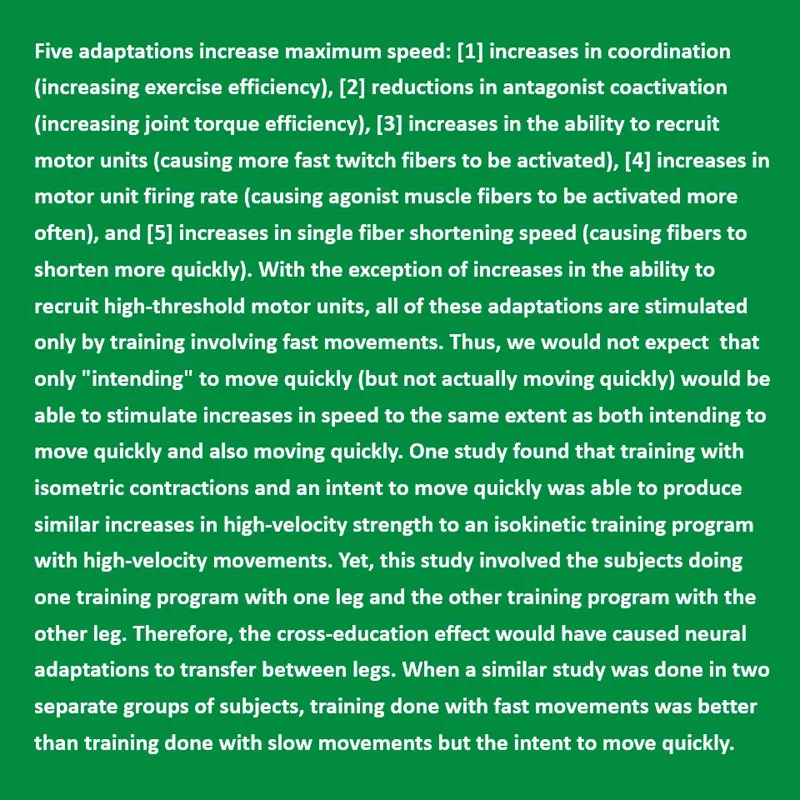
For around two decades following the turn of the millennium, one of the most popular ideas in S&C was the belief that simply "intending" to move quickly was enough to maximize gains in speed and that actually moving quickly was unnecessary. But where did this idea come from and does it hold any wate
Apr 27, 2026 0 5

Sprinting muscles
How should we write strength training programs for sprinters? We can identify which muscles require hypertrophy by reference to [1] the biomechanics literature that shows which muscles contribute most to increases in running speed, and [2] the cross-sectional literature that has found associations b
Apr 13, 2026 0 7
Overreaching = accumulated damage?
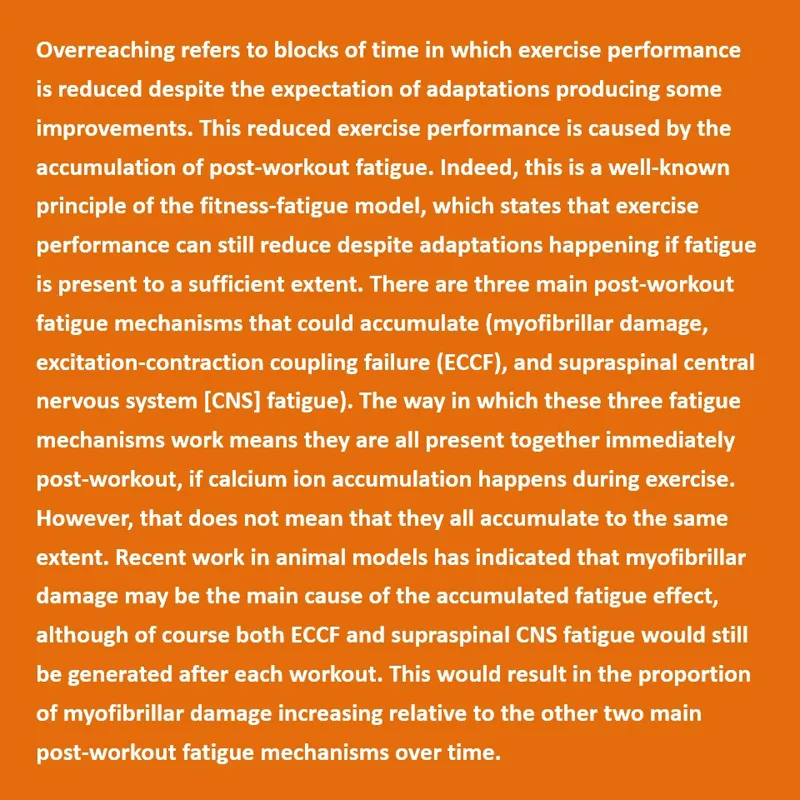
What is overreaching and what causes it to happen? While many myths exist regarding the underlying causes of overreaching during strength training, we can easily derive the truth of the matter from the basic physiology. . #1. Overreaching defined Overreaching refers to blocks of time in which exerci
Apr 6, 2026 0 7

Maintenance of fascicle length by strength training
The volume and frequency needed to maintain muscle mass during strength training is relatively clear because the majority of studies have reported very similar findings. In contrast, the volume and frequency of eccentric-only training necessary to maintain muscle fascicle lengths is much less clear.
Mar 30, 2026 0 10

Supraspinal CNS fatigue after exercise
Historically, central nervous system (CNS) fatigue in the post-workout period has been very poorly explained by fitness influencers and experts. Fortunately, we now have a very simple model that explains exactly how it works: muscle damage causes an inflammatory response that the brain detects, prod
Mar 23, 2026 0 9

CNS fatigue during exercise (training variables)
We now understand that there are two CNS fatigue mechanisms that occur during exercise, being [1] supraspinal (brain) CNS fatigue, and [2] spinal CNS fatigue. Clearly, if we want to achieve high levels of motor unit recruitment, we want to avoid these fatigue mechanisms. But what training variables
Mar 16, 2026 0 9

Spinal CNS fatigue during exercise
Historically, central nervous system (CNS) fatigue during exercise has been very poorly explained by fitness influencers and experts. We now understand that there are two totally different CNS fatigue mechanisms that occur during exercise, being [1] supraspinal (brain) CNS fatigue, and [2] spinal CN
Mar 9, 2026 0 7

Supraspinal CNS fatigue during exercise
Historically, central nervous system (CNS) fatigue during exercise has been very poorly explained by fitness influencers and experts. Fortunately, we now have a very simple model that explains one of the two types of CNS fatigue mechanisms that happens during exercise, which is supraspinal (brain) C
Mar 2, 2026 0 14
The psychobiological model of fatigue
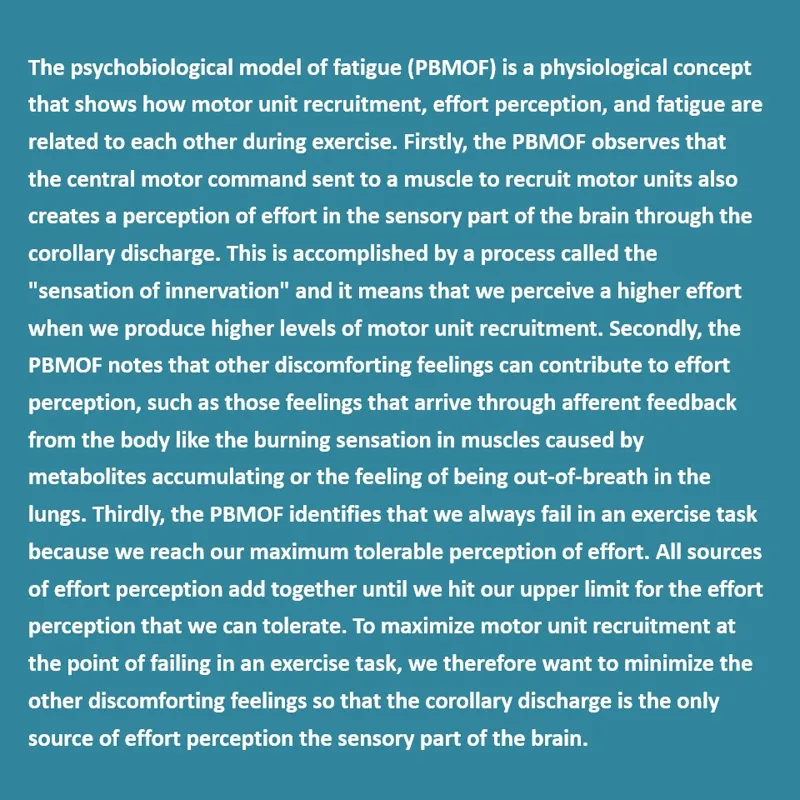
The psychobiological model of fatigue (PBMOF) is an essential physiological concept that helps us understand how motor unit recruitment, effort perception, and fatigue are related to each other during a bout of exercise. . #1. What is the psychobiological model of fatigue? The PBMOF starts with the
Feb 23, 2026 0 10

Neuromechanical matching criticisms
Since I introduced the principle of neuromechanical matching to the fitness industry a couple of years ago, some influencers have accepted it as a useful too, while others have attacked it since it undermines their ability to make whatever arguments they like for whatever exercises they prefer to pr
Feb 16, 2026 0 9
Hip adductors
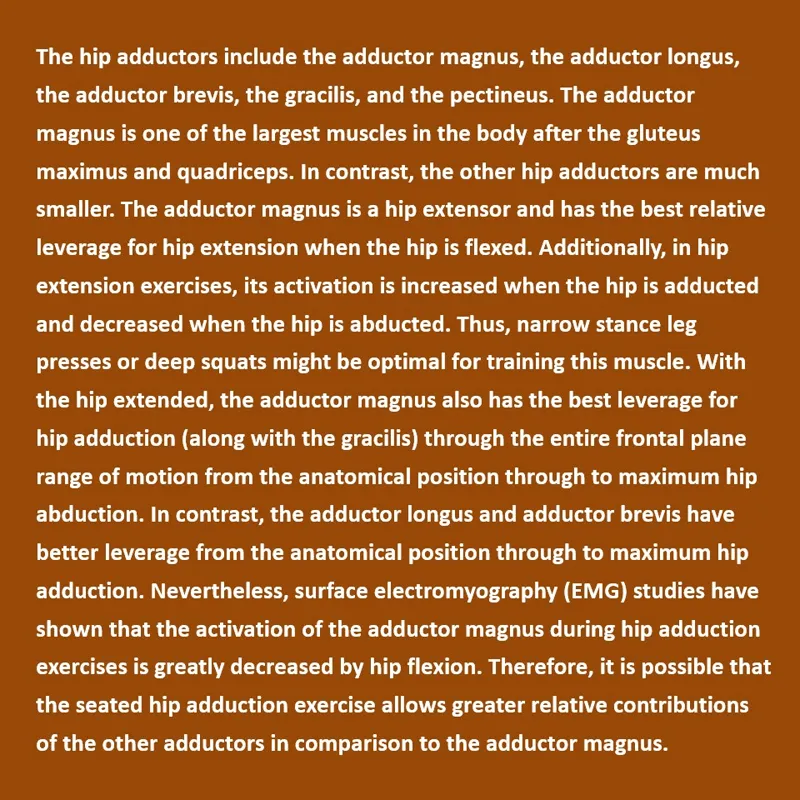
Unlike many other large muscle groups, the hip adductors (which include the adductor magnus, the adductor longus, the adductor brevis, the gracilis, and the pectineus) are rarely focused on in conventional bodybuilding training programs. Similarly, they are frequently overlooked in athletic training
Feb 9, 2026 0 8

Detraining of speed
Some strength and conditioning coaches have argued that speed is lost very rapidly during detraining in comparison to other physical qualities. Yet, the research literature does not support this view. In fact, there is a strong argument to be made that periods of detraining either have no effect on
Feb 2, 2026 0 8

Secondary muscle damage effect
Although most textbooks and educational materials show strength losses post-workout recovering in a relatively smooth line back to baseline, this is not actually what happens. Instead, there is a "secondary muscle damage effect" that involves a reduction in strength during the post-workout period. .
Jan 26, 2026 0 10

Capillarization
After both strength training programs and aerobic exercise training programs, we see increases in measures of capillarization. This has given rise to many speculations, including the idea that it might be possible to enhance muscle growth if capillarization is increased before we start a training bl
Jan 19, 2026 0 9

Fatigue resistance changes
Fatigue is a temporary reduction in exercise performance that is caused by individual fatigue mechanisms. When adaptations take place as a result of exercise help us resist these fatigue mechanisms, muscular endurance increases. . #1. How do we measure resistance to fatigue? (absolute muscular endur
Jan 12, 2026 0 8

Creatine supplementation
It is often claimed that dietary supplementation with creatine monohydrate can enhance the gains in muscle size achieved during strength training. But does this supplement really cause an increase in myofibrillar number or does it just cause a transitory increase in muscle fiber water content instea
Jan 5, 2026 0 8

Fatigue prevents gains in speed
We know that the presence of certain fatigue mechanisms can negatively affect our ability to stimulate some of the adaptations that contribute to maximum strength. So how do fatigue mechanisms affect our ability to create the adaptations that contribute to maximum speed? . #1. What are the adaptatio
Dec 29, 2025 0 9

Increasing speed
Speed is the ability to move at a very fast velocity. Speed is not the same thing as strength. Strength allows us to accelerate but it does not guarantee that we can actually move at a certain velocity. Having a lot of strength (the ability to produce a large force) without also having a high maximu
Dec 22, 2025 0 17
How does immobilization cause atrophy?
How does immobilization cause atrophy? Does it involve an actively catabolic process that removes proteins from muscle fibers? Or does it involve simply the absence of the background hypertrophy stimulus that occurs during the activities of daily life? . #1. How do we know HOW immobilization causes
Dec 15, 2025 0 4
Time under tension
For several decades, bodybuilding experts have maintained the idea that "time under tension" (TUT) is a key factor that contributes towards muscle growth. However, the physiology makes it clear that this is completely impossible. . #1. What causes muscle growth? Muscle growth is the result of lots o
Dec 8, 2025 0 8
Growth does not happen during exercise
We commonly hear it stated that muscles do not grow in the gym but rather when we are resting at home. There is an interesting element of truth in this statement that is worth exploring. . #1. Muscle protein synthesis is suppressed during exercise For decades, it has been known that muscle protein s
Dec 1, 2025 0 4
Preacher curls for brachialis
While investigating the potential for the elbow flexors to display stretch-mediated hypertrophy, researchers have inadvertently reported some interesting information about how the various components of that muscle group respond to different exercises, especially in respect of the biceps brachii and
Nov 24, 2025 0 8
Exercise is not a recovery modality
Strength and conditioning coaches often program recovery workouts. However, the research literature generally indicates that exercise does not function as a recovery modality, no matter how many times commenters mention increasing "blood flow" as if that is some kind of argument. . #1. Light exercis
Nov 17, 2025 0 4
Hypertrophy and strength gains
Hypertrophy is just one adaptation that contributes to an increase in strength of the trained exercise. It contributes to strength gains by increasing the capacity of the muscle to produce force by adding new contractile proteins. Since other adaptations also contribute to strength gains, however, t
Nov 10, 2025 0 7

Fatigue does NOT increase recruitment
One of the most annoying tendencies among hypertrophy researchers is their predisposition towards thinking that fatigue can do all kinds of magical things that it is physiologically unable to do. For example, it is very common for them to suggest that fatigue can increase motor unit recruitment. Fat
Nov 3, 2025 0 6

Lagging muscles
One of the most common questions in the fitness industry is how to bring up lagging muscle groups. Unfortunately, the two most popular answers to that question are completely wrong. . #1. More volume is not the answer Most fitness influencers will tell you to perform more volume with the lagging mus
Oct 27, 2025 0 8

Fatigue mechanisms are protective
Fatigue is a temporary, reversible reduction in exercise performance after a preceding bout of exercise. Fatigue mechanisms are physiological changes that cause fatigue. Why do fatigue mechanisms exist? They are protective. They stop muscle fibers from running out of energy in the form of ATP. . #1.
Oct 20, 2025 0 7

Age and recovery
Old age is generally associated with an impairment in recovery from strength training workouts. It is helpful to understand how and why this happens. . #1. Old muscle recovers more slowly than young muscle When older and younger animals are subjected to muscle-damaging eccentric-only training workou
Oct 13, 2025 0 9

Vertical jump countermovement depths
Looking at vertical jump countermovement depths in various different situations can teach us quite a lot about how vertical jumping works. . #1. Relative vertical impulse determines vertical jump height Jump height is determined by the vertical impulse in the concentric phase of the movement relativ
Oct 6, 2025 0 6
Removing the stretch-shortening cycle
Some fitness influencers have suggested that we could affect the adaptations produced by strength training sets by performing a "deadstop" at the end of each eccentric phase. Physiologically, this means removing the stretch-shortening cycle (SSC). . #1. What does the SSC do? The SSC is produced by a
Sep 29, 2025 0 3

The stretch-shortening cycle
The stretch-shortening cycle (SSC) effect is not produced by a single mechanism but by a group of mechanisms. Indeed, any physiological phenomenon that causes concentric force production (or concentric velocity) to be increased by the presence of a preceding eccentric or isometric contraction is a S
Sep 22, 2025 0 7

Reducing muscle strain injury risk
What adaptations are useful for reducing the risk of muscle strain injury? To identify them, we must first create a model of how muscle strain injury happens. . #1. How do muscle strain injuries to happen? Muscle strain injuries appear to happen by way of mechanical failure of muscle fibers at the p
Sep 15, 2025 0 8

Muscle strain injury factors
In the two previous articles in this series, we have looked at muscle strain injuries and how they are different from exercise-induced muscle damage (EIMD). In this article, we are going to consider what factors might be able to reduce the risk of a muscle strain injury (and whether these factors mi
Sep 8, 2025 0 10

Muscle strain injuries in sport
Why muscle strain injuries happen in sport is an interesting problem to solve because experiments have only been able to produce them by elongating muscles to extra-physiological lengths that are impossible to duplicate in real life because of the limits of the joint angle range of motion. . #1. Mus
Sep 1, 2025 0 4
Showing 1 - 50 of 306