





Age and recovery
Old age is generally associated with an impairment in recovery from strength training workouts. It is helpful to understand how and why this happens.
.
#1. Old muscle recovers more slowly than young muscle
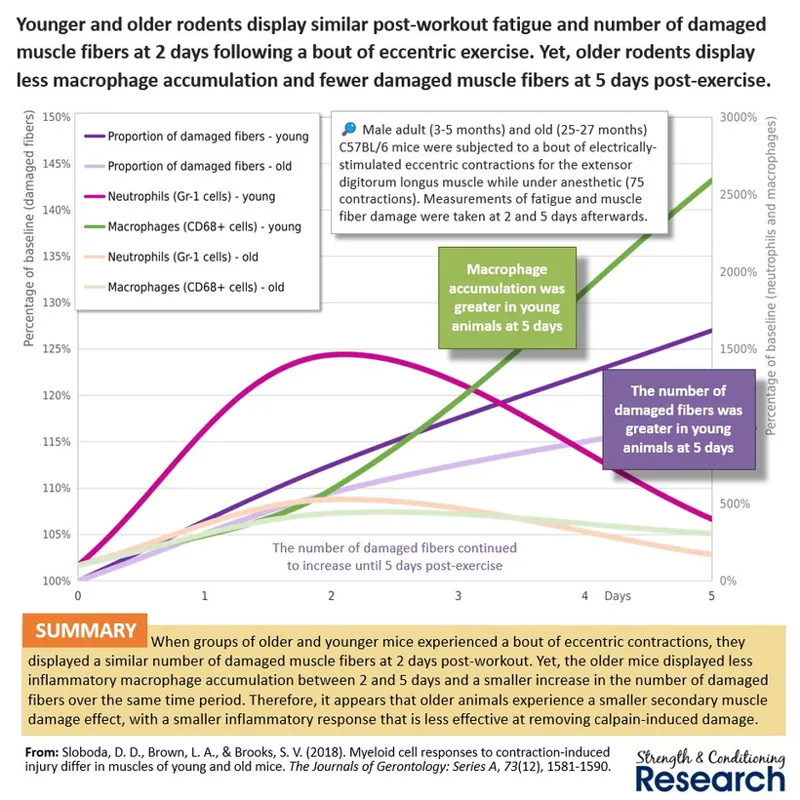
When older and younger animals are subjected to muscle-damaging eccentric-only training workouts, they display similar post-workout fatigue and muscle damage markers immediately post-exercise but the older animals recover much more slowly.
.
Similarly, when older and younger individuals are compared in human studies, the immediate post-workout fatigue is not that different. Yet, the recovery rate after the workout is again very different because the repair processes are slowed in the older subjects.
.
This slower rate of recovery in elderly people and animals can likely be explained by a reduced or dysregulated inflammatory function. Indeed, research has shown that the secondary muscle damage effect is blunted in older animals. The accumulation of inflammatory markers is reduced and the subsequent removal of damaged muscle fibers is much less at the same time-point. This obviously indicates that the process is happening much more slowly in elderly muscle tissue.
.
Interestingly, the same thing happens to delayed onset muscle soreness (DOMS), which is also extended in older animal populations. This could provide some more support for a link between inflammation and DOMS.
.
#2. Old muscle is more susceptible to mechanical stretch damage than young muscle
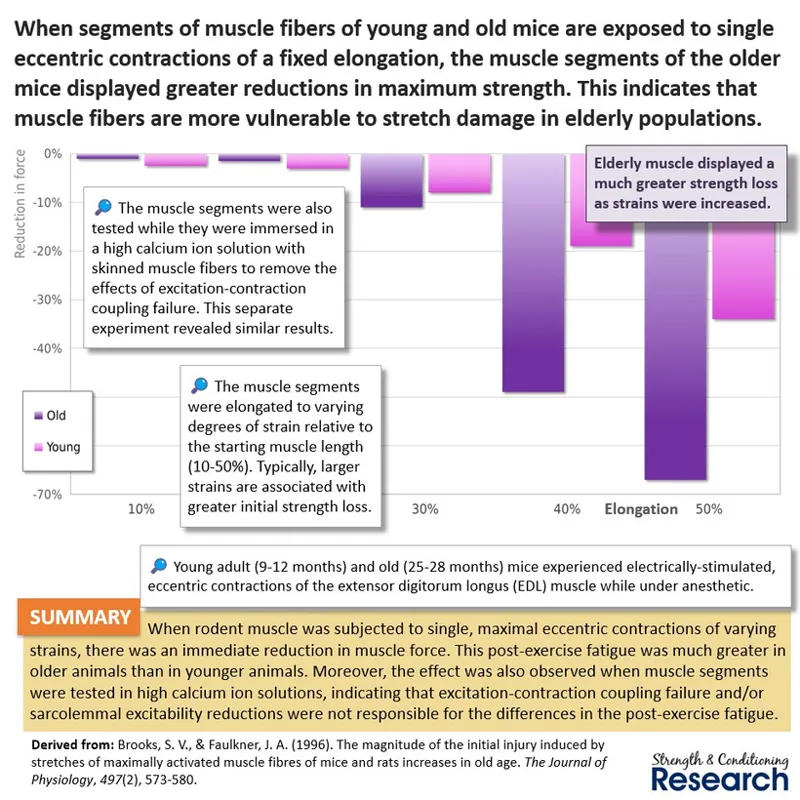
In animal models (which involve maximal levels of muscle activation by means of electrical stimulation), older muscle displays more muscle damage after being subjected to a single, maximal eccentric contraction through a large range of motion compared to younger muscle. This mechanical damage is more akin to a mild muscle strain injury than to exercise-induced muscle damage, however.
.
The capacity of muscle fibers to transmit forces laterally is a key mechanism that protects them from being overstretched and thereby damaged during eccentric contractions. Elderly muscle lacks dystrophin, which is an essential component of the costameres that allow lateral force transmission to occur. Consequently, it tends to display fibrosis in response to severe injury to the muscle fibers, which is identified as increased collagen content.
.
#3. Old people cannot train with exactly the same volume-frequency combinations as young people
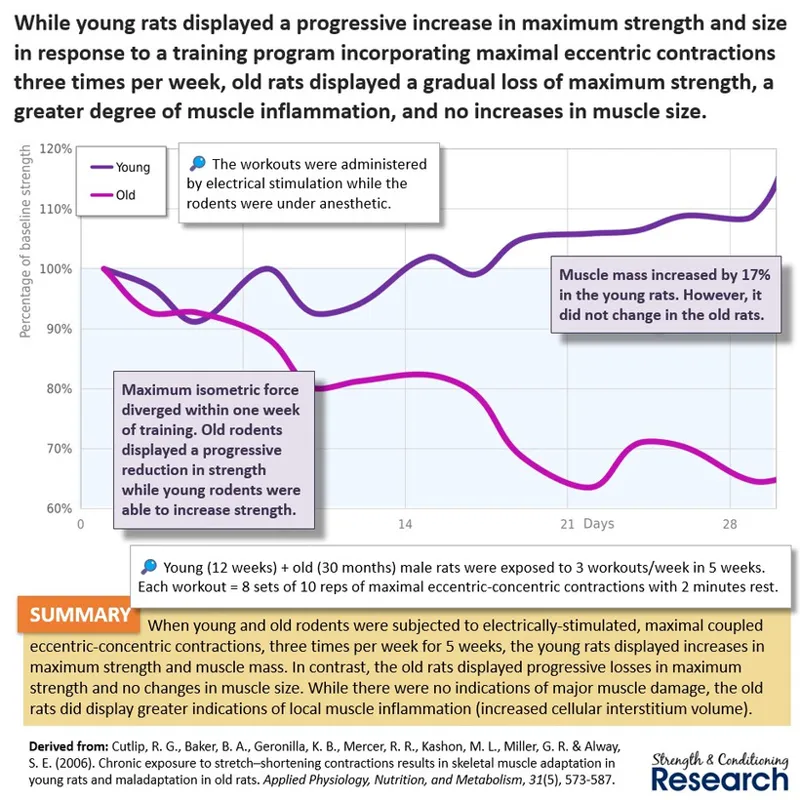
The ability to recover from each workout plays a key role in the success of a strength training program. Since older subjects cannot recover as quickly, they do not have the ability to train with the same workout volume as frequently. Thus, when doing relatively high workout volumes, they fail to make progress when training very frequently.
.
When training frequency is reduced (for the same workout volume), the old subjects are able to recover and therefore can make progress in terms of both strength gains and hypertrophy. Importantly, other studies have shown that the same positive effects can be achieved by reducing workout volume and keeping training frequency high. So the answer is not simply to adjust the training frequency but rather to address the volume-frequency combination.
Conclusions
Old people respond differently to strength training compared to young people. One feature is their ability to recover from exercise. In both animal models and human studies, older subjects display a slower rate of strength recovery from exercise even when fatigue measured immediately post-workout is the same. This appears to be the result of a blunted secondary muscle damage effect, which is mediated by inflammation. In older subjects, the accumulation of macrophages is reduced and therefore the degradation and removal of any sections of the fibers that were damaged by calpain activity occurs more slowly. Also, in animal models, older subjects are more susceptible to mechanically-induced strain injury from single eccentric contractions compared to young subjects. This appears to be caused by their muscle fibers having reduced capacity for lateral force transmission (due to a loss of dystrophin), leading to overstretching of the muscle fibers. In practice, these observations mean that elderly lifters cannot make use of the same volume-frequency combinations as young lifters. Indeed, animal models have shown that while young subjects can recover from a given workout volume performed 3 times per week (and thereby make gains in strength and size), old subjects cannot recover from the same training program (and so do not make gains in strength or size). Yet, those same old subjects can make progress by doing the same workout volumes twice per week (or by doing lower workout volumes 3 times per week).
Comments (1)
Thank you for your thoughts about recovery and age. Most of the studies you presented are animal studies, based on eccentric exercise. Do you know human studies with real-world exercise programs and the Impact on recovery in different human ages? Thanks! Quick search: https://pmc.ncbi.nlm.nih.gov/articles/PMC10854791/#B41-cells-13-00255