





Fiber type-specific atrophy
Does fiber type affect the rate at which a muscle fiber atrophies during periods of mechanical unloading? Surprisingly, this has been a very troublesome question for researchers for many decades. Here, we might finally have an answer.
.
#1. Fast twitch fibers atrophy faster than slow twitch fibers during detraining
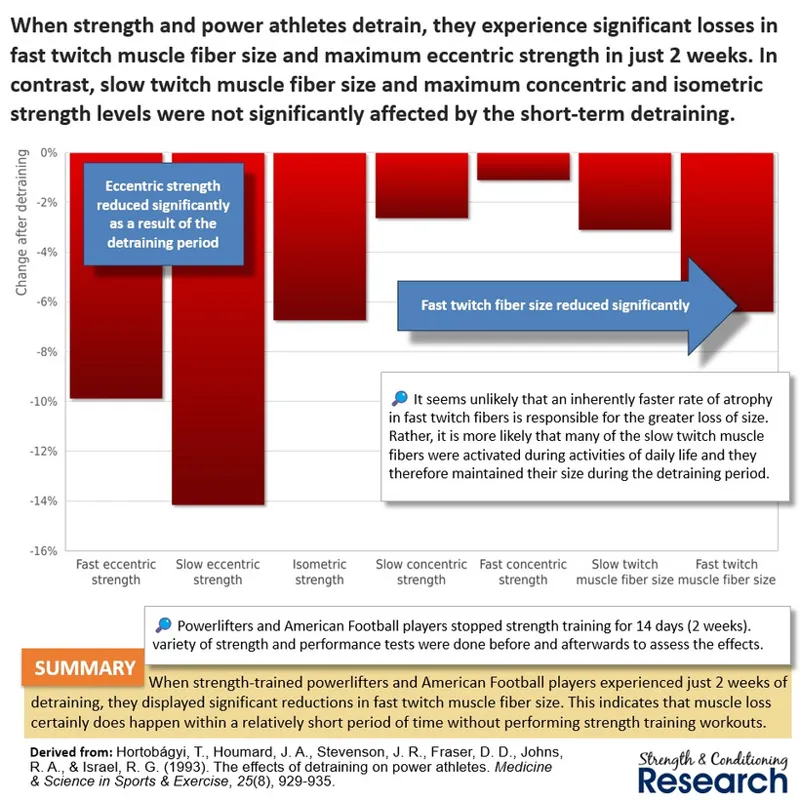
Subsequent to a previous strength training program, fast twitch muscle fiber size dissipates faster than slow twitch muscle fiber size during detraining.
.
Multiple studies have reported this phenomenon, with very rapid atrophy being observed in fast twitch muscle fibers during detraining following a previous strength training program and the rate of atrophy of slow twitch muscle fibers being somewhat slower.
.
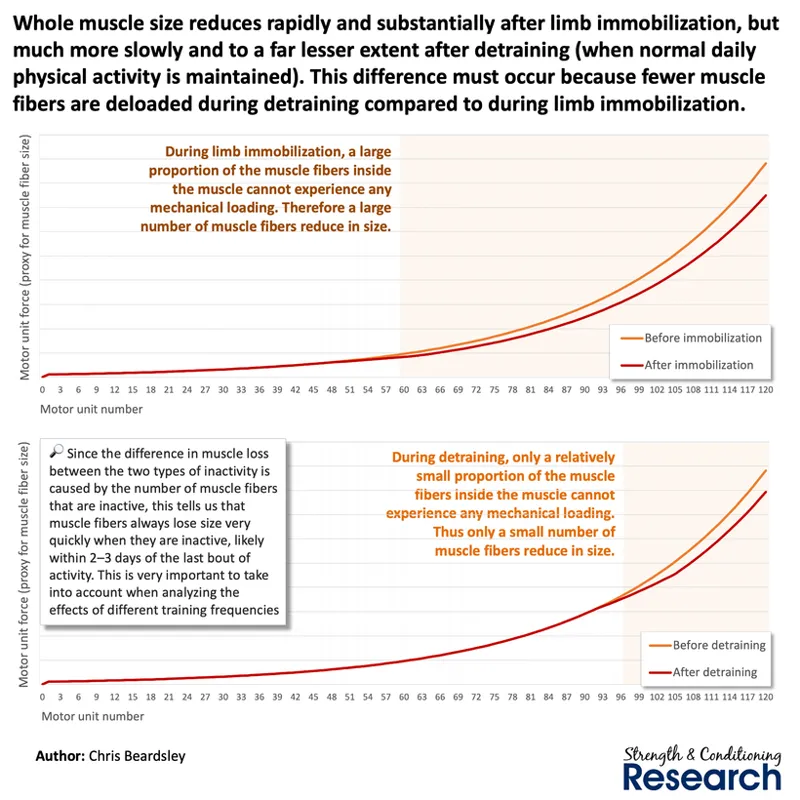
Does this mean that fast twitch fibers inherently decrease their size more rapidly than slow twitch fibers in the absence of mechanical loading? Well, not necessarily. The most obvious explanation for the more rapid loss of fast twitch fiber size than slow twitch fiber size during detraining is that the slow twitch muscle fibers are predominantly linked to low-threshold or lower high-threshold motor units and are therefore more likely to be used in the activities of daily life, which allows them to continue experiencing a hypertrophy stimulus even during a detraining period.
.
#2. Muscle fiber atrophy rate probably depends upon the size of the muscle fiber at baseline not muscle fiber type
During animal models of muscle disuse, like denervation, there is a complete removal of the hypertrophy stimulus from all muscle fibers in the muscle. This allows us to assess the effect of fiber type on the rate of atrophy. Generally, the muscle fiber size at baseline seems to be the main driver of the rate and extent of atrophy, with larger (more glycolytic) muscle fibers decreasing in size faster than smaller (more oxidative) fibers. In fact, if muscle fibers are small enough, they do not appear to reduce in size at all during unloading periods.
.
Indeed, we can see that muscle fiber size is the most important factor that drives the extent to which muscle fibers shrink during unloading because of studies that have reported greater fast twitch fiber atrophy in predominantly fast twitch muscles and greater slow twitch fiber atrophy in predominantly slow twitch muscles. In a predominantly fast twitch muscle, the fast twitch fibers are on average much larger than the small, highly-oxidative muscle fibers at the bottom end of the motor unit pool, so they atrophy to a greater extent. In contrast, within a predominantly slow twitch muscle, the only fast twitch fibers are likely small, being part of the voluntary activation deficit at the top end of the motor unit pool. Thus, they atrophy much less.
.
#3. Slow twitch muscles atrophy faster than fast twitch muscles in animal models of disuse atrophy and in human immobilization
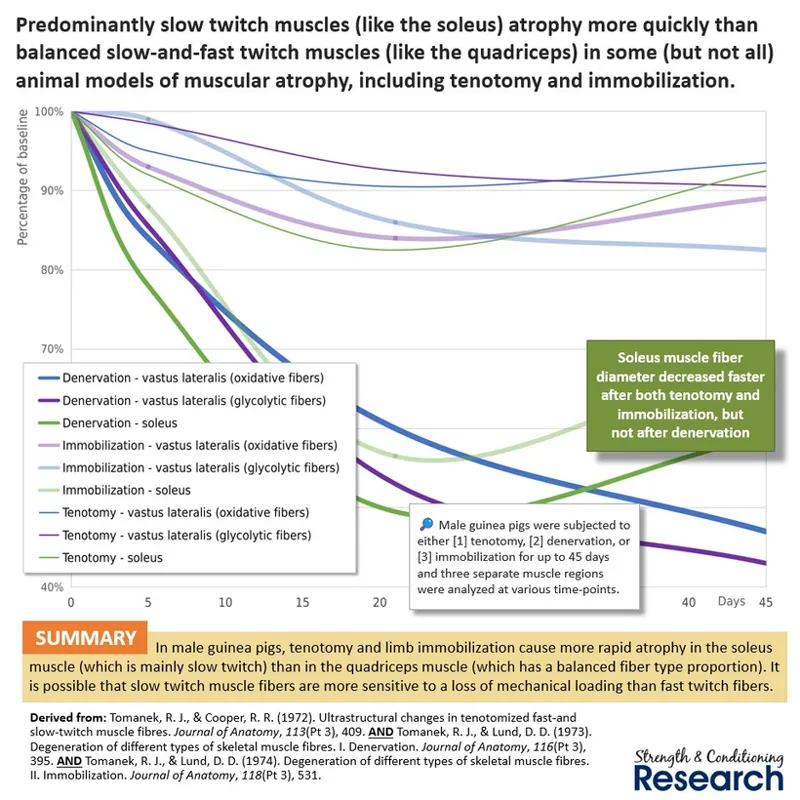
Animal models of disuse atrophy like denervation, tenotomy, and immobilization all cause atrophy rapidly and across all of the muscle fibers in a muscle. There is no protective effect on the slow twitch muscle fibers of the low-threshold motor units and lower high-threshold motor units because there is no physical activity of any kind. Curiously, slow twitch muscles tend to atrophy more quickly under such conditions. Why does this happen?
.
Interestingly, the same phenomenon can be observed in human immobilization trials. Again, in human immobilization trials, there is no protective effect on the slow twitch muscle fibers of the low-threshold motor units and lower high-threshold motor units because there is no physical activity. Again, slow twitch muscles atrophy more quickly than fast twitch muscles. The most obvious explanation for this is that slow twitch muscles tend to be postural muscles that are used at greater relative effort levels in the activities of daily life. Thus, their fibers are maximally hypertrophied further up the motor unit pool. Thus, they have more muscle fiber size to lose during mechanical unloading.
.
Conclusions
When detraining following a strength training program, fast twitch fiber size often reduces faster than slow twitch fiber size. Yet, this is easily explained by the fact that hypertrophy and atrophy are fiber-specific. Therefore, the fast twitch fibers of higher high-threshold motor units experience atrophy due to an absence of mechanical loading during detraining even while the slow twitch fibers of low-threshold and lower high-threshold motor units are still stimulated by activities of daily life. In contrast, when mechanical loading is removed from all of the fibers in a muscle at the same time (as in immobilization), does muscle fiber type influence the rate of atrophy? In fact, it seems likely that muscle fiber diameter is the primary driver of the rate and extent of atrophy. Larger fibers lose size faster and to a greater extent than smaller fibers. This explains why postural, slow twitch muscles atrophy faster than some balanced fast-and-slow twitch muscles during immobilization (they are more hypertrophied at baseline). It also explains why the fast twitch fibers of predominantly slow twitch muscles atrophy slowly (they are small fibers that are rarely or never used) and why the slow twitch fibers of predominantly fast twitch muscles also atrophy slowly (they are small, extremely oxidative fibers that are used constantly but which cannot grow due to the size principle of striated muscle).