



Cooling effects on hypertrophy
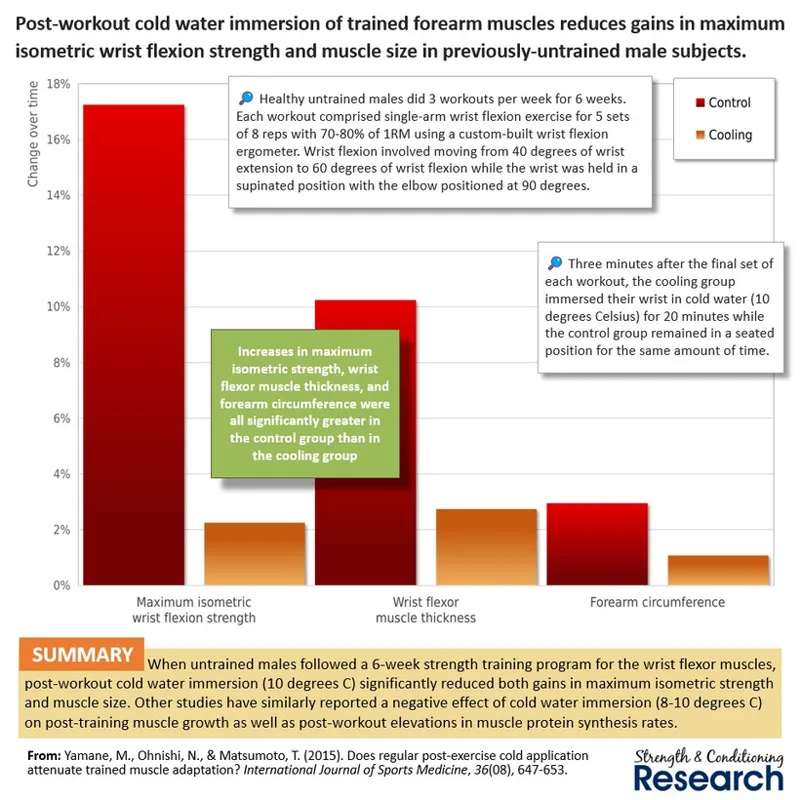
In contrast to the effects of cold application on muscle damage repair, the effects of cold application on hypertrophy are relatively well-established. Multiple studies have now found that muscle growth is suppressed when muscles are cooled immediately post-workout.
.
#1. Hypertrophy is reduced when muscles are cooled immediately post-workout
Multiple studies have reported that the magnitude of muscle hypertrophy is reduced whenever the trained muscles are cooled in the post-workout recovery period. Even so, the majority (if not all) of the studies have tested a similar temperature (8-10 degrees C) and a slightly warmer temperature might not have the same negative effects.
.
#2. Cold reduces muscle protein synthesis rates
Muscle fibers increase in size when their rates of muscle protein synthesis are elevated temporarily and this is not accompanied by a concomitant increase in muscle protein breakdown rates. Thus, it is an important discovery that post-exercise cold water application (8 degrees C) suppresses the rates of muscle protein synthesis in the trained muscle.
.
#3. Cold increases muscle protein breakdown rates
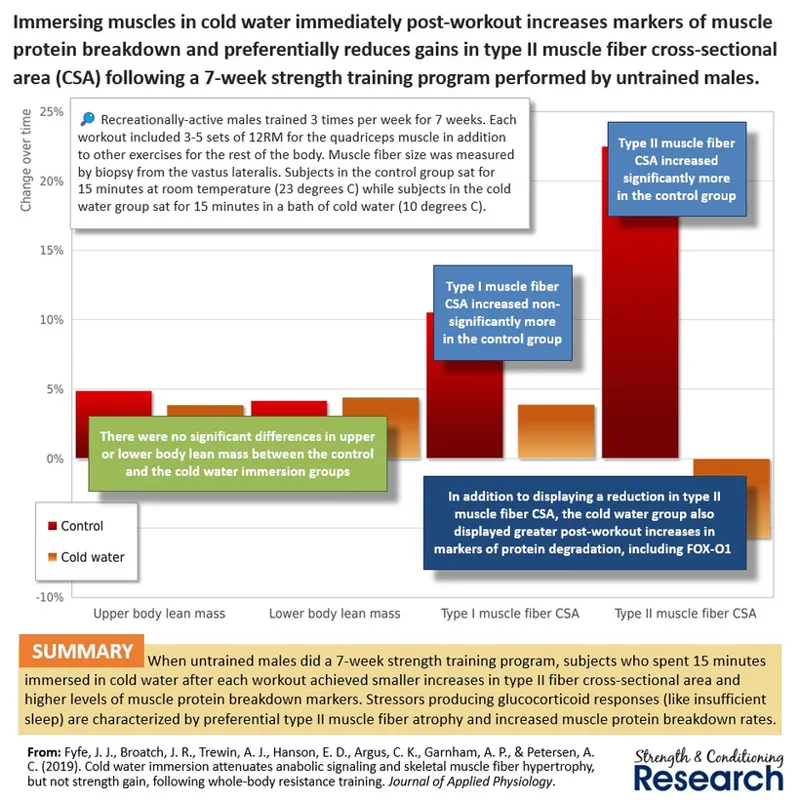
In humans, colder environmental temperatures suppress gene expression associated with myogenesis (muscle growth) and increase gene expression associated with proteolysis (muscle breakdown).
.
Similarly, in animal studies, colder environmental temperatures reduce muscle protein synthesis rates and also increase muscle protein breakdown rates by activating proteolytic pathways. This increase in muscle protein breakdown rates is linked to the increase in circulating glucocorticoids, indicating that cold temperatures are perceived as stressful.
.
Indeed, the circulating glucocorticoids are statistically associated with the increased muscle protein breakdown rates and the reduced muscle protein synthesis rates when temperatures are altered across even a fairly narrow range. This suggests that the impact of temperature on both muscle protein breakdown and muscle protein synthesis is mediated by the actions of the stress hormones.
.
#4. Cold preferentially reduces type II muscle fiber size
In this respect, is is important to note that post-exercise cold application blunts the growth of type II fibers specifically while also promoting a greater rate of muscle protein breakdown. Both of these observations are distinctive features of glucocorticoid-mediated atrophy.
.
Conclusions
Multiple studies in humans have reported that post-workout muscle cooling during a strength training program reduces the amount of hypertrophy that results. Similarly, when the growth rate of animals is measured while they are living in different environmental temperatures, animals housed at colder temperatures experience less growth than those living at more conventional temperatures. In line with these observations, post-workout muscle cooling in humans and lower environmental temperatures in animals are both associated with reduced rates of muscle protein synthesis (MPS) and increased rates of muscle protein breakdown (MPB), especially involving the ubiquitin-proteasome system. Since muscle size is determined by the balance between MPS and MPB rates, it therefore makes sense that cold application will reduce hypertrophy when implemented within an exercise training program. Three observations indicate that cold temperature suppresses hypertrophy by functioning as a stressor and producing glucocorticoids. Firstly, exposure to colder temperatures does in fact increase the levels of circulating glucocorticoids in animal models. Secondly, the increases in MPB rates in animals housed at colder temperatures are associated with levels of circulating glucocorticoids. Thirdly, there is a preferential reduction in hypertrophy in fast twitch muscle fibers when post-workout muscle cooling during a strength training program in humans. This is a well-described feature of excessive circulating glucocorticoids in a variety of situations.
Comments (1)
This means cold showers/ice baths are out of the question for maximizing growth, even if spaced hours apart? That's a shame. And what about the increased quality of sleep in cooler rooms? Would the increased stress related to a cooler room be outweighed by the benefits of high-quality rest?