




Cooling effects on muscle damage recovery
While the practice of cold application immediately after muscle injury or exercise-induced muscle damage is a historically popular one, the literature presents a more confusing picture. Some studies have reported that cold application accelerates strength recovery while other studies suggest that it slows down the rate of post-workout recovery.
.
#1. Cool water application SPEEDS UP strength recovery from exercise-induced muscle damage
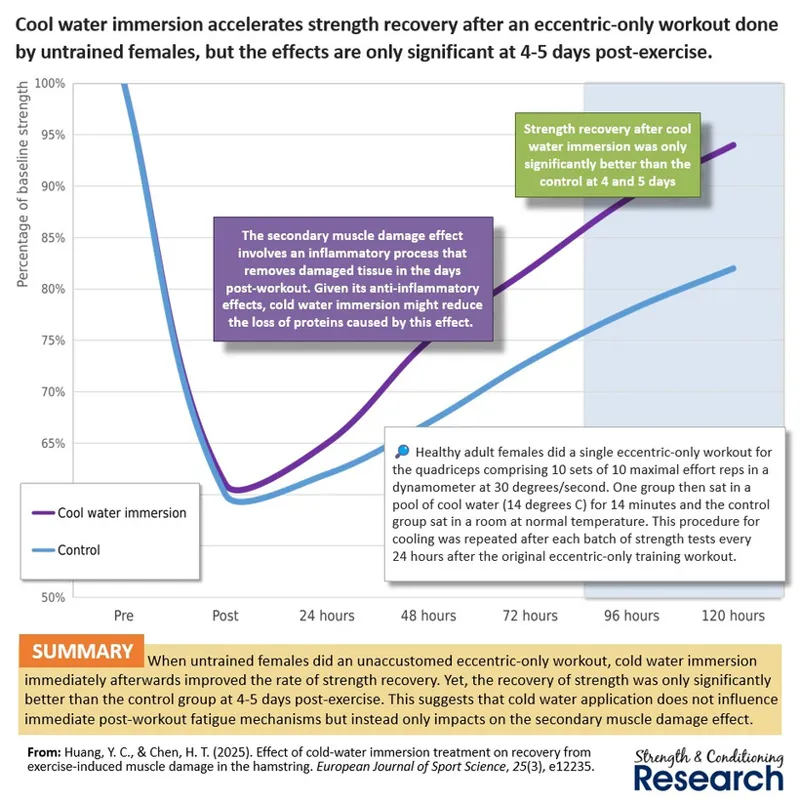
Studies investigating the effects of cold application have tested ice (0-4 degrees C), cold water (approximately 8-12 degrees C) and cool water (approximately 14-20 degrees C). When untrained lifters sit in cool water immediately post-workout, this speeds up strength recovery. Yet, the effects are most apparent only at 4-5 days post-exercise, which implies that the cool water is suppressing the secondary muscle damage effect by reducing inflammation.
.
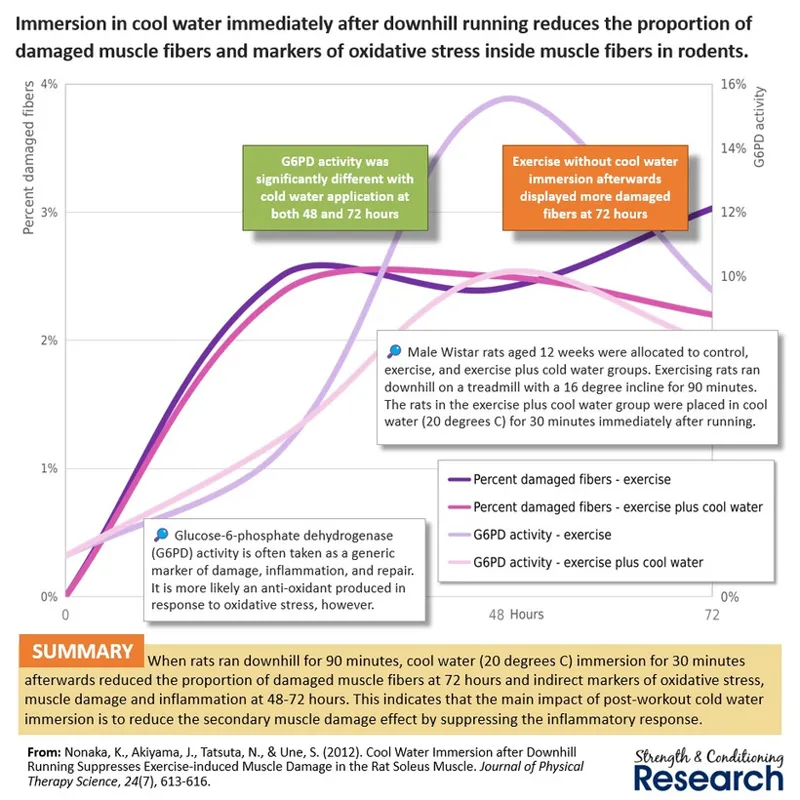
The same observation can be made in animal models. Here again, direct indications of muscle damage and indirect indications of muscle damage, inflammation, and oxidative stress are only suppressed by post-workout cool water application at 2-3 days after the downhill running bout. Again, this implies that the cool water is primarily suppressing the secondary muscle damage effect by reducing inflammation.
.
#2. Ice application SLOWS recovery from severe non-exercise muscle injury
Animal models have shown that the application of ice to a muscle that was damaged by compressive forces slows down the process of repair and regeneration. This seems to happen at least in part by slowing down the infiltration of inflammatory neutrophils and macrophages. This leads to a delay in the recovery of damaged muscle fibers such that muscle fiber size remains smaller for longer.
.
#2. Ice application similarly SLOWS recovery from severe exercise-induced muscle damage
In animal models of downhill running, the application of ice slows down the recovery from exercise-induced muscle damage and also increases the total amount of damage that results from the bout of exercise.
.
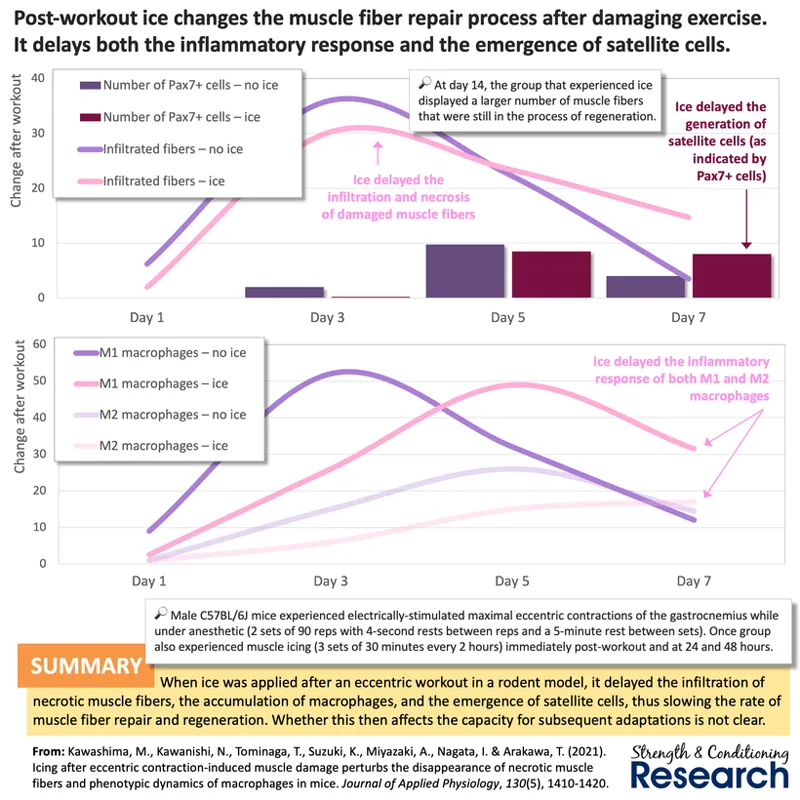
Again, the application of ice also slows down the inflammatory process that is involved in the repair of damaged muscle fibers. This study also found that ice slows down the appearance of satellite cells that perform muscle fiber regeneration.
.
In addition to the effects on the inflammatory response and on the satellite cells, cold water application in humans in the post-workout period reduces myofibrillar protein synthesis rates that are elevated for both hypertrophy and muscle damage repair processes.
.
Conclusions
While cold application has been used historically to speed up the recovery process after a muscle injury or after exercise-induced muscle damage, the research literature presents a more complex picture. Immersion in cool water (14-20 degrees Celsius) seems to accelerate strength recovery after bouts of muscle-damaging eccentric contractions in both animals and humans. It appears to reduce the damage caused by the secondary muscle damage effect, which is mediated by post-exercise inflammation. In contrast, ice application appears to slow down rates of repair and regeneration after both exercise-induced muscle damage and non-exercise muscle injury. While the colder temperatures produced by ice and cold water (4-8 degrees Celsius) are still associated with a suppressed inflammatory response and therefore less secondary muscle damage, they additionally appear to suppress rates of muscle protein synthesis, which is required for muscle damage repair to occur. Thus, it seems plausible that the effects of post-exercise cooling are dose-dependent. Brief exposure to cool water (14-20 degrees Celsius) may prevent an excessive secondary muscle damage effect by slightly reducing the post-exercise inflammatory response. Longer exposures to colder temperatures may prevent necessary damage and essential repair processes from happening entirely, causing strength to recover much more slowly.