

Removing the stretch-shortening cycle
Some fitness influencers have suggested that we could affect the adaptations produced by strength training sets by performing a "deadstop" at the end of each eccentric phase. Physiologically, this means removing the stretch-shortening cycle (SSC).
.
#1. What does the SSC do?
The SSC is produced by a group of five SSC mechanisms. These mechanisms increase concentric phase performance by a series of alterations in the central nervous system (CNS) and in the muscle itself (read more).
.
#2. What SSC mechanisms could contribute to the hypertrophy stimulus?
Overall, it is likely that SSC mechanisms have minimal impact on the muscle growth stimulus. However, to the extent that each mechanism could have an impact, it is almost certainly positive. Therefore, it is likely that keeping the SSC is beneficial (at best) or equal to using a deadstop (at worst). There is certainly no mechanism by which implementing a deadstop could be superior for bodybuilding.
.
Conclusions
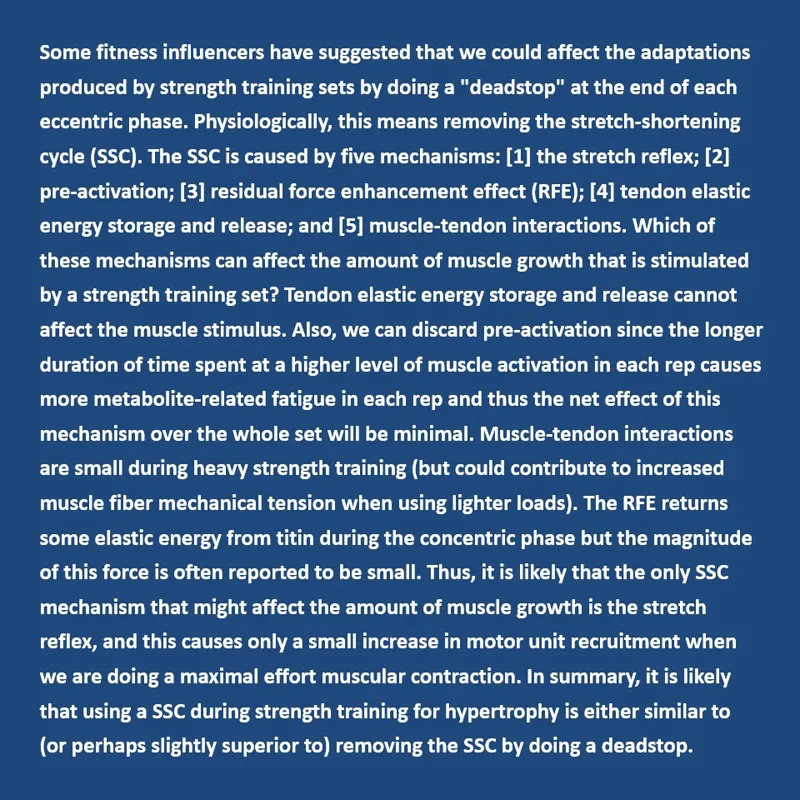
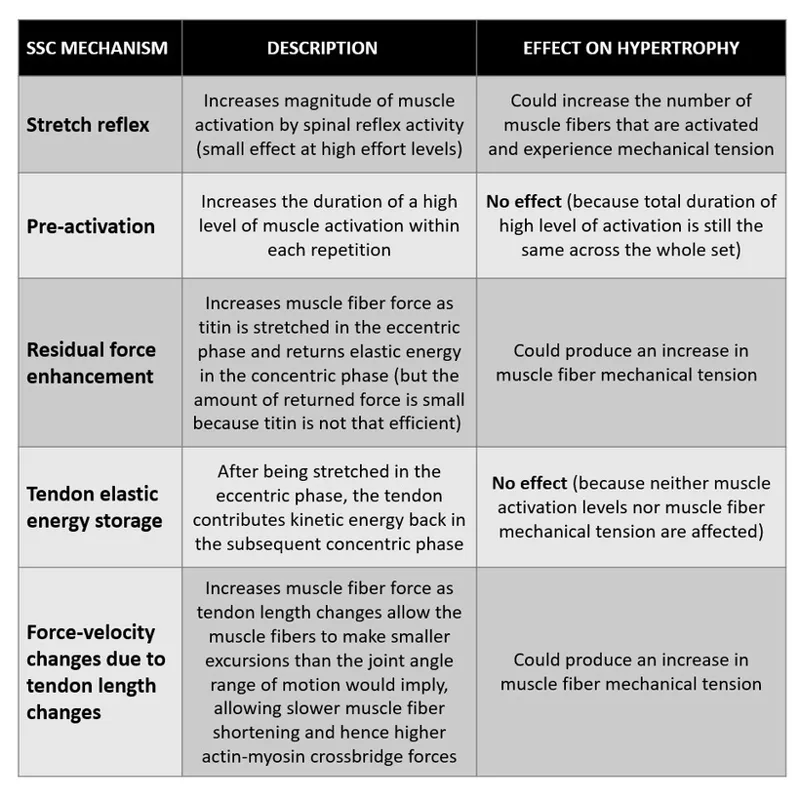
Some fitness influencers have suggested that we could affect the adaptations produced by strength training sets by performing a "deadstop" at the end of each eccentric phase. Physiologically, this means removing the stretch-shortening cycle (SSC). The SSC is caused by five mechanisms: [1] the stretch reflex; [2] pre-activation; [3] residual force enhancement effect (RFE); [4] tendon elastic energy storage and release; and [5] muscle-tendon interactions. Which of these mechanisms can affect the amount of muscle growth that is stimulated by a strength training set? Tendon elastic energy storage and release cannot affect the muscle stimulus. Also, we can discard pre-activation since the longer duration of time spent at a higher level of muscle activation in each rep causes more metabolite-related fatigue in each rep and thus the net effect of this mechanism over the whole set will be minimal. Muscle-tendon interactions are small during heavy strength training (but could contribute to increased muscle fiber mechanical tension when using lighter loads). The RFE returns some elastic energy from titin during the concentric phase but the magnitude of this force is often reported to be small. Thus, it is likely that the only SSC mechanism that might affect the amount of muscle growth is the stretch reflex, and this causes only a small increase in motor unit recruitment when we are doing a maximal effort muscular contraction. In summary, it is likely that using a SSC during strength training for hypertrophy is either similar to (or perhaps slightly superior to) removing the SSC by doing a deadstop.

Comments (4)
Is the additional fatigue accounted for when saying that not deadstopping might be beneficial?
If tendons were perfectly elastic and could return all energy gained by the lifting the weight for the first time and the following eccentric/dropping of the weight, we would be able to perform infinite reps with zero subsequent mechanical tension. Therefore, the actual elasticity of tendons allows a rep to be performed with slightly less force produced from the muscle via a reduction in activation or tension. The obvious example would be repeated jumping and the Achilles tendon. I would guess bouncing would trigger less hypertrophy than single reps, reps equated. Wrong?
On further consideration of this I think I missed an obvious point. For the first example I think the muscle the tendon connects to would have to be infinitely stiff and resist lengthening itself. Of course muscles are not like this, especially if they do not have infinite mechanical tension. As a side note normal tendon lengthening with a non-lengthening muscle belly would also result in a very small range of motion.
If we consider deadstopping to be a very small rest of 1 second or so, and we know that cluster sets are useful, there must be some point at which any detriment to hypertrophy by removing the SSC is negated by the benefits of a rest within a cluster set. What do you think?