

The stretch-shortening cycle
The stretch-shortening cycle (SSC) effect is not produced by a single mechanism but by a group of mechanisms. Indeed, any physiological phenomenon that causes concentric force production (or concentric velocity) to be increased by the presence of a preceding eccentric or isometric contraction is a SSC mechanism.
.
#1. Stretch reflex
The stretch reflex is produced by the stretching of muscle spindles. When stretched, they send afferent signals to the spinal cord, which responds by increasing the level of motor unit recruitment at the local muscular level. Naturally, this increase in muscle activation increases the amount of concentric force production. Nevertheless, the effect seems to be primarily limited to submaximal contractions and may not apply to maximal contractions during strength training activities (or at least the effect may be comparatively very small).
.
#2. Preactivation
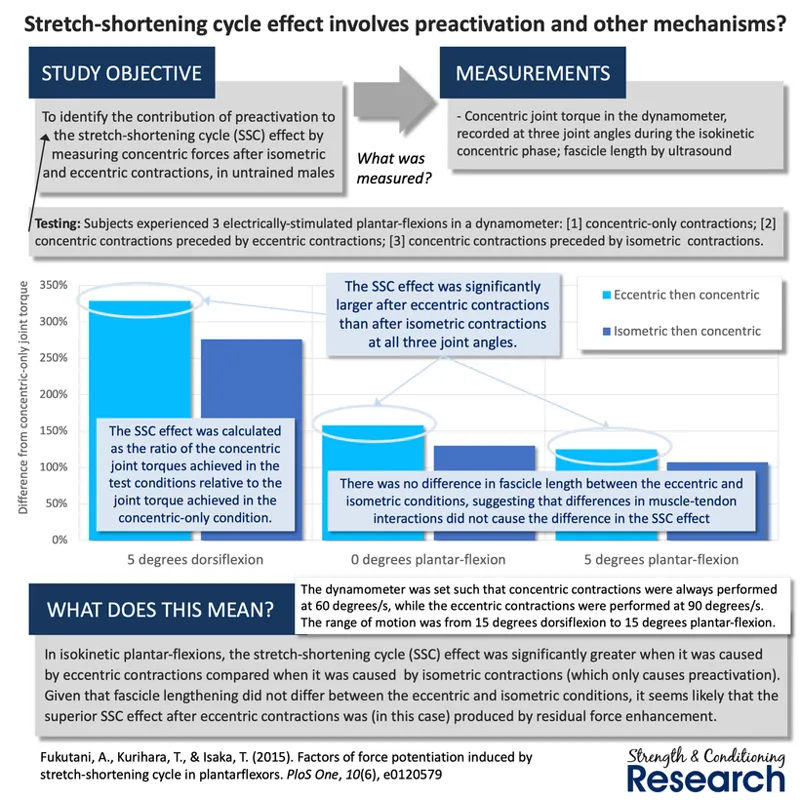
Pre-activation refers to the existence of muscle activation at the very onset of the concentric phase, which is self-evidently not the case in concentric-only contractions, which necessarily begin from a totally quiescent state. While the stretch reflex can enhance this degree of muscle activation, pre-activation can occur without a stretch reflex, as we can see from its presence during concentric contractions after isometric contractions.
.
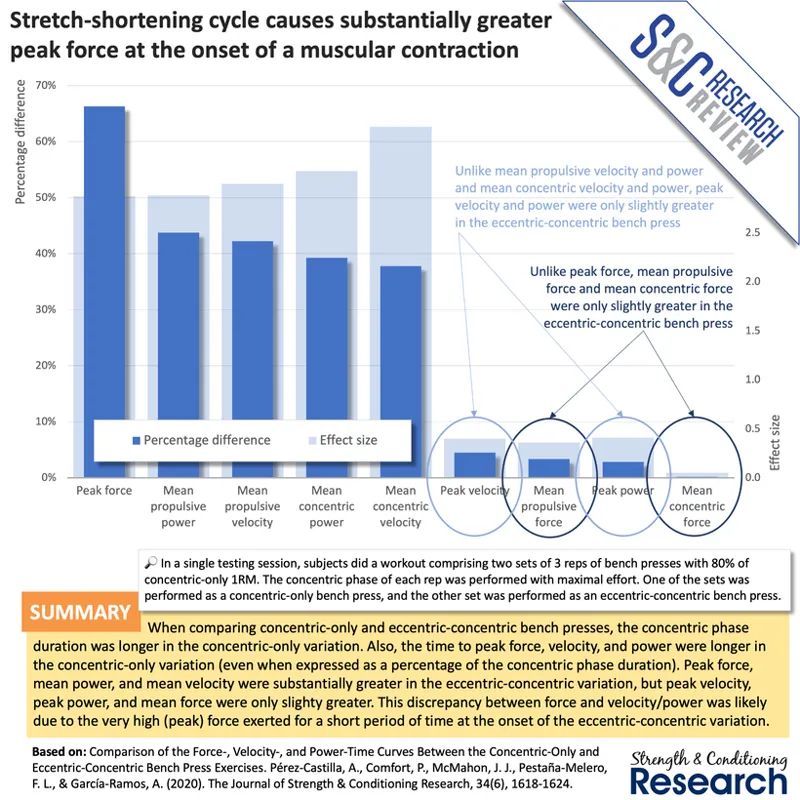
Pre-activation is particularly noticeable during fast movements in which the maximum velocity reached is dependent upon the impulse generated during the lifting phase. When some muscle fibers are activated earlier in the concentric phase, they can exert a greater force in the initial part of the contraction, thereby contributing to a higher rate of acceleration and a larger total impulse.
.
#3. Residual force enhancement effect
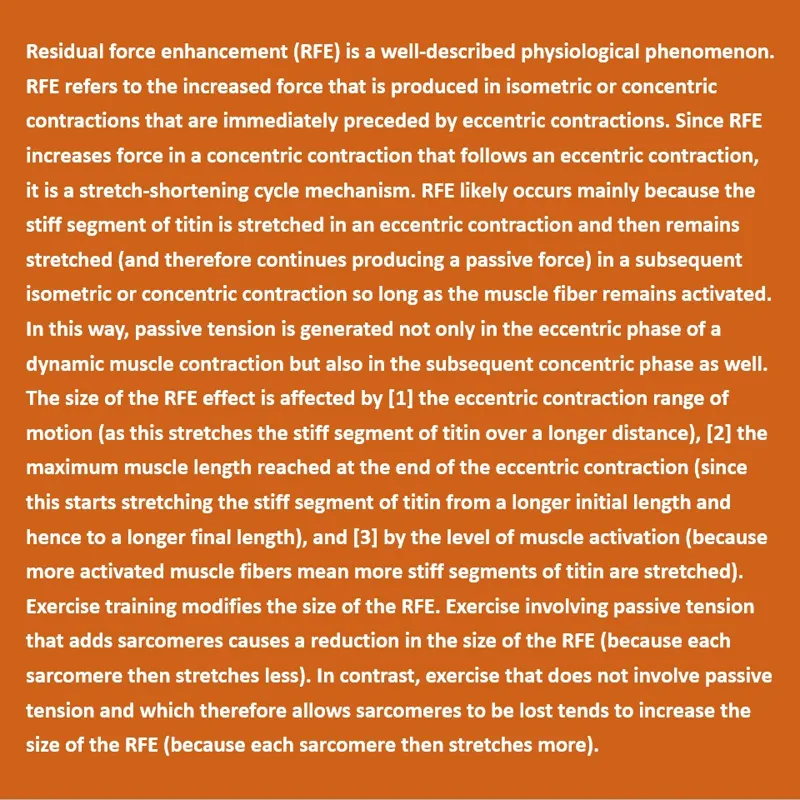
The residual force enhancement effect is simply the release of elastic energy stored by titin. Titin absorbs kinetic energy during the eccentric phase, stores this as elastic potential energy, and then dissipates some of this energy as heat while returning some of it as kinetic energy during the subsequent concentric phase (read more).
.
#4. Elastic energy storage
Like titin, tendons also store kinetic energy from the eccentric phase of a movement as elastic potential energy and then return this as kinetic energy in the subsequent concentric phase. However, they are able to store and release the energy much more efficiently.
.
#5. Muscle-tendon interactions
When muscle fibers shorten more slowly, they produce greater forces. When tendons elongate and shorten during a muscular contraction, they permit muscle fibers to lengthen and shorten less, thereby producing a higher level of mechanical tension. This is probably the main mechanism by means of which plyometrics involve a large SSC, and improvements in this mechanism are likely how plyometric training produces increases in the overall size of the SSC effect (read more).
.
Conclusions
The stretch-shortening cycle (SSC) effect is not caused by a single mechanism but by a group of mechanisms. Any physiological phenomenon that causes concentric phase performance to be increased by the presence of a preceding eccentric or isometric contraction is a SSC mechanism. There are at least five known SSC mechanisms: [1] the stretch reflex (increases the level of motor unit recruitment in the concentric phase through changes at the spinal level); [2] pre-activation (increases the proportion of the concentric phase that involves a high level of muscle fiber activation); [3] the residual force enhancement effect (increases concentric phase muscle fiber force as titin releases its stored elastic potential energy from the eccentric phase in the subsequent concentric phase); [4] tendon elastic energy storage and release (increases force transmitted by the tendon into the joint as the tendon releases its stored elastic potential energy from the eccentric phase in the subsequent concentric phase); and [5] muscle-tendon interactions (increases muscle fiber force because any tendon length changes allow muscle fibers to lengthen and shorten more slowly).