




Residual force enhancement
Residual force enhancement (RFE) is a well-described physiological phenomenon. RFE refers to the increased force that is produced in either isometric or concentric contractions that are immediately preceded by eccentric contractions. Since the RFE can increase force in a concentric contraction that follows an eccentric contraction, the RFE is a stretch-shortening cycle mechanism.
.
#1. How does RFE work?
The RFE effect occurs because the stiff segment of titin is stretched during an eccentric contraction and then remains stretched (and hence continues producing a passive force) during a subsequent isometric or concentric contraction. In this way, passive tension is produced not only in the eccentric phase of a dynamic muscular contraction but also in the subsequent concentric phase as well.
.
#2. Does RFE occur during strength training?
Yes, RFE occurs during strength training. Recently, it was shown that isometric contractions at long muscle lengths that were immediately preceded by eccentric contractions produced greater forces than isometric contractions at long muscle lengths that were commenced from a relaxed muscle.
.
#3. Does RFE change after strength training?
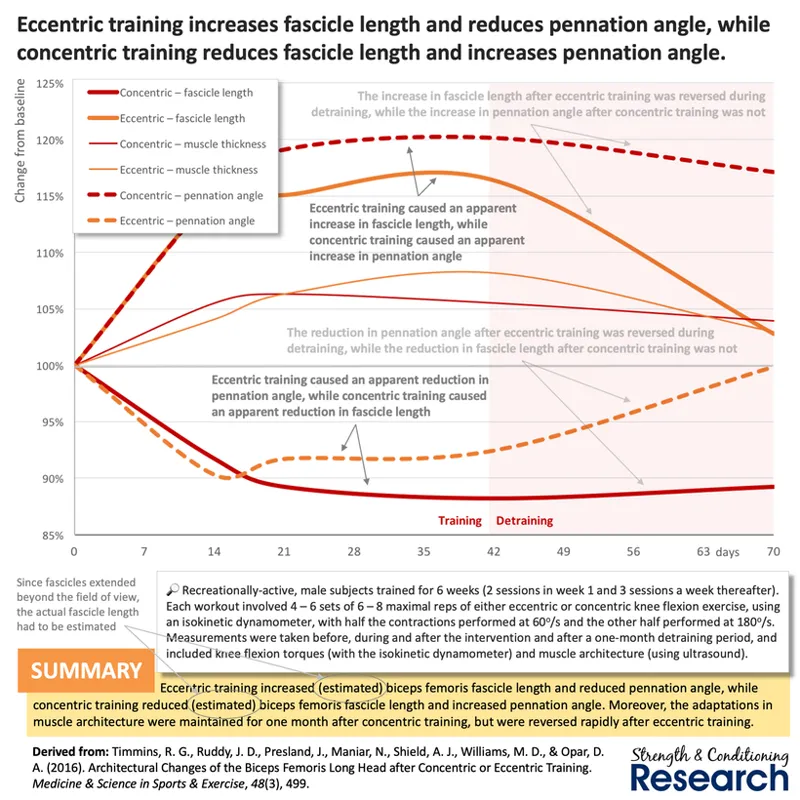
Yes, RFE is probably affected by changes in the number of sarcomeres in series. Types of strength training that involve a high level of passive tension (like eccentric training and strength training with peak forces in a stretched position) will cause a gradual reduction in the amount of RFE that can occur over time by adding sarcomeres in series. In contrast, types of strength training that involve little passive tension (like concentric training and strength training with peak forces in a contracted position) cause a gradual increase by reducing sarcomeres in series.
.
Over time, the presence of passive tension tends to cause the addition of sarcomeres in series, while the absence of passive tension tends to cause the loss of sarcomeres in series. Lots of sarcomeres in series decrease the ability of muscle fibers to generate passive tension (because each sarcomere is stretched to a lesser extent). In contrast, few sarcomeres in series increase the ability of muscle fibers to create passive tension (because each sarcomere is stretched to a greater extent).
.
#4. Does RFE contribute to the stretch-shortening cycle effect?
Yes, RFE does contribute to the stretch-shortening cycle effect. Moreover, the size of the RFE effect is increased by various factors. Firstly, when muscle fibers are activated and stretched through longer distances, the residual force enhancement effect is greater. This is because the stiff segment of titin behaves like an elastic band and therefore increases the amount of force it produces with increasing stretch amplitude.
.
Secondly, when muscle fibers are activated and stretched to longer maximum muscle lengths, the RFE is greater. This is because the stiff segment of titin is likely already somewhat stretched at the start of an eccentric contraction that starts from a longer muscle length.
.
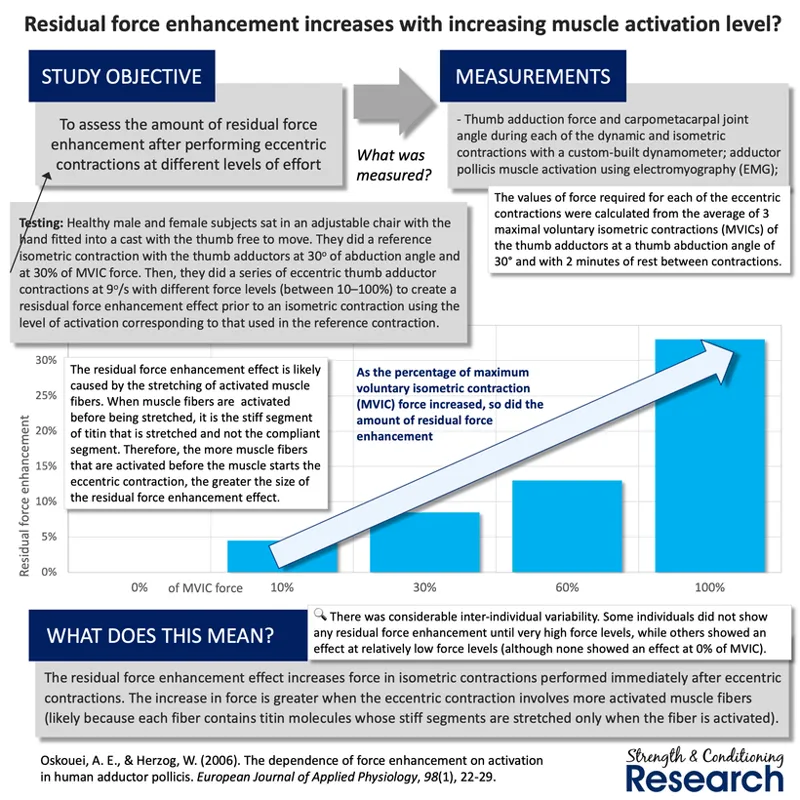
Thirdly, when more muscle fibers are activated and stretched, the RFE effect is greater. This is because activating a muscle fiber increases the amount that the stiff segment of each titin molecule inside a muscle fiber stretches. Therefore, the more muscle fibers that are activated, the more stiff segments within titin molecules are stretched and produce force. Also, it is important to note that if a muscle fiber is ever deactivated during a stretch-shortening cycle contraction, most of the RFE is lost. This is likely because the deactivation allows the stiff segment of titin to relax, because the compliant segment is free to move.
.
Conclusions
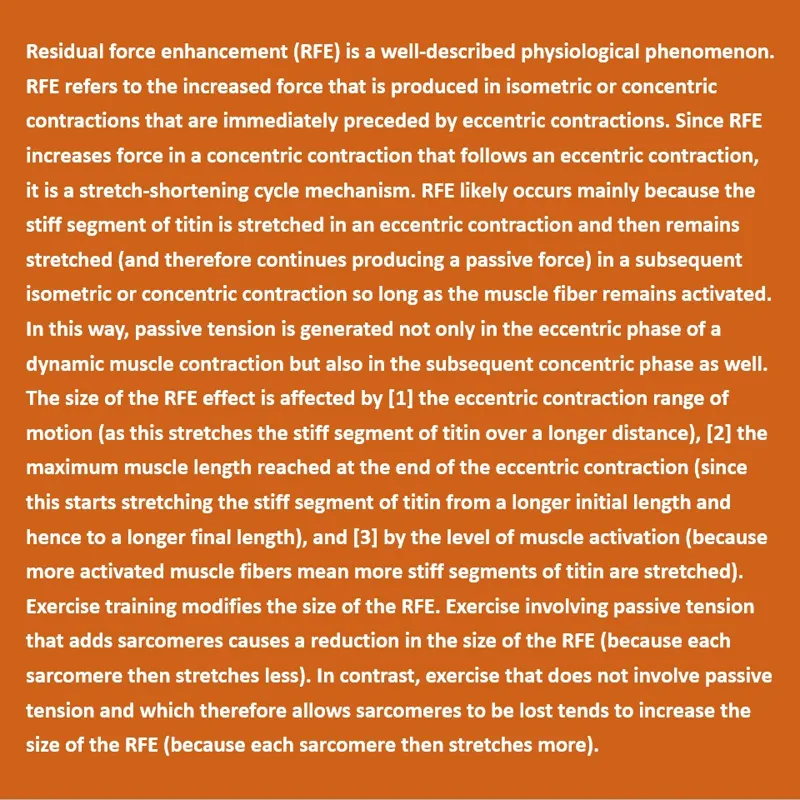
Residual force enhancement (RFE) is a well-described physiological phenomenon. RFE refers to the increased force that is produced in either isometric or concentric contractions that are immediately preceded by eccentric contractions. Since RFE can increase force in a concentric contraction that follows an eccentric contraction, it is a stretch-shortening cycle mechanism. RFE likely occurs mainly because the stiff segment of titin is stretched during an eccentric contraction and then remains stretched (and therefore continues producing a passive force) in a subsequent isometric or concentric contraction, so long as the muscle fiber remains activated throughout. In this way, passive tension is produced not only in the eccentric phase of a dynamic muscle contraction but also in the subsequent concentric phase as well. The size of the RFE effect is affected by [1] the eccentric contraction range of motion (as this stretches the stiff segment of titin over a longer distance), [2] the maximum muscle length reached at the end of the eccentric contraction (since this starts stretching the stiff segment of titin from a longer initial length and hence to a longer final length), and [3] by the level of muscle activation (because more activated muscle fibers mean more stiff segments of titin are stretched). Exercise training modifies the size of the RFE. Exercise involving passive tension that adds sarcomeres causes a reduction in the size of the RFE (because each sarcomere then stretches less). In contrast, exercise that does not involve passive tension and which therefore allows sarcomeres to be lost tends to increase the size of the RFE (because each sarcomere then stretches more).
Comments (4)
Hello Chris - thank you - I'm a personal trainer - 24 years - your writings support my observation both personally and with my clients - light training to failure does not yield as much hypertrophy as heavy - often I have simply increased the load to change a clients body - muscular development - I just heard Dr.Schoenfeld on a podcast assert training with as high as 40 repetitions to failure elicits identical hypertrophy to heavier loading - do you really believe this?
Currently, the research does show that the same number of sets of moderate (6–15) and light (16–30 or 35) reps to failure produces similar hypertrophy. However, I suspect that there are important fatigue mechanisms that have the potential to reduce hypertrophy with light loads, and these may only become apparent with [1] very well-trained individuals and [2] higher volumes. Hopefully, future research will clarify!
thank you Chris - so why not heavier load for hypertrophy? If recruitment equals more titin involvement it would seem like heavier load would create a perfect scenario for maximal tension
Yes, that is one of two reasons why heavier loads might actually cause more hypertrophy than lighter loads (the other is less supraspinal fatigue). Not sure why those factors don't show up in the long-term data.