






Elbow flexors (includes biceps brachii)
The elbow flexors are a surprisingly small elbow flexor muscle group comprising four individual muscles ( biceps brachii long head, biceps brachii short head, brachialis, and brachioradialis). Fortunately, there are studies that allow us to understand the best ways to train each muscle.
.
#1. Elbow flexion internal moment arm lengths – elbow angle
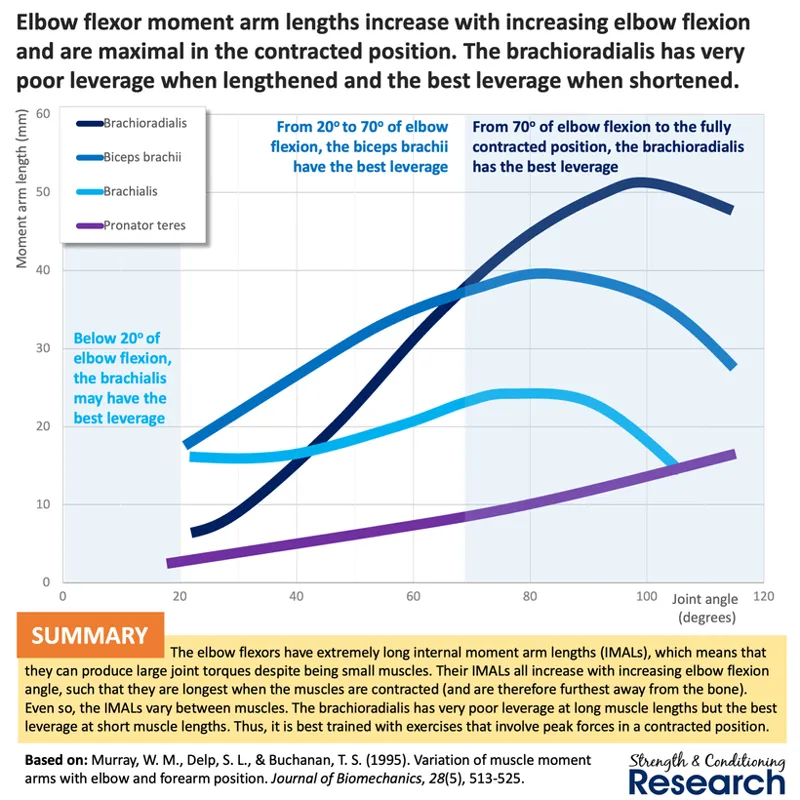
The elbow flexors have different origins and insertions and therefore different leverages. Moreover, the leverages change over the course of the joint angle range of motion (ROM). The brachioradialis has best leverage in the contracted position, while the brachialis and biceps brachii have better leverage in the stretched position.
.
These differences in leverages match with the differences in muscle activation levels. The brachioradialis has the highest relative muscle activation in the contracted position, while the brachialis and biceps brachii have better relative muscle activation in the stretched position.
.
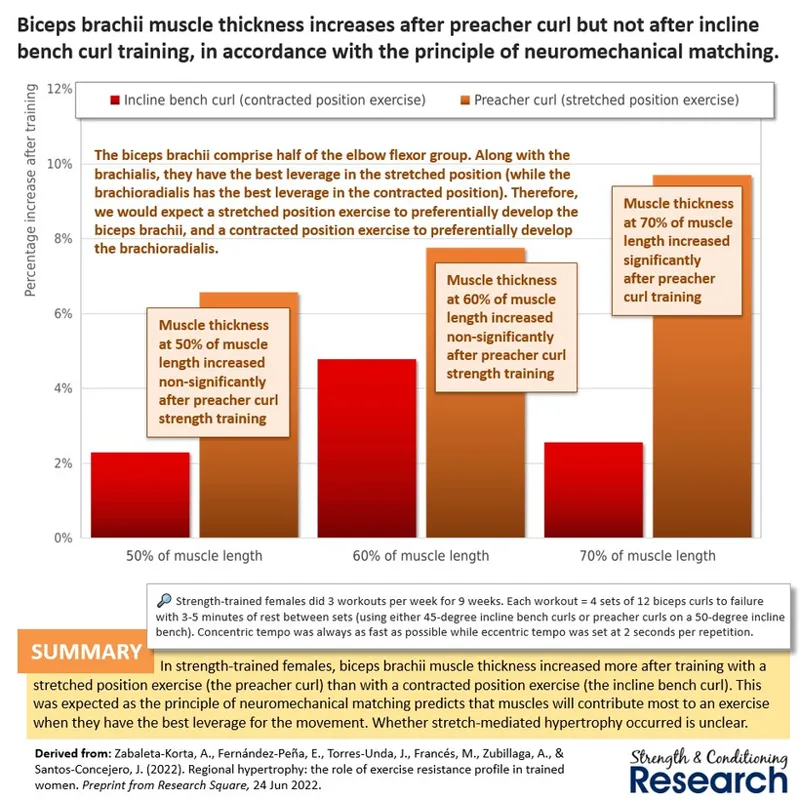
Some long-term strength training data also reflect these differences, although sadly the brachioradialis is rarely measured. The biceps brachii tend not to grow as much after being trained with contracted position exercises (in this study the resistance profile of the incline bench curl made it a contracted position exercise).
.
While some researchers maintain that the greater muscle growth resulting from training with a resistance profile that emphasises the stretched position is stretch-mediated hypertrophy, it is important to note that whole elbow flexor volume increases similarly after training with exercises with difference resistance profiles. This confirms that the differences in individual muscle growth are due to neuromechanical matching and not sarcomerogenesis.
.
#2. Elbow flexion internal moment arm lengths – wrist position
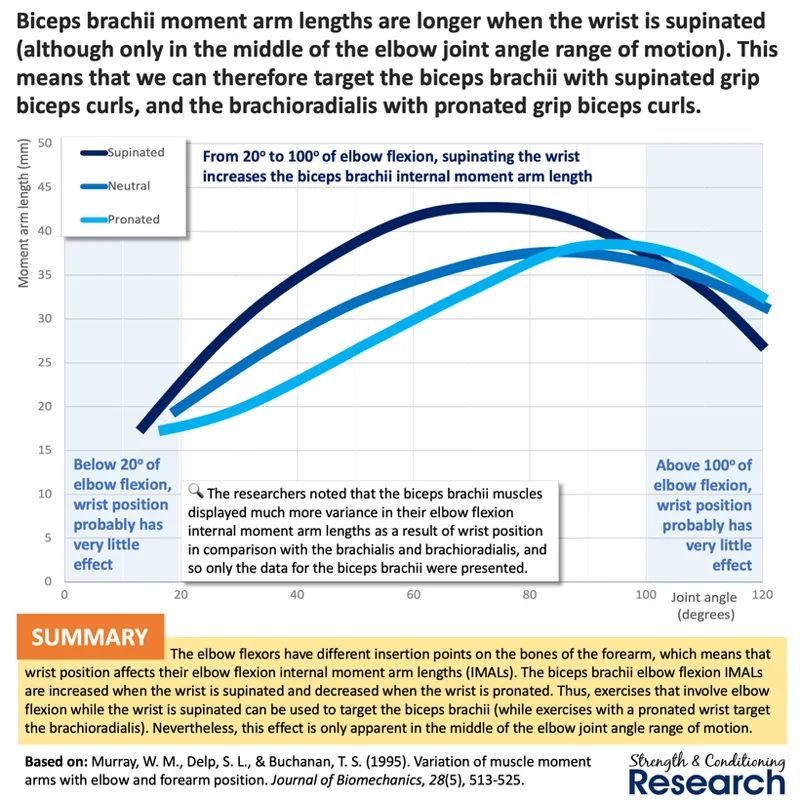
Wrist position affects the relative leverages of the elbow flexors. The biceps brachii are more involved with a supinated grip. The brachioradialis is more involved with a pronated grip.
.
Again, the muscle activation data reflect these differences. Biceps brachii voluntary activation levels during maximal efforts are suppressed when the wrist is pronated.
.
#3. Shoulder flexion internal moment arms – shoulder angle
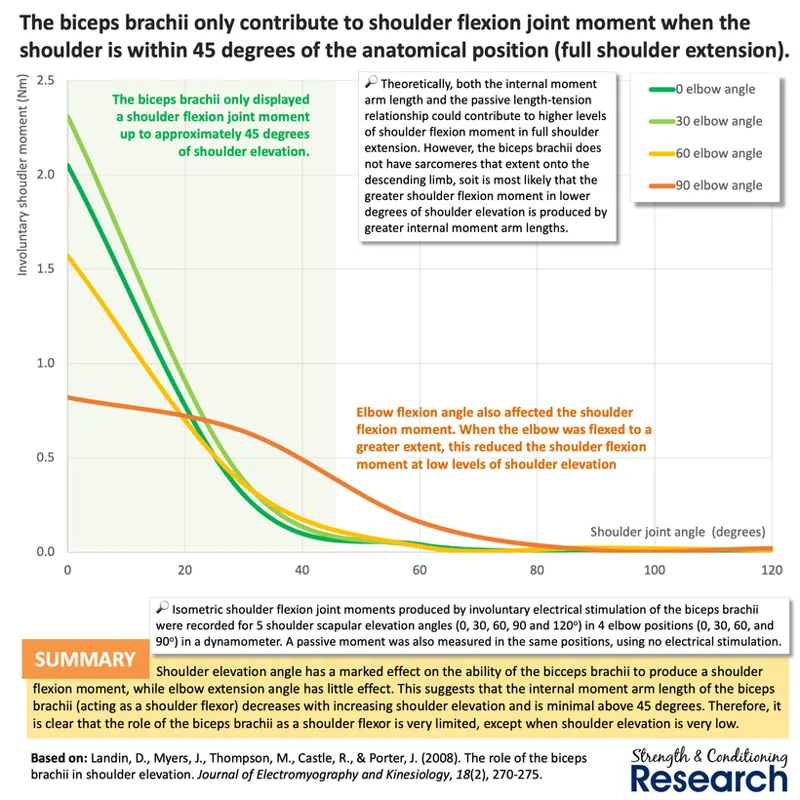
The biceps brachii are not particularly good shoulder flexors and have minimal leverage once the shoulder is elevated above 45 degrees.
.
#4. Stretch-mediated hypertrophy
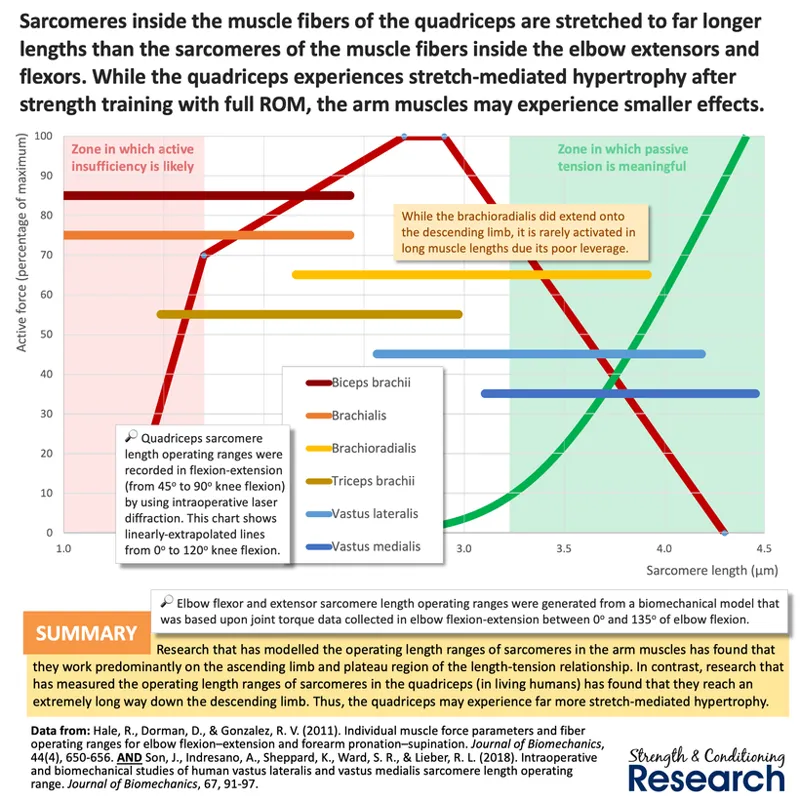
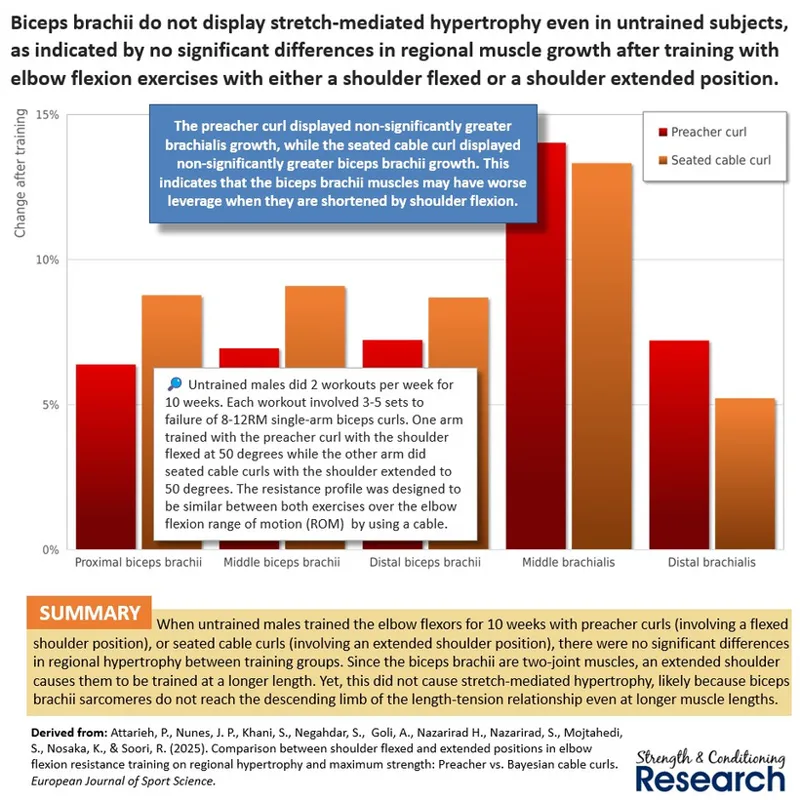
The sarcomeres of the biceps brachii probably do not reach the descending limb of the length-tension during strength training exercises. Therefore, we should not expect the biceps brachii to experience stretch-mediated hypertrophy (although the brachioradialis could).
.
Strength training studies that have tested training the elbow flexors at different muscle lengths in order to assess the prevalence of stretch-mediated hypertrophy have usually done so by comparing exercises using different partial ranges of motion (ROMs). This strategy is not ideal if only some of the elbow flexors are tested since different muscles will work to different extents in different ROMs due to the principle of neuromechanical matching. One alternative is to alter the shoulder position to train the biceps brachii at a longer muscle length. These studies confirm that the biceps brachii do not experience sarcomerogenesis.
.
#5. Recovery
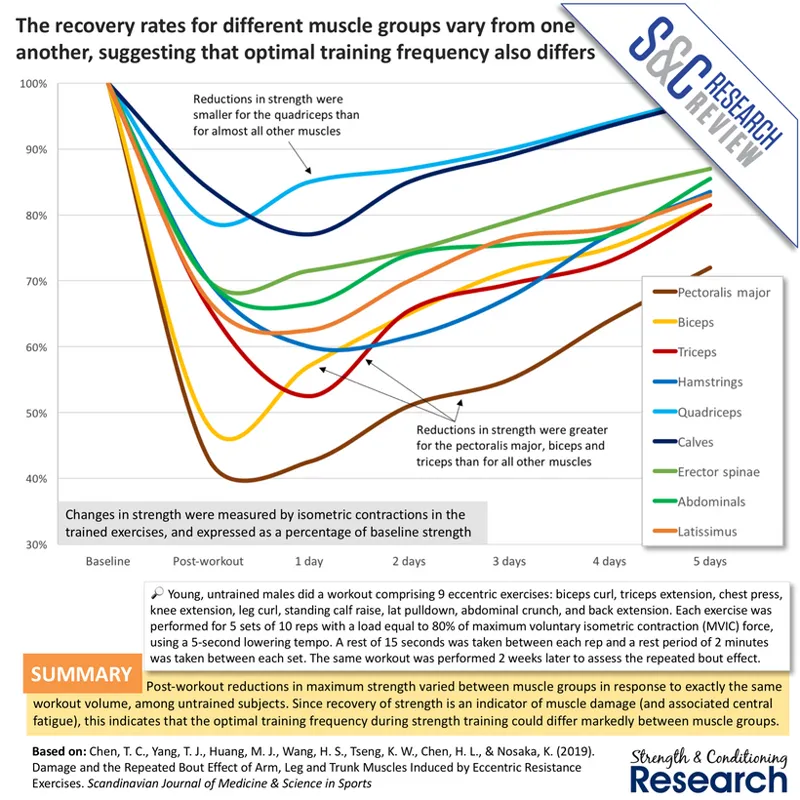
The elbow flexors recover much more slowly than most of the other muscles in the body.
.
The elbow flexors likely recover slower than most other muscles partly due to the extremely high proportion of fast twitch muscle fibers that they contain. Fast twitch muscle fibers are more easily damaged after exercise because they have far fewer mitochondria.
.
Additionally, the extremely high voluntary activation capacity of the elbow flexor muscle group means that more of the fast twitch fibers that are present inside the muscle can actually be activated (and therefore damaged by calcium ion influx) during maximal efforts.
.
Conclusions
The elbow flexors comprise four muscles (the biceps brachii long head, the biceps brachii short head, the brachialis, and the brachioradialis). The biceps brachii can perform shoulder flexion as well as elbow flexion, but the brachialis and brachioradialis can only perform elbow flexion. Even so, the shoulder internal moment arms of the biceps brachii are non-existent when the shoulder is elevated past 45 degrees from the side of the body, so these muscles only produce a shoulder flexion moment when the arm is close to the anatomical position. The biceps brachii have the best elbow flexion leverage near to full elbow extension, while the brachioradialis has the best leverage in full elbow flexion. Doing elbow flexion in wrist supination increases biceps brachii leverage, while doing elbow flexion in wrist pronation increases brachioradialis leverage. Thus, supinated grip preacher curls target the biceps brachii and pronated grip EZ bar curls with elastic resistance target the brachioradialis. Exercises that involve force production at long muscle lengths are not essential, as the elbow flexors do not display much stretch-mediated hypertrophy, likely because their sarcomeres work on the plateau of the length-tension relationship even when the muscle is stretched. Finally, as a fast twitch muscle with a very high voluntary activation capacity, the elbow flexors are easily damaged and may need to be trained with somewhat lower workout volumes.
Comments (3)
Hi, Chris. Is there any research on wrist flexors? Would be great to see your analysis on those
Hey, Chris! Maybe this question is not related to this post exactly, but I remember reading one of your older articles about training volume and there you stated that some people experience very big decreases in reps set after set, for example: 1 set - 10 reps, then 8 and 5 (more often than not they are more fast twitch dominant) vs some people do not experience this. 1. Assuming rest between sets is enough (3 minutes), RIR is 2, and trainee is well rested could this drop in reps across sets mean that one person is a high responder and other is not? 2. If so, if reps are not dropping a lot, could this also mean that one person could handle LESS volume (high responder) and other needs MORE volume (low responder)? 3. All in all, how can we determine if programmed volume is optimal or enough? I know that progress week to week is a good proxy, but progression, especially in more advance people do not happen so fast thank you!
(1) as far as I know, we haven't managed to link fast twitch fiber proportion with responder status, although it makes sense that people with a higher proportion of fast twitch fibers should be able to increase muscle size to a greater extent.