




Repetition ranges
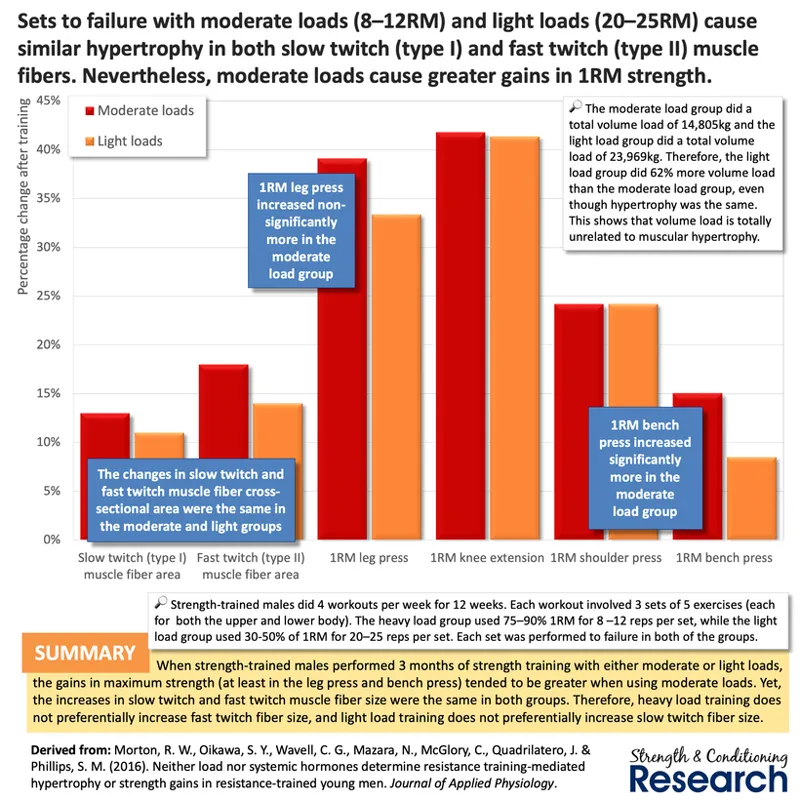
Historically, bodybuilders and hypertrophy researchers have recommended training with different repetition ranges to maximize muscle growth in muscle fibers of different types. However, the physiology suggests that strength training with heavy, moderate, and light load training methods actually cause the same growth in both slow twitch and fast twitch muscle fibers. Therefore, it is unnecessary to change rep ranges during a strength training program for hypertrophy.
.
#1. Only high-threshold motor units grow after strength training
Several studies have now shown that only the muscle fibers of high-threshold motor units grow after strength training programs, as indicated by increases in the action potential amplitudes of those motor units. In contrast, the muscle fibers belonging to low-threshold motor units do not grow.
.
Low-threshold motor units control groups of slow twitch muscle fibers, while high-threshold motor units control groups of both slow twitch muscle fibers and also groups of fast twitch muscle fibers. The high-threshold motor units controlling slow twitch muscle fibers are recruited earlier in the sequence (and therefore with lower levels of effort) than the high-threshold motor units controlling fast twitch muscle fibers. The slow twitch muscle fibers of low-threshold motor units do not grow because they are already constantly used in the activities of daily life.
#2. Fast twitch muscle fibers grow more easily than slow twitch muscle fibers
After conventional strength training programs in humans and in animal models, fast twitch muscle fibers tend to display greater anabolic signaling responses compared to slow twitch muscle fibers.
.
And (as we might expect) this then leads to greater increases in fast twitch muscle fiber size (compared to slow twitch muscle fiber size) after a strength training program. This can be observed both within muscles as well as when comparing the hypertrophy of predominantly slow twitch and predominantly fast twitch muscles.
.
#3. Rep range does not affect growth in slow twitch and fast twitch muscle fibers
Since there is a difference in growth between slow twitch muscle fibers and fast twitch muscle fibers after conventional strength training, it has been suggested that heavy and moderate loads (which are used in such programs) cause preferential fast twitch hypertrophy, while light loads might cause preferential slow twitch hypertrophy. Yet, research has shown that there is no difference between the effects of heavier and lighter loads on the hypertrophy of slow twitch and fast twitch muscle fibers.
.
This finding has now been confirmed using a number of different research study designs, including those assessing the effects of heavy and light loads on slow and fast twitch muscle fibers within the same muscle, and those assessing the effects of heavy and light loads on slow and fast twitch muscle fibers in different muscles.
.
#4. It is possible that type IIX muscle fibers may not grow after training with light loads
To the extent that there is a difference between rep ranges, it is possible that light load strength training might fail to cause hypertrophy in the type IIX muscle fibers of the highest motor units, because of the afferent feedback from metabolite accumulation causing supraspinal central nervous system (CNS) fatigue.
Conclusions
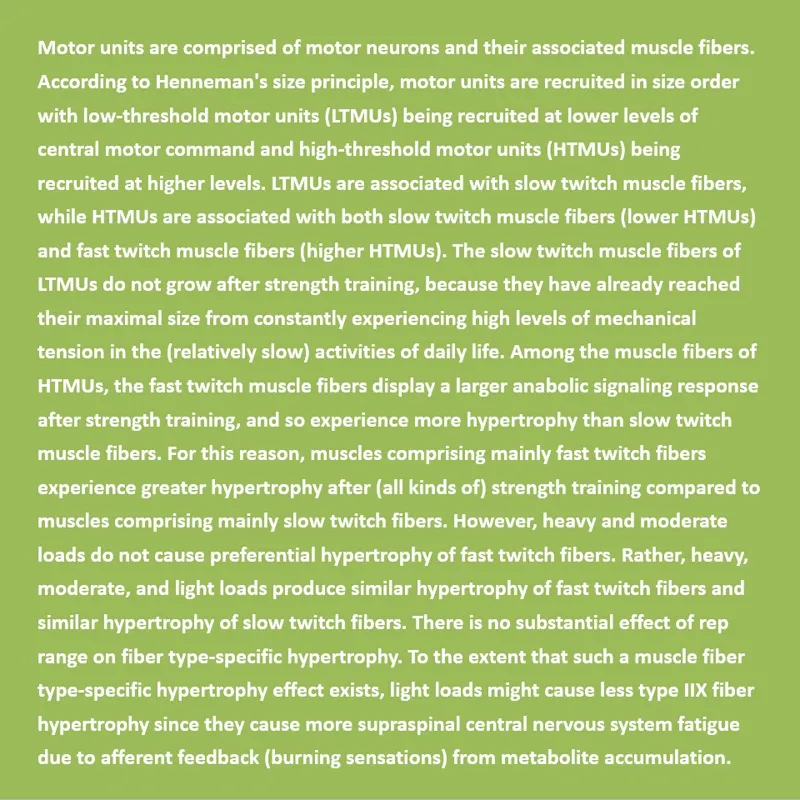
Motor units are comprised of motor neurons and their associated muscle fibers. According to Henneman's size principle, motor units are recruited in size order with low-threshold motor units (LTMUs) being recruited at lower levels of central motor command and high-threshold motor units (HTMUs) being recruited at higher levels. LTMUs are associated with slow twitch muscle fibers, while HTMUs are associated with both slow twitch muscle fibers (lower HTMUs) and fast twitch muscle fibers (higher HTMUs). The slow twitch muscle fibers of LTMUs do not grow after strength training, because they have already reached their maximal size from constantly experiencing high levels of mechanical tension in the activities of daily life. Among the muscle fibers of HTMUs, the fast twitch muscle fibers display a larger anabolic signaling response after strength training, and so experience more hypertrophy than slow twitch muscle fibers. For this reason, muscles comprising mainly fast twitch fibers experience greater hypertrophy after strength training compared to muscles comprising mainly slow twitch fibers. Yet, heavy and moderate loads do not cause preferential hypertrophy of fast twitch fibers. Rather, heavy, moderate, and light loads produce similar hypertrophy of fast twitch fibers and similar hypertrophy of slow twitch fibers. There is no substantial effect of rep range on fiber type-specific hypertrophy. To the extent that such a fiber type-specific hypertrophy effect exists, light loads might cause less type IIX fiber hypertrophy since they cause more supraspinal central nervous system fatigue due to afferent feedback from metabolite accumulation.