





Throwing
Throwing is a key, upper body movement that is an essential part of many ball sports. It also comprises a meaningful proportion of the track and field events. Consequently, it is important that we understand the basic physiological elements of throwing, and how it can be improved, outside of improvements in coordination.
.
#1. Throwing involves a proximal-to-distal sequence
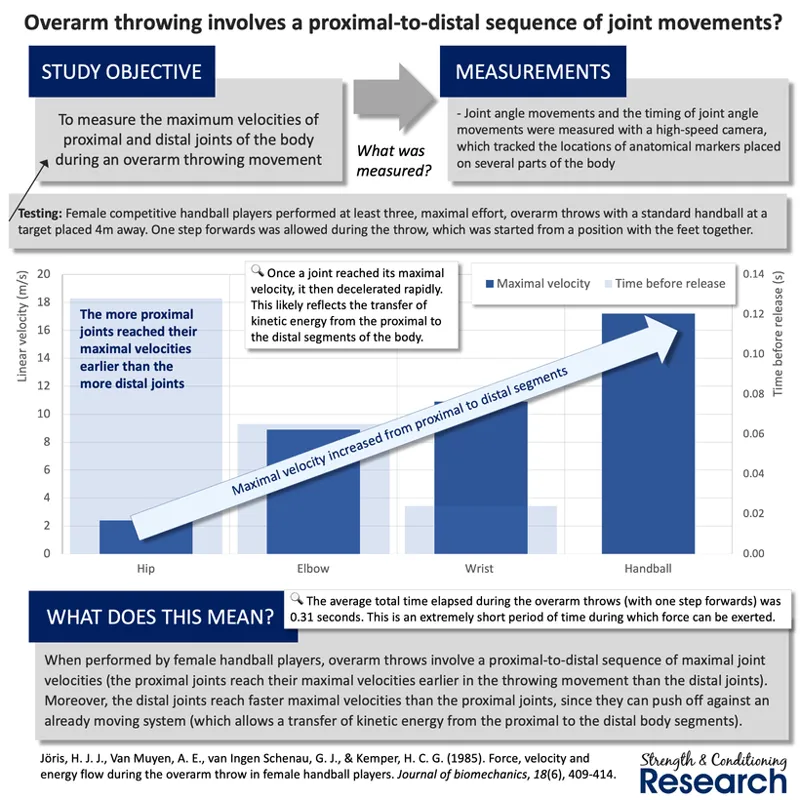
Like many athletic movements (including vertical jumping and sprint running), overarm throwing involves a proximal-to-distal sequence of joint angle movements. In other words, the proximal joints reach their maximal angular velocities first, and the distal joints reach their maximal angular velocities later. In this way, the more distal segments of the body can use the more proximal segments as a moving platform to accelerate from, thereby achieving faster maximal velocities than would otherwise be possible.
.
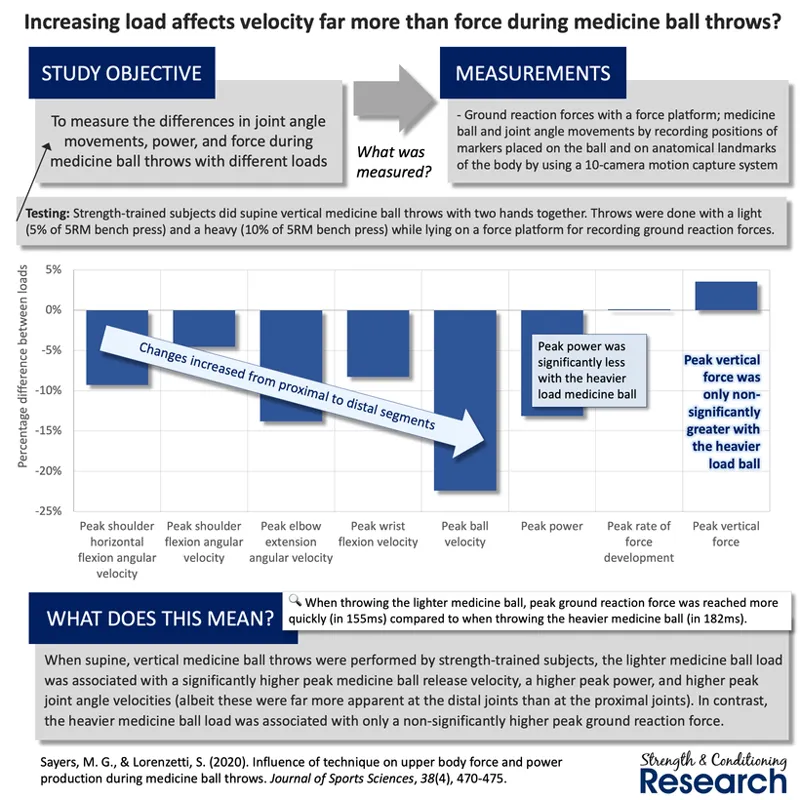
This means that when we increase the weight of the ball, the maximum velocity of the more distal segments reduces more than the maximum velocity of the more proximal segments (because the maximum velocity of the more distal segments is dependent upon the velocities of the more proximal segments). And this in turn means that the maximum ball velocity is reduced much more than the ground reaction force as ball weight is increased.
.
#2. Throwing performance is affected by the lower body musculature
Since throwing involves a proximal-to-distal sequence, whereby the more proximal segments can transfer kinetic energy to the more distal segments, the lower body can contribute substantially to throwing performance.
.
#3. Throwing performance is affected by the force-velocity profile
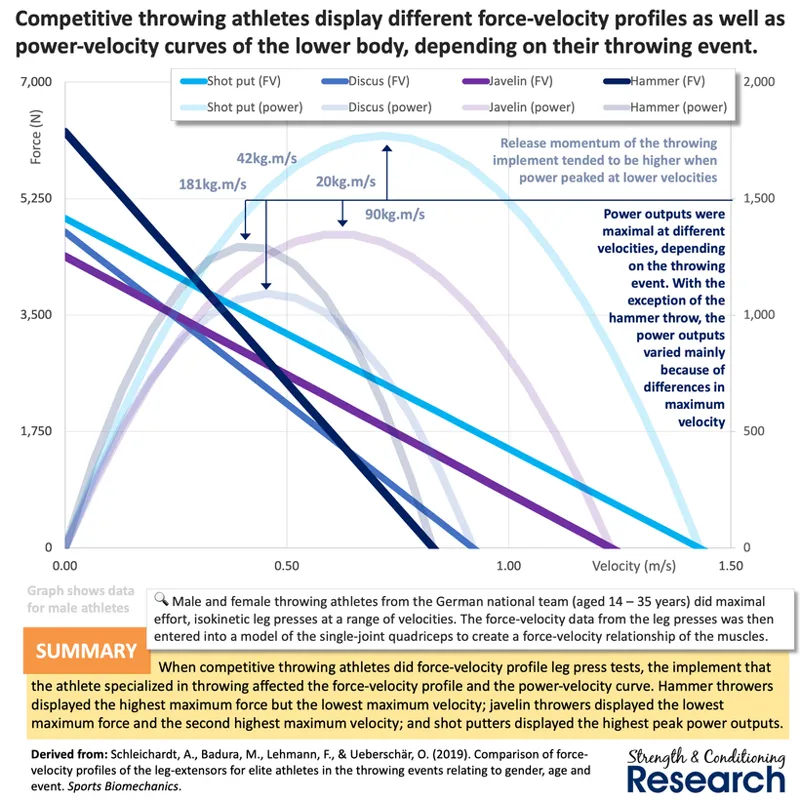
Research has shown that individual athletes display different force-velocity profiles in athletic movements such as vertical jumping and sprint running. Force-velocity profiles can also be calculated using leg presses and leg press dynamometers, which provides a general indication of lower body force-velocity profile in lower body combined hip and knee extension movements. This is relevant for throwing, because the legs contribute to throwing performance through the proximal-to-distal sequence and subsequent kinetic energy transfer. When lower body force-velocity profiles are measured for throwers, throwers of different disciplines display different results. Those that throw heavier implements tend to display more force-dominant profiles, while those that throw lighter implements tend to display more velocity-dominant profiles (albeit with some exceptions).
.
Since throwing is a rotational movement, it is also relevant to consider force-velocity profiles during trunk rotation. When such force-velocity profiles are measured for athletes of different backgrounds, it is apparent that those athletes that do trunk rotations against greater resistance tend to display more force-dominant profiles, while those that do trunk rotations at fast speeds against no resistance tend to display more velocity-dominant profile.
.
Importantly, improvements in throwing performance after training are velocity-specific. This means that throwing heavier implements improves throwing performance to a greater extent with heavier implements and to a lesser extent with lighter implements, while throwing lighter implements improves throwing performance to a greater extent with lighter implements and to a lesser extent with heavier implements.
.
This is likely why high-level throwing athletes tend to display unusually high fast twitch fiber proportions. The high proportion of fast twitch muscle fibers allows the athletes to display high forces at fast speeds, which otherwise would not be possible.
.
#4. Throwing performance tends not to reduce with detraining
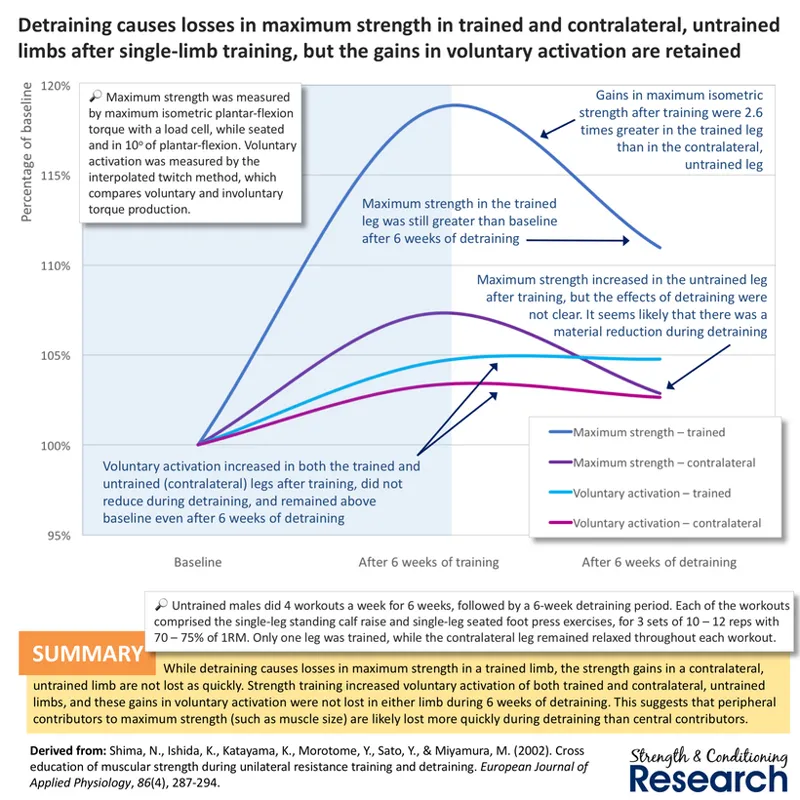
Strength training tends to cause improvements in throwing performance, alongside a number of adaptation that improve maximum strength (including hypertrophy). Nevertheless, detraining does not cause a large reduction in throwing performance, even through the gains in muscle size are then lost. It therefore seems likely that the gains in throwing performance that were achieved during training were caused mainly by an adaptation that is not lost during detraining.
.
In this respect, it is noteworthy that [1] strength training causes an increase in motor unit recruitment (which is known to be a very important contributor to gains in both maximum strength and high-velocity strength) and that [2] detraining tends not to cause any losses in motor unit recruitment. This suggests that most of the increases in throwing performance after strength training are actually causes by increases in motor unit recruitment level, rather than by increases in muscle size.
.
This in turn suggests that the contribution of hypertrophy to increases in throwing performance is relatively small in comparison with the improvements in motor unit recruitment. This likely occurs because the effects of the increase in muscle size on throwing performance are cancelled out either by [A] muscle fiber type shifts from type IIX to type IIA (which obviously reduces high-velocity strength by reducing maximum speed), or by [2] the increase in internal moment arm length that necessarily occurs in conjunction with the increase in muscle size. Longer internal moment arm lengths cause muscle fibers to move through larger excursions for the same joint angle movement, which in turn means that they reach their maximum linear velocity at lower angular velocities.
.
Conclusions
Throwing is a fast movement that is essential to many sports. Importantly, it involves a proximal-to-distal sequence of joint angle movements, such that the proximal joints reach their (slower) maximal angular velocities first, while the distal joints reach their (faster) maximal angular velocities later. In this way, the distal segments of the body can use the proximal segments as a moving platform to accelerate from, thereby achieving their maximal velocities later, and also faster than would otherwise be possible. For this reason, lower body strength and leg movements (such as stride length) during a throw can influence performance substantially. Throwing displays a force-velocity profile, although this is rarely measured in throws. Research has shown that both the lower body and the trunk force-velocity profiles of throwers and other athletes differ according to their sport, with athletes specializing in throwing lighter loads (or moving more quickly) tending to display more velocity-orientated profiles, and those athletes specializing in throwing heavier loads (or moving more slowly) tending to display more force-orientated profiles. For this reason, it is likely that individualized force-velocity training methods can be applied to throwers, just as they can be for jumping and sprinting athletes. Nevertheless, since the throwing movement is extremely fast, those adaptations that benefit maximum velocity are always likely to be somewhat more important.
Comments (1)
Thanks for this, Chris. Really good. In golf it is common to do load velocity profiling with training clubs lighter and heavier than the competition club and look for deficits there. The Stack System is the name of the product most often used for this.