


Flexing
Flexing is often performed by bodybuilders as practice for their shows. Yet, it can also stimulate hypertrophy, because it is nothing more than an isometric contraction that is produced by allowing an antagonist muscle to resist the force produced by an agonist muscle.
.
#1. Isometric contractions do cause hypertrophy
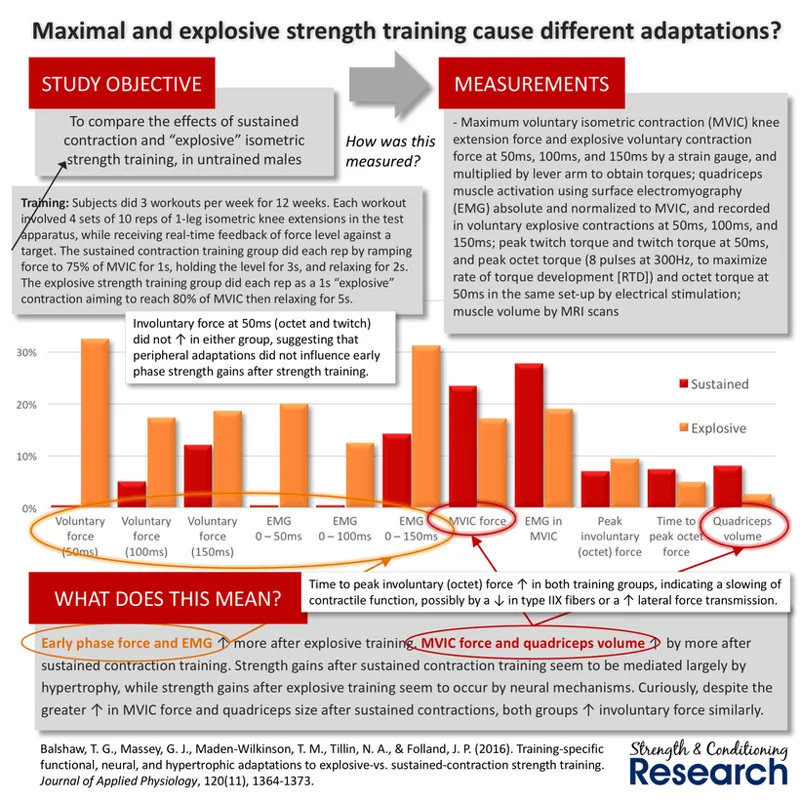
In the wider fitness industry, the idea that isometric contractions can cause hypertrophy is often contentious, which is very silly. Indeed, it is not remotely contentious in the field of exercise science, where isometric contractions are quite regularly used to create muscle growth in both humans and in a variety of animal models.
.
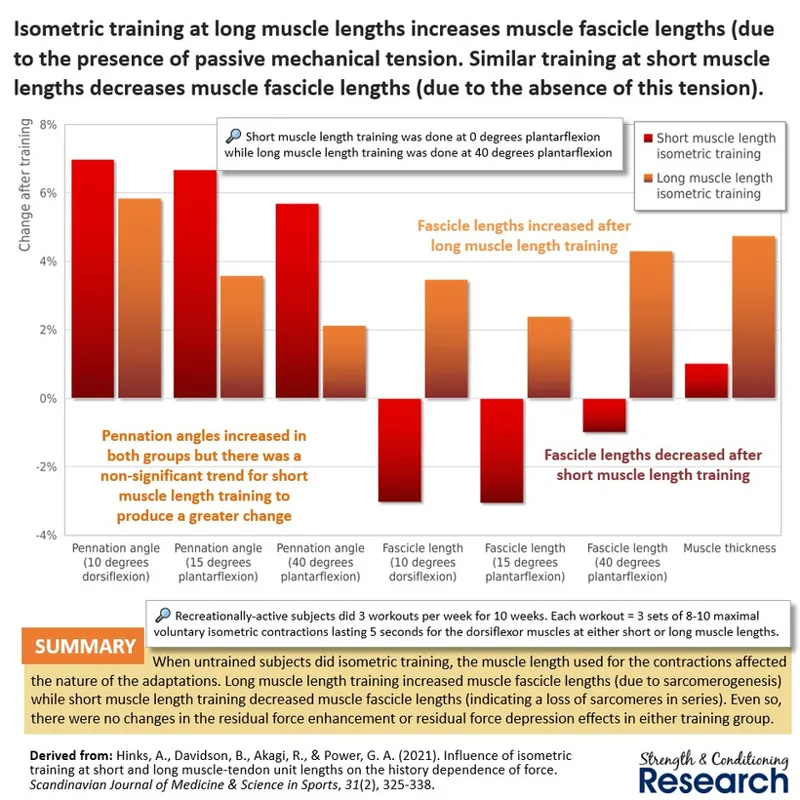
Indeed, isometric contractions function in much the same way as dynamic contractions. For example, they display greater muscle growth (alongside greater increases in muscle fascicle length) when they are performed at long maximum muscle lengths compared to at short maximum muscle lengths, in much the same way as conventional strength training.
.
#2. Isometric contractions produce hypertrophy because of the force-velocity relationship
From a physiological point of view, it is obvious why isometric contractions produce hypertrophy. We can moderate the level of effort that we use very easily through voluntary control, and this means that we can exert maximal efforts in isometric contractions and thereby achieve a high level of central motor command (which in turn causes a high level of motor unit recruitment and therefore a lot of activated muscle fibers). Each of the activated muscle fibers is then exposed to a high level of active mechanical tension due to the force-velocity relationship.
.
#3. Flexing produces hypertrophy because the antagonist muscles act as the resistance
While isometric contractions are often performed against external resistance, we have internal resistance available through the use of antagonist muscles. These antagonist muscles are able to exert forces against the agonists (commonly called "flexing") in order to produce isometric antagonist-agonist cocontractions without the need for any external resistance. Researchers have shown that high levels of effort (leading to high levels of muscle activation) can be achieved during such simultaneous antagonist-agonist cocontractions.
.
Moreover, researchers have also shown that this type of flexing training can lead to hypertrophy in humans, which is not at all unexpected based upon the underlying physiology.
.
In fact, when isometric cocontractions are performed between normal sets of strength training, they actually function as additional sets. This generates extra hypertrophy in accordance with the dose-response relationship of volume on muscle growth.
.
Conclusions
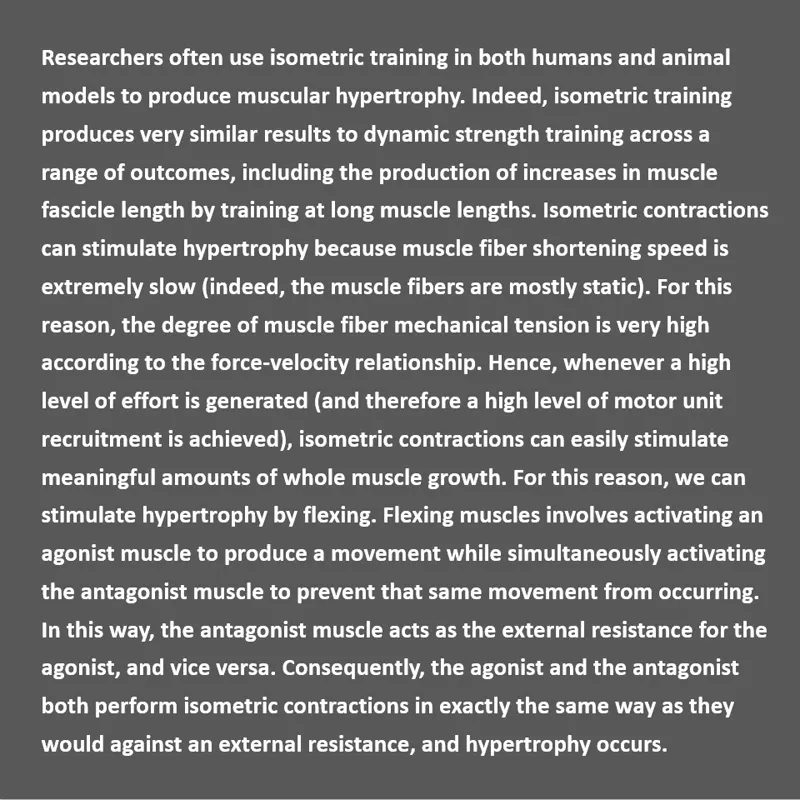
Researchers often use isometric training in both humans and animal models to produce muscular hypertrophy. Indeed, isometric training produces very similar results to dynamic strength training across a range of outcomes, including the production of increases in muscle fascicle length by training at long muscle lengths. Isometric contractions can stimulate hypertrophy because muscle fiber shortening speed is extremely slow (indeed, the muscle fibers are mostly static). For this reason, the degree of muscle fiber mechanical tension is very high according to the force-velocity relationship. Hence, whenever a high level of effort is generated (and therefore a high level of motor unit recruitment is achieved), isometric contractions can easily stimulate meaningful amounts of whole muscle growth. For this reason, we can stimulate hypertrophy by flexing. Flexing muscles involves activating an agonist muscle to produce a movement while simultaneously activating the antagonist muscle to prevent that same movement from occurring. In this way, the antagonist muscle acts as the external resistance for the agonist, and vice versa. Consequently, the agonist and the antagonist both perform isometric contractions in exactly the same way as they would against an external resistance, and hypertrophy occurs.
Comments (2)
If this is so, then why even use external resistance to stimulate hypertrophy? I am guessing that since the only metric you can objectively measure using flexing is time spent contracting (since your perception of maximum effort is not objective), that this makes progressive resistance difficult to implement with such a method.
Yes, it's the practical side of things that is the problem