






Deltoids
The shoulder muscle complex is a complicated group of muscles with multiple attachments and innervations, that can produce force in various directions at the glenohumeral joint.
.
#1. Frontal plane internal moment arm lengths
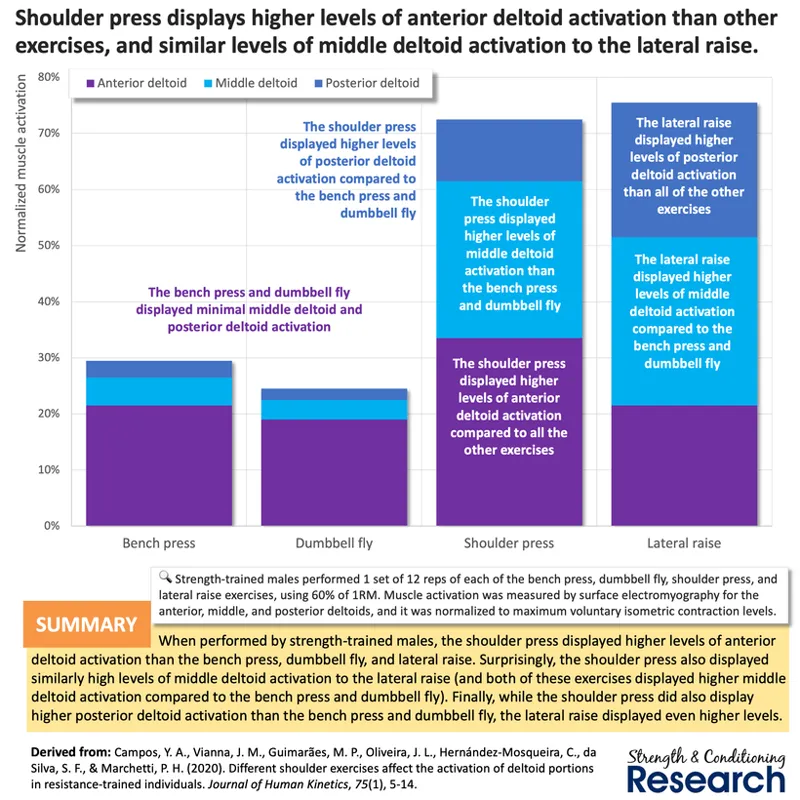
The internal moment arm lengths of the anterior and middle deltoids both increase with increasing shoulder abduction angle. The middle deltoid is the best shoulder abductor until approximately 90 degrees of shoulder elevation, after which point the anterior deltoid becomes superior. Thus, lateral raises and wide-grip overhead presses with peak effort below shoulder height will be optimal for the middle deltoid, while wide-grip overhead presses with peak effort above shoulder height will be better for the anterior deltoid.
.
Indeed, this is why the lateral raise often displays similar levels of middle deltoid activation to the wide-grip overhead press.
.
#2. Sagittal plane flexion internal moment arm lengths
The internal moment arm lengths of the anterior and middle deltoids both increase with increasing shoulder flexion angle. Yet, the clavicular head of the pectoralis major is the best shoulder flexor until approximately 120 degrees of shoulder elevation. Only after this point does the anterior deltoid become similarly effective. Therefore, when identifying shoulder flexion exercises to train the anterior deltoid, it is probably best to work substantially above shoulder height, such as with overhead press variations.
.
Indeed, this is why the clavicular pectoralis major is slightly more highly activated than the anterior deltoid in the front raise exercise (which involves peak effort below shoulder height in the sagittal plane).
.
#3. Sagittal plane extension internal moment arm lengths
The internal moment arm lengths of the posterior deltoid are always better than any other muscle for sagittal plane shoulder extension. Therefore, it will always be effectively trained by any exercise working in this plane irrespective of the joint angle at which peak effort occurs.
.
#4. Transverse plane internal moment arm lengths
The posterior deltoid also has excellent leverage for shoulder horizontal extension. Therefore, in practice. we can treat the posterior deltoid as the primary shoulder horizontal extensor for the entire range of motion.
.
#5. Regional divisions within the deltoid muscle complex
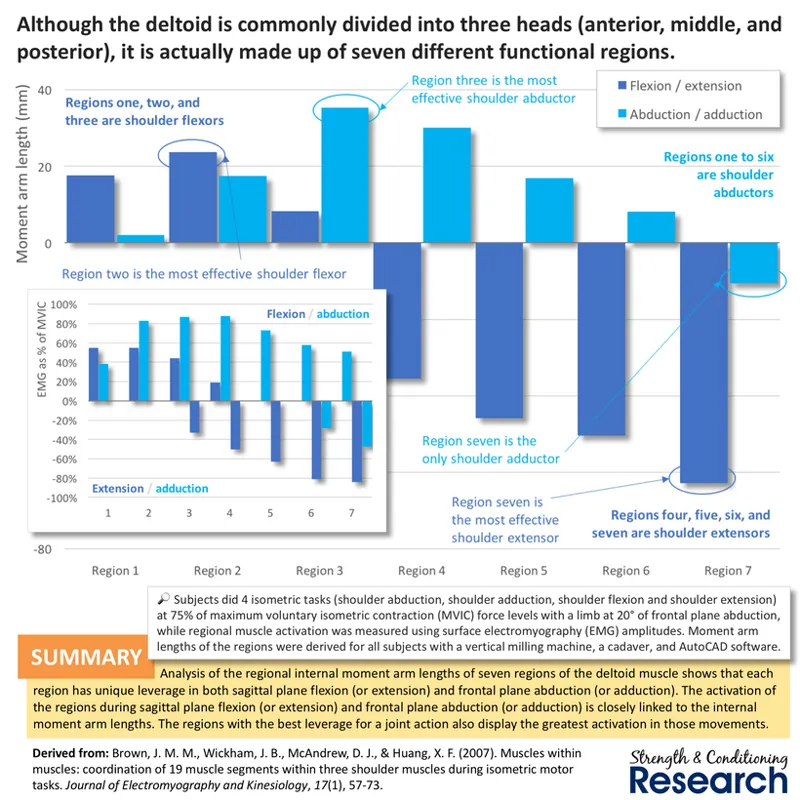
For many years, it was assumed that the deltoid had three functional regions (anterior, middle, and posterior) but recent research has identified that there are seven functional regions. Each of the seven regions are activated to a greater extent when they have better leverages (owing to the principle of neuromechanical matching). This suggests that exercise variety is very important for the deltoid, and simply targeting the three main regions may not be sufficient to maximize muscle growth in all individuals.
.
#6. Pressing variations can be altered to target the deltoid
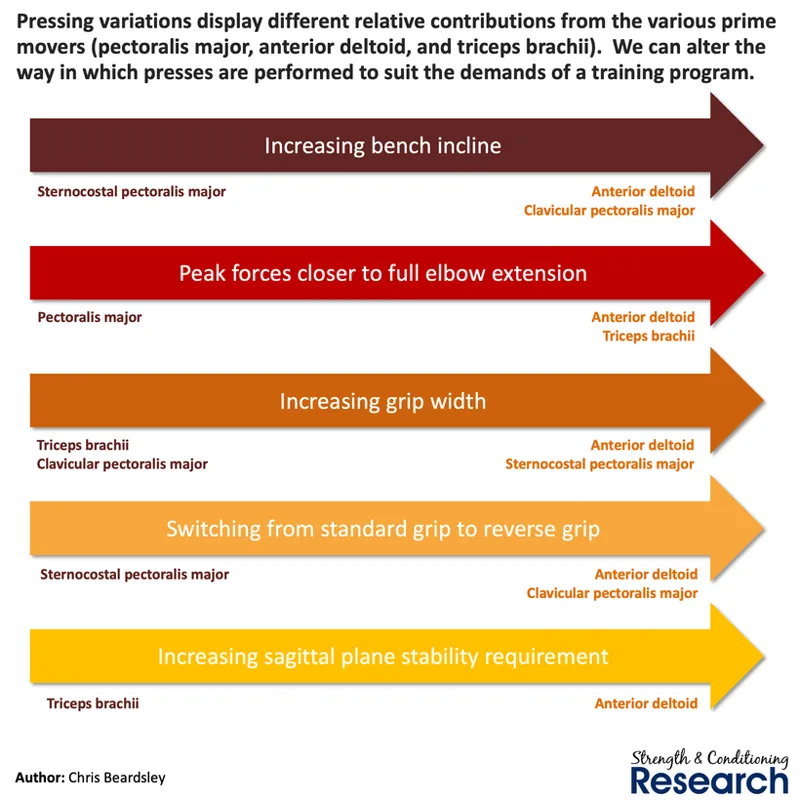
For many years, we have known that different pressing variations can be used to target either the anterior deltoid, pectoralis major, or triceps brachii. Research has now shown that [1] increasing bench incline, [2] training with peak forces closer to full elbow extension (as when using elastic resistance or partial ranges of motion, [3] increasing grip width, [4] using a reverse grip, and [5] using a barbell instead of machines or dumbbells can all increase the relative contributions of the anterior deltoid during pressing variations.
.
#7. Stretch-mediated hypertrophy
The sarcomere operating length ranges of the deltoids appear to show that the anterior and middle deltoids at least can experience stretch-mediated hypertrophy. Yet, these data sets are the least accurate of those that are available and may not represent the correct picture.
.
Indeed, when the middle deltoid was exposed to training programs with differing resistance profiles, there was no benefit of a stretched position exercise compared to a contracted position exercise. Unfortunately, since the study was performed in strength-trained subjects, it is unclear whether the lack of stretch-mediated hypertrophy was caused by the operating sarcomere length ranges of the middle deltoid or the saturation of the sarcomerogenesis stimulus.
.
#8. Recovery
Since upper body muscles tend to display higher levels of voluntary activation and a more fast twitch fiber proportion, they are usually more easily-fatigued (and damaged) than lower body muscles. Nevertheless, there are variations between the three regions of the deltoid. The posterior deltoid is way more slow twitch than the other two regions, which means that it will tolerate both a higher volume and regular training.
.
Conclusions
The deltoids are conventionally divided into three major regions (anterior, middle, and posterior) but can in fact be subdivided into seven regions based on differences in internal moment arm length and regional muscle activation. This suggests that a high degree of exercise variety is key to maximizing deltoid hypertrophy. The anterior deltoid is the best sagittal plane shoulder flexor when the arm is elevated directly overhead (the clavicular region of the pectoralis is a better shoulder flexor at lower degrees of shoulder elevation). It is also the best frontal plane shoulder abductor when the arm is elevated above shoulder height (the middle deltoid has better leverage below this point). Therefore, it very much behaves as an overhead muscle. The middle deltoid is the best frontal plane shoulder abductor below shoulder height and can therefore be trained with lateral raises or wide-grip overhead presses with peak effort below shoulder height. While the posterior deltoid is often thought of as a transverse plane shoulder horizontal extensor (and it is a good one), it is also an excellent sagittal plane shoulder extensor. It can therefore be trained with either rear delt flys or simply close-grip pull-downs and close-grip rows. Finally, it is worth noting that whether the deltoid muscles experience stretch-mediated hypertrophy is relatively unclear at present.
Comments (8)
Hi chris, hope you are doing great. You often talk about internal moment arm lenght variation with different joint angle position of a segment (as for example, the middle delt gain internal moment arm lenght with shoulder flexion). Is there any chances that you could refered me to any kind of litterature, books or any authors names, so i could read on my on about it? I think i need to visualize it in order to better understand the concept. Thanks in advance
For the shoulder, the best source of data is the Ackland research. There is a systematic review freely available online here: https://www.ncbi.nlm.nih.gov/pmc/articles/PMC6284439/
Chris, while shoulder extension teres major has by far the biggest MAL (50+ mm), yet here on the graph we ignore it, saying posterior deltoid is the main extensor, while its MAL is smaller (30+mm). Is there specific reason why we ignore TM? Thank u
My question was just what changes to consider if I change my grip to neutral instead of pronation on any lift variant.
Really, what are the changes to consider at the hypertrophy level if I do lateral raises either with a dumbbell or a pulley with a neutral grip in the glenoscapular plane?
Are you comparing dumbbell vs. pulley or frontal plane vs. scapular plane or lateral raises vs. overhead presses?
Hello Chris - thanks - it seems like the deltoid does not need a shoulder specific day of training - other than the overhead press would not the chest press variations and back row/pulldown variations target all of the 7 regions - so back, chest, overhead press and no need for the traditional 3 front/side/bent over raise? Particularly if I include the horizontal row? Thanks!
Yes, I agree. Overhead press, horizontal press, and narrow grip row are probably enough for the majority of people to get good deltoid development. Advanced lifters might add the lateral raise for slightly more middle deltoid focus but that's it.