


Two-joint muscles
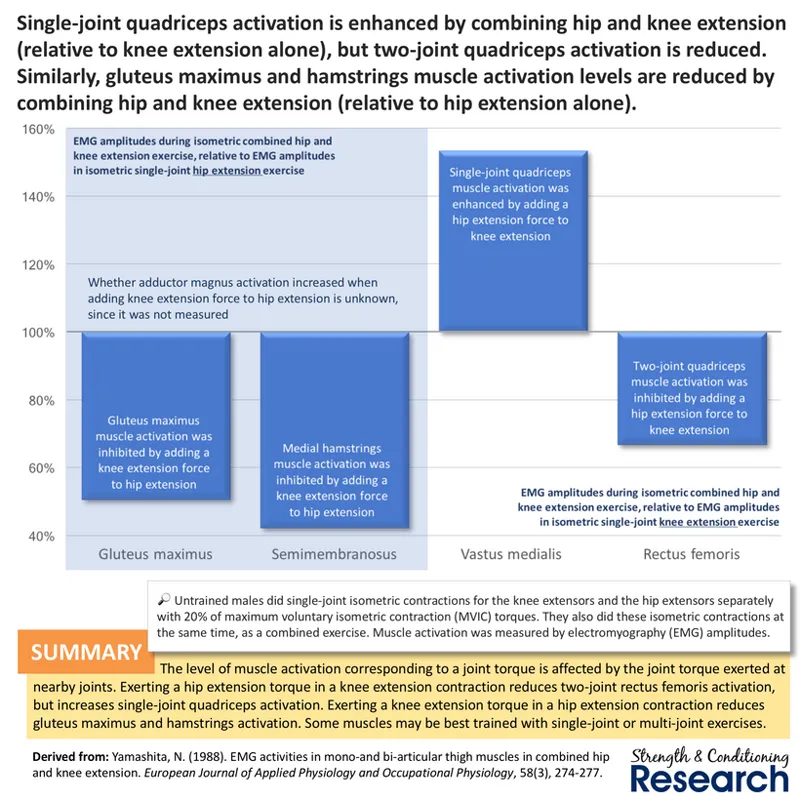
During multi-joint exercises, two-joint muscles often display reduced activation if they act as antagonists at one joint as well as agonists at another joint. We can observe this phenomenon happening at the hip/knee, shoulder/elbow, and knee/ankle.
.
#1. Rectus femoris and hamstrings at the hip/knee
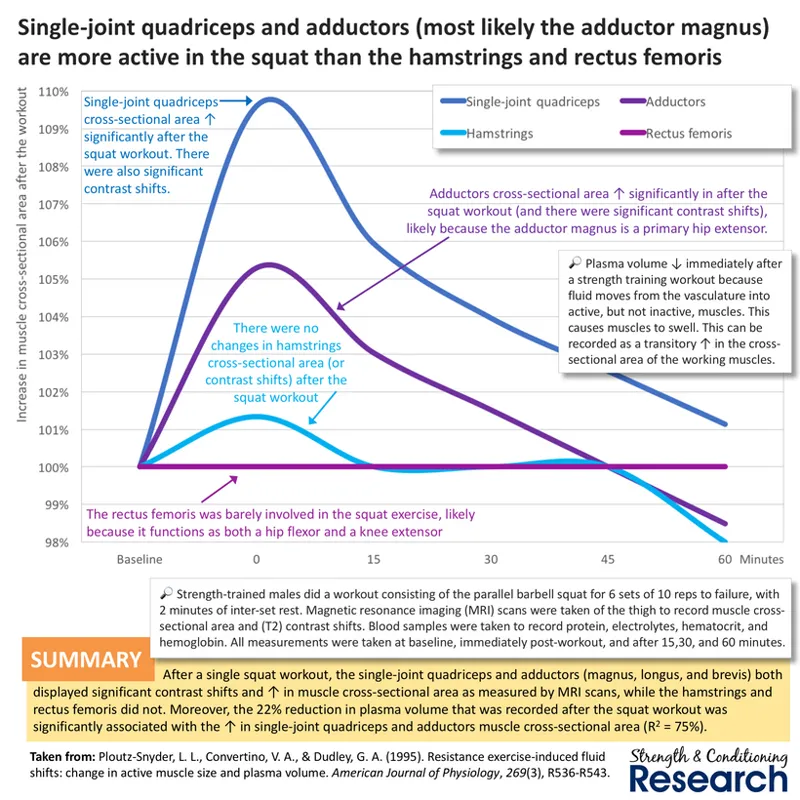
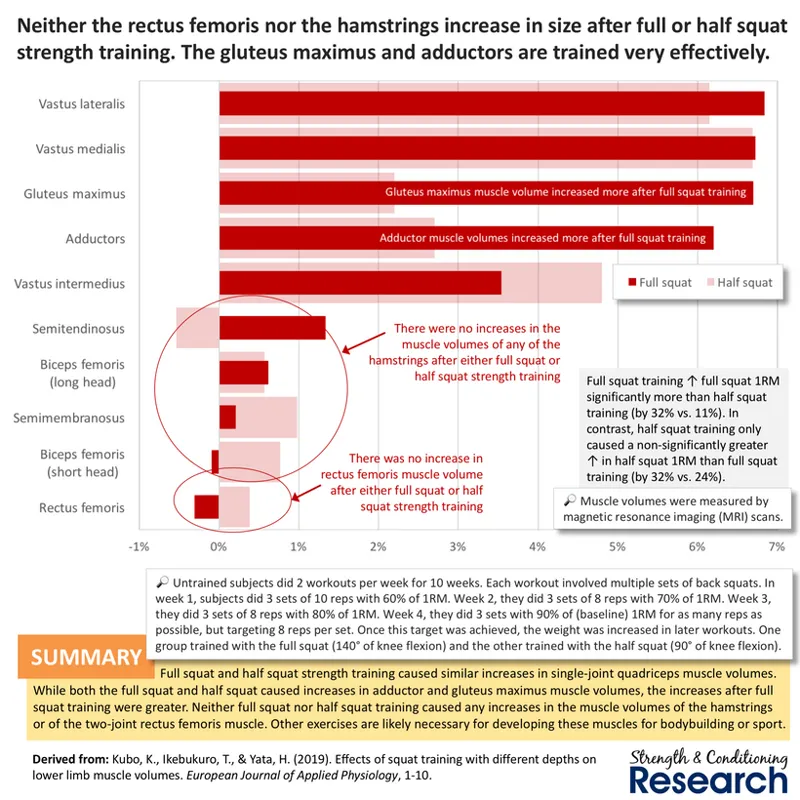
The rectus femoris is a hip flexor as well as a knee extensor. During combined hip extension and knee extension movements (like squats and leg presses), it therefore would behave as an antagonist at the hip and an agonist at the knee. For this reason, its activation reduces dramatically during combined hip extension/knee extension movements. The hamstrings behave similarly, since they are hip extensors and knee flexors.
.
Activation studies have confirmed that neither the rectus femoris nor the hamstrings are particularly active during squats, which are combined hip extension and knee extension exercises.
.
Similarly, most long-term strength training studies have also confirmed that exercises like the leg press and back squat do not cause any meaningful hypertrophy of the rectus femoris or hamstrings.
.
#2. Triceps brachii long head at the shoulder/elbow
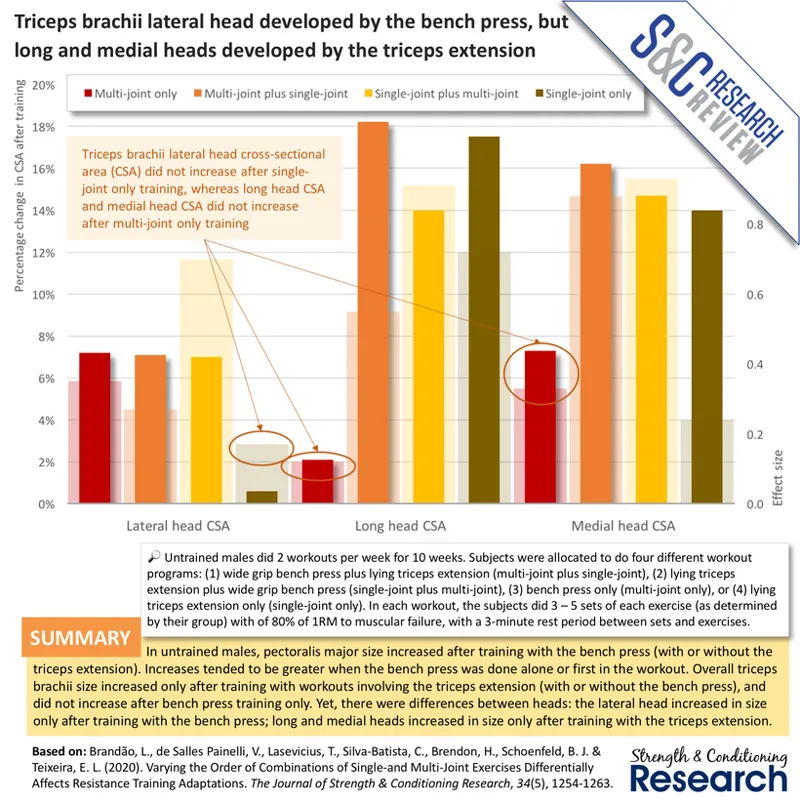
When the triceps brachii long head activates, it produces a turning force at the shoulder to produce shoulder extension, as well as a turning force at the elbow to produce elbow extension. In combined shoulder flexion and elbow extension movements (like bench presses), it therefore would behave as an antagonist at the shoulder and an agonist at the elbow. For this reason, its activation reduces dramatically during combined shoulder flexion/elbow extension movements. While this is not always observed in electromyography studies, it is apparent if we look at long-term training studies, in which the triceps brachii long head does not hypertrophy after pressing exercise variations.
.
#3. Gastrocnemius at the knee/ankle
When the gastrocnemius activates, it produces a turning force at the ankle to produce plantar flexion, as well as a turning force at the knee to produce knee flexion. During combined knee extension and plantar flexion movements (like squats and leg presses), it therefore would behave as an antagonist at the knee and an agonist at the ankle. For this reason, its activation likely reduces in combined knee extension/plantar-flexion movements. While this observation is not always made during electromyography studies, it can be observed insofar as exercises like the leg press do not stimulate hypertrophy of this muscle group, even though it does cause hypertrophy of the soleus.
.
Conclusions
During multi-joint exercises, two-joint muscles can act as antagonists at one joint and agonists at another joint. For example, the rectus femoris acts as a hip flexor and a knee extensor during combined hip extension and knee extension exercises (like the squat and leg press). The two-joint hamstrings muscles act as hip extensors and knee flexors in the same type of exercises. The triceps brachii (long head) acts as a shoulder extensor and as an elbow extensor in upper body exercises involving combined shoulder flexion and elbow extension (like the bench press and overhead press). And the gastrocnemius acts as a knee flexor and ankle plantar-flexor during combined knee extension and ankle plantar-flexion exercises (like the squat and leg press). In each case, the use of each of these two-joint muscles is inefficient for producing the movement. Consequently, it is unsurprising that we see evidence that [1] their muscle activation is dramatically reduced in favor of the nearby single-joint muscles of the same group, and that [2] they do not experience meaningful hypertrophy after being trained with such multi-joint exercises. Indeed, research has shown that the rectus femoris, hamstrings, and gastrocnemius do not grow meaningfully after squat or leg press strength training programs, and similarly, the triceps brachii (long head) does not grow meaningfully after bench press training programs. For developing these muscle groups, single-joint exercises are likely necessary.
Comments (3)
Hey Chris, thanks for this very interesting read. Wouldn't by this thinking, the rectus femoris/gastroc would be inefficient for producing force in a sprint. Those muscles work as antagonists and agonists in the stance phase of a run, so it begs the question what are those muscles useful for outside of stability? Then ultimately why do we even have those muscles? I am having a hard time understanding this, I would like to see how these participants were performing there squats because I think you can train the rectus especially in a squat
Hello Chris - this a rare case where I respectfully beg to differ - I believe the above when employing light or moderate loading - however with heavy load I think the leg press will hypertrophy the rectus femoris and hamstrings and definitely the triceps will be hypertrophied (all 3 heads) with heavy bench press training - my theory is the heavier load is an emergency circumstance in which the central nervous system deploys all tissue that can protect our body - on the other hand I would be happy for you to educate me - I guess my question is does the body necessarily respond the same to all levels of loading (compressive force)?
Heavier loads do increase the involvement of the hamstrings in the squat (and therefore probably the leg press). But the rectus femoris doesn't actually even have the leverage to operate in either movement, so even if the multi-joint inhibition did not exist, it still wouldn't be able to do anything to help.