




Static stretching causes fatigue
Static stretching causes fatigue immediately after it is done, which is why it is often recommended to minimize static stretching prior to a workout or between strength training sets. Here are the two main mechanisms why static stretching causes fatigue.
.
#1. Static stretching does cause meaningful fatigue during workouts
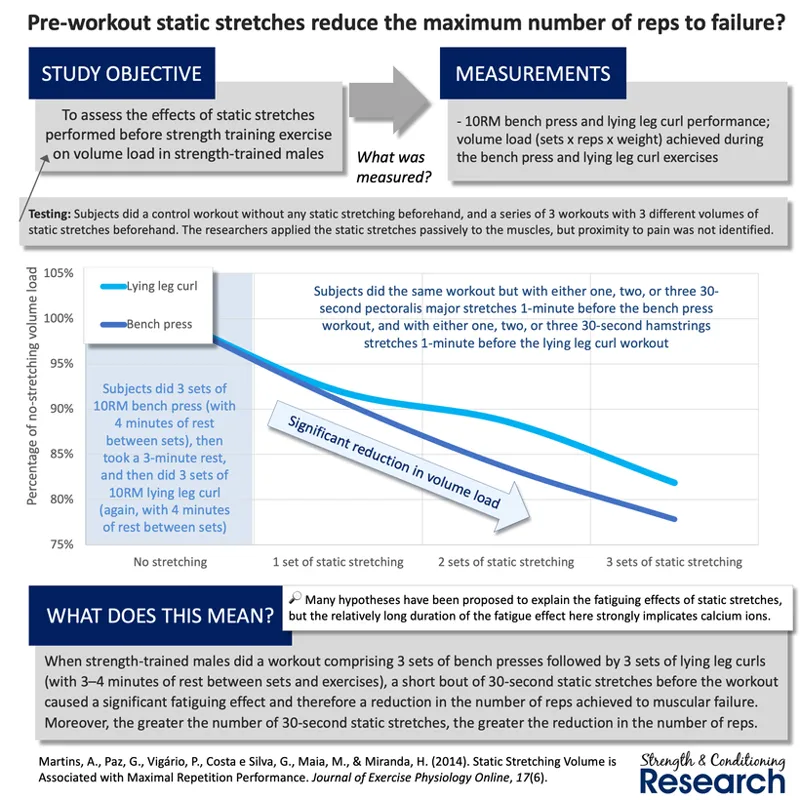
First of all, it is important to note that a bout of static stretching can meaningfully reduce the number of reps that are possible during a strength training set. Therefore, if the fatigue mechanisms reduce either [1] the level of mechanical tension that is exerted by the muscle fibers, or [2] the level of motor unit recruitment, then the stimulus for hypertrophy will necessarily be reduced as well.
.
#2. Static stretching causes central nervous system fatigue
Importantly, meta-analyses have shown that single bouts of static stretching can cause non-local fatigue in other muscles, when the fatigue is measured immediately post-stretch. The magnitude of the non-local fatigue effect is quite large, which indicates that more than half of the total fatigue that is caused instantly by the static stretching bout is probably caused by a central nervous system effect that reduces motor unit recruitment.
.
Mechanistic investigations have suggested that the non-local fatigue effect that has been repeatedly observed could be induced by a spinal phenomenon that reduces excitability of the motor neurons. This would then make it a relatively uncommon form of spinal central nervous system fatigue that has not often been reported during exercise.
.
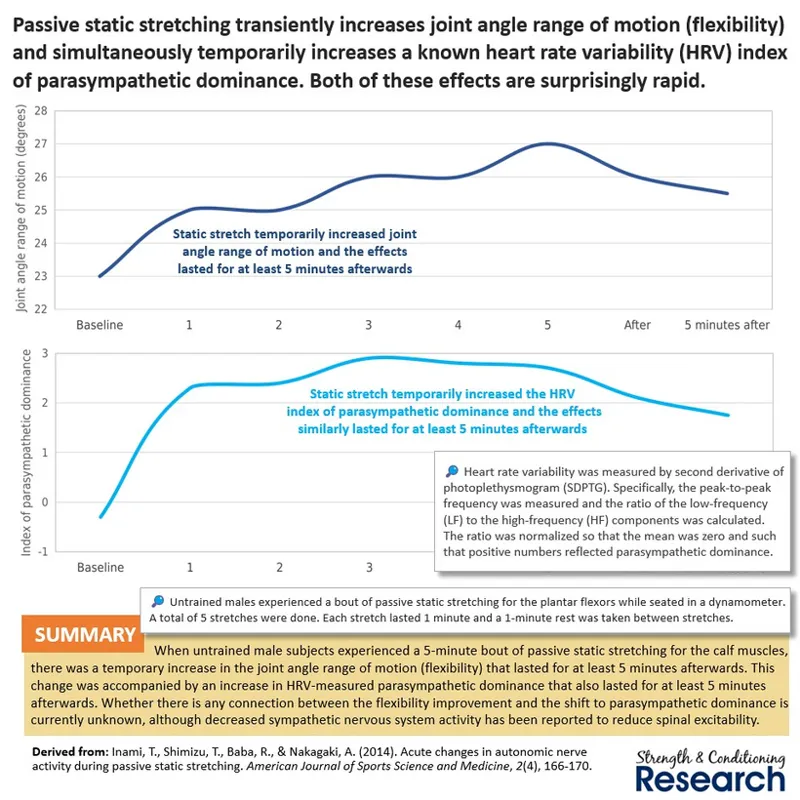
Interestingly, static stretching does have the ability to increase parasympathetic activity while it is being performed (which causes the opposite effect from strength training or high-intensity aerobic exercise bouts, which increase sympathetic nervous system activity).
.
#3. Static stretching causes relatively prolonged fatigue
Importantly, a bout of static stretching also causes relatively prolonged fatigue after it has been performed. Recent studies suggest that the fatigue is present for at least 20 minutes. This indicates that the fatigue mechanism must permit a relatively sustained reduction in maximum strength. It cannot be a mechanism that resets itself quickly after the static stretch has been completed, such as most reflex mechanisms. The most obvious group of fatigue mechanisms that occur during exercise and which are able to last at least 20 minutes are those that involve the accumulation of excess calcium ions inside the cytoplasm.
.
#4. Static stretching causes calcium ion-related fatigue
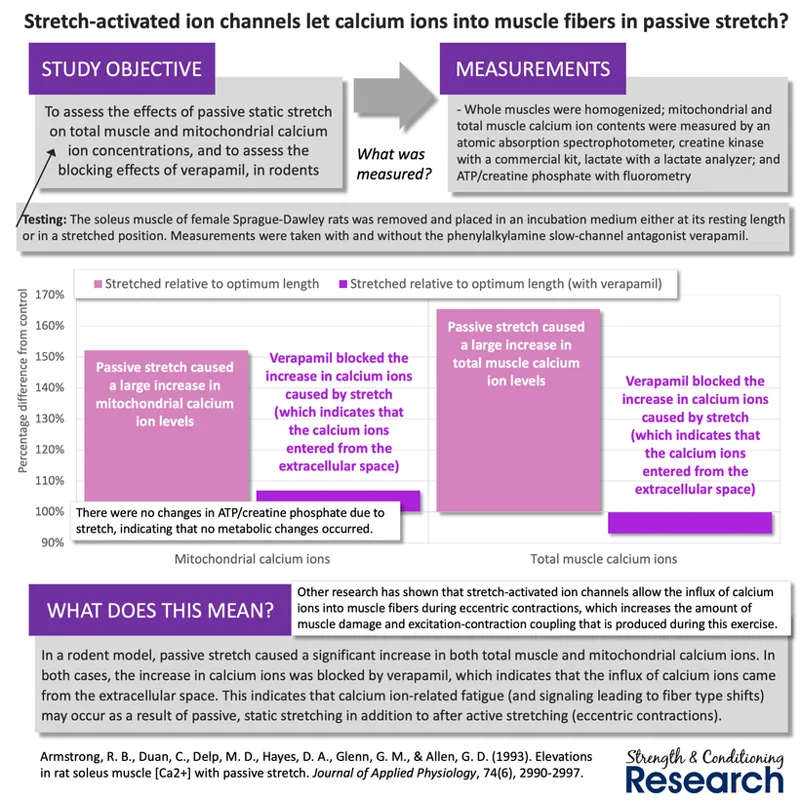
In fact, there are several lines of enquiry that strongly suggest that the prolonged fatigue mechanism produced by static stretching is a calcium ion-related fatigue mechanism. First of all, researchers have shown that passive static stretches can cause the opening of stretch-activated ion channels, which allows additional calcium ions to accumulate inside the cytoplasm of the muscle fiber, and which is an essential pathway through which calcium ion-related fatigue mechanisms can occur.
.
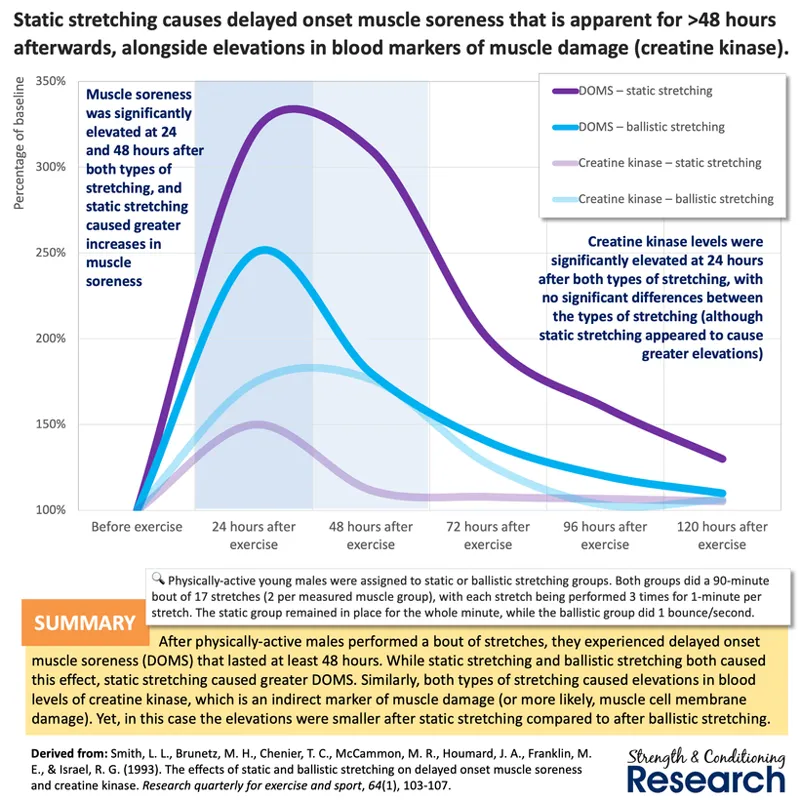
Secondly, researchers have shown that static stretching causes post-workout delayed onset muscle soreness (DOMS) and elevations in creatine kinase levels. Both DOMS and elevated creatine kinase levels are often taken as indirect markers of muscle damage occurring. Muscle damage after a workout is caused by calcium ion-related fatigue during a workout.
.
Thirdly, researchers have shown that there is a post-workout inflammatory response after passive, static stretching, in much the same way as there is a post-workout inflammatory response after isometric contractions (in fact, the response is non-significantly larger after the passive, static stretches). This inflammatory response very likely occurs in response to the presence of muscle damage.
.
Conclusions
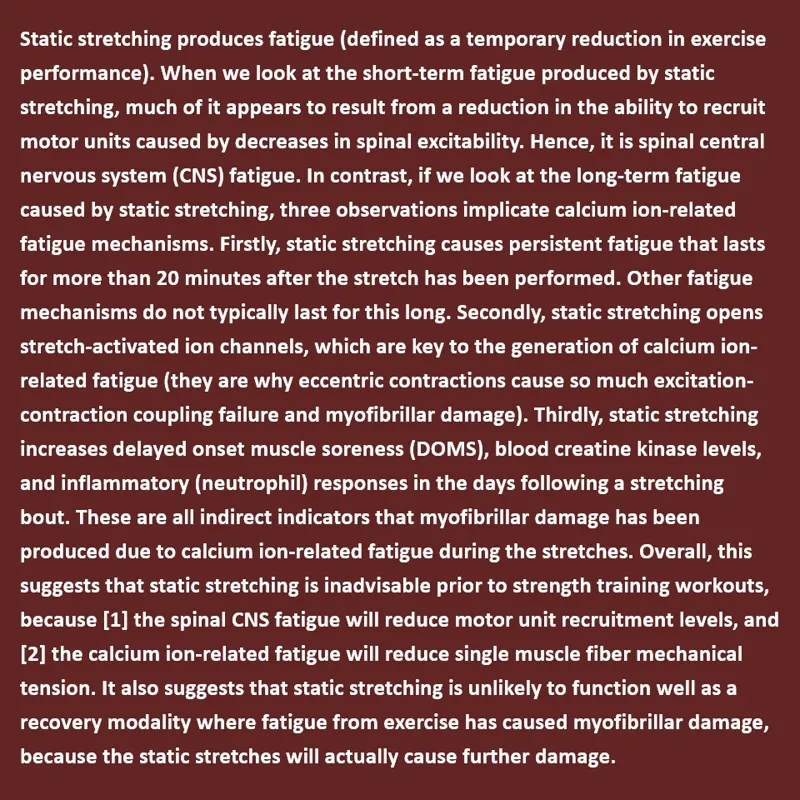
Static stretching produces fatigue (defined as a temporary reduction in exercise performance). When we look at the short-term fatigue produced by static stretching, much of it appears to result from a reduction in the ability to recruit motor units caused by reductions in spinal excitability. Hence, it is spinal central nervous system (CNS) fatigue. In contrast, if we look at the long-term fatigue caused by static stretching, three observations implicate calcium ion-related fatigue mechanisms. Firstly, static stretching causes persistent fatigue that lasts for more than 20 minutes after the stretch has been performed. Other fatigue mechanisms do not typically last for this long. Secondly, static stretching opens stretch-activated ion channels, which are key to the generation of calcium ion-related fatigue (they are why eccentric contractions cause so much excitation-contraction coupling failure and myofibrillar damage). Thirdly, static stretching increases delayed onset muscle soreness (DOMS), blood creatine kinase levels, and inflammatory (neutrophil) responses in the days following a stretching bout. These are all indirect indicators that myofibrillar damage has been produced due to calcium ion-related fatigue during the stretches. Overall, this suggests that static stretching is inadvisable prior to strength training workouts, because [1] the spinal CNS fatigue will reduce motor unit recruitment levels, and [2] the calcium ion-related fatigue will reduce single muscle fiber mechanical tension. It also suggests that static stretching is unlikely to function well as a recovery modality where fatigue from exercise has caused myofibrillar damage, because the static stretches will actually cause further damage.
Comments (4)
Hey, Chris! I wanted to ask this question very long time ago, but you never made an article about it. Now we have it, so thanks to you! Is sarcomerogenesis accepted phenomenon that happens in humans also? Because some sudies do show changing sarcomere lengths others - do not Also, we know that whole muscle length itself does not change. It is always constant and has two attachment points, how then sarcomerogenesis work? Is it the same with passive stretching and with strength training? Does eccentric portion of the lift (or stretching) also causes mechanical tension just like the concentric portion or does it stimulate only sarcomerogenesis? I hope my questions were clear enough! Thanks again, Chris.
Yes, sarcomerogenesis almost certainly does happen in humans based on indirect observations, although we do not yet have good direct data to confirm this. An upcoming FAQ article will explain the effects of sarcomerogenesis and how it differs between the eccentric phase of strength training and static stretching. This is actually something that I cover in detail in the mentorship because it is quite complex.
Interesting, is this because static stretching is held to feel the stretch, with slight pain. Could stretching at slight intensity like 30-40% ( Like microStretching) cause the same amount of fatigue?
Most likely the stretch amplitude would have an effect, given that it's the opening of the stretch-activated ion channels that causes the calcium ion-related fatigue. So greater stretch would lead to greater opening of these channels and therefore greater calcium ion influx and greater fatigue.