


Glute bridge and hip thrust variations
The glute bridge and hip thrust are popular exercises for the gluteus maximus muscle. But how are they different from one another? To answer this question, we must start by looking at the involvement of the hamstrings and the quadriceps in each exercise.
.
#1. What is the role of the hamstrings during hip thrusts and glute bridges?
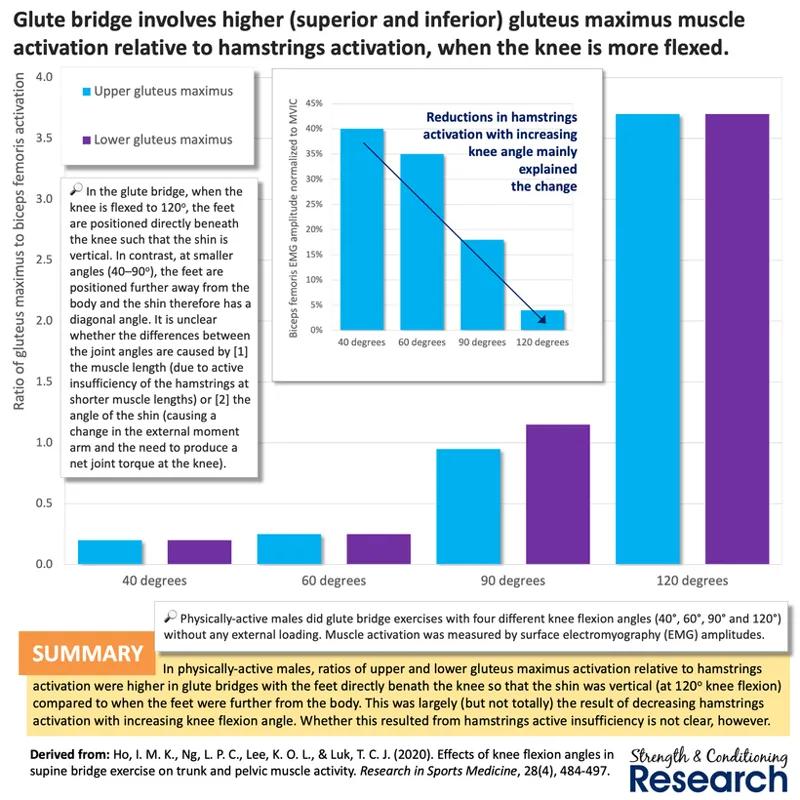
It is commonly assumed that the hamstrings play a role in extending the hip during both the hip thrust and the glute bridge. But is this really the case? When knee angle is varied in glute bridges, this alters the hamstrings activation substantially. Greater activation occurs when the muscle is lengthened due to reduced knee flexion. While this is often attributed to active insufficiency, it is far more likely that it happens because the knee is required to generate a net knee flexor torque instead of a net knee extensor torque.
.
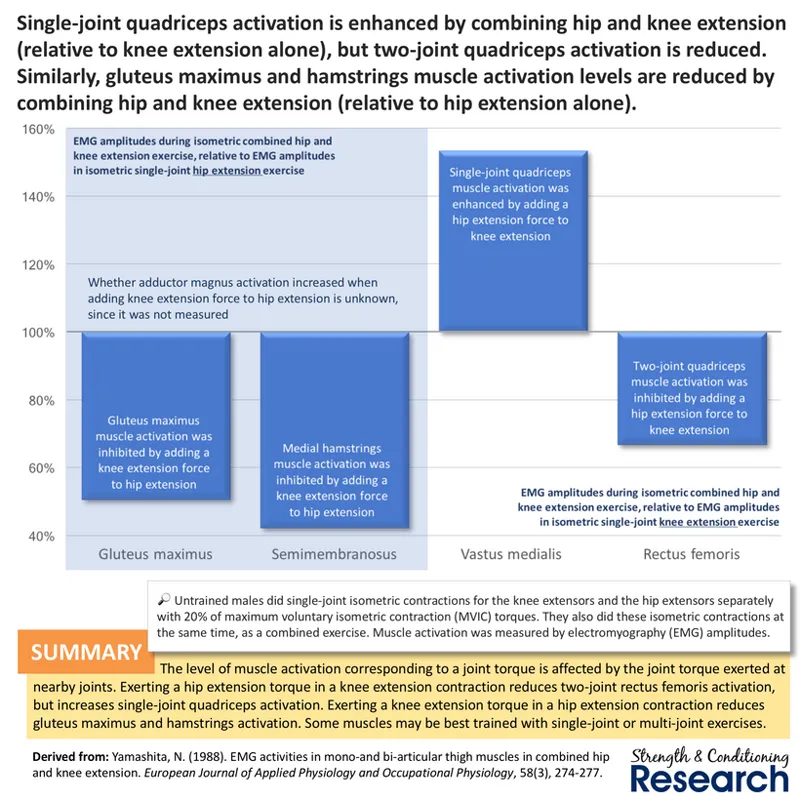
We know that two-joint muscles switch off when they are required to act as antagonists at one joint at the same time as agonists at the other joint. For example, the hamstrings and rectus femoris switch off in squat patterns compared to during single-joint hip extension and single-joint knee extension at the same joint angles. Thus, it seems likely that the hamstrings are more strongly activated in glute bridges when the knee is less flexed (such that the knee produces a net knee flexor torque) because they are not antagonists at the knee while trying to be agonists at the hip. Since hip thrusts and glute bridges usually involve a flexed knee (such that the knee produces a net knee extensor torque), we can predict that the hamstrings will be minimally active in both exercises.
.
Recent long-term studies show that the hamstrings are not activated enough to experience any hypertrophy during hip thrust strength training, even when performed by untrained individuals. This tells us that the hamstrings really are not activated very much at all and any apparent activation is most likely just cross-talk from the adductor magnus.
.
#2. What is the role of the quadriceps during hip thrusts and glute bridges?
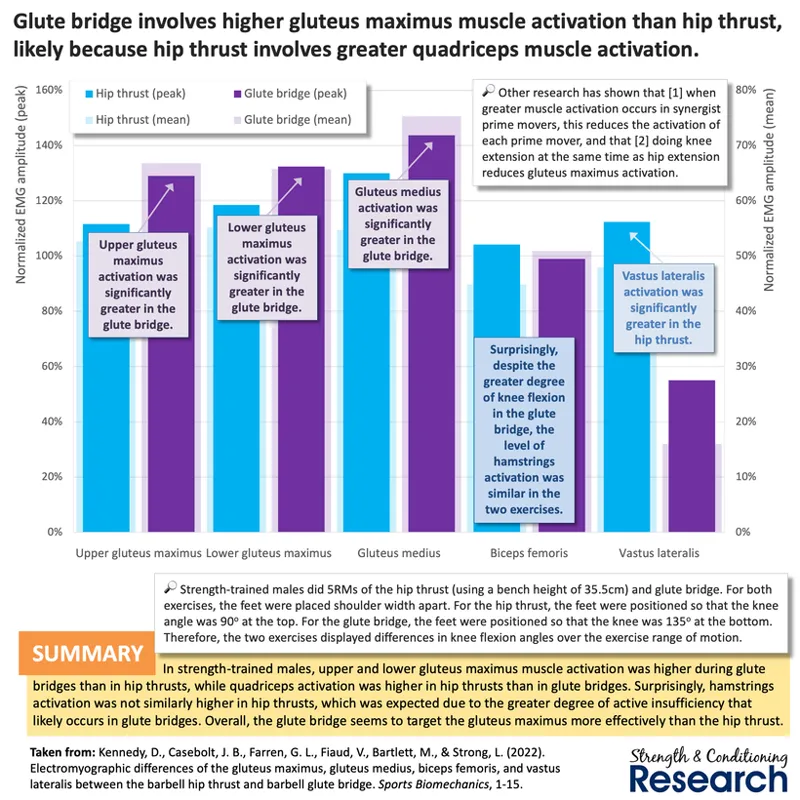
When comparing quadriceps activation between hip thrusts and glute bridges, we can see that the quadriceps are much more active in the hip thrust (in contrast to the hamstrings, which display very similar activation). This is likely because of the greater external knee extension moment arm length in the hip thrust, which requires more quadriceps muscle force. Interestingly, the hip thrust involves a lower level of gluteus maximus activation compared to the glute bridge. Why does this happen?
.
Importantly, since the hip thrust involves more quadriceps activation, it involves more total muscle mass than the glute bridge when lifting a barbell. This has a negative effect on our ability to achieve high levels of motor unit recruitment in the target muscle, which in this case is the gluteus maximus (read more).
.
Conclusions
The glute bridge and hip thrust are popular exercises for the gluteus maximus. Importantly, neither exercise displays high levels of hamstrings activation, and long-term studies show that this muscle group does not grow after strength training programs involving the hip thrust exercise. In contrast, there appears to be a large difference between the two exercise variations in respect of [1] quadriceps activation levels, with the hip thrust displaying a much higher activation level, and [2] gluteus maximus activation levels, with the glute bridge displaying a slightly higher activation level. It seems quite likely that quadriceps activation is higher in the hip thrust compared to in the glute bridge because the external moment arm length of the barbell on the knee joint is longer. Yet, this difference in quadriceps activation can also explain the relatively higher gluteus maximus activation in the glute bridge. Indeed, research has shown that when the total amount of muscle mass involved in an exercise is greater, the muscle activation level of each individual participating muscle is lower. Ultimately, each muscle requires some central motor command in order to experience motor unit recruitment. Yet, total central motor command is limited (because its copy signal, the corollary discharge, creates perceived effort in the brain and this necessarily cannot increase past our maximum tolerable perception of effort). Therefore, when more muscles require central motor command, this reduces the amount of central motor command that each of the participating muscles can receive.
Comments (5)
Interesting! So if hip flexion helps to target upper glutes more, it means that in seated hip abduction machine we should lean forward? I thought it was backwards
Chris, I noticed that in your workout examples you only programmed glute bridges and quadruped hip extensions, there are no hip abduction exercises. In your opinion, is this enough to fully develop glutes? It would be interesting to know why you do not program anything for glute medius: do glute bridges also train it? Also, second question would be, if bridges mostly train upper part of the gluteus maximus, then exercises that are hardest at long muscle lengths like lunges or deadlifts will train lower parts of it? Thank you, Chris!
There's an upcoming Patreon article about [1[]using hip abduction exercises, and also [2] about the upper gluteus maximus. Upper glutes are probably best trained using hip abduction in a hip flexed position.
Hello Chris - thanks - does this mean the seated hip abduction machine is a hypertrophy stimulating exercise for the gluteus maximus, posterior parts of the gluteus medius and minimus, and piriformis?
Yes, it's primarily going to target the upper gluteus maximus and certain parts of the gluteus medius.