




Gluteus maximus regions
Many muscles have multiple regions that can be trained with different exercises, according to their internal moment arm lengths. The gluteus maximus has two main regions (and many minor regions), which are most normally referred to as the upper (or anterior) and lower (or posterior) regions. Here is what we know about those regions and how to train them.
.
#1. The gluteus maximus is a very complex muscle with various regions
The gluteus maximus is a very complex muscle that can be subdivided into various regions. Some researchers have performed dissections in order to differentiate between the regions anatomically. Such analyses have found that there are at least seven major regions with varying origins that could potentially contribute to slightly different extents depending on hip joint angle and movement plane.
.
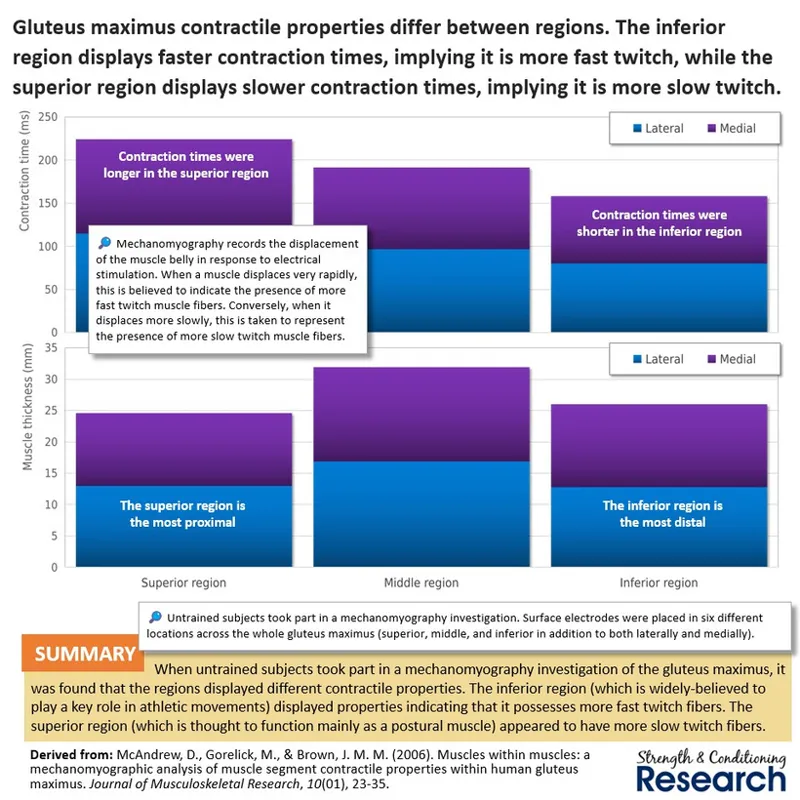
Other researchers have performed mechanomyography in order to differentiate between the muscle fiber type of the various regions. Such analyses have found that there are probably some differences between the medial and lateral areas as well as between the upper, middle, and lower regions. Most importantly, the upper region seems to contain more slow twitch muscle fibers (implying that it has more postural functions), while the lower part seems to contain more fast twitch muscle fibers (which implies that it has more athletic functions.
.
#2. The upper gluteus maximus is a hip abductor (especially with a flexed hip)
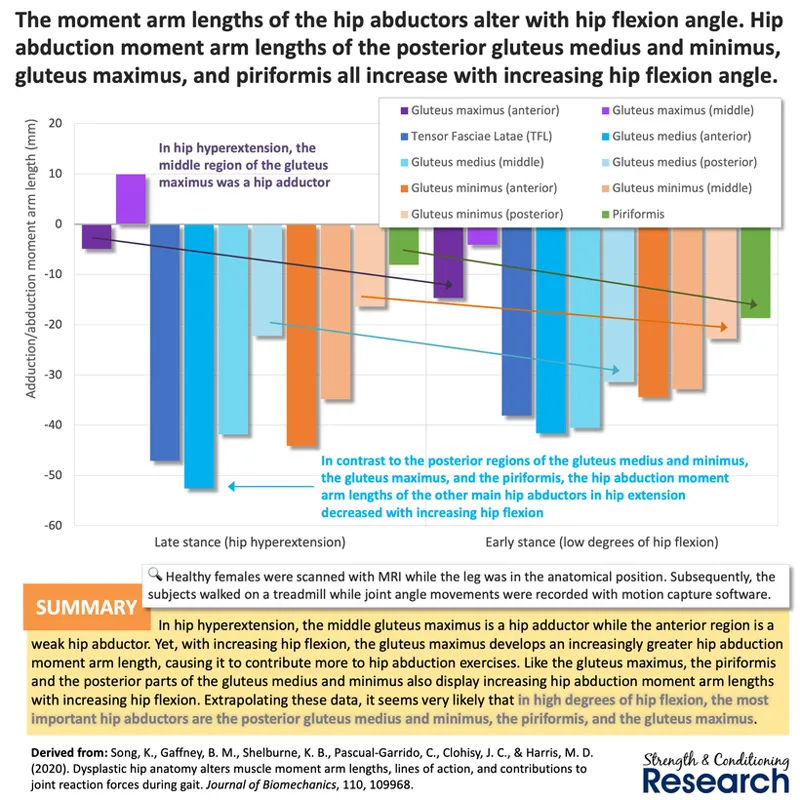
The upper gluteus maximus is a multi-functional region that can perform many different joint actions relatively well. Conventionally, it is regarding as having hip abduction functionality. This study is the only data that exists regarding the hip abduction leverage of the upper (anterior) gluteus maximus and it shows that the leverage increases with increasing hip flexion. It is noteworthy that the lower regions of the gluteus maximus (middle and posterior) do not have good hip abduction leverage whatsoever.
.
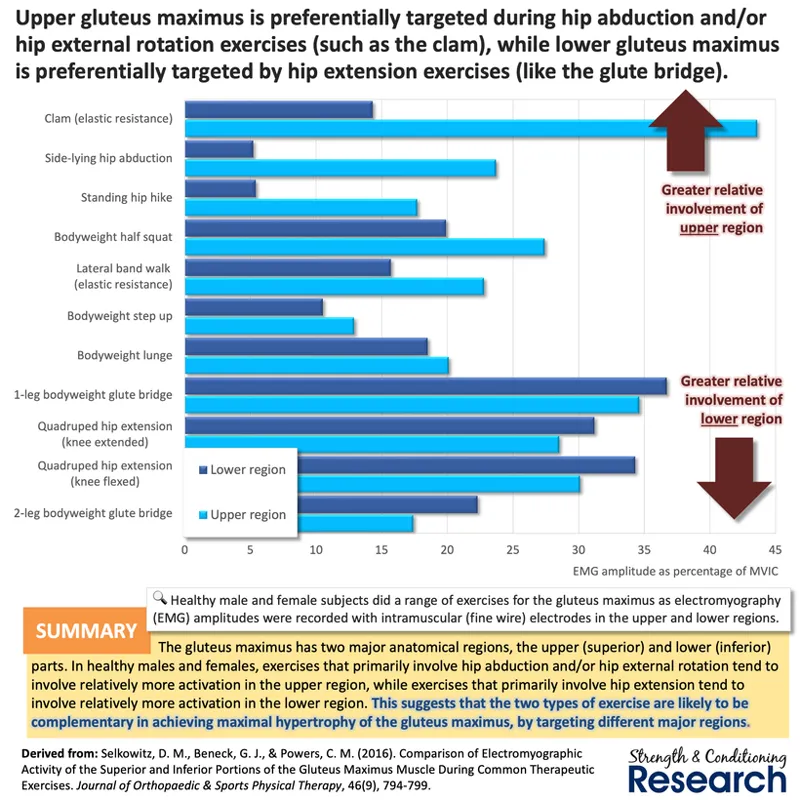
The muscle activation data confirm that the upper gluteus maximus is more strongly activated as a hip abductor in greater degrees of hip flexion. In contrast, the lower gluteus maximus has very poor ability to contribute to the hip abduction movement.
.
#3. The upper gluteus maximus is a hip external rotator (but only with an extended hip)
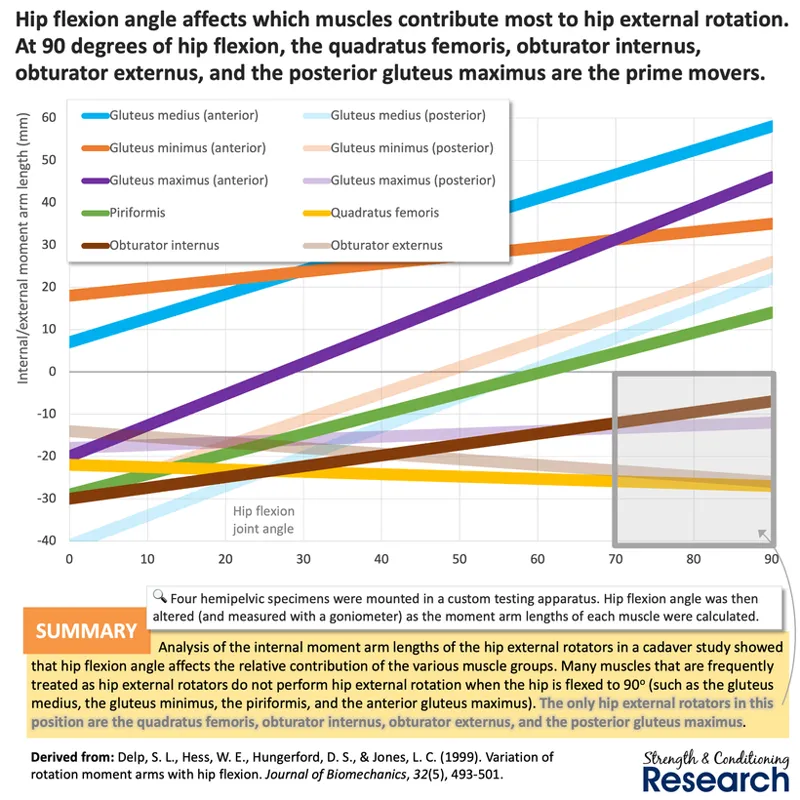
The upper gluteus maximus is a multi-functional region that can perform many different joint actions relatively well. Conventionally, it is regarding as having hip external rotation functionality. This study is the only data that exists regarding the hip external rotation leverage of the upper (anterior) gluteus maximus and it shows that we must maintain the hip in an extended position in order to make the upper (anterior) gluteus maximus contribute to hip external rotation. Even then, the lower (posterior) region will still contribute to much the same extent.
.
Nevertheless, the muscle activation data appear to show a greater contribution of the upper gluteus maximus to hip external rotation. Many exercises that involve an element of hip external rotation seem to involve greater levels of upper gluteus maximus activation than lower gluteus maximus activation.
.
#4. The lower gluteus maximus is a better hip extensor than the upper gluteus maximus
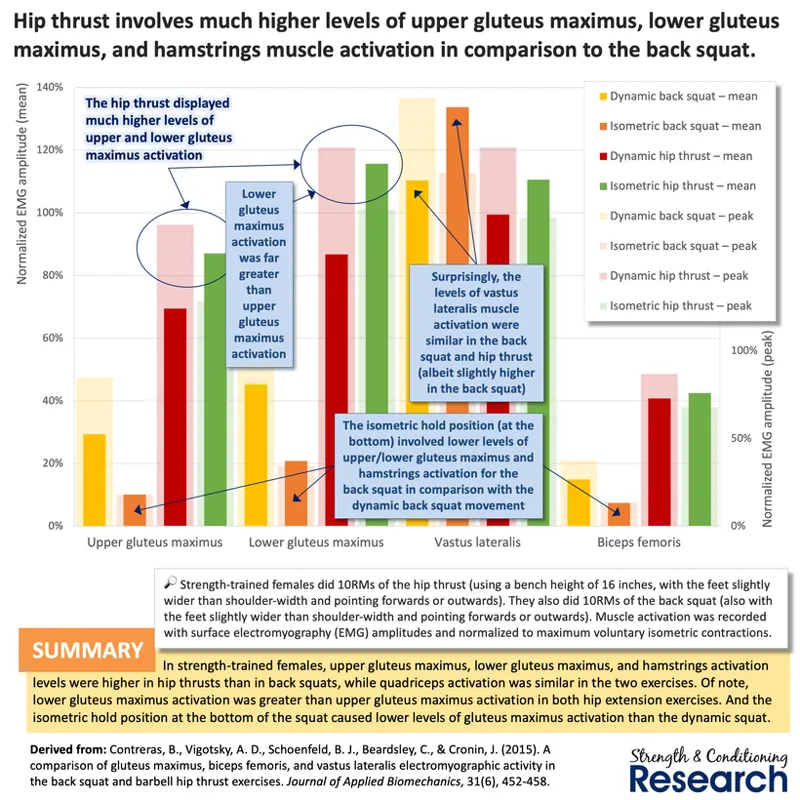
The lower gluteus maximus is a much better hip extensor than the upper gluteus maximus. During hip extension movements that involve the gluteus maximus to a large extent, the lower region is typically more strongly activated than the upper region. This has been noted in the hip thrust and back squat.
.
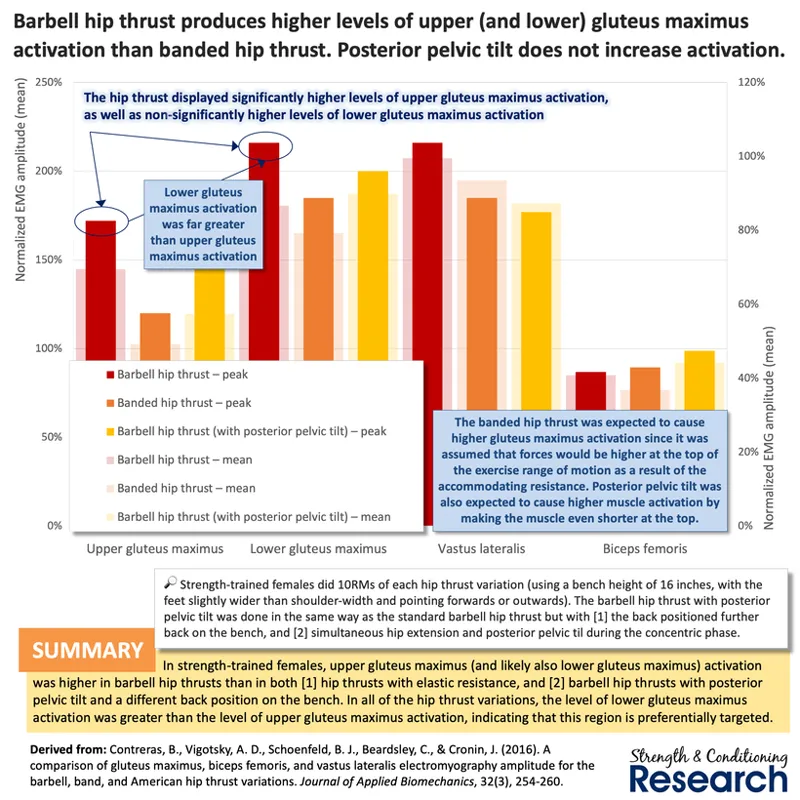
The exact same phenomenon has been reported when studying the different hip thrust variations.
.
Hip extension variations that involve the gluteus maximus are those that involve maximum leverage of that muscle relative to the other hip extensors. Obviously, this happens at full hip extension.
.
Muscle activation studies confirm this finding, showing that the gluteus maximus displays maximum levels of activation during hip extension isometric contractions when the hip is fully extended.
.
Conclusions
Many muscles have multiple regions that can be trained with different exercises, according to their internal moment arm lengths. The gluteus maximus quite likely has a number of regions that can be identified anatomically and by mechanomyography. Even so, there are two major regions: the upper region and the lower region. The upper region appears to contain more slow twitch fibers (which implies it is a more postural muscle) while the lower regions appears to contain more fast twitch muscle fibers (which implies it is involved more in athletic movements). As regards their functions, the upper gluteus maximus is a hip abductor and its leverage increases with increasing hip flexion (while the lower gluteus maximus does not have good hip abduction leverage). Hence, this region can be trained with seated hip abductions. The upper gluteus maximus is also a hip external rotator but only when the hip is fully extended (while the lower gluteus maximus is a hip external rotator irrespective of hip flexion angle). Hence, this region can be trained with clam shell exercises but only when in an extended hip position Finally, the lower gluteus maximus appears to be a better hip extensor than the upper gluteus maximus, at least when comparing the available muscle activation data. It has the best leverage in the fully extended hip position. Thus, this region can be trained easily with glute bridges and hip thrusts.
Comments (1)
Did you mean the superior and inferior regions of the glute max? (Referring to the introduction of the article)