









Sarcomere lengths
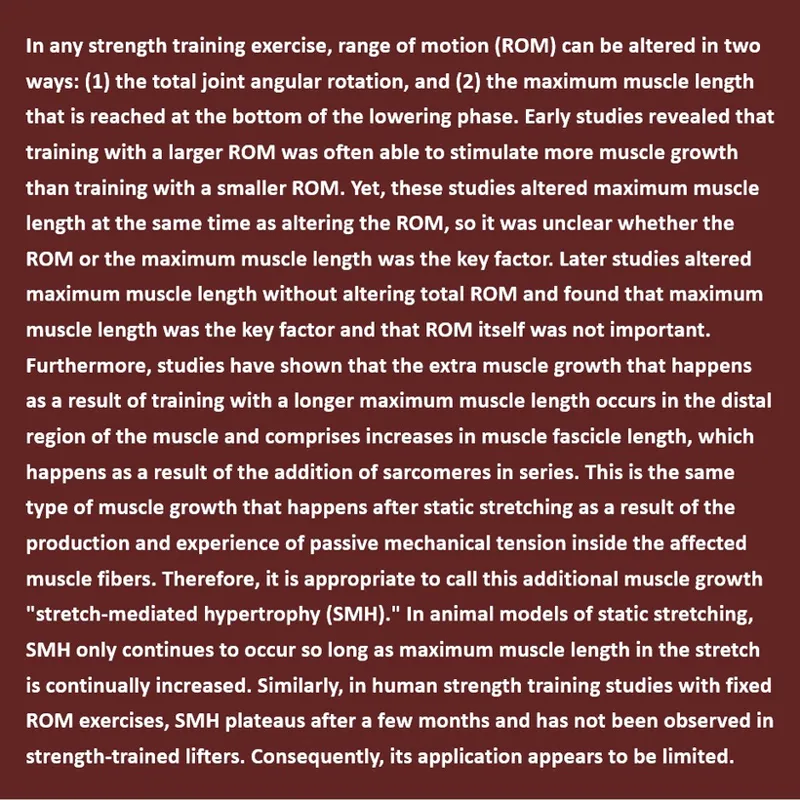
Strength training with a larger range of motion (ROM) or an exercise that a longer maximum muscle length often (but not always) produces greater muscle growth than strength training with exercises that have a smaller ROM or which reach a shorter maximum muscle length. Why does this variation between muscle groups exist?
.
#1. Effects of maximum muscle length on hypertrophy
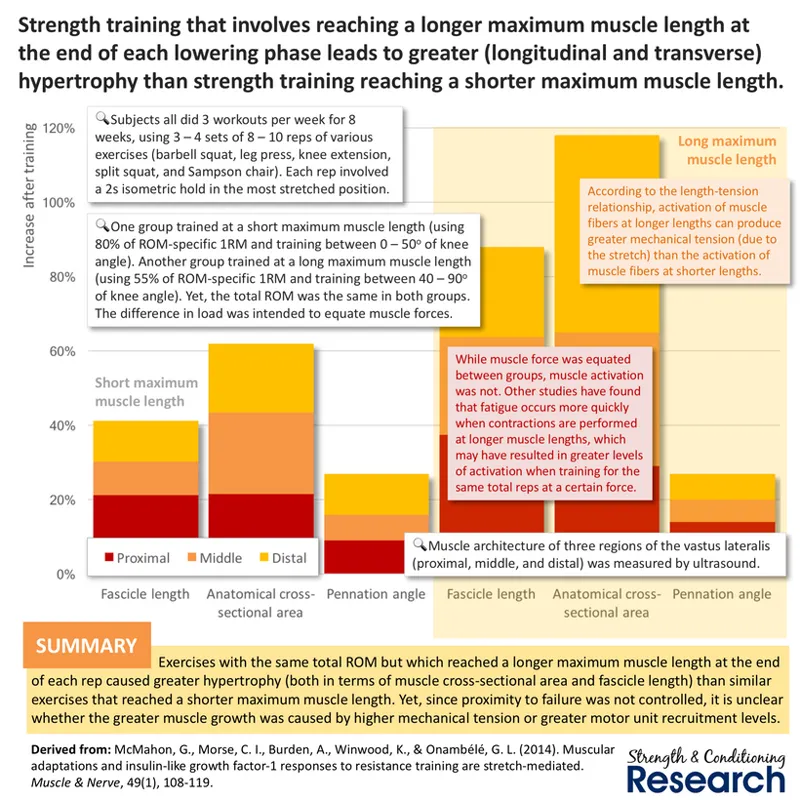
Many studies have shown that strength training with exercises that reach longer maximum muscle lengths can enhance the amount of muscle growth achieved. Additionally, they have revealed that the additional muscle growth takes the form of new sarcomeres being added in series, as measured by an increase in muscle fascicle lengths (read more).
.
#2. Effects of sarcomere length on sarcomerogenesis
The sarcomerogenesis literature has shown that sarcomere length is the driver of sarcomere addition. So muscle fibers will only add sarcomeres if their sarcomeres are stretched to the required threshold length such that enough passive mechanical tension is generated to stimulate sarcomere addition. Whether a sarcomere is stretched to this point obviously depends upon its starting length when the muscle fiber is at rest, and this in turn depends on the number of sarcomeres that are already in series in the working muscle fiber (read more).
.
#3. Quadriceps sarcomere lengths
Most studies have reported that the quadriceps muscles display greater overall hypertrophy after being trained at longer muscle lengths, which suggests that the passive tension produced at these longer muscle lengths is meaningful.
.
Additionally, most studies have reported that the quadriceps display greater increases in muscle fascicle length after being trained at longer muscle lengths, which also suggests that the passive tension produced at these longer muscle lengths is meaningful. Increases in muscle fascicle length can only be stimulated by the presence of passive tension, with the signaling responses being initiated by the elongation of the stiff segment of titin.
.
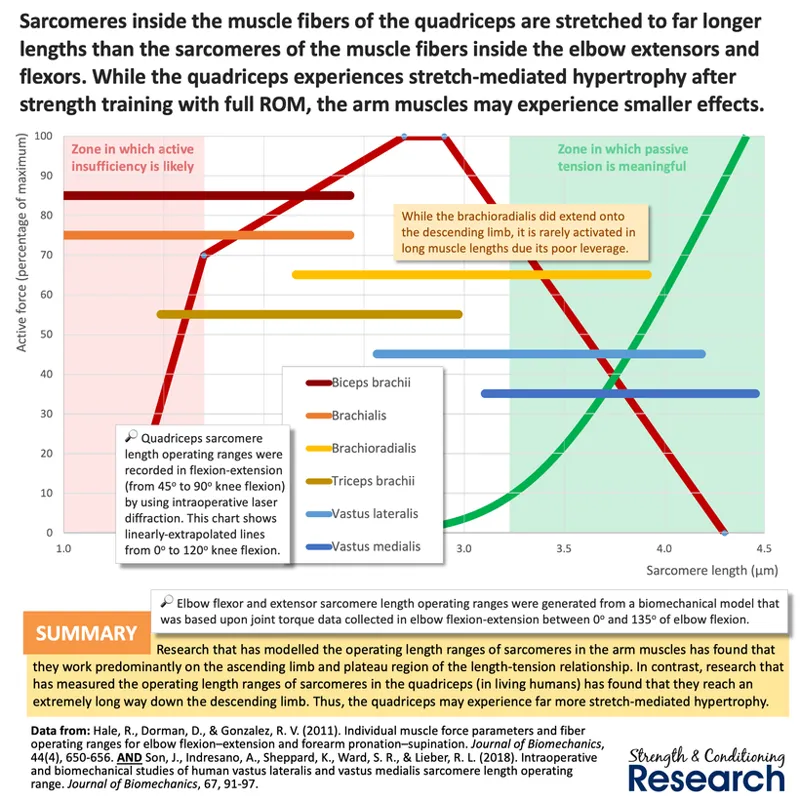
While not all studies of sarcomere lengths have reported that quadriceps muscle sarcomere lengths extend onto the descending limb of the length-tension relationship, the most recent ones with the best methodology do in fact indicate that they extend a very long way down the descending limb.
.
#4. Triceps brachii sarcomere lengths
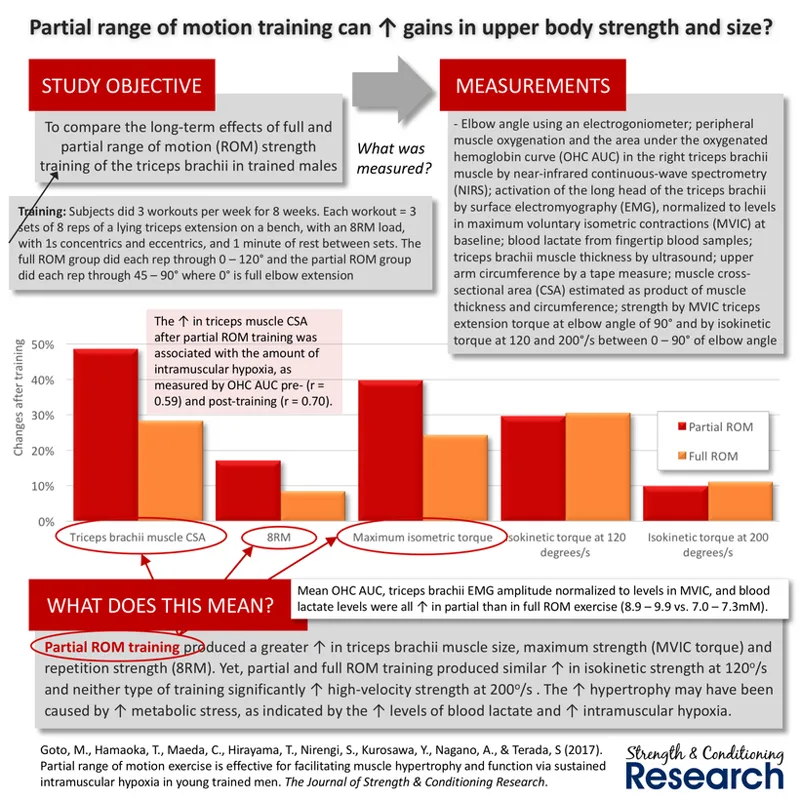
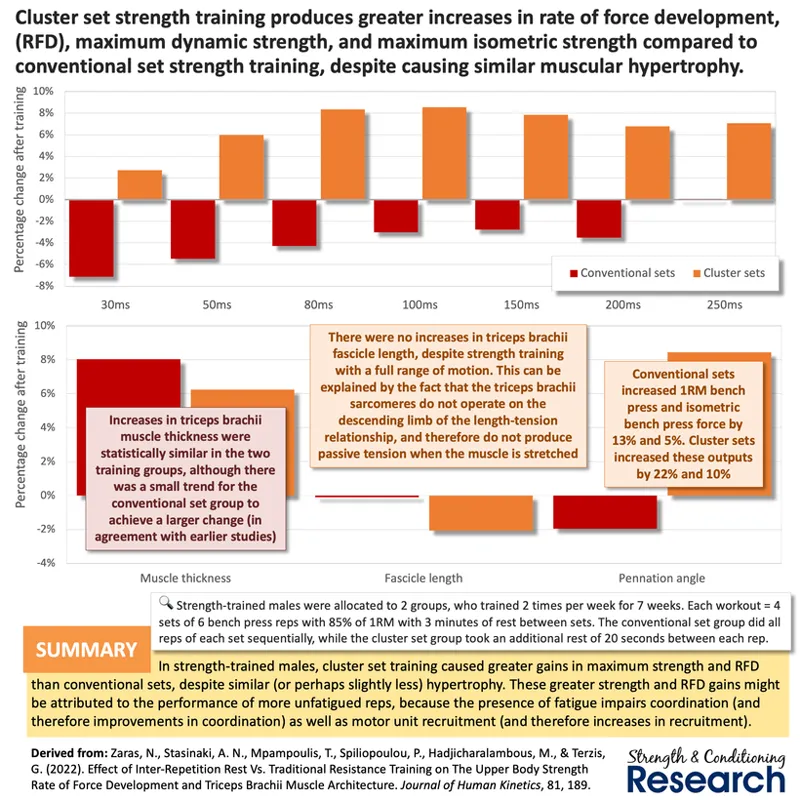
In contrast to the quadriceps, most studies have reported that the triceps brachii do not display greater hypertrophy after being trained at longer muscle lengths, which suggests that the passive tension generated is not very meaningful.
.
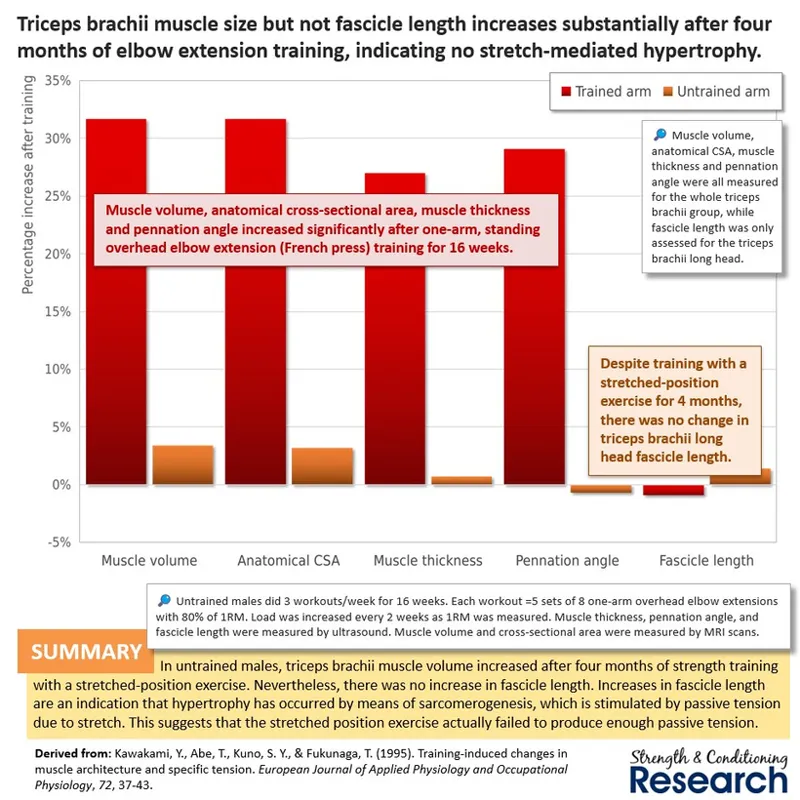
Also, research shows that the triceps brachii long head does not display greater increases in muscle fascicle length after being trained at longer muscle lengths, which also suggests that the passive tension produced at these longer muscle lengths is not meaningful (and is a better way of confirming that the passive tension is not substantially greater when working at longer muscle lengths).
.
Indeed, it is a consistent finding across the entire literature that the triceps brachii long head does not display any meaningful increases in muscle fascicle length after strength training with an overhead, stretched-position exercise.
.
In fact, every single study that has ever measured triceps brachii fascicle lengths has reported exactly the same finding, which is no increases whatsoever.
.
While not all studies of sarcomere lengths have reported that triceps brachii muscle sarcomere lengths fail to extend very far onto the descending limb of the length-tension relationship, there are indications that the sarcomeres of this muscle group do in fact work predominantly on the plateau region.
.
#5. Biceps brachii sarcomere lengths
Similarly, studies have reported that the biceps brachii does not display greater hypertrophy after being trained at longer muscle lengths, which suggests that the passive tension produced at these longer muscle lengths is not very meaningful.
.
Additionally, when inter-set stretching is tested, it is capable of causing some extra muscle growth in the quadriceps but not in the biceps brachii (or triceps brachii) muscles.
.
While not all studies of sarcomere lengths have reported that biceps brachii sarcomere lengths fail to extend very far onto the descending limb of the length-tension relationship, there are indications that the sarcomeres of this muscle group do in fact work predominantly on the ascending limb and hence do not achieve much passive mechanical tension even at maximum muscle lengths.
.
#6. Hamstrings sarcomere lengths
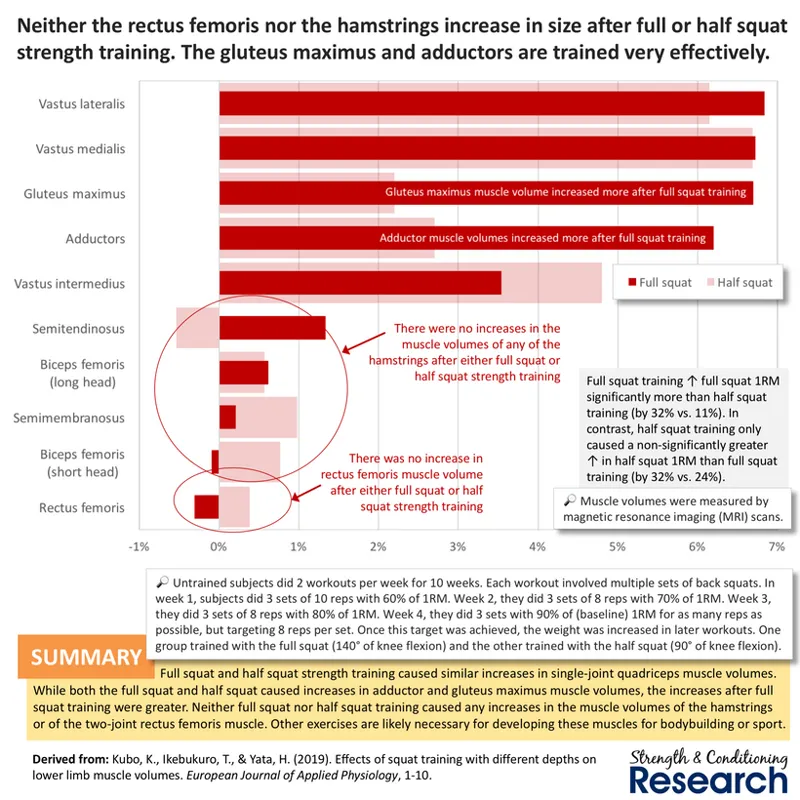
The hamstrings certainly experience a large amount of stretch-mediated hypertrophy when they are trained at long muscle lengths. This predicts that the sarcomeres of this muscle group also extend a long way down onto the descending limb of the length-tension relationship.
.
Recent investigations have confirmed that the hamstrings do achieve quite long sarcomere lengths at end ranges of motion during relevant exercises, with the semimembranosus being the most affected.
.
#7. Gluteus maximus sarcomere lengths
Currently, we have data showing that the gluteus maximus experiences a large amount of stretch-mediated hypertrophy when it is trained at long muscle lengths. This predicts that its sarcomeres extend a long way down onto the descending limb of the length-tension relationship, but we do not have the sarcomere length measurements to confirm that.
.
Conclusions
Strength training with a larger range of motion (ROM) or with exercises that reach a longer maximum muscle length often (but not always) produces greater muscle growth compared to strength training with exercises that have a smaller ROM or which reach a shorter maximum muscle length. So why do some muscle groups display this effect, while others do not? The extra muscle growth caused by reaching a longer maximum muscle length (which is called "stretch-mediated hypertrophy") is stimulated by passive mechanical tension and is formed by adding new sarcomeres. The sarcomerogenesis literature has shown that sarcomere length is the driver of sarcomere addition. Muscle fibers only add new sarcomeres if their sarcomeres are stretched to the required threshold length such that sufficient passive mechanical tension is generated to stimulate sarcomere addition. Whether the sarcomeres of a muscle are stretched to this point can be estimated by reviewing the length-tension relationship (LTR) of its muscle fibers. The sarcomere lengths of the quadriceps and hamstrings clearly reach the descending limb of the LTR and therefore likely produce sufficient passive mechanical tension to stimulate sarcomere addition in strength training exercises. Long-term training studies have confirmed that this is indeed the case. The sarcomere lengths of the biceps brachii and triceps brachii do not reach the descending limb of the LTR and so do not produce enough passive mechanical tension to stimulate sarcomere addition in strength training exercises. Long-term training studies have again confirmed that this is indeed the case.


Comments (3)
Professor, in the study by Sato et al. (2021) the biceps brachii responded better (hypertrophy) when it was stimulated in greater stretching. I've read some of your writing suggesting that most of your biceps muscle fibers are unlikely to experience any stretch-mediated hypertrophy during normal strength training or even as a result of stretching between sets. So, I would like to know your position on this study. doi: 10.3389/fphys.2021.734509.
I discuss this study (and the others) in the new podcast here: https://www.patreon.com/posts/podcast-1-80832172
Really good article! Thank you!