






Range of motion
One of the most common recommendations in the fitness industry when training for hypertrophy is to do reps with a larger range of motion (ROM). Yet, it is probably the longer maximum muscle length that produces the superior muscle growth, and not the larger ROM, and then only in certain muscles and in untrained individuals. For this reason, the extra hypertrophy produced by training with either a larger ROM or a longer maximum muscle length is called "stretch-mediated hypertrophy."
.
#1. What causes the extra hypertrophy: maximum muscle length or ROM?
In any strength training exercise, ROM can be altered in two ways: (1) the total joint angular rotation, and (2) the maximum muscle length that is reached at the bottom of the lowering phase.
.
Most early studies that assessed the effects of ROM actually changed both of these factors at the same time, by using a partial ROM variation that stops at a shorter maximum muscle length. Therefore, such studies do not really allow us to say which factor is stimulating the greater hypertrophy (the total ROM or the maximum muscle length).
.
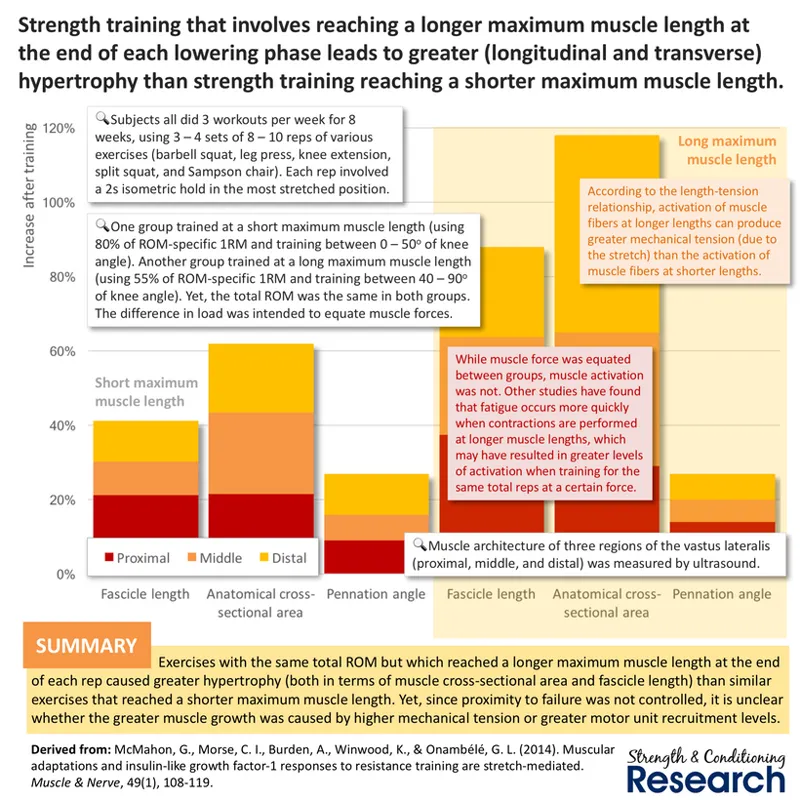
More recent studies have tested the effects of maximum muscle length separately from ROM. This has allowed us to determined that the maximum muscle length is the responsible factor and not the ROM.
.
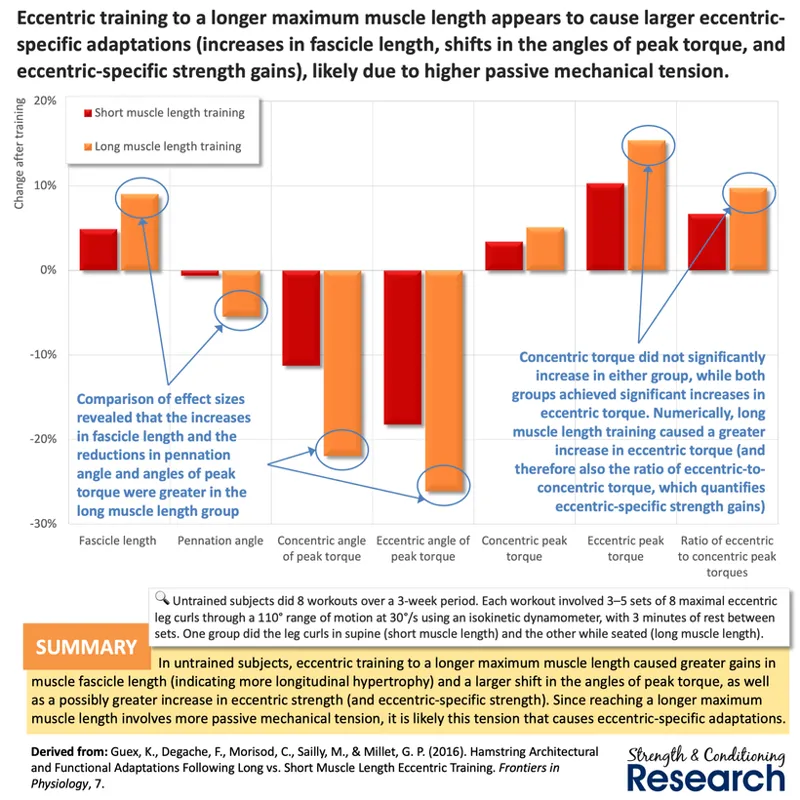
Two-joint muscles are a useful source of information about whether maximum muscle length or ROM is responsible for the extra hypertrophy caused by training with greater ROM, because the maximum muscle length can very easily be altered at one joint while ROM is maintained the same at the other joint. For example, leg curls can be done lying (with short hamstrings) or seated (long hamstrings).
.
Similarly, knee extensions can be done with the seat upright (with a short rectus femoris) or inclined (with a long rectus femoris). In both cases, training with a longer two-joint muscle caused more muscle growth to happen.
.
#2. What causes the extra hypertrophy: sarcomeres or myofibrils?
Studies examining the effects of maximum muscle length have often reported that training with a longer maximum muscle length tends to cause preferential distal region hypertrophy, which is often taken to be a marker of increased sarcomeres in series.
.
Studies have also reported that training with a longer maximum muscle length tends to cause more fascicle length increases, which is certainly a marker of increased sarcomeres in series.
.
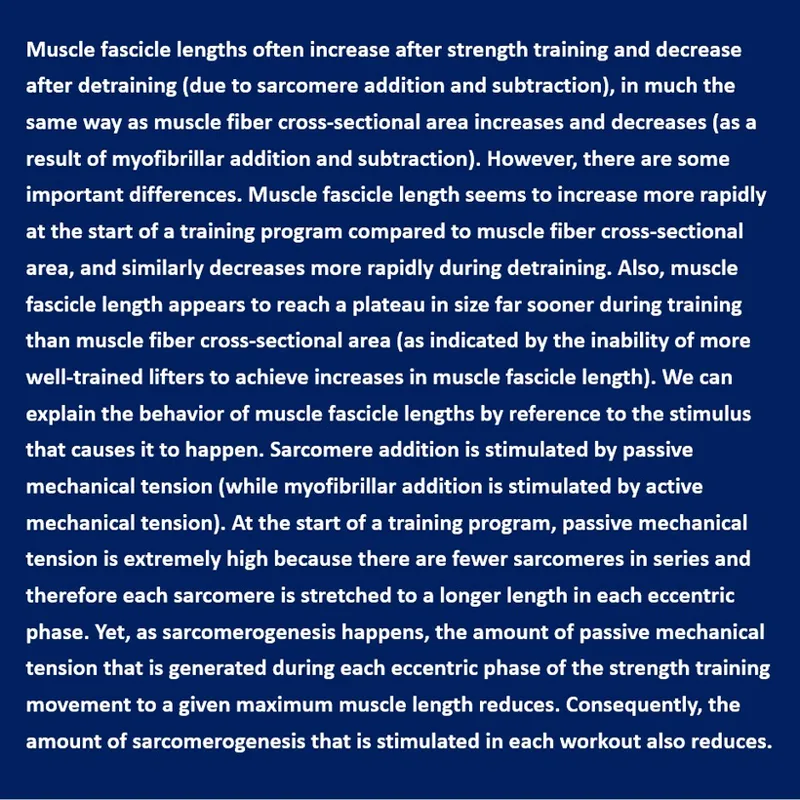
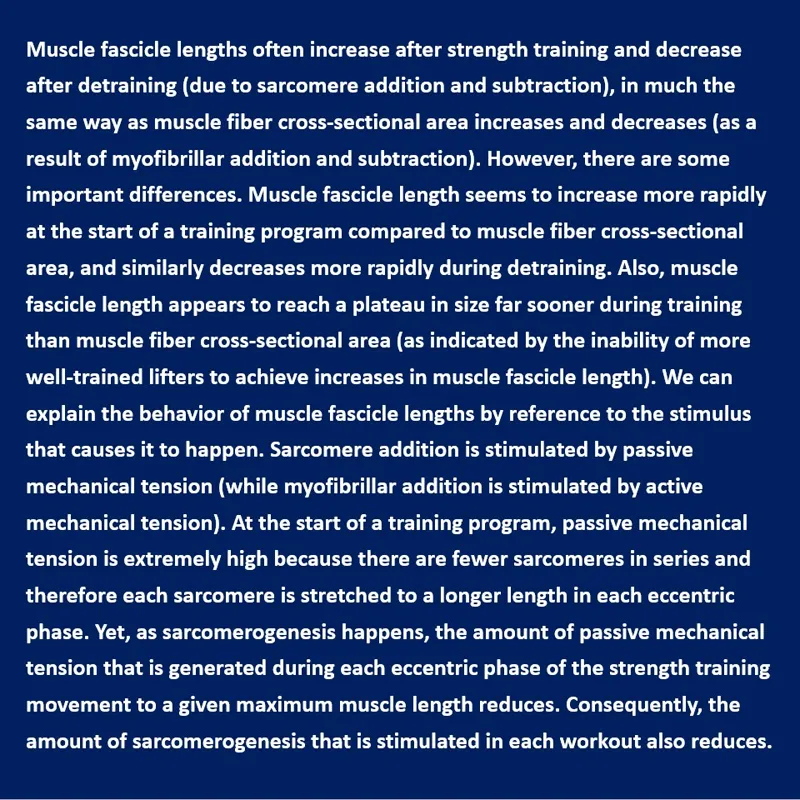
Indeed, a review of the underlying mechanisms has revealed that the extra hypertrophy (that we now call "stretch-mediated hypertrophy") only involves an increase in muscle fascicle length by adding new sarcomeres and does not involve an increase in muscle fiber cross-sectional area by the addition of new myofibrils (read more).
.
#3. Can the extra hypertrophy happen in trained lifters?
Given that increases in muscle fascicle length stop happening after a relatively short period of time (probably between 3-6 months), it is unlikely that stretch-mediated hypertrophy will happen in more well-trained lifters (read more).
.
#4. Can the extra hypertrophy happen in all muscle groups?
Not all muscle groups display stretch-mediated hypertrophy. Some muscle groups (like the triceps brachii) have been trained repeatedly with stretched-position exercises and have not produced any increases in muscle fascicle length and similarly have not displayed greater overall increases in muscle mass as a result of being trained in that stretched position. This is probably because the sarcomeres inside their muscle fibers are not elongated sufficiently to produce a meaningful amount of passive mechanical tension (read more).
.
Conclusions
In any strength training exercise, range of motion (ROM) can be altered in two ways: (1) the total joint angular rotation, and (2) the maximum muscle length that is reached at the bottom of the lowering phase. Early studies revealed that training with a larger ROM was often able to stimulate more muscle growth than training with a smaller ROM. Yet, these studies altered maximum muscle length at the same time as altering the ROM, so it was unclear whether the ROM or the maximum muscle length was the key factor. Later studies altered maximum muscle length without altering total ROM and found that maximum muscle length was the key factor and that ROM itself was not important. Furthermore, studies have shown that the extra muscle growth that happens as a result of training with a longer maximum muscle length occurs in the distal region of the muscle and comprises increases in muscle fascicle length, which happens as a result of the addition of sarcomeres in series. This is the same type of muscle growth that happens after static stretching as a result of the production and experience of passive mechanical tension inside the affected muscle fibers. Therefore, it is appropriate to call this additional muscle growth "stretch-mediated hypertrophy (SMH)." In animal models of static stretching, SMH only continues to occur so long as maximum muscle length in the stretch is continually increased. Similarly, in human strength training studies with fixed ROM exercises, SMH plateaus after a few months and has not been observed in strength-trained lifters. Consequently, its application appears to be limited.


Comments (9)
Hello, Chris! I have a few questions related to range of motion and muscle training. 1. If triceps do not benefit from stretch mediated hypertrophy, and concentric training or partial rep training causes less fatigue, is there a point in changing triceps extension resistance profile by standing further away from the cable machine so that we would train mostly at short muscle lengths? 2. If biceps also do not grow more from stretch mediated hypertrophy, why then the study showed more biceps hypertrophy from partial reps at long muscle lengths vs short? Is that because of neuromechanical matching? 3. We know from Kuba 2019 that full squats are better than partial squats for gluteus development. But what about leaned forward squats or lunges where you keep your shins as vertical as possible (as in romanian deadlifts but with more bent knees) to eliminate quad involvement? Would that be more beneficial for gluteus maximus? 4. Based on principle of neuromechanical matching we know that some muscle groups benefit from different resistant profiles. For example, we know that triceps medial and lateral heads are better recruited when using resistance bands for making the top portion of the lift harder (like in close grip or JM press) but I remember you saying that if we use resistance bands on leg press the failure point of the lift is the same as not using it so there is no additional motor unit recruitment. How is banded JM press different from banded leg press then? Hope my questions are clear! regards.
(1) there could be differences in hypertrophy between regions of the triceps by training at different joint angles, but overall I suspect that the best way to do single-joint triceps exercises is to target the long head by performing them in shoulder extension and with peak forces in more flexed elbow positions (as in the standard standing cable pushdown).
Understood Chris. Appreciate the honesty. Looking forward to more of your work. Have a blessed new year :-)
Appreciate the reply Chris. What about the effect of sleep debt on strength gains? Recently there was research by Bret Contreras indicating that the optimal amount of sleep per night is 7hours, not 9 hours. What is your perspective on this?
I haven't done a lot of work myself in understanding the relationship between sleep and strength gains. There is a reasonable amount of research showing that sleep deprivation impairs workout performance by causing (supraspinal) CNS fatigue through inflammatory signaling. Not sure what the mechanism would be for excess sleep, but I will keep my eyes open for any new literature.
Chris, even though it's not related to this post, I have a question regarding strength gains (both low velocity and high velocity). How far away from failure should we be for each set? This is because research has shown that it's important to stay far away from failure to optimise recovery. I.e. what is the ideal rpe for each set? Is rpe6 ever effective for maximising strength gains? Or is rpe8 the most effective? And if we stay far away from failure from each set. This affects the number of stimulating reps that we get from each set. Does this mean we have to do more sets to make up for it? Looking forward to your reply, Chris. Merry Christmas!
Yes, a closer proximity to failure in each set tends to cause greater sustained fatigue after the workout (although this effect is larger with lighter loads than with heavier loads). Equally, the total number of stimulating reps per set is reduced by stopping sets before reaching failure. Therefore, there is probably an optimal number of reps to stop before failure, to balance the hypertrophic and fatiguing effects of a set. This number is likely different depending on the load used, even when working with traditional bodybuilding weights: we can probably train closer to failure when working with moderately-heavy (5–10RM) loads than with moderately-light (11-15RM) loads. Exactly what proximity to failure is ideal will also vary depending on the individual, since some people are more susceptible to sustained fatigue than others, but I would expect that working in the 1-2RER range would have the best balance of effects, most of the time.
Great article. If I perform the bench press without allowing my elbow to descend below the shoulder with 200 load will that yield less hypertrophy than allowing my elbow to descend further, stretching the pectoral, with 175 load? So does the load matter alongside muscle length? Thaks!
It depends upon the proximity to failure in each case. If training to failure in both cases, then training with greater ROM will produce greater hypertrophy for most muscles in most exercises (but not all, as I explained in the previous article about passive tension).