


Regional muscle damage
Muscle fibers are damaged during strength training exercise. Interestingly, not every muscle fiber in a muscle is damaged equally and the muscle fibers in some regions are usually damaged to a greater extent than the muscle fibers located in other regions.
.
#1. Evidence of regional muscle damage
Regional muscle damage has been observed after aerobic exercise, such in the hamstrings after long distance running. This damage is typically recorded by reference to functional magnetic resonance imaging (fMRI) scans to detect muscle fiber swelling.
.
Regional muscle damage has been observed using the same technology after strength training exercise, such in the quadriceps muscles after knee extensions and squats. Importantly, the locations within the muscle in which damage is most pronounced differ between exercises. Some exercises cause more damage in some regions, while other exercises cause more damage in other regions.
.
#2. Causes of regional muscle damage
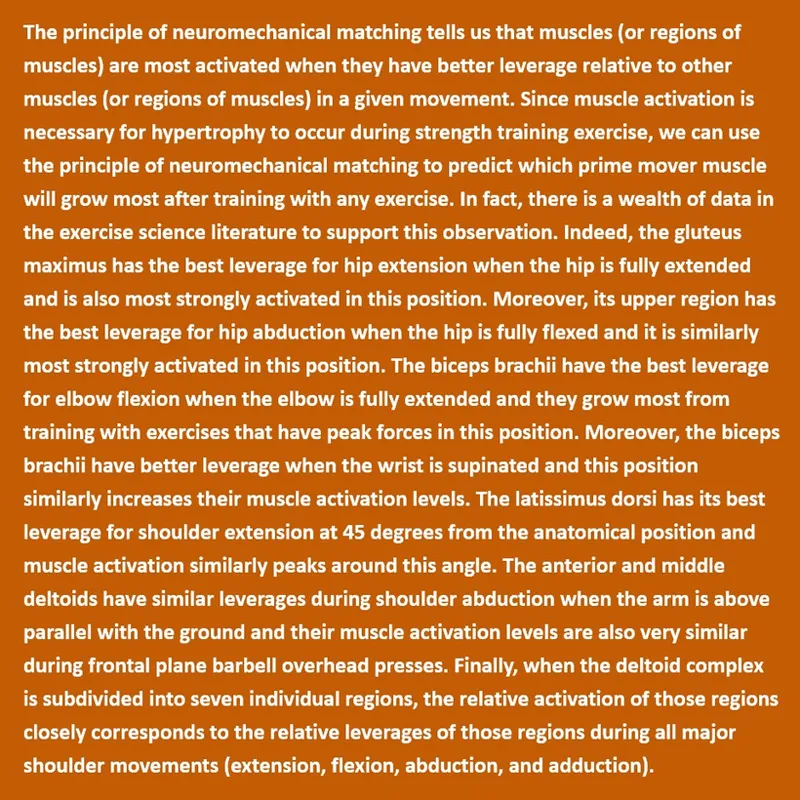
The regional damage that occurs after exercise is likely the result of [1] regional muscle activation, [2] differences in muscle architecture between regions, and [3] differences in muscle fiber type proportion between regions. Different exercises activate different regions of a muscle as a result of the principle of neuromechanical matching (read more).
.
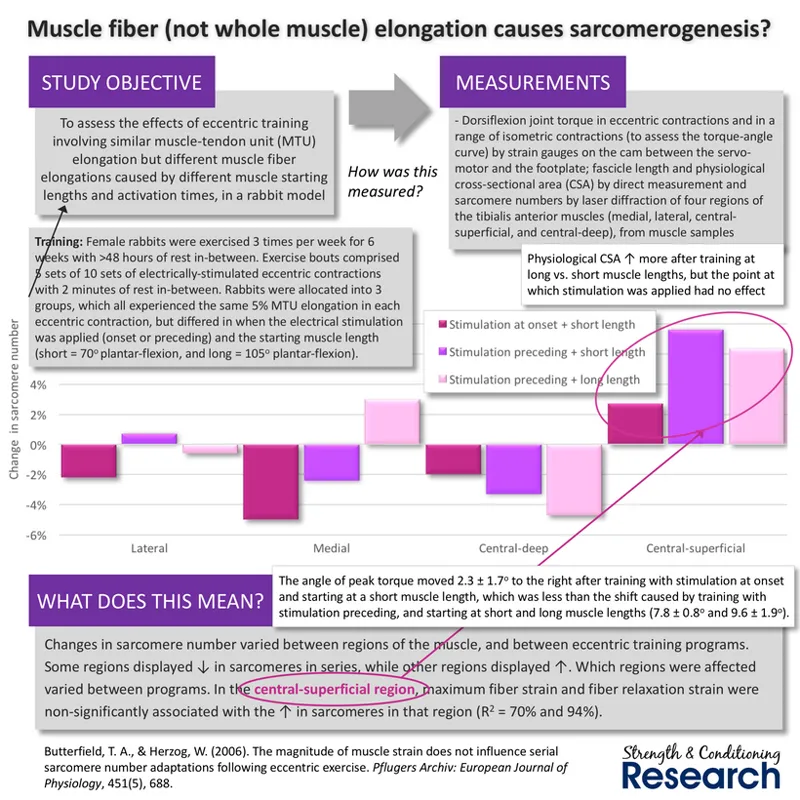
Muscle architecture varies between regions. This means that the muscle fibers in one region of a muscle lengthen more than those in another region during an eccentric contraction of the whole muscle. Muscle fiber lengthening affects the amount of calcium ion influx into the muscle fibers through stretch-activated ion channels.
.
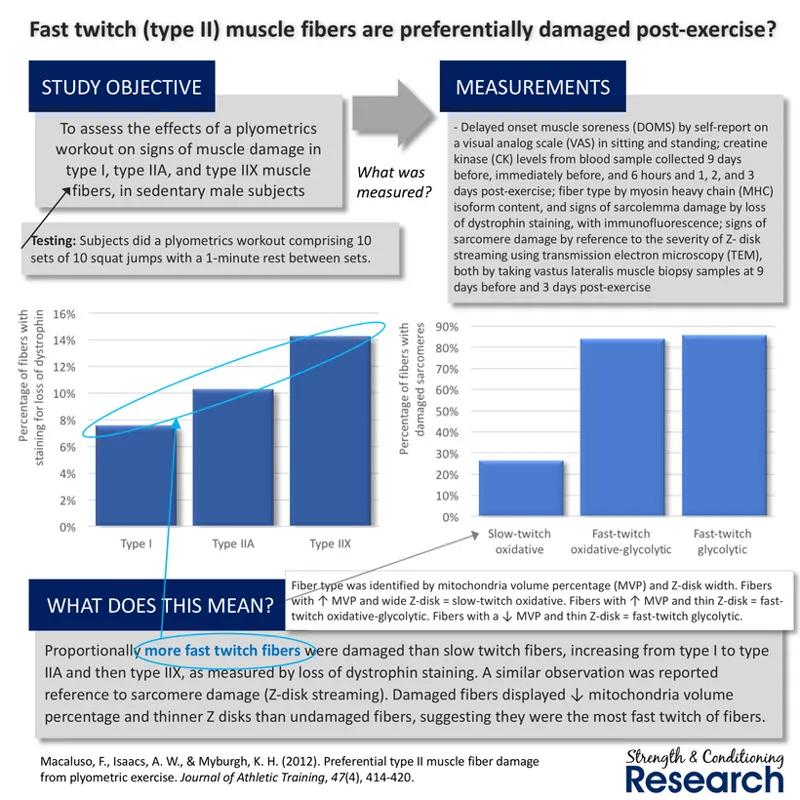
Muscle fiber proportion can vary between regions. Since fast twitch muscle fibers are much more susceptible to damage than slow twitch muscle fibers, this means that there can easily be differences in damage between regions.
.
Conclusions
Muscle fibers are damaged during and after exercise. Yet, not every muscle fiber in a muscle is damaged equally. Muscle fibers in some regions are usually damaged to a greater extent than muscle fibers in other regions. This observation has been made after aerobic exercise and strength training. The regional damage that occurs after exercise is likely the result of [1] regional muscle activation, [2] differences in muscle architecture between regions, and [3] differences in muscle fiber type between regions. Regional muscle activation can occur when using a specific exercise due to the principle of neuromechanical matching. Muscle fibers are damaged principally in response to calcium ion influx subsequent to activation, so differences in activation between regions will affect the amount that each region is damaged. Muscle architecture varies between regions and means that the muscle fibers in one region of a muscle lengthen more than those in another region during an eccentric contraction of the whole muscle. Muscle fiber lengthening similarly affects the amount of calcium ion influx albeit in this case through the stretch-activated ion channels. Muscle fiber proportion can vary between regions. Since fast twitch fibers are more susceptible to damage than slow twitch fibers, this means that there can be differences in damage between regions. Yet, only regional muscle activation varies with exercise selection, making it the only mechanism that can be voluntarily manipulated. Training programs that involve the same exercise for a muscle group in every workout may therefore cause highly localized muscle damage. Programs that involve rotating between multiple exercises for the same muscle group likely spread muscle damage out across a wider area.

Comments (6)
Hi Chris - would you expect different locations of muscle damage for the Biceps Brachii by loading different parts of Elbow Flexion? Let´s say one exercise is loading 10-20 degree and another is loading 60-70 degree of elbow flexion.
Probably not, but I would expect different locations of muscle damage after training the biceps brachii by [1] elbow flexion, and [2] shoulder flexion.
Great article - is this supporting the notion of training a muscle from different angles? I hear this in the gym from trainers. Chris ultimately will this make a muscle volume difference long term? Or do you suspect that eventually untapped motor units will have to be recruited once the ideal neuromechanical match has hypertrophied? Thanks
Yes, so long as (1) the muscle does have distinct regions (and not all of them do), and (2) the exercises are biomechanically different and don't just look different (many exercises look different but actually put the load onto the same regions of the muscle – a good example of this would be biceps curls. Most biceps curls load exactly the same parts of the elbow flexors).
Does this support the idea of biasing exercises and maybe periodizing? e.g. training back with arms close rib cage (better leverages) and combine with arms in abduction for less leverage
Yes, definitely. I often give the example of training the latissimus dorsi (which is very clearly divided into three anatomical sections – superior, middle, and inferior). The inferior and middle regions are trained more by frontal plane shoulder adductions like lat pull-downs and pull-ups, while the superior region is trained more by sagittal plane shoulder extensions like narrow-grip rows. Alternating these back exercises is a good way to reduce fatigue within a training week.