








The principle of neuromechanical matching
The principle of neuromechanical matching tells us that muscles (or regions of muscles) are most strongly activated when they have better leverage than other muscles (or regions of muscles) for a given movement. Since muscle activation is necessary for hypertrophy to occur, we can further predict that muscles will grow more when they are trained with exercises that involve peak forces where they have better leverage than other muscles that work at the same joint. Therefore, we should expect correspondence between three variables: [1] internal moment arm lengths, [2] muscle activation levels, and [3] hypertrophy. Here are a number of examples of correspondences between these three variables.
.
#1a. Gluteus maximus (out of the hip extensors)
Three muscle groups can contribute to hip extension: the gluteus maximus, the hamstrings, and the adductor magnus. Research into the internal moment arms of these muscle groups has shown that the gluteus maximus has its best leverage when the hip is fully extended.
.
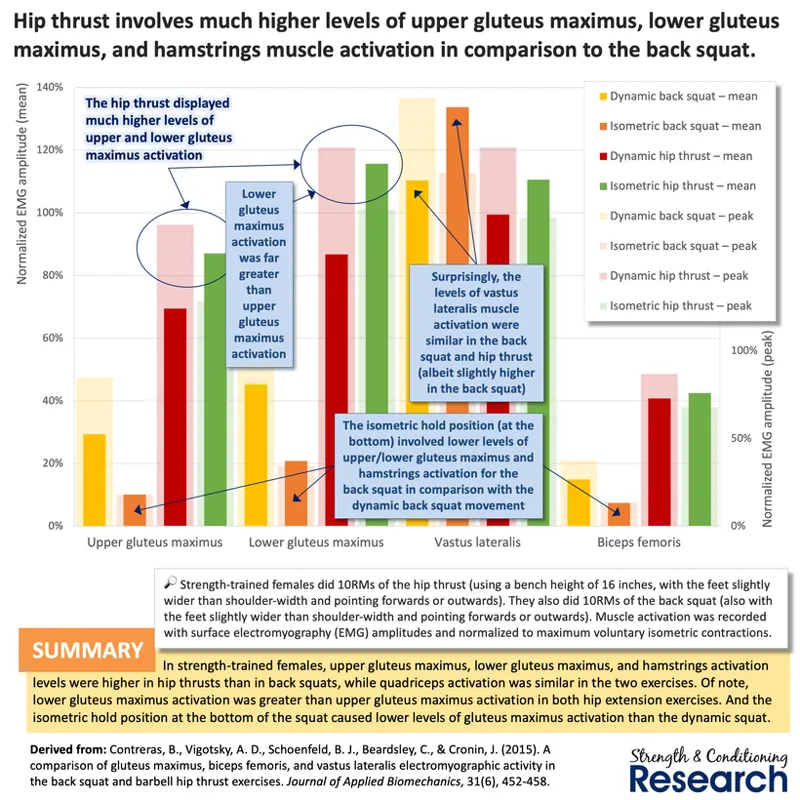
Similarly, research using electromyography (EMG) has shown that the gluteus maximus also exerts is greatest activation levels when the hip is fully extended.
.
While there are currently no studies directly comparing the relative benefits of training the gluteus maximus with exercises that involve peak forces in full hip extension (like hip thrusts) and with exercises that involve peak forces in greater hip flexion (like squats), some research has provided early indications that the hip thrust is a superior exercise to the leg press and stiff-legged deadlift exercises.
.
#1b. Upper and lower gluteus maximus during hip extension
The gluteus maximus can be subdivided into two major regions, the upper and the lower parts. Importantly, the lower region is much more strongly activated during hip extension exercises, as can be seen in both squat and hip thrust variations.
.
Notably, the lower part of the gluteus maximus grows more after these hip extension exercises than the upper part of the gluteus maximus, which shows the connection between the region of the muscle that is most activated (due to neuromechanical matching) and resulting hypertrophy.
.
#2. Gluteus maximus (out of the hip abductors)
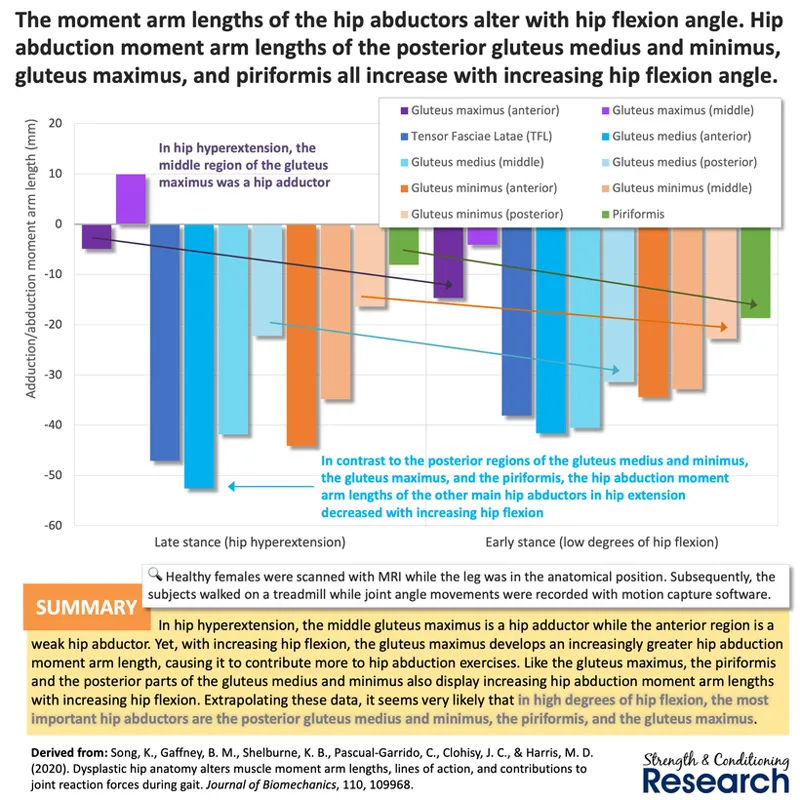
Many muscle groups contribute to hip abduction, including the gluteus maximus and the gluteus medius. Analysis of internal moment arm lengths shows that the upper gluteus maximus region increases its relative leverage for hip abduction with increasing hip flexion, while the anterior and middle regions of the gluteus medius decrease their relative leverage.
.
As expected, the upper gluteus maximus region increases its muscle activation levels during hip abduction efforts with increasing degrees of hip flexion angle.
.
#3. Biceps brachii (out of the elbow flexors)
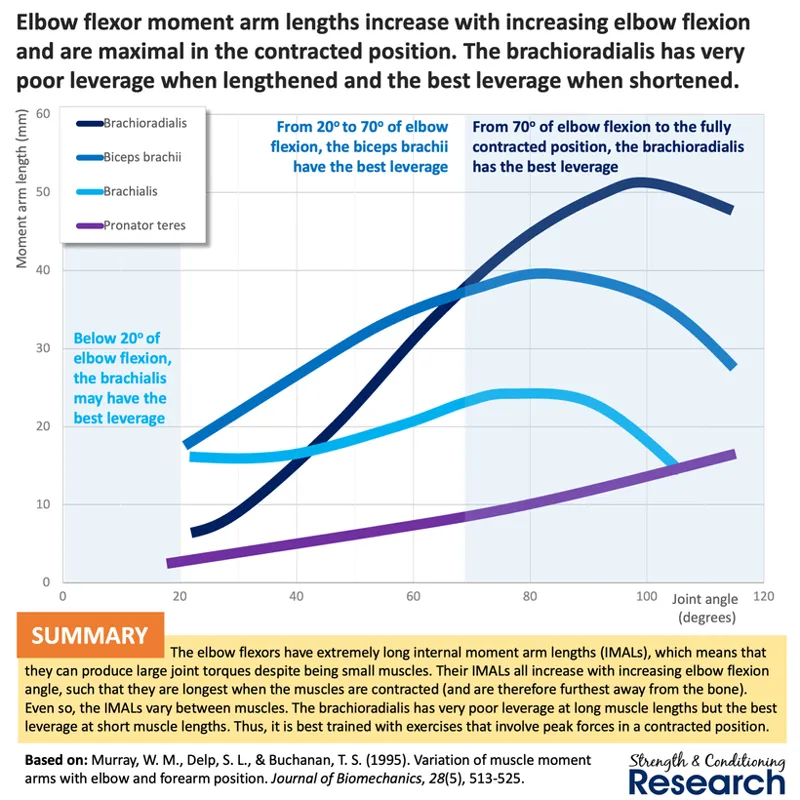
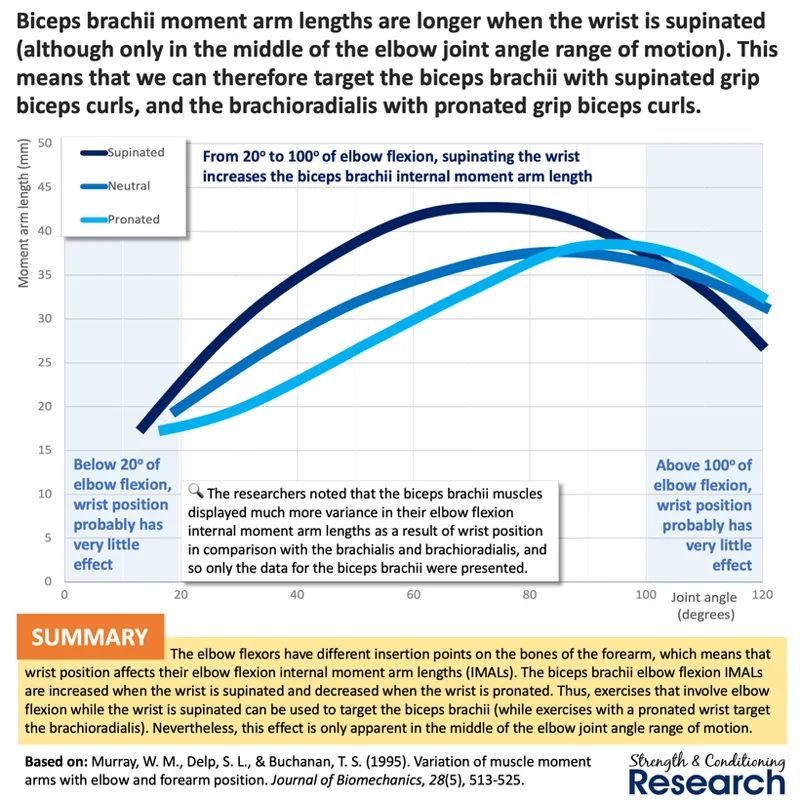
The elbow flexors comprise four separate muscles: the biceps brachii (long head and short head), the brachialis and the brachioradialis. Importantly, the biceps brachii (long and short head) have their best leverages relative to the other elbow flexors when the elbow is fully extended, while the brachioradialis has its best leverage relative to the other elbow flexors when the elbow is fully flexed.
.
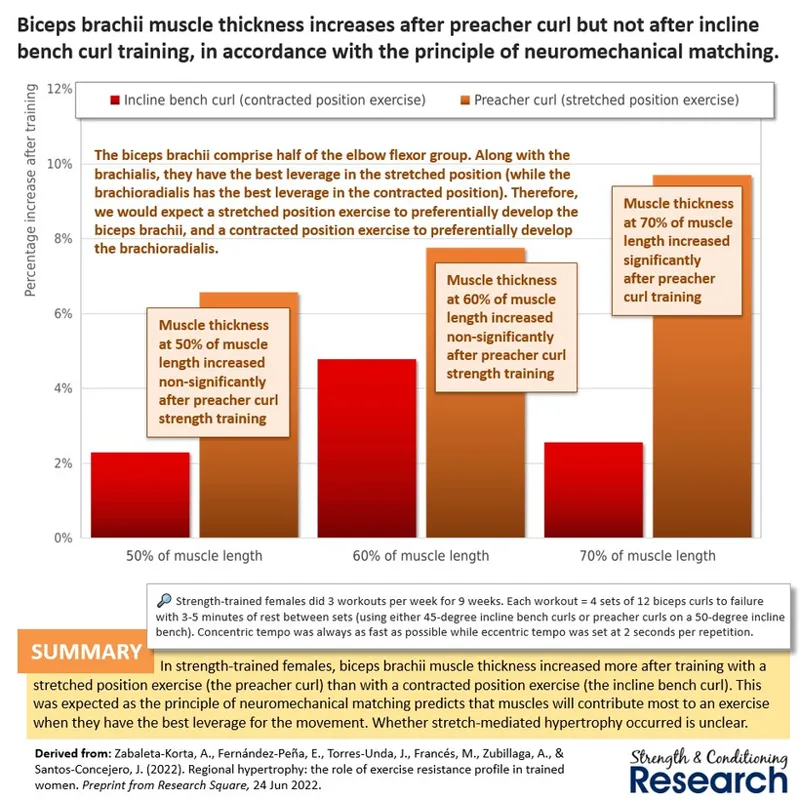
This corresponds with data showing that when biceps brachii muscle hypertrophy is measured after long-term strength training, there is more growth after using a preacher curl exercise than after using an incline bench curl exercise. While this is typically assumed to be caused by passive mechanical tension, it is far more likely to be the result of the principle of neuromechanical matching.
.
#4. Biceps brachii (out of the elbow supinators)
The elbow flexors comprise four separate muscles: the biceps brachii (long head and short head), the brachialis and the brachioradialis. Importantly, the biceps brachii (long and short head) experience better elbow flexion leverage while the wrist is supinated, while the brachioradialis is advantaged by wrist pronation.
.
This then corresponds to improved biceps brachii voluntary activation levels in maximum elbow flexion efforts when the wrist is placed in a supinated position.
.
#5. Latissimus dorsi (out of the shoulder extensors)
The latissimus dorsi has its best leverage for the shoulder extension movement around 45 degrees from the anatomical position (arms by the sides of the body).
.
This corresponds closely with the joint angle at which maximum levels of muscle activation occur during sagittal plane vertical pull-down and pull-over exercises.
.
#6. Anterior and middle deltoids (as shoulder abductors)
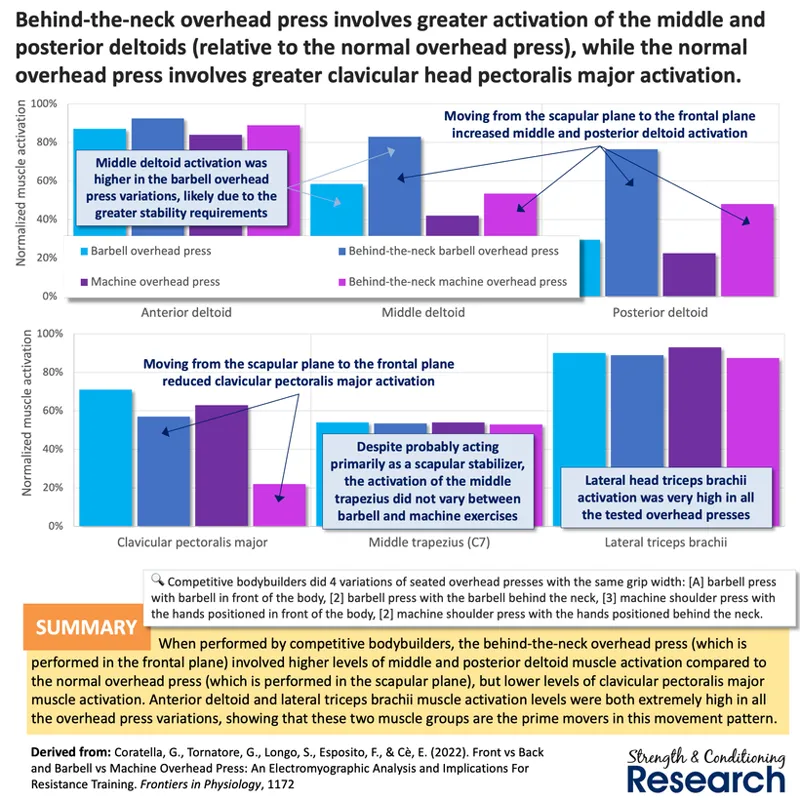
Although the middle deltoid is widely believed to be the prime mover during all shoulder abduction exercises, the anterior deltoid actually has similar or better leverage when the arm is parallel with the ground or higher. This means that in wide-grip overhead presses in the frontal plane, we should expect similar levels of muscle activation in the anterior and middle deltoids (and similar hypertrophy).
.
Indeed, recent research has shown that the levels of anterior and middle deltoid activation are very similar during behind-the-neck barbell overhead presses.
.
#7. Deltoid regions (all shoulder movements)
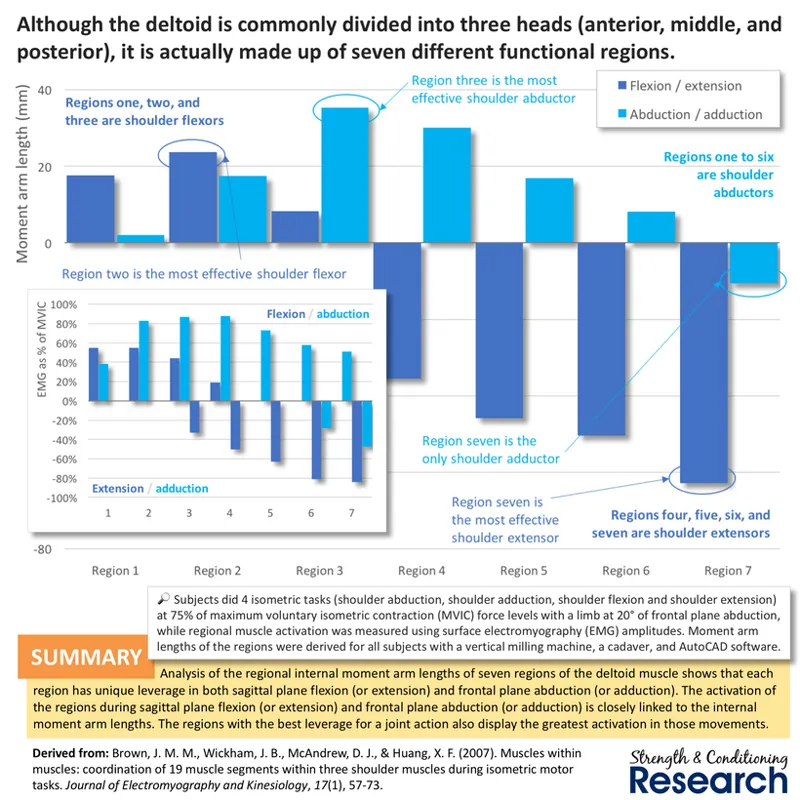
While it is usually assumed that the deltoids comprise only three regions, further investigations have revealed the presence of seven functional compartments. Importantly, the activation of these functional compartments during shoulder flexion, extension, abduction, and adduction varies in line with their leverages.
.
#8. Hamstrings
MRI-derived T2 activation data have shown that the short head of the biceps femoris is more strongly activated during lying leg curls (knee flexion with an extended hip). Meanwhile, the semimembranosus and biceps femoris long head are more strongly activated during seated leg curls (knee flexion with a flexed hip).
.
This corresponds well with the most recent data from long-term hypertrophy training studies.
.
Conclusions
The principle of neuromechanical matching tells us that muscles (or regions of muscles) are most activated when they have better leverage relative to other muscles (or regions of muscles) in a given movement. Since muscle activation is necessary for hypertrophy to occur during strength training exercise, we can use the principle of neuromechanical matching to predict which prime mover muscle will grow most after training with any exercise. In fact, there is a wealth of data in the exercise science literature to support this observation. Indeed, the gluteus maximus has the best leverage for hip extension when the hip is fully extended and is also most strongly activated in this position. Moreover, its upper region has the best leverage for hip abduction when the hip is fully flexed and it is similarly most strongly activated in this position. The biceps brachii have the best leverage for elbow flexion when the elbow is fully extended and they grow most from training with exercises that have peak forces in this position. Moreover, the biceps brachii have better leverage when the wrist is supinated and this position similarly increases their muscle activation levels. The latissimus dorsi has its best leverage for shoulder extension at 45 degrees from the anatomical position and muscle activation similarly peaks around this angle. The anterior and middle deltoids have similar leverages during shoulder abduction when the arm is above parallel with the ground and their muscle activation levels are also very similar during frontal plane barbell overhead presses. Finally, when the deltoid complex is subdivided into seven individual regions, the relative activation of those regions closely corresponds to the relative leverages of those regions during all major shoulder movements (extension, flexion, abduction, and adduction).
Comments (2)
Good morning Chris. I hope you're well. I wanted to ask, how do you interpret the leverage a muscle has based on the engagement it requires? I explain: One muscle may have greater leverage than another in a certain joint range, but if the other muscle (has good leverage but a little less) has a greater cross-sectional area, could it be enough to be more protagonist in that movement? To give a clearer example I would like to talk about the deep squat and the participation of the adductor vs gluteus maximus. The adductor may have better leverage at the bottom of a deep squat, but if the gluteus maximus has greater CSA, can this make up for the difference in leverage? If the gluteus maximus CSA is better, could it be a stronger hip extensor at the beginning of the concentric phase?
I also thought of this question recently