



Oxygen conforming response
The oxygen conforming response is rarely mentioned in the context of fatigue and yet it is an important observation that demonstrates how increases in motor unit recruitment occur over the course of a strength training set taken to failure.
.
#1. What is the oxygen conforming response?
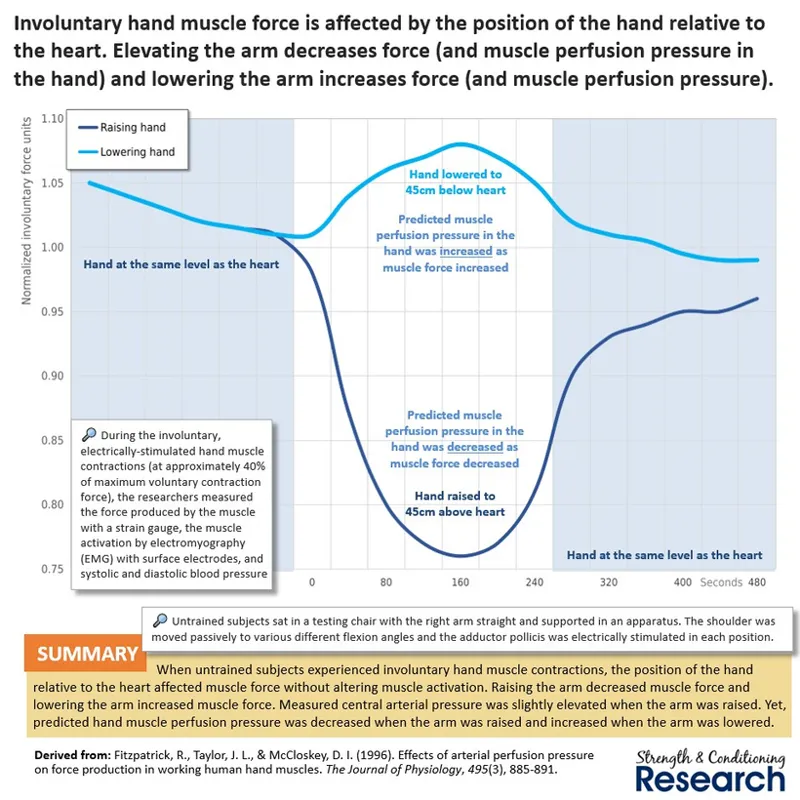
The oxygen conforming response describes the observation that there is a rapid (and quickly reversible) reduction in muscle force for a given level of muscle activation whenever oxygen delivery to the muscle is reduced. Consequently, a reduction in oxygen delivery typically requires an increase in muscle activation (and perceived effort) for muscle force to remain the same.
.
#2. What causes the oxygen conforming response?
The oxygen conforming response was originally observed following investigations into the effects of limb position on involuntary (electrically-stimulated) muscle force. When local muscle arterial perfusion pressure is decreased by elevating a limb relative to the location of the heart, this causes a decrease in muscle force and when local muscle arterial perfusion pressure is increased by lowering a limb relative to the position of the heart, this causes an increase in muscle force.
.
#3. Which muscle fibers are affected by the oxygen conforming response?
The oxygen conforming response affects slow twitch (oxidative) muscle fibers to a greater extent than the fast twitch (glycolytic) muscle fibers. When a muscle is comprised predominantly of slow twitch muscle fibers, its force is substantially reduced by a reduction in local muscle arterial perfusion pressure (which can be done by elevating the muscle above the level of the heart while it is contracting). In contrast, when a muscle is comprised mainly of fast twitch muscle fibers, its force is not reduced by a reduction in local muscle arterial perfusion pressure. This indicates that a lack of oxygen delivery to oxidative (but not glycolytic) muscle fibers likely underpins the oxygen conforming response.
.
Conclusions
The oxygen conforming response describes a relationship between muscle activation, local muscular force-producing capacity, and the delivery of oxygen to the muscle. Oxygen delivery to the muscle can be increased by increasing muscle perfusion pressure and can similarly be decreased by decreasing muscle perfusion pressure. The oxygen conforming response was initially observed in animal models in which muscle perfusion pressure of working muscles was deliberately increased or decreased by artificial means. Electrically-stimulated muscle forces were observed to increase and decrease similarly. Human studies also found that electrically-stimulated muscle forces increased with increases in muscle perfusion pressures (and vice versa). Human studies also showed that when voluntary contractions were used to generate a fixed muscle force, decreases in muscle perfusion pressure (which were attained by elevating the working muscles above the level of the heart) caused subjects to voluntarily increase muscle activation in order to compensate for the decreases in local muscular force-producing capacity that occurred. Critically, the oxygen conforming response is muscle fiber type-specific. It affects the more oxidative muscle fibers more than the less oxidative muscle fibers. For this reason, in animal models, there are large effects of altering oxygen delivery in muscles that are predominantly slow twitch and minimal effects in muscles that are predominantly fast twitch. For this reason, it seems likely that the oxygen conforming response contributes to the recruitment of higher threshold motor units as hypoxia develops during fatiguing strength training sets.
Comments (2)
Does this suggest that for training the quads, leg press allows us to fatigue quicker during the set and recruit higher threshold quicker vs a hack squat?
Does this suggests a mechanism for blood flow restriction training being reported to increase hypertrophy? If so, seems like increasing intensity of effort would level the effect.