


Low carbohydrate diets
Low carbohydrate diets are the subject of a great deal of controversy. And the purpose of this article is not to provide an exhaustive analysis of the various pros and cons. However, there is an important concept that is rarely addressed when talking about low carbohydrate diets and that is the effect of low muscle glycogen and/or low blood glucose on the stimulus for hypertrophy during a workout.
.
#1. Low carbohydrate diets are associated with less hypertrophy
When strength-trained lifters perform a normal strength training program, those lifters that habitually eat more carbohydrates as part of their normal diet tend to display greater muscle growth and greater strength gains. Importantly, this occurs in the absence of dietary controls and therefore avoids placebo effects.
.
Similarly, when competitive natural bodybuilders are tasked with following diets with maintenance level caloric intake (and the same protein relative to body mass), those who eat the programmed low carbohydrate diets tend to display less hypertrophy than those who eat the programmed high carbohydrate diets.
.
#2. Low muscle glycogen and/or low blood glucose cause CNS fatigue
Low blood glucose has been associated with increased supraspinal central nervous system (CNS) fatigue during exercise, probably due to afferent feedback signaling that increases our rating of perceived effort for a given level of central motor command. Since the magnitude of central motor command determines the maximum level of motor unit recruitment that can be achieved, which in turn determines the number of activated muscle fibers, we can see that the stimulus for hypertrophy is likely reduced when following a low carbohydrate diet.
.
Research has shown that the presence of this supraspinal CNS fatigue reduces exercise performance without changes in muscle fiber ATP levels. Consequently, hypotheses that refer to the presence of absence of muscle glycogen to provide energy for exercise can be rejected, as local energy supply does not alter.
.
#3. Low muscle glycogen and/or low blood glucose cause calcium ion-related fatigue (excitation-contraction coupling failure)
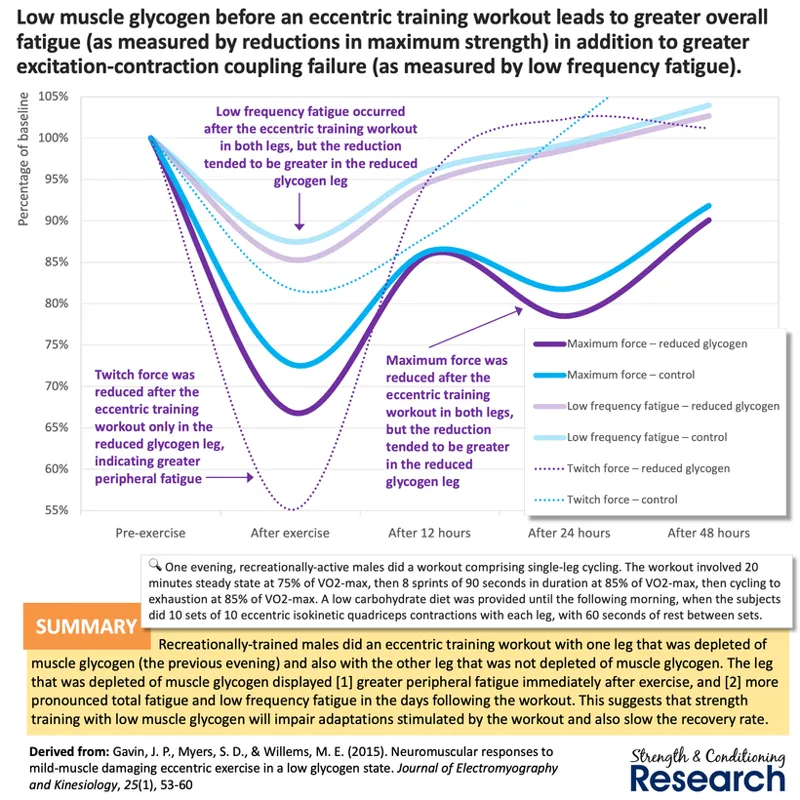
Low muscle glycogen has been associated with increased excitation-contraction coupling failure (a form of calcium ion-related fatigue) during eccentric exercise, as measured by low frequency fatigue. Exactly how this occurs is still not clear. Yet, since the presence of calcium ion-related fatigue reduces the magnitude of mechanical tension that a muscle fiber produces, we can see that the stimulus for hypertrophy is likely reduced when following a low carbohydrate diet.
.
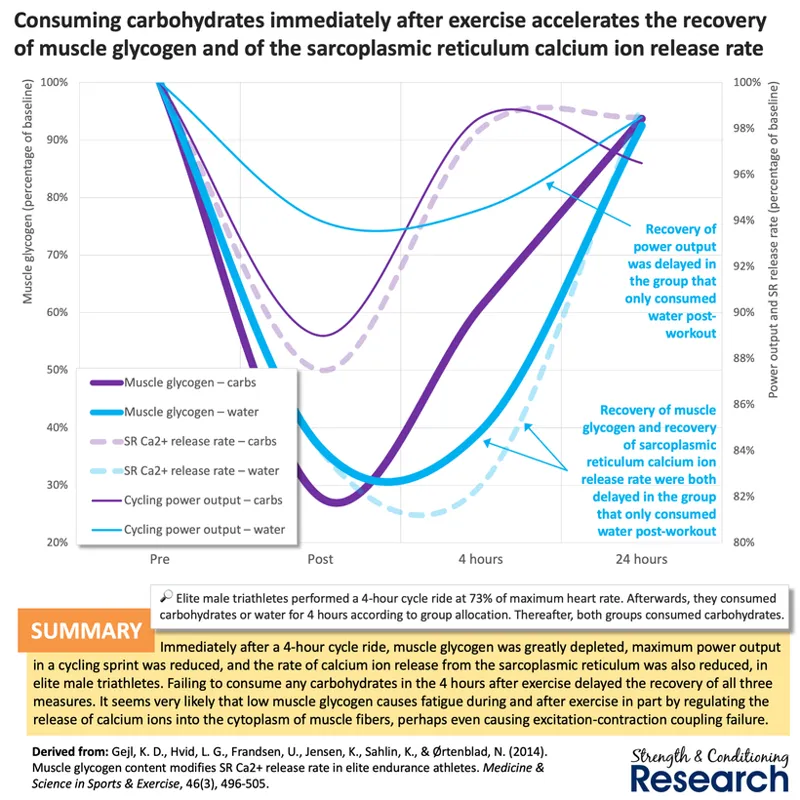
Moreover, we can further confirm that the lack of muscle glycogen accelerates excitation-contraction coupling failure by studies that have measured changes in the sarcoplasmic reticulum calcium ion release rate, which is a far more direct way of identifying the presence of excitation-contraction coupling failure.
.
Conclusions
Low carbohydrate diets are the subject of a great deal of controversy, and they have many proponents and detractors. However, despite the frequent and heated debates on the topic, there is one key concept that is rarely addressed, which is the effect of low muscle glycogen and/or low blood glucose on the stimulus for hypertrophy during a workout. The stimulus for hypertrophy depends upon two key factors: [1] the level of motor unit recruitment (since this determines the number of activated muscle fibers), and [2] the magnitude of mechanical tension displayed by each of the activated muscle fibers (since this is the actual stimulus for muscle fiber growth). Importantly, low muscle glycogen and/or low blood glucose have been associated with both increased supraspinal central nervous system (CNS) fatigue (which reduces the level of motor unit recruitment by reducing the magnitude of central motor command that can be generated at our maximum tolerable perception of effort) and increased excitation-contraction coupling failure (which reduces the magnitude of mechanical tension that an activated muscle fiber generates by decreasing the flow of calcium ions into the cytoplasm to signal myosin to bind to actin and form actin-myosin crossbridges). The acceleration of these fatigue mechanisms during strength training workouts could explain why studies have shown that low carbohydrate diets are associated with reduced hypertrophy and smaller strength gains. In contrast, the availability of muscle glycogen itself is not likely to have any direct effect on the stimulus for hypertrophy, because ATP levels are not reduced by low muscle glycogen levels, despite the widespread assumption to the contrary in the fitness industry.
Comments (1)
Hi chris, great article. Do you think a little reduction in volume or intensity due in hypocaloric diets (moderate) between 3.0 and 3.5 gr/kg due to glycogen depletion in consequent weeks is needed. ?Or we just probably would need a “deload” session is we keep variables the same?