





Regional hypertrophy
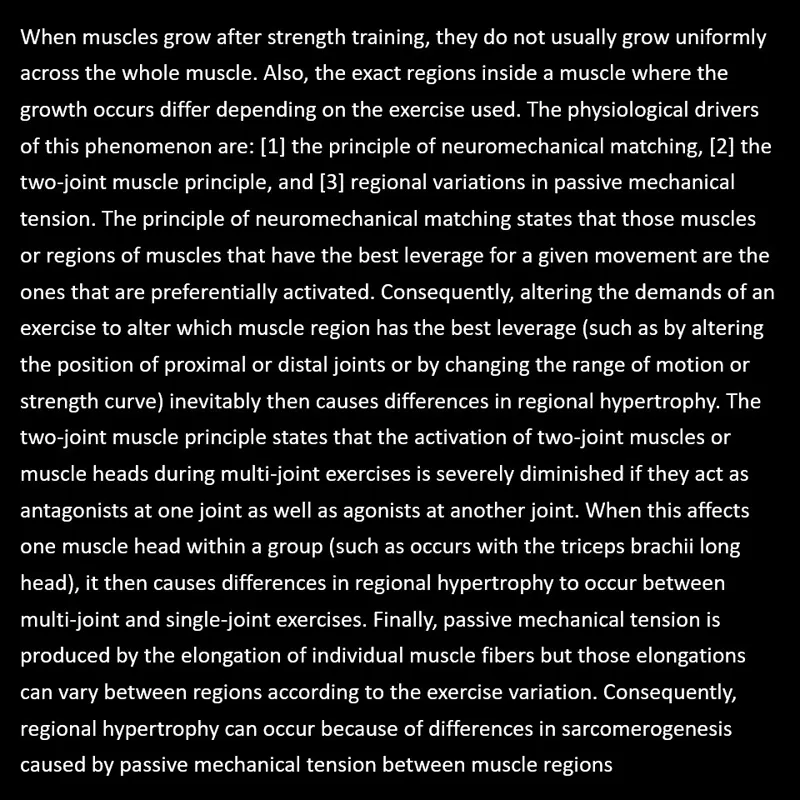
When muscles grow after strength training, they do not always grow uniformly across the whole muscle. The exact regions within a muscle where the growth occurs differ according to the exercise used. The physiological drivers of this phenomenon are: [1] the principle of neuromechanical matching, [2] the two-joint muscle principle, and [3] regional variations in passive mechanical tension.
.
#1. The principle of neuromechanical matching
The principle of neuromechanical matching tells us that the leverage of the muscle fibers controlled by a motor unit influences whether it is recruited for a given task. The muscles or regions of muscles that have the best leverage for a given movement are the ones that are preferentially activated. This means that those muscles or regions of muscles then grow most after training (read more).
.
#2. Regional hypertrophy caused by the neuromechanical matching principle
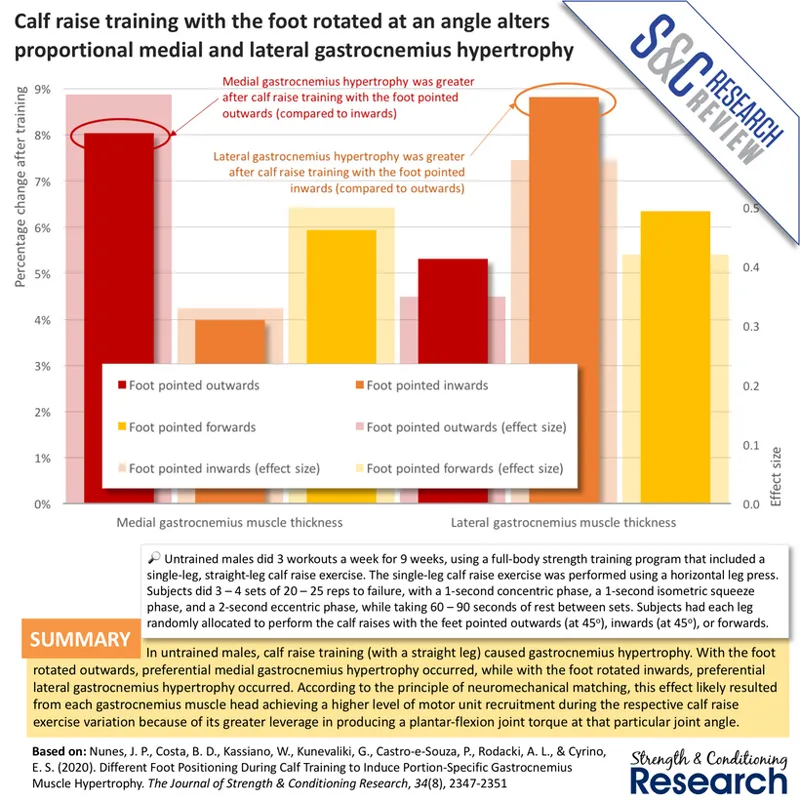
After strength training programs comparing different exercises, there tends to be greater hypertrophy of certain regions of a muscle relative to other regions. One training variable that affects the hypertrophy of certain regions relative to other regions is the position of proximal or distal joints. For example, hip rotation during calf raises affects whether it is the lateral or medial gastrocnemius head that is more developed after training. Altering the degree of hip rotation alters which of the two heads has better leverage (and so is more activated) in the movement.
.
A second training variable that affects the hypertrophy of certain regions relative to other regions is the range of motion or strength curve. For example, the bench incline used during bench press training can affect which region of the pectoralis major muscle is developed to the greatest extent. Changing bench incline alters the range of motion through which the shoulder is flexed, since a more horizontal position moves the shoulder from the anatomical position to 90 degrees, whereas an incline bench position starts the shoulder from 30-45 degrees of flexion and finishes at 120-135 degrees. Compared to a horizontal bench, an incline bench press produces greater hypertrophy of the superior region of the pectoralis major (which corresponds to the clavicular head).
.
#3. The two-joint muscle principle
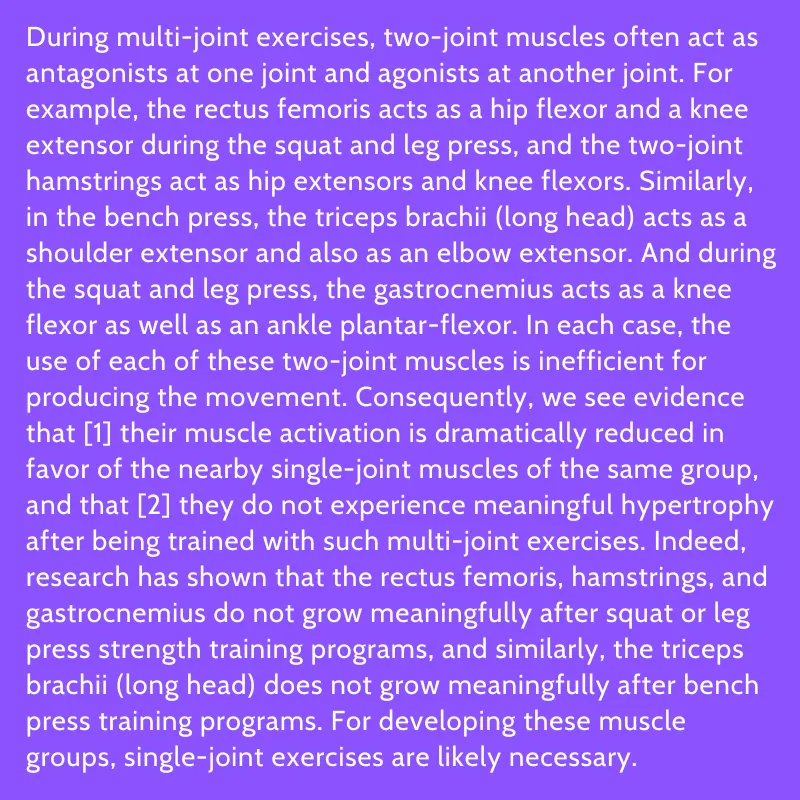
During multi-joint exercises, two-joint muscles often display reduced activation if they act as antagonists at one joint as well as agonists at another joint, and this affects the regional hypertrophy that results. We can observe this phenomenon happening at the hip/knee, shoulder/elbow, and knee/ankle (read more).
.
#4. Regional hypertrophy caused by the two-joint muscle principle
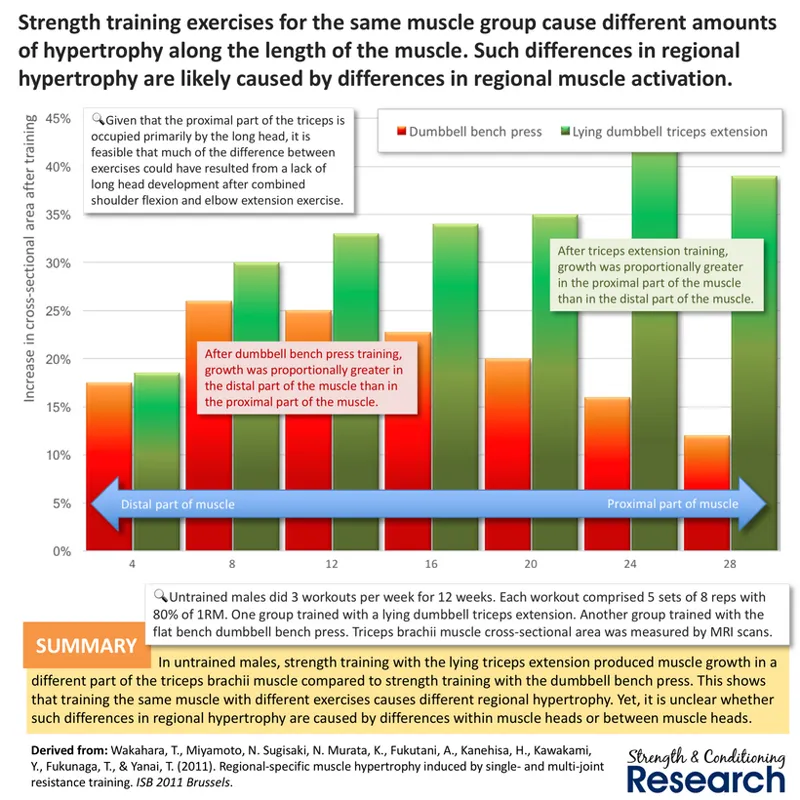
After strength training programs comparing single-joint and multi-joint exercises, there tends to be different regional hypertrophy. For example, bench press training tends not to develop the proximal parts of the triceps brachii (where the two-joint long head is the largest element), while single-joint triceps extension training does. This is likely due to greater activation of the two-joint long head during the single-joint triceps extension compared to in the bench press.
.
The same phenomenon occurs with the rectus femoris and the quadriceps.
.
#5. Passive mechanical tension
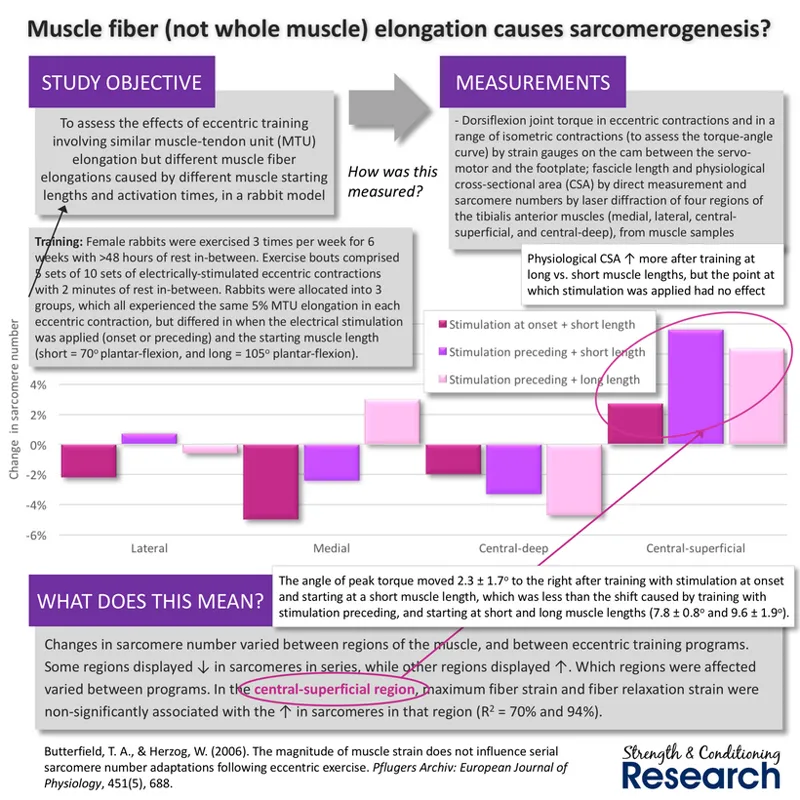
During any exercise, the amount of passive mechanical tension that the muscle fibers experience affects the resulting sarcomerogenesis. Since the amount of passive mechanical tension is affected by the strain of the muscle fibers and this strain differs depending on the exercise variation, regional hypertrophy can vary between exercises. Indeed, rodent studies have shown that sarcomerogenesis differs between regions of a muscle depending on regional muscle fiber strains.
.
#6. Regional hypertrophy caused by passive mechanical tension
After strength training programs comparing full range of motion (ROM) and partial ROM exercises, there tends to be different regional hypertrophy. For example, training with a full range of motion (ROM) during the squat causes more hypertrophy of the distal region of each quadriceps muscle, while training with a partial ROM causes proportionally greater hypertrophy in the proximal regions.
.
Similarly, eccentric leg press training causes proportionally greater hypertrophy of the distal region of the quadriceps, while concentric leg press training causes proportionally more hypertrophy of the middle region. Again, this likely occurs because the distal region happens to be where more sarcomerogenesis occurs.
.
Conclusions
When muscles grow after strength training, they do not usually grow uniformly across the whole muscle. Also, the exact regions inside a muscle where the growth occurs differ depending on the exercise used. The physiological drivers of this phenomenon are: [1] the principle of neuromechanical matching, [2] the two-joint muscle principle, and [3] regional variations in passive mechanical tension. The principle of neuromechanical matching states that those muscles or regions of muscles that have the best leverage for a given movement are the ones that are preferentially activated. Consequently, altering the demands of an exercise to alter which muscle region has the best leverage (such as by altering the position of proximal or distal joints or by changing the range of motion or strength curve) inevitably then causes differences in regional hypertrophy. The two-joint muscle principle states that the activation of two-joint muscles or muscle heads during multi-joint exercises is severely diminished if they act as antagonists at one joint as well as agonists at another joint. When this affects one muscle head within a group (such as occurs with the triceps brachii long head), it then causes differences in regional hypertrophy to occur between multi-joint and single-joint exercises. Finally, passive mechanical tension is produced by the elongation of individual muscle fibers but those elongations can vary between regions according to the exercise variation. Consequently, regional hypertrophy can occur because of differences in sarcomerogenesis caused by passive mechanical tension between muscle regions.

Comments (6)
Chris, I do not know if you comment on new studies, but the recent one got a lot of attention. It was on triceps brachii training showing that overhead triceps extensions were more effective than triceps extensions with neutral arm position for the long head. Are there any chance that the long head of a triceps benefits from training at long muscle lengths? Or could it be any other reason for explaining the big difference in hypertrophy of a long head? I leave the study here: https://pubmed.ncbi.nlm.nih.gov/35819335/ Thanks, Chris! A lot of people are talking about this study now.
Thank you, Chris. (my goodness, there are a lot of guys named Chris on here, LOL). Do you have a list of the specific exercises that are the best 2-3 choices for taking advantage of the regional stimulation of each muscle? If you do, I may have just not come across it yet. And thank you for such great work each month
In this article, I list the factors that I think are useful to take into account when training each muscle. In a section towards the end of the article, there is a list of links to articles/infographics about each muscle, which each contain the best information I have at the moment for identifying the 2 or 3 exercises that might be optimal. https://sandcresearch.medium.com/how-can-we-identify-the-best-way-to-train-each-muscle-fff8ec763643
Would it not then be best to select an optimal exercise wherein the line of force perfectly aligns with the muscles fibers and whose strength curve matches the body and then do this exercise for more volume rather than chasing various exercises to piecemeal the stimulus in such a way that the entire muscle gets maximal stimulation? This is the premise of Doug Brignole's "Physics of Resistance Training"
Great article Chris. Am I wrong to say that it seems like the key is the strain placed on a muscle fiber based upon it's position or relationship to the direction of resistance and in a sense it is involuntary. Meaning the strain will happen whether our central nervous system reacts to it or not. So it is the passive tension you speak of combined with motor unit recruitment. If so why wouldn't very heavy loads have an advantage as it would seem they naturally would provide the greatest strain on the fibers. Thanks!
Exercise selection can cause different regions of a muscle to be activated, according to the principle of neuromechanical matching. Thus, muscle fibers will experience strain according to whether the exercise used causes their region to be activated.