




Load or exercise periodization?
Experts often recommend varying rep ranges (loads) during strength training programs. However, the physiological basis for varying loads is weak. In contrast, there are good reasons for varying exercise selection.
.
#1. Light and moderate loads cause hypertrophy through the same mechanisms
The main argument that fitness influencers use for varying repetition ranges during strength training is that the different loads cause hypertrophy through different mechanisms (or even in different muscle fiber populations). This is not true, however. Light and moderate loads cause hypertrophy through the same mechanisms (read more).
.
Nevertheless, there is one mechanism through which altering the rep range could affect the overall hypertrophy that results from a strength training program. By performing a block of strength training with heavy loads early on during a strength training program, we can potentiate gains in muscle size in future blocks involving moderate or light loads. This is probably because training with heavy loads permits faster increases in motor unit recruitment. By making it possible to recruit more high-threshold motor units, more muscle fibers can be trained in future workouts. When training more muscle fibers, greater hypertrophy results.
.
Even so, this effect is probably limited, for two reasons. Firstly, increases in motor unit recruitment after strength training are very large in the first few months of strength training and far smaller thereafter.
.
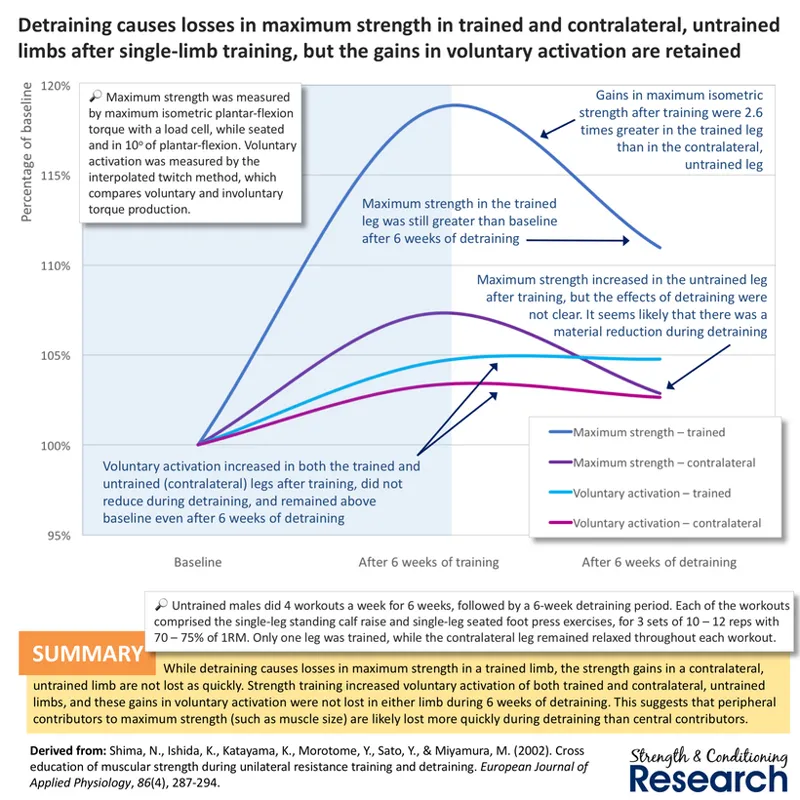
Secondly, once an increase in motor unit recruitment has been achieved, it does not then disappear during blocks of other exercise. Indeed, research has shown that the ability to recruit high-threshold motor units (which is measured as voluntary activation) is stable even during periods of detraining.
.
#2. Training with light loads causes much more post-workout fatigue
When lifting the same number of sets to muscular failure, using lighter loads causes more sustained fatigue compared to conventional moderate loads. This suggests that recovery will be slower when using lighter loads, and that training frequency will need to be lower. This suggests that there is really no rationale for preferring light loads over moderate loads (read more).
.
#3. Training with greater exercise variation probably enhances hypertrophy
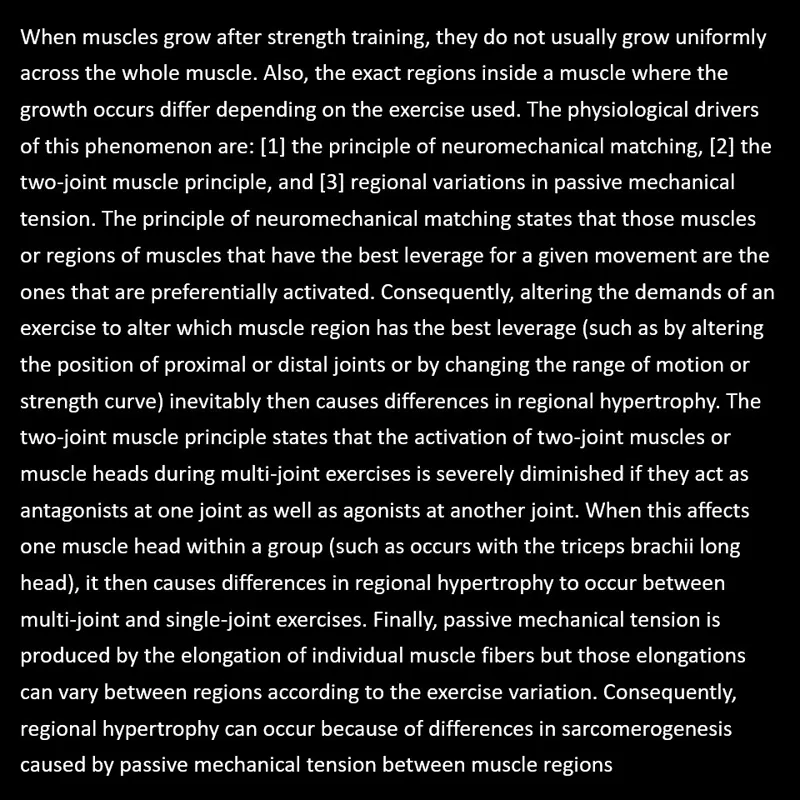
While muscles grow after strength training, they do not always grow evenly across the whole muscle. Moreover, the precise regions within a muscle where that growth occurs seems to differ, depending on the exercise that is used during training. This suggests that training with a variety of exercises is likely to be helpful for maximizing the amount of muscle growth that occurs (read more).
.
#4. Different exercises probably cause muscle damage in different muscle regions
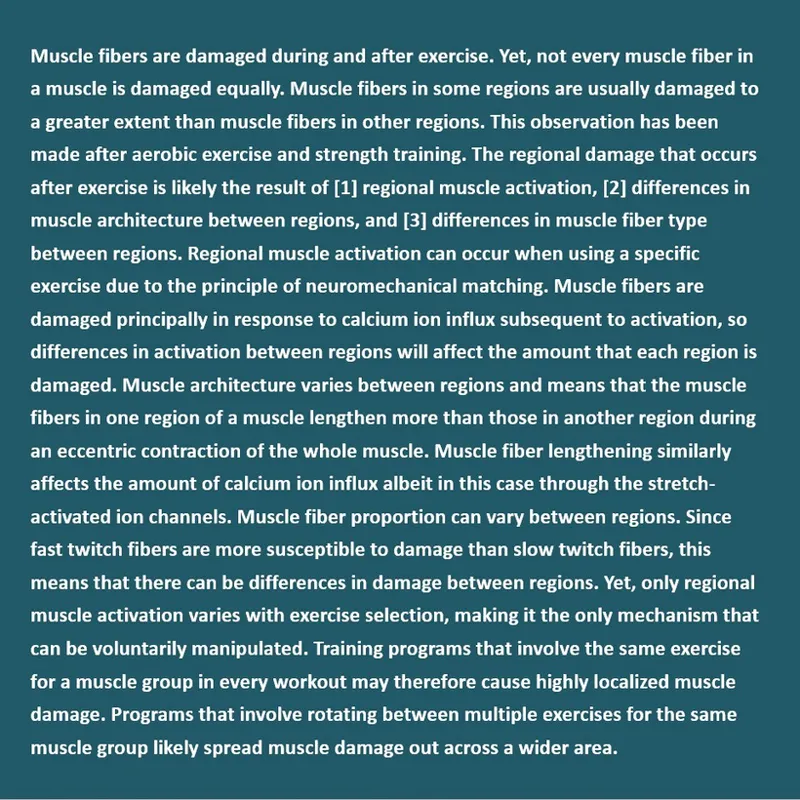
Muscle damage is localized within the regions of trained muscle. The exact region that is affected depends on the exercise that is used. This suggests that exercise variety could be used within a training week allow some regions of a muscle to recover while others are trained (read more).
.
Conclusions
Experts often recommend varying rep ranges (loads) by using moderate and light loads during strength training programs. In support of this suggestion, they claim that moderate (6-15RM) and light (16-30RM) loads cause hypertrophy through different mechanisms or even in different populations of muscle fibers. Indeed, it is often stated that light loads cause preferential hypertrophy in slow twitch muscle fibers. Yet, the mechanisms by which moderate and light loads cause hypertrophy are identical and the location of the hypertrophy is also identical. There is no difference in the magnitude or type of the hypertrophy stimulus produced by different repetition ranges. Also, it is clear that training with light loads causes more post-workout fatigue than training with moderate loads. Thus, using light loads will likely impact negatively on training frequency. Hence, it is logical to avoid varying repetition ranges and to use moderate loads exclusively. In contrast, there are good reasons to include a variety of exercises in a training program. Owing to the principle of neuromechanical matching, different exercises stimulate hypertrophy and cause muscle damage to occur in different regions of a muscle. Consequently, a wider variety of exercises will likely cause more overall muscle growth because they allow a greater total number of muscle fibers to experience a meaningful level of mechanical tension stimulus. Additionally, varying exercises across a training week means that the most glycolytic, fast twitch muscle fibers in each region of a muscle are not damaged in every workout, which means that it has more time to recover.



Comments (11)
I really appreciate your fast and insightful responses. So thank you very much. Yes, I am currently reading your book on hypertrophy, just finished reading about volume but it lacked practical implications and guidelines. So that’s why I am asking you all these questions here. I will try reading that chapter again and make clearer conclusions, LOL
So in general, it is best to count volume per exercise by identifying if we are progressing in that exercise. If strength stalls (in certain exercise) we may suspect that volume is too high but if we are progressing volume is more or less "optimal"?
More or less, although if we are progressing we don't really know whether the volume is producing the fastest possible rate of progress unless we increase volume and either [1] achieve faster progress, or [2] stall. Essentially, testing is necessary to identify the optimal exercise volume for a single workout, and it is feasible. We can make predictions based on the muscle that we are training, because some muscles are more susceptible to damage than others, but that is a slightly different question.
Chris, the question that keeps bothering me is about volume for hypertrophy. I know we count volume by sets per muscle group per week and volume can change with intensity (RIR), where lower RIR produces more hypertrophy but also more fatigue (if trained to failure). But my question is, how can we find an optimal volume per muscle group per week? What would be the main factors showing that a muscle group is trained sufficiently but not too much? Especially for more complex muscle groups, like gluteus maximus as it gets trained not only in hip thrusts, but also in deadlifts or squats and the volume tends to overlap. In your opinion, how would you find optimal volume per muscle group? I know the question is very complex and hard to answer, but maybe there are some checkpoints we should know? Thank you!
In terms of training volume, we can identify the lowest effective volume by starting with a small number of sets (that does not cause any increase in repetition strength) and increasing the number of sets until we are able to achieve an improvement. That is usually a very low number of sets per exercise per workout unless the exact same exercise has been done consistently for several months.
Hey Chris. in regards to this article. Do you think varying rep reanges can be a useful strategy of periodization not because of a diferent kind of stimulus but as a mean to keep progressing? after all, there is a bigger jump in percentage of 1RM from 5 to 6 reps than 11 to 12 reps.
Yes, I often suggest that progressive overload combines both increases in load and increases in reps. A good method is to increase reps from 5 to 7 over time (across all sets) and then increase weight, dropping back to 5 reps again.
Excellent work. Training a region of a muscle while another region recovers? In practice how would this work, compared to say training two regions in one workout and allowing for adequate recovery? For example, assuming 3 sets, day 1: rows, day 3: pulldowns, day 5: rows, so 9 sets total VS. day 1: row and pulldown, and day 5: row and pulldown, 12 sets total. I guess I'm struggling to see the practical advantage except perhaps where set volume was more, 5 sets then I think the first method would be more manageable. I'm guesssing this works best for back, quads and maybe chest, where exercises for regions don't overlap as much.
Alternating between two workouts (A and B) where workout A involves only pull ups and workout B involves only rows would allow each region of the lats to recover for a whole week, while training the muscle twice a week.
Great article as usual. Chris do you really believe that after 3 years of training light training to fatigue will yield the same muscle volume as heavy training? So if I perform all sets close to fatigue performing 20 repetitions I will be as muscular as if performing all sets close to fatigue with 8 repetitions? Long term it would make no difference substantively or visually. Thanks!
Yes, but with two caveats. Firstly, if there was no initial heavy strength training block at the beginning to achieve increases the ability to recruit high-threshold motor units, then the ultimate capacity for hypertrophy with light loads would be limited compared to with moderate or heavy loads. Secondly, training frequency will be lower when using light loads all the time, because of the greater sustained fatigue (including muscle damage) that this type of training produces.