





Light load strength training (hypertrophy)
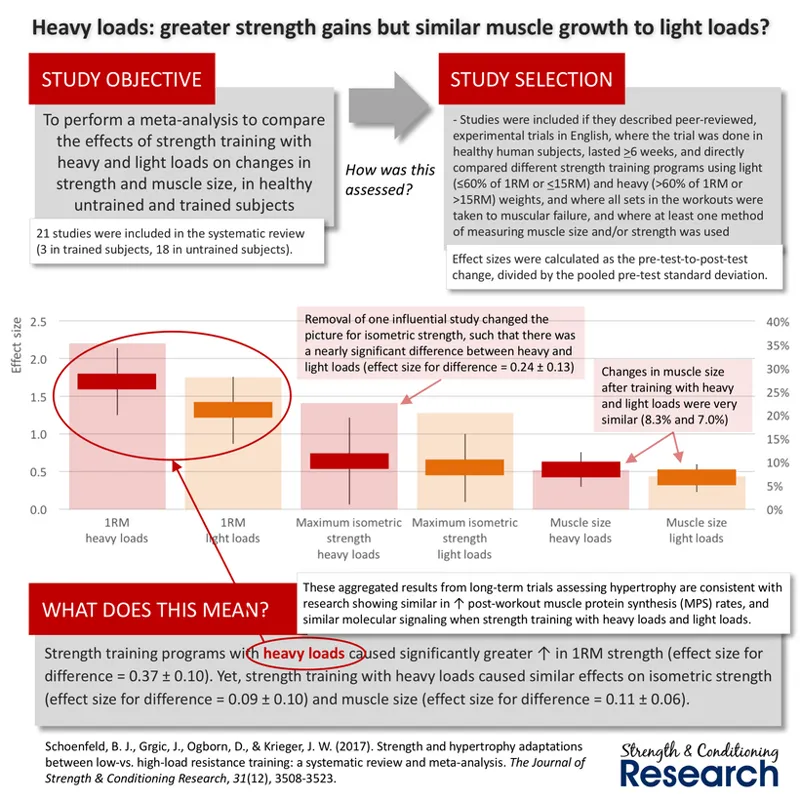
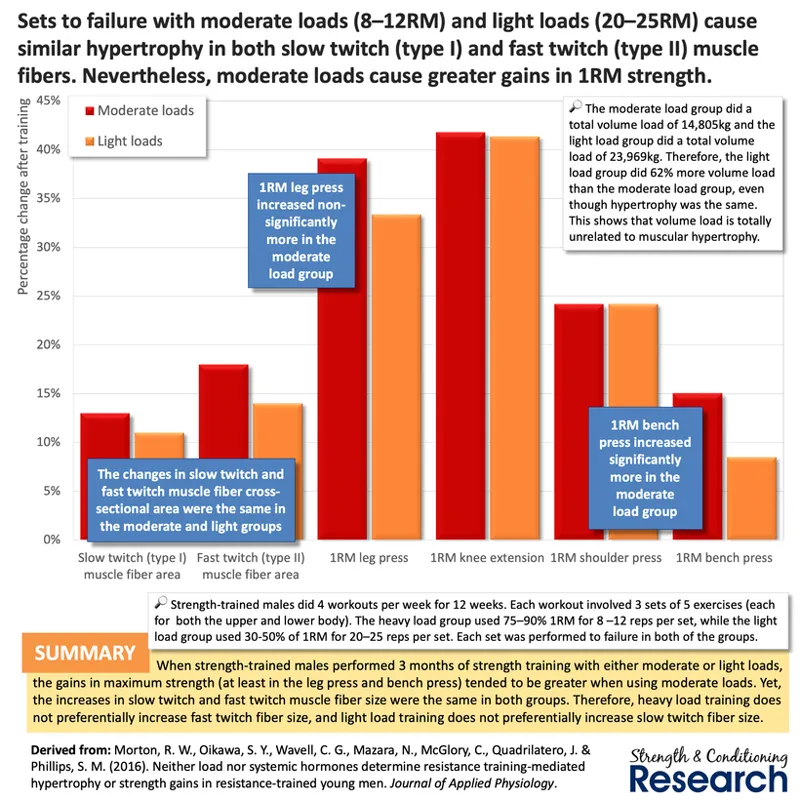
Studies have shown that light load strength training causes more-or-less the same hypertrophy as moderate load strength training, so long as the same number of sets to failure are performed. Why does this happen?
.
#1. Light and moderate load strength training to failure produce similar hypertrophy
Light load strength training to failure causes similar hypertrophy to moderate load strength training to failure, when the same number of sets are performed. The reasons for the differences in strength gains have been explained by multiple mechanisms (read more).
.
#2. What explanations have been suggested for why light and moderate load strength training to failure produce similar hypertrophy?
Why similar hypertrophy occurs after training with light and moderate loads to failure is still being debated. Several explanations have been proposed. We can divide these explanations into two categories. In the first category, hypertrophy is produced by different mechanisms after training with light loads compared to after training with heavy loads. This category is difficult to accept, since it is unclear why the same amount of muscle growth should be triggered by these different mechanisms, when other factors (such as range of motion, volume, etc.) cause large differences in muscle growth after training. This category includes [A] metabolic stress, [B] sarcoplasmic hypertrophy, and [3] fiber type-specific hypertrophy. In the second category, hypertrophy is produced by the same mechanisms after training with light and heavy loads. It includes [A] motor unit recruitment as a direct stimulus of muscle growth, and [B] stimulating rep theory.
.
#3. Metabolic stress
Some researchers have argued that light load strength training stimulates muscle fiber growth through metabolic stress, while moderate load strength training stimulates muscle fiber growth by means of mechanical tension. Yet, the metabolic stress hypothesis has been thoroughly debunked (read more).
.
#4. Sarcoplasmic hypertrophy
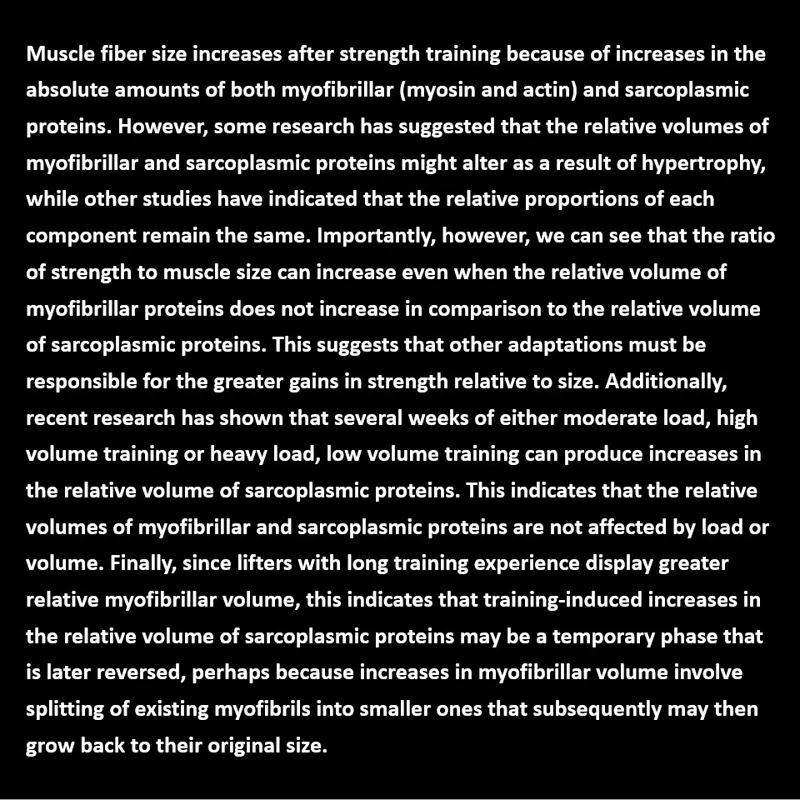
It has been suggested that light load strength training might develop the sarcoplasm inside muscle fibers to a proportionally greater extent, while conventional, moderate load strength training might develop the myofibrils comparatively more. Yet, recent research has shown that both lighter and heavier loads cause preferential sarcoplasmic hypertrophy in the early weeks of a training program, which suggests that there is no effect of load on the amount of sarcoplasm growth (read more).
.
#5. Slow twitch fiber growth
It has been suggested that light load strength training might develop slow twitch muscle fibers to a proportionally greater extent, while conventional, moderate load strength training might develop fast twitch muscle fibers comparatively more. Yet, research has shown that the slow and fast twitch fibers of a muscle grow similarly after training with moderate and light loads.
.
Similarly, recent research has shown that strength training with higher reps and light loads does not cause muscles that are predominantly slow twitch to grow to a greater extent than strength training with lower reps and heavier loads. Therefore, it is highly unlikely that light loads and heavy loads are training different groups of muscle fibers to differing extents.
.
#6. Motor unit recruitment
Some researchers have argued that light load strength training and heavy load strength training both cause hypertrophy through the same mechanism, which is the recruitment of high-threshold motor units. This idea is based on the observation that the muscle fibers of low-threshold motor units do not tend to grow after strength training, and therefore the recruitment of high-threshold motor units is necessary to stimulate any growth.
.
However, research has shown that when a muscle fiber is activated but does not experience high levels of mechanical tension, this does not produce hypertrophy. This has been shown in rodent models. Yet, it is also very obvious from any study of high-velocity, high-effort movements (such as jumping), which involve maximal levels of motor unit recruitment but do not cause muscle growth.
.
#7. Stimulating rep theory
The most likely explanation for why light load strength training to failure causes the same amount of muscle growth as heavier load strength training with fewer reps per set is that it involves the same dosage of mechanical tension on the muscle fibers of the high-threshold motor units. This is called the stimulating rep theory (read more).
.
Conclusions
Studies have shown that light and moderate load strength training can generate more-or-less the same hypertrophy, so long as the same number of sets to failure are performed. Why does this happen? We can divide proposed explanations into two categories: [1] those that involve different hypertrophy mechanisms during training with light and moderate loads (such as metabolic stress, sarcoplasmic hypertrophy, and fiber type-specific muscle growth), and [2] those that involve the same hypertrophy mechanisms occurring when training with light and moderate loads (motor unit recruitment as a direct stimulus of hypertrophy and stimulating rep theory). Explanations that involve different hypertrophy mechanisms occurring during training with light and moderate loads are difficult to accept because of the very similar muscle growth that results from the same number of sets to failure with each repetition range. This problem is especially clear when we consider that other training variables like volume, range of motion, rest period duration, and proximity to failure can all have quite large effects on the amount of muscle growth that is achieved. Similarly, the idea that motor unit recruitment (which really means muscle fiber activation) can stimulate hypertrophy directly is difficult to accept because muscle fibers are often activated during fast movements and yet do not grow. This leaves stimulating rep theory as the only viable option. This theory suggests that hypertrophy is only stimulated by reps that involve [1] a high level of motor unit recruitment, and [2] a slow concentric movement speed that facilitates a high level of mechanical tension. These conditions only occur together in the last few reps before reaching failure, regardless of the rep range being used.



Comments (5)
Incredible article Chris. Thanks so much. Doesn't he force-velocity relationship show that eccentric contractions create the highest force? If so would maximal hypertrophy be generated with heavy eccentrics? Where is the flaw in this? Thanks!
Yes, but this article is about normal strength training, so it excludes the eccentric force-velocity relationship (because normal strength training actually involves very low levels of muscle activation in the eccentric phase of the lift, such that very few high-threshold motor units are recruited). I will explain how eccentric contractions work in some future articles on this site.
I've wondered the same. I was speculating that this may be some form of potential "sarcoplasmic" growth.
Great article! Any thoughts on this study, which apparently shows that a combination of heavy+light is better than either separately? It was volume matched with regards to sets to failure, but not volume-load: https://bit.ly/3dAsYBV It reminds me of this classic study, although it wasn’t volume-matched a single high-rep set didn’t increase volume so much that you would expect just another heavy set to equal its hypertrophic benefit?: https://pubmed.ncbi.nlm.nih.gov/15574075/ https://pubmed.ncbi.nlm.nih.gov/15574075/
That new study showing apparently greater muscle growth with a combination of loads did not actually measure changes in muscle size, but only measured changes in body weight and thigh circumference.