




Very light load strength training
Light load strength training produces similar hypertrophy to strength training with conventional, moderately-heavy loads, so long as the same number of sets are performed to failure. However, when load is too light, the amount of hypertrophy that occurs is greatly reduced. Why does this happen?
.
#1. How does load affect hypertrophy?
Many studies have shown that strength training to failure produces the same amount of muscle growth regardless of the load (when the same number of sets are performed). Yet, in such studies, the light load tested is typically between 30 – 60% of 1RM. When using a load that is lighter than 30% of 1RM, the amount of hypertrophy is smaller.
.
#2. How does load affect repetition range?
Importantly, the number of reps that can be achieved with a given percentage of 1RM is not linear but instead displays a dramatic increase once we go lighter than approximately 30% of 1RM. This shows us that the fatigue mechanisms are changing at this point.
.
#3. How does load affect CNS fatigue during strength training?
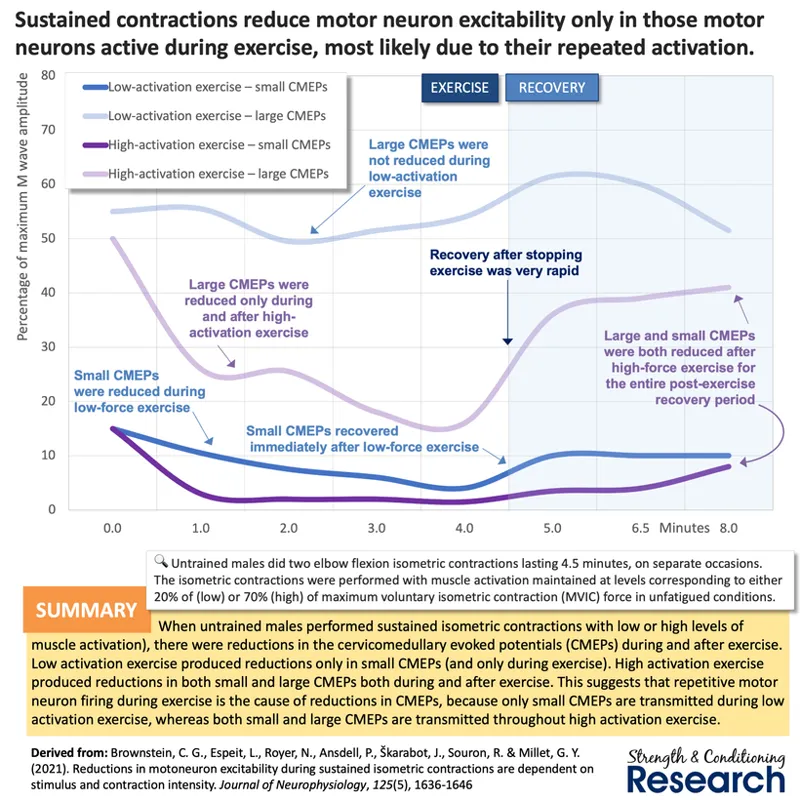
During a set of strength training exercise, fatigue mechanisms develop. Each fatigue mechanism has a different effect on the resulting adaptations. Fatigue can be divided into mechanisms that arise inside the brain and spinal cord (which is called central nervous system (CNS) fatigue), and mechanisms that arise inside the muscle (which is called peripheral fatigue). CNS fatigue mechanisms reduce the level of motor unit recruitment that can be achieved. When this reduction is substantial, it can impair muscle growth because it prevents many muscle fibers belonging to high-threshold motor units from being trained. CNS fatigue can be further divided into supraspinal and spinal mechanisms. CNS fatigue has been observed during strength training and it is has been documented to be greater after training with higher repetition ranges compared to with lower repetition ranges.
.
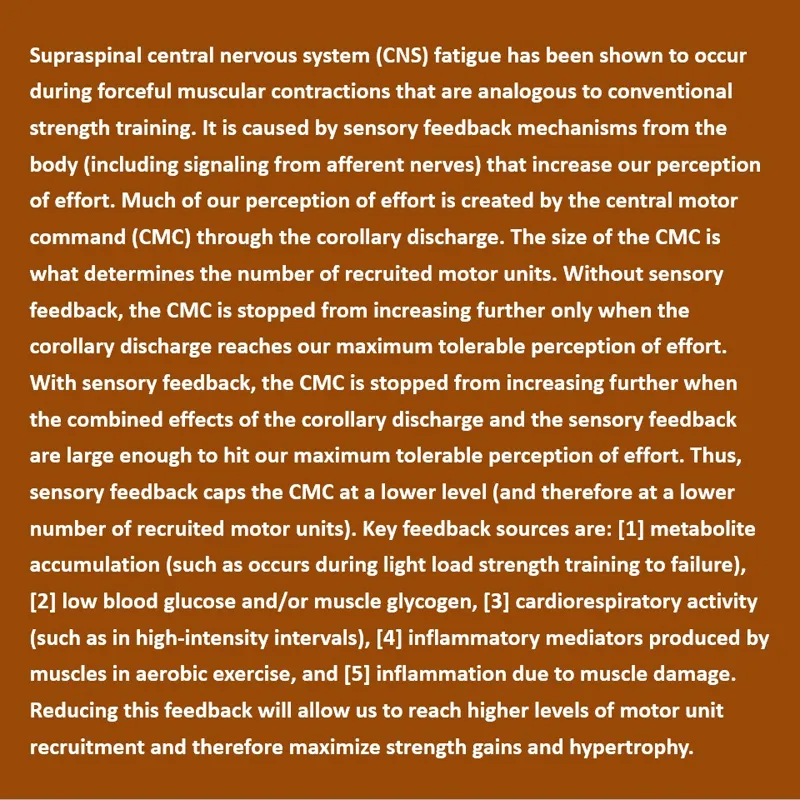
Can we ascribe this greater CNS fatigue after training with lighter loads to any specific fatigue mechanism? Supraspinal CNS fatigue is almost certainly greater after training with higher repetition ranges because of the greater sensory feedback created by the disagreeable sensations (read more).
.
Spinal CNS fatigue certainly also happens during strength training exercise. Whether it is greater when training with lighter loads compared to with heavier loads has not been directly investigated. Yet, we can infer that it should be greater because it seems to occur as a result of repeated motor neuron recruitment and obviously motor neurons are recruited for a longer duration of time when using lighter loads compared to when using heavier loads.
.
#4. How does load affect peripheral fatigue during strength training?
Peripheral muscular fatigue has also been observed during strength training. Also, it is has been documented to be greater after training with higher rep ranges compared to with lower rep ranges. While we tend to assume that metabolite-related fatigue is greater after training with lighter loads, this may not be valid when the loading is very light. Indeed, a key feature of metabolite-related fatigue is that metabolites are trapped in muscles by the occlusion of blood flow. When muscular contractions are sufficiently forceful, they compress the blood vessels, which prevents metabolites from escaping into the bloodstream. The metabolites then produce fatigue mechanisms. If muscular contractions fall below a certain level of force (approximately 25-30% of maximum force), then metabolites can escape once produced. In such cases, metabolite-related fatigue mechanisms cannot occur.
.
Moreover, we know that calcium ion-related fatigue in the form of excitation-contraction coupling failure is certainly more pronounced after exercises that involve lower forces and longer durations. It seems likely that the longer duration of time spent exercising provides the necessary time for calcium ion release (but not reuptake) to produce its fatiguing effects.
.
Conclusions
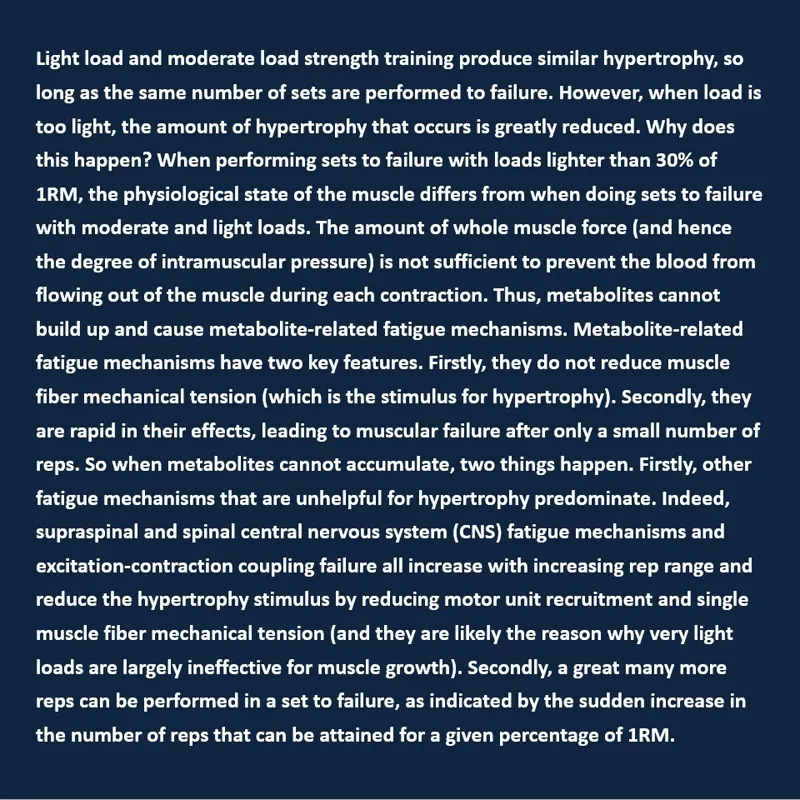
Light load and moderate load strength training produce similar hypertrophy, so long as the same number of sets are performed to failure. However, when load is too light, the amount of hypertrophy that occurs is greatly reduced. Why does this happen? When performing sets to failure with very light loads that are lighter than 30% of 1RM, the physiological state of the muscle differs from when doing sets to failure with moderate and light loads. Specifically, the amount of whole muscle force (and the subsequent degree of intramuscular pressure) is not sufficient to prevent the blood from flowing out of the muscle during each contraction. Hence, metabolites cannot build up and cause metabolite-related fatigue mechanisms. Metabolite-related fatigue mechanisms have two critical features. Firstly, they do not reduce muscle fiber mechanical tension (which is the stimulus for hypertrophy). Secondly, they are relatively rapid in their effects, leading to muscular failure occurring after only a small number of reps. Therefore, when metabolites cannot accumulate, two things happen. Firstly, other fatigue mechanisms that are unhelpful for hypertrophy predominate. Indeed, supraspinal and spinal central nervous system (CNS) fatigue mechanisms and excitation-contraction coupling failure all increase with increasing rep range and reduce the hypertrophy stimulus by reducing motor unit recruitment and single muscle fiber mechanical tension (and this is likely the reason why very light loads are largely ineffective for muscle growth). Secondly, a great many more reps can be performed in a set to failure, as indicated by the sudden increase in the number of reps that can be attained for a given percentage of 1RM.
Comments (2)
Great article - so does this mean that even if I progress the load with very light strength training there will be no hypertrophy? So if I can lift 10 load 60 times today to fatigue and eventually lift 15 load 60 times to fatigue there will be no muscle growth?
The amount of hypertrophy that occurs will gradually reduce as the rep range increases, yes. Eventually, the adaptations will switch from being hypertrophic to being purely endurance-related.