







Limitations of passive mechanical tension
Muscle fibers can produce pulling forces actively (through the binding of actin-myosin crossbridges) and passively (by the stretching of elastic structures). Both of these pulling forces can stimulate an adaptation that contributes to an increase in muscle fiber size.
.
#1. Passive stretch produces hypertrophy in animals without muscle activation
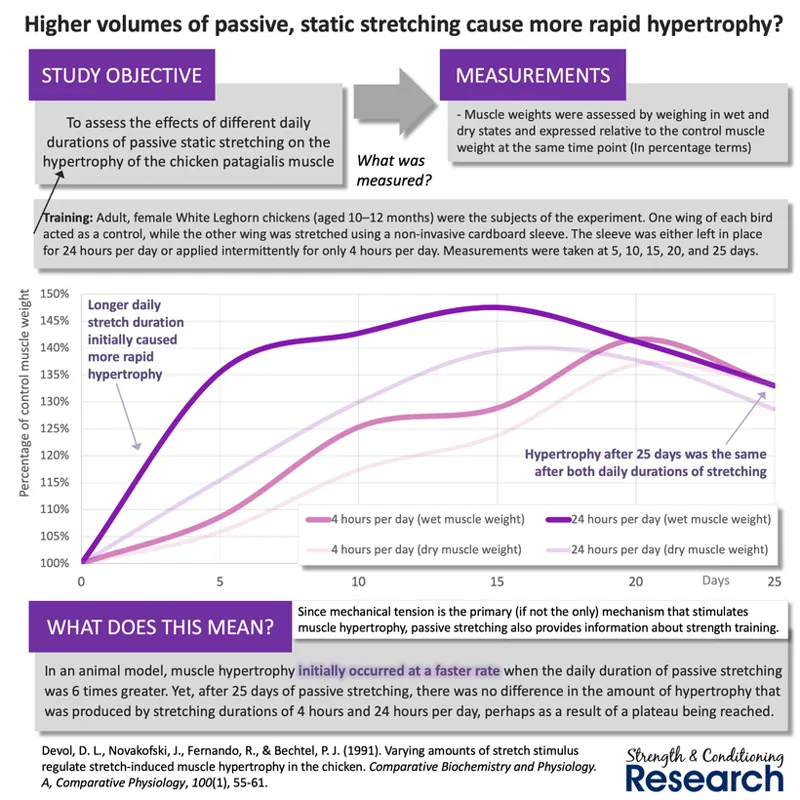
Many older studies have shown that passively stretching a muscle can produce hypertrophy in animals. Moreover, the volume of the static stretches affects the resulting hypertrophy, with greater volumes producing more muscle growth (in exactly the same way as greater volumes of strength training produce more hypertrophy).
.
One of the limitations of many of these studies was that the animal could still activate the stretched muscle from time to time. So it was not obvious whether the stretch was able to produce muscle hypertrophy in the absence of muscle fiber activation. Thus, it was very important when researchers discovered that the passive stretch of muscles could produce muscle growth when the muscle was denervated (which prevents muscle activation). This shows that mechanical tension stimulates hypertrophy in the absence of muscle activation.
.
#2. Passive stretch produces hypertrophy in humans without muscle activation
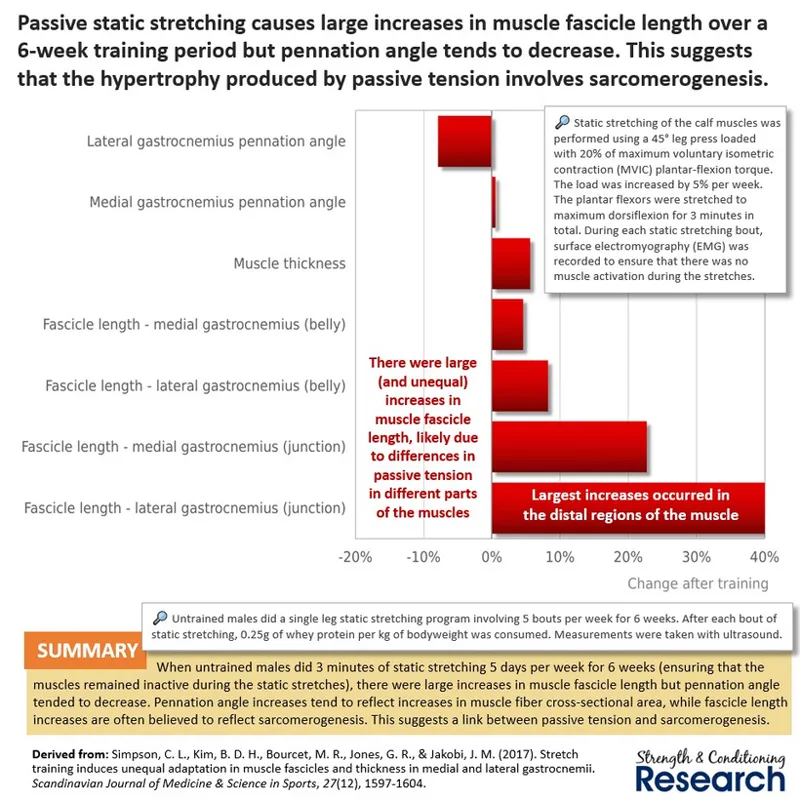
Recently, several groups of researchers have demonstrated that passive static stretching can produce hypertrophy in humans as well as in animals (although not all studies have found this effect, which is likely due to differences in stretch tolerance between subject populations).
.
Additionally, some of these studies have taken care to exclude the influence of muscle activation by applying surface electrodes to muscles during the stretches. This fits with the findings of animal models and shows that mechanical tension can stimulate muscle growth even when that passive force is not produced at the same time as muscle activation.
.
#3. Passive stretch only produces longitudinal hypertrophy
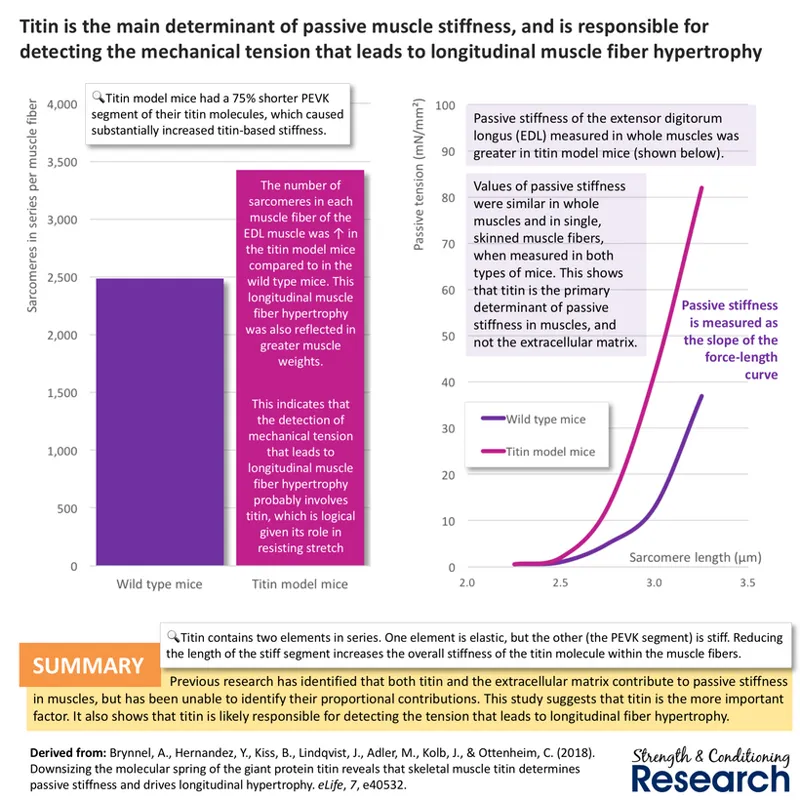
One interesting feature of passive stretching is that it stimulates muscle growth by causing muscle fibers to increase in length. This type of muscle growth is called "longitudinal hypertrophy," and it involves an addition of new sarcomeres in series. In contrast, strength training produces muscle growth by causing muscle fibers to increase in diameter.
.
This same observation has been made in humans, since the hypertrophy that occurs after static stretching predominantly comprises increases in muscle fascicle length, while pennation angle (which tends to increase in parallel with increases in muscle fiber diameter) does not increase.
.
Longitudinal hypertrophy seems to be stimulated when the stiff segment of titin is stretched and produces a high force. Titin is an important structure that runs adjacent to the myofibrils inside muscle fibers. It is structured in three segments in series (a compliant segment, a bridging segment, and a stiff segment). When muscle fibers are stretched passively, the compliant segment is stretched until it reaches its limit (which still produces very little force). After the compliant segment of titin has reached its limit, the stiff segment is stretched, and this generates a very high degree of force production.
.
#4. What determines the force produced during a passive stretch?
The force that is produced by the stiff segment of titin in a passive static stretch is determined by two key factors, both of which affect the extent to which the stiff segment is lengthened. Firstly, the extent to which the stiff segment is lengthened is determined by the stretch tolerance of the individual performing the static stretch. When we perform static stretches, we experience discomfort. This discomfort (and not the properties of the muscle) is what prevents us from stretching the muscle fibers beyond a certain length.
.
When stretch tolerance is low, the elongation of the sarcomere will also be low (and therefore passive tension will be low and little hypertrophy will occur). In contrast, when stretch tolerance is high, the elongation of the sarcomere will also be high (and therefore passive tension will be high and substantial hypertrophy will occur).
.
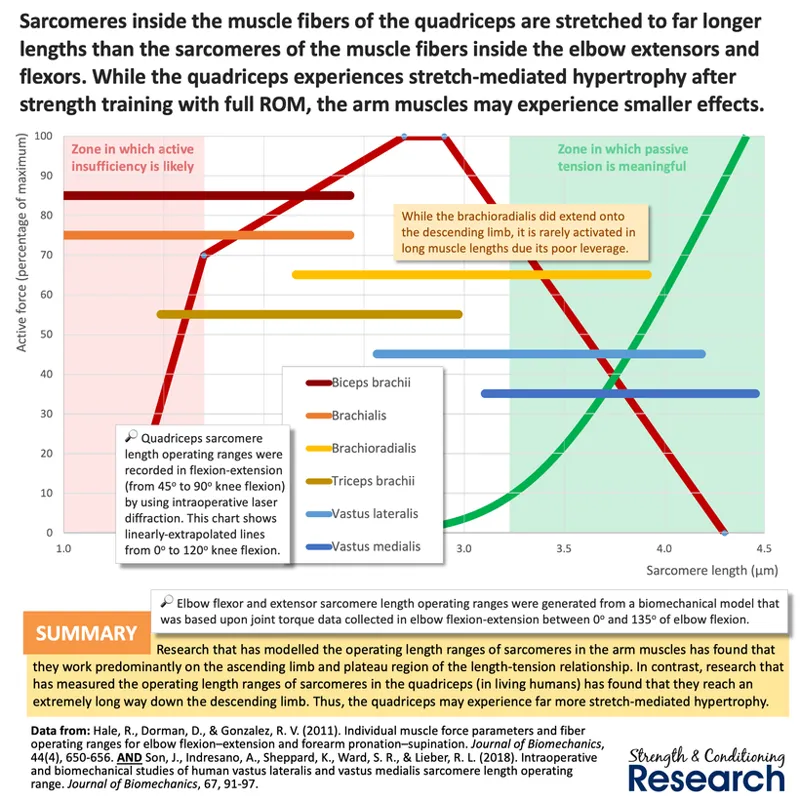
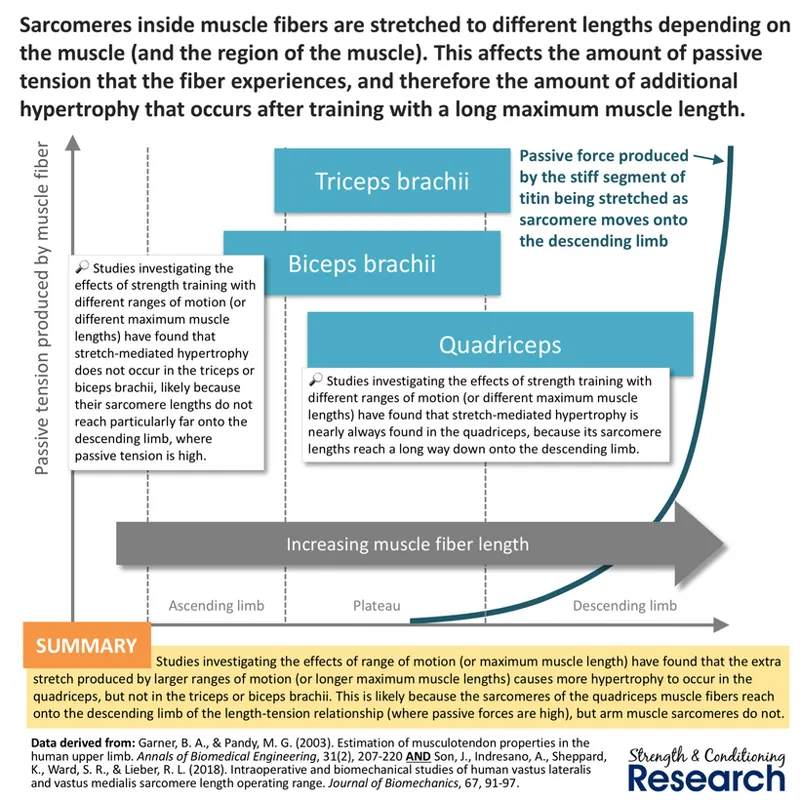
Secondly, the extent to which the stiff segment of titin is lengthened during a stretch is determined by the working length ranges of the sarcomeres when the muscle itself is lengthened. Indeed, research has shown that sarcomeres do not always reach very long lengths even when their muscle fibers are stretched to long lengths. Some muscles seem to contain muscle fibers with sarcomeres that reach very long lengths (which means that the stiff segment of titin is stretched a lot and so produces a high force), while other muscles seem to contain muscle fibers with sarcomeres that do not reach very long lengths (such that the stiff segment is not stretched very far, and so does not produce a high force).
.
When sarcomere elongation for a given amount of muscle lengthening is small (as occurs in the biceps and triceps brachii), the elongation of the sarcomere during a static stretch will be small (and therefore passive tension will be low and little hypertrophy will occur). In contrast, when sarcomere elongation for a given amount of muscle lengthening is large (as occurs in the quadriceps), the elongation of the sarcomere during a static stretch will be high (and therefore passive tension will be high and substantial hypertrophy will occur).
.
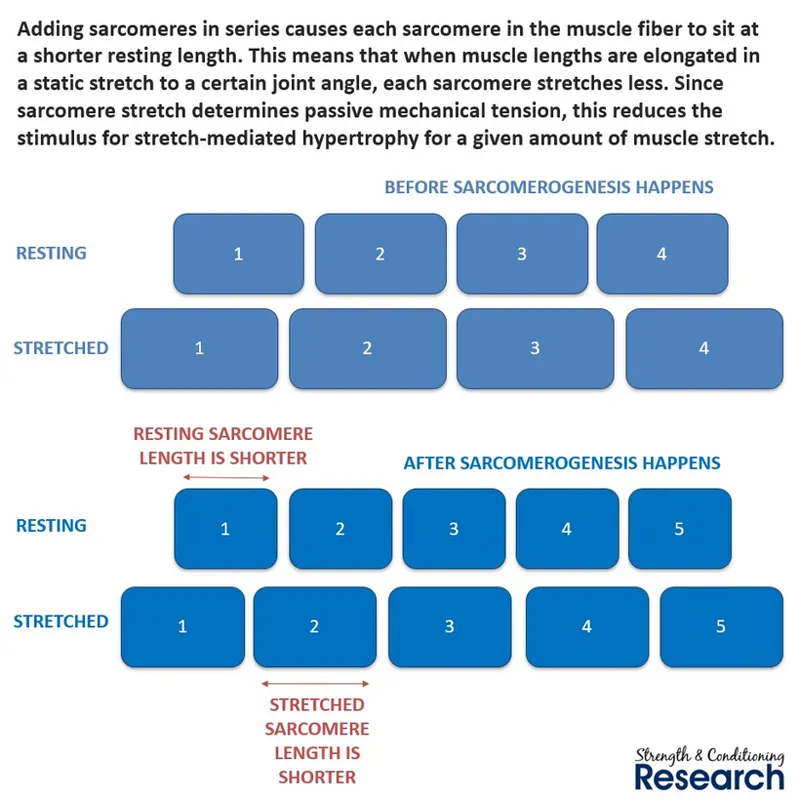
Indeed, this phenomenon can be observed after sarcomerogenesis happens because that causes the addition of more sarcomeres into a muscle fiber and hence each sarcomere stretches less for a given amount of muscle fiber lengthening.
.
Conclusions
Muscle fibers can produce pulling forces actively (by the binding of actin-myosin crossbridges) and passively (by the stretching of elastic structures). Both of these pulling forces stimulate an adaptation that contributes to an increase in muscle fiber size. Active mechanical tension causes the addition of myofibrils and passive mechanical tension stimulates the addition of sarcomeres in series. Importantly, passive mechanical tension that stimulates sarcomerogenesis can be created by static stretching in the absence of any muscle activation in both animal models and human studies. Even so, this passive mechanical tension is limited in two ways. Firstly, it is limited by the stretch tolerance of the individual who is stretching because stretch tolerance is the primary determinant of how far a muscle can be elongated during a static stretch. The elongation of the muscle is a key factor that determines the elongation of the elastic structures inside the muscle fibers that produce the passive mechanical tension that stimulates sarcomerogenesis. Secondly, it is limited by the working sarcomere lengths of the muscle fibers that are being stretched. The elastic structures that produce passive mechanical tension inside muscle fibers are arranged in individual sarcomeres. Muscle fibers can have different numbers of sarcomeres. When a muscle fiber has very many sarcomeres, each sarcomere is elongated less for a given amount of muscle fiber elongation. For this reason, not all individuals and not all muscles will experience the same amount of stimulus for the addition of sarcomeres during static stretching training programs.
Comments (3)
If you were to use static stretching, what dosage would you use, in terms of sets and time?
This is amazing. How substantial is the stretch mediated hypertrophy by comparison to the active form. I worry about the joint contact surfaces/osteoarthritis. Is it really worth gong to extreme joint positions in your opinion? Thanks!
How much hypertrophy occurs due to passive tension really depends on the amount of stretch, which is partly determined by the muscle and partly by the exercise. I don't think it is possible to provide a general rule. As regards joint loads, that is a very difficult question, because we don't currently have good models for showing what kinds of exercise/load/ROM cause the highest loads.