



Sarcoplasmic and myofibrillar hypertrophy
Many years ago, when researchers noticed that strength training with heavy loads tended to increase maximum strength relative to muscle size to a greater extent than strength training with moderate or light loads, they hypothesized that this could occur in part due to greater myofibrillar hypertrophy after heavy load strength training (representing a preferential increase in the relative amounts of actin and myosin myofilaments) and greater sarcoplasmic hypertrophy after light load strength training (representing a preferential increase in the amounts of sarcoplasmic, non-contractile elements).
.
#1. Myofibrillar density changes cannot explain gains in strength relative to size
When first researchers measured changes in maximum strength relative to size at the same time as changes in myofibrillar density, they soon discovered that there were meaningful changes in maximum strength relative to size even when there were no changes in myofibrillar density. This suggests that the original hypothesis was not valid, since other factors must explain the greater gains in maximum strength relative to muscle size, at least over short-term durations of strength training.
.
More recently, however, it has been shown that experienced lifters may display a greater density of myofibrils than untrained individuals. This suggests that very long periods of strength training may actually allow an increase in myofibrillar density, which could contribute to increased levels of maximum strength relative to size.
.
#2. Myofibrillar density changes do not differ between loads and volumes
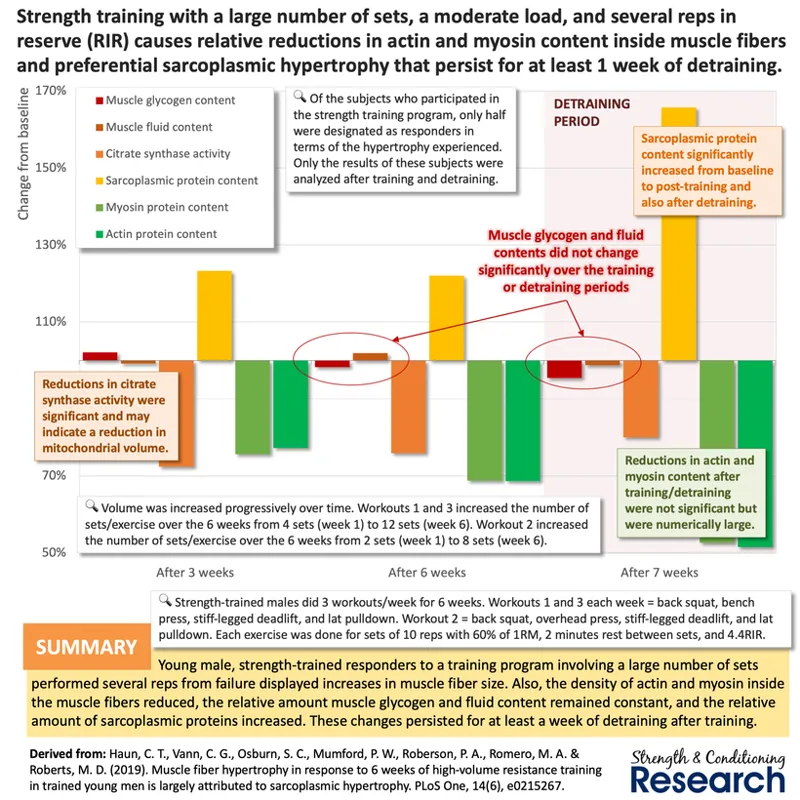
While early studies focused on the density of myofibrils inside muscle fibers, more recent studies have involved taking measurements of the changes in the relative amounts of myofibrillar proteins (actin and myosin) after strength training. In doing so, they noticed that the relative amounts of these proteins reduces after high volume, moderate load strength training, which suggests that preferential sarcoplasmic hypertrophy is occurring. Initially, this was regarded as a sign that the original hypothesis may have been correct, and that lighter load strength training had the potential to produce different hypertrophy from heavy load strength training.
.
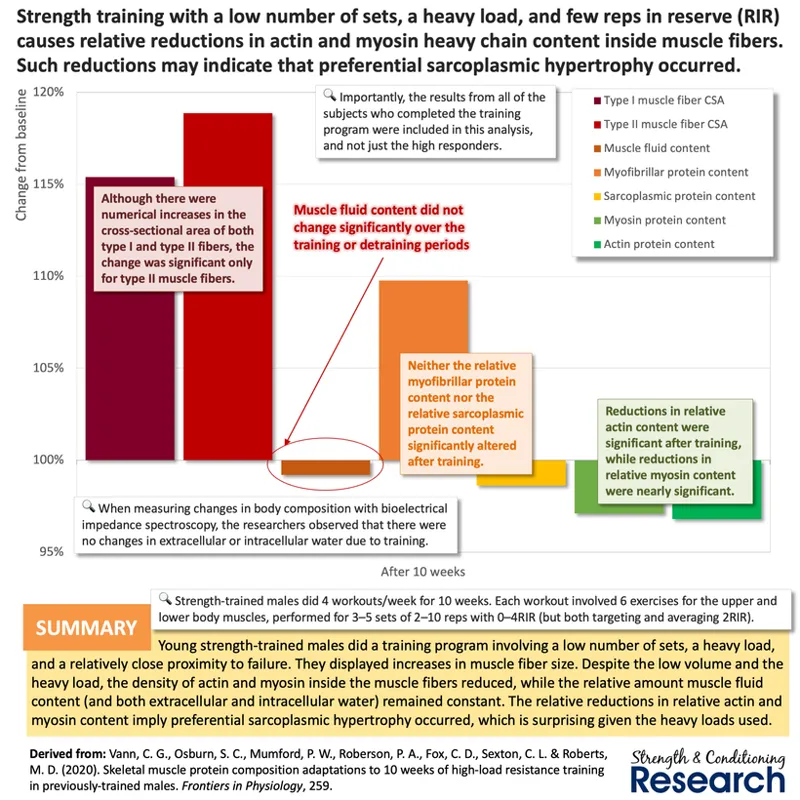
Nevertheless, a follow-up study by the same laboratory discovered that similar relative reductions in actin and myosin myofilament content also occurred after low volumes of heavy load strength training. This therefore suggests that preferential sarcoplasmic hypertrophy may only be a temporary phase that muscle fibers pass through before reverting to a normal density of myofibrils. It does not appear to be an adaptation that can be manipulated by using different types of strength training.
.
Generally, it is accepted that muscle fibers increase in size after strength training mainly due to increases in the number of myofibrils in parallel. Interestingly, some research suggests that this occurs when individual myofibrils split and form a larger number of smaller myofibrils. It seems likely that these smaller myofibrils then gradually grow until they are the same size as the original myofibrils that they split from. This process may explain the temporary increased amount of sarcoplasmic hypertrophy if the intermyofibrillar distance is altered slightly during this process.
.
Conclusions
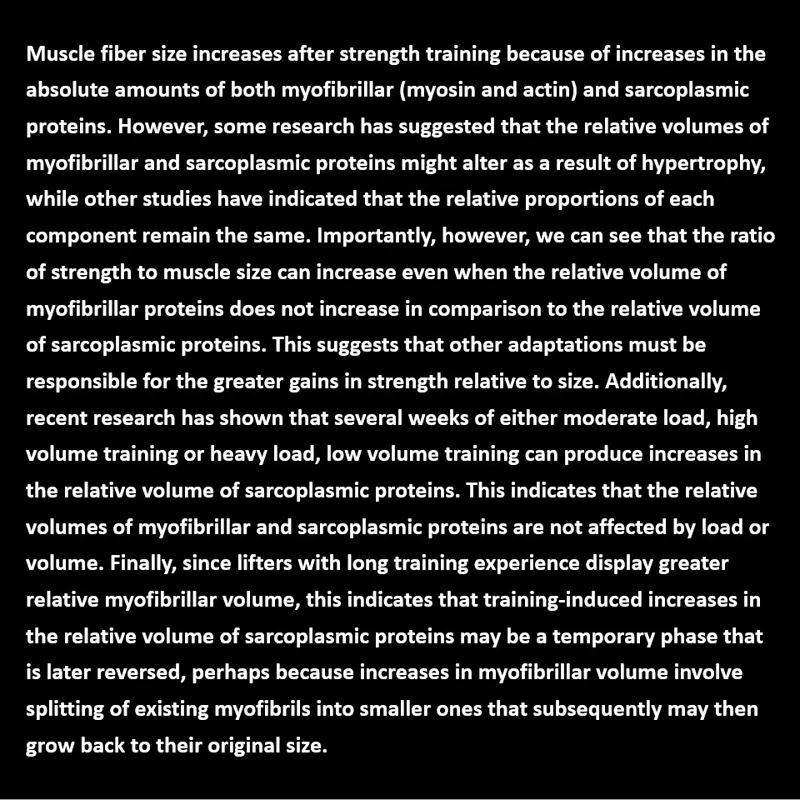
Muscle fiber size increases due to increases in the absolute volumes of both myofibrillar (myosin and actin) and sarcoplasmic proteins. Some research has suggested that the relative volumes of myofibrillar and sarcoplasmic proteins might change as a result of hypertrophy, while other studies have indicated that the relative proportions of each component remain the same. Importantly, however, we can see that the ratio of strength to muscle size can increase even when the relative volume of myofibrillar proteins does not increase in comparison to the relative volume of sarcoplasmic proteins. This suggests that other mechanisms are responsible for such gains in strength relative to size. Additionally, recent research has shown that several weeks of either moderate load, high volume training or heavy load, low volume training can produce increases in the relative volume of sarcoplasmic proteins. This indicates that the relative volumes of myofibrillar and sarcoplasmic proteins are not affected by load or volume. Finally, since lifters with long training experience display greater relative myofibrillar volume, this indicates that training-induced increases in the relative volume of sarcoplasmic proteins may be a temporary phase that is later reversed, perhaps because increases in myofibrillar volume involve splitting of existing myofibrils into smaller ones that subsequently may then grow back to their original size.
Comments (2)
Thank you Chris - you have been educating on transverse hypertrophy and longitudinal hypertrophy. Would either favor sarcoplasmic or myofibrillar hypertrophy? Also I believe I have seen "mitochondrial fractional synthetic rate." Is that included in sarcoplasmic hypertrophy? Thanks.
If we accept the hypothesis that an increase in the relative volume of sarcoplasmic proteins is a temporary phase that is later reversed (and that this is because increases in myofibrillar volume involve splitting of existing myofibrils into smaller ones that subsequently may then grow back to their original size), then transverse hypertrophy would favor sarcoplasmic hypertrophy at first, and then later it would favor myofibrillar hypertrophy. Sarcomerogenesis would not really favor either at any point.