





Pectoralis major
The pectoralis major is the main chest muscle with three main regions (clavicular, sternal, and costal) that have unique origins and insertions. Fortunately, there are studies that allow us to understand how to train each region.
.
#1. Internal moment arm lengths – sagittal plane flexion
The three regions of the pectoralis major have different origins but similar insertions on the humerus, much like the latissimus dorsi. The superior (clavicular) region originates on the medial half of the clavicle, the middle (sternal) region originates on the lateral side of the sternum, and the inferior (costal) region originates on the anterior sides of the upper six ribs. These regions have different internal moment arm lengths from one another. According to the principle of neuromechanical matching, this means that the regions will contribute differently to different exercises and movements. The superior (clavicular) region has good leverage for shoulder flexion, especially below shoulder height.
.
This is why we see very high levels of pectoralis major activation during front raises, because they are shoulder flexion exercises with range of motion limited to below shoulder height.
.
#2. Internal moment arm lengths – sagittal plane extension
In contrast, the inferior (costal) region of the pectoralis major is a surprisingly good shoulder extensor above shoulder height. It is likely the primary large contributor to shoulder extension in this range of motion, along with the triceps brachii long head and posterior deltoid.
.
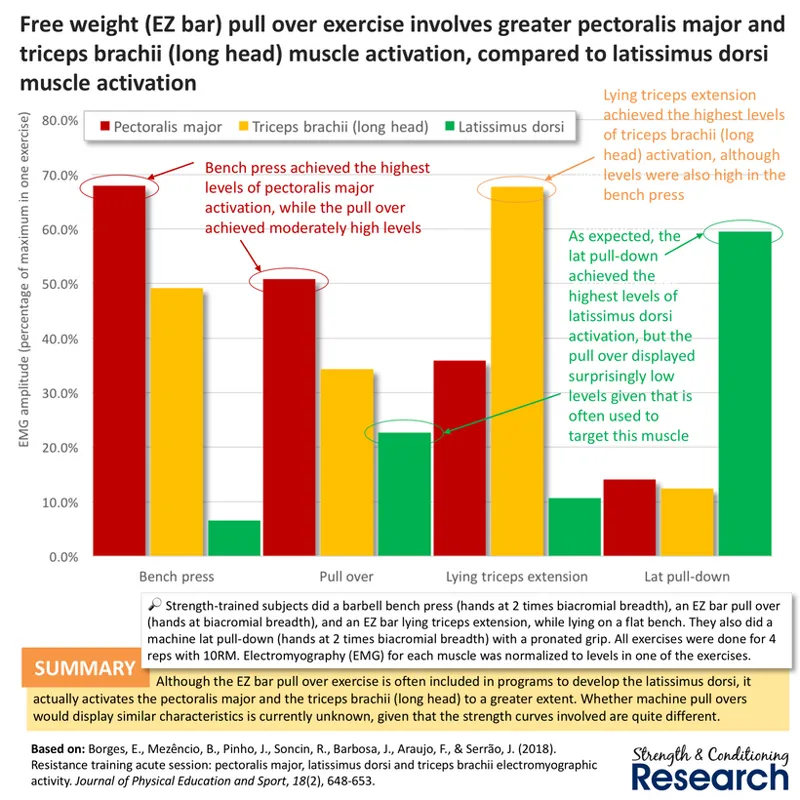
Indeed, this is why we see high levels of pectoralis major muscle activation during pullover variations, even though these are often considered to be a latissimus dorsi exercise.
.
#3. Internal moment arm lengths – frontal plane adduction
The middle (sternal) and inferior (costal) regions are very good shoulder adductors. Even so, they tend to be overshadowed by the latissimus dorsi except when the arms are very close to the sides of the body. Thus, they will work better in frontal plane standing cable cross-overs in comparison to in wide-grip pull-downs.
.
Muscle activation data support the findings from the internal moment arm lengths. The lower regions of the pectoralis major are good shoulder adductors, while the upper region is not.
.
#4. Internal moment arm lengths – transverse plane
The pectoralis major contributes substantially to horizontal flexion in the transverse plane, which is why the pec deck exercise is described as such.
.
#5. Direction of force production
Historically, it has often been argued that the direction of force application during pressing movements can alter the relative contributions of the various regions of the pectoralis major. Altering the direction of force application and/or the degree of shoulder external rotation during horizontal flexion essentially replicates the effects of switching between incline, flat, and decline bench presses. Indeed, when the shoulder is in a greater degree of external rotation (corresponding to a more inclined bench press), the superior (clavicular) region of the pectoralis major is more strongly activated.
.
Indeed, there is some (comparatively weak) evidence that the incline bench press does lead to greater superior (clavicular) region muscle growth in comparison with other bench press variations. This suggests that this region is preferentially developed after horizontal flexion movements when the shoulder is more externally rotated.
.
#6. Stretch-mediated hypertrophy
The current data regarding the operating sarcomere length ranges of the pectoralis major indicate that all three regions probably do experience stretch-mediated hypertrophy.
.
There are limited training data to support this observation. However, static stretching does lead to a preferential increase in maximum strength at long muscle lengths, which is an indicator of increases in muscle fascicle length altering the joint torque-angle curve.
.
#7. Recovery
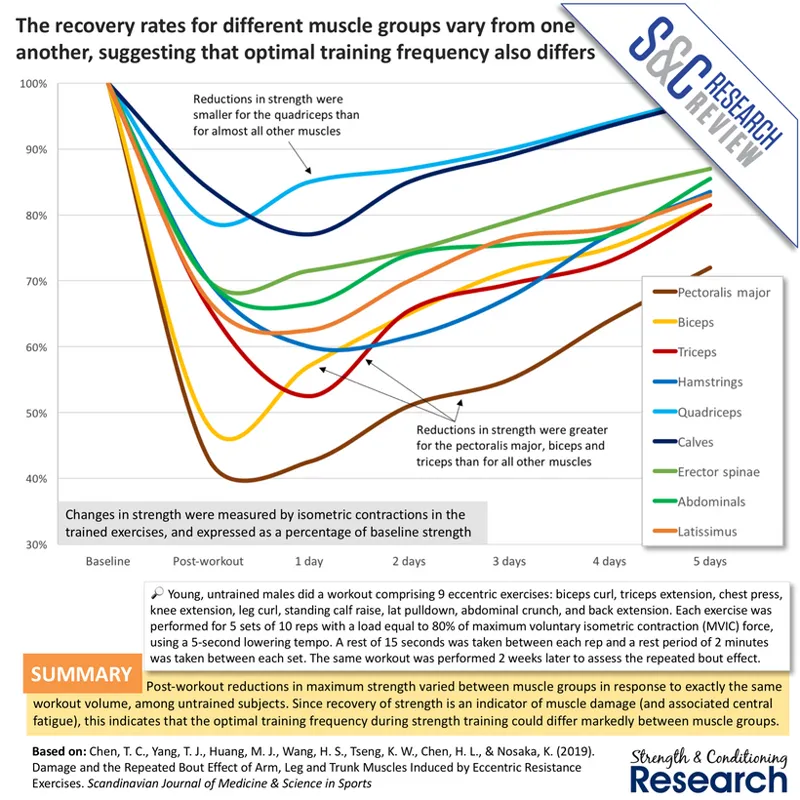
The pectoralis major recovers much more slowly than most of the other muscles in the body, even though it is not typically a muscle that often experiences a great deal of delayed onset muscle soreness (DOMS). Indeed, this is a good example of why using DOMS to infer recovery status is not particularly helpful. Nevertheless, this suggests that for the pectoralis major, the optimal training frequency for a given amount of workout volume will be lower than for workouts that target other muscle groups.
.
The pectoralis major likely recovers slower than most other muscles due to the extremely high proportion of fast twitch muscle fibers that it contains. Fast twitch muscle fibers are more easily damaged after exercise because they have fewer mitochondria. Thus, they experience greater damage from the calpains (proteases) that are released in response to the influx of calcium ions during exercise.
.
Conclusions
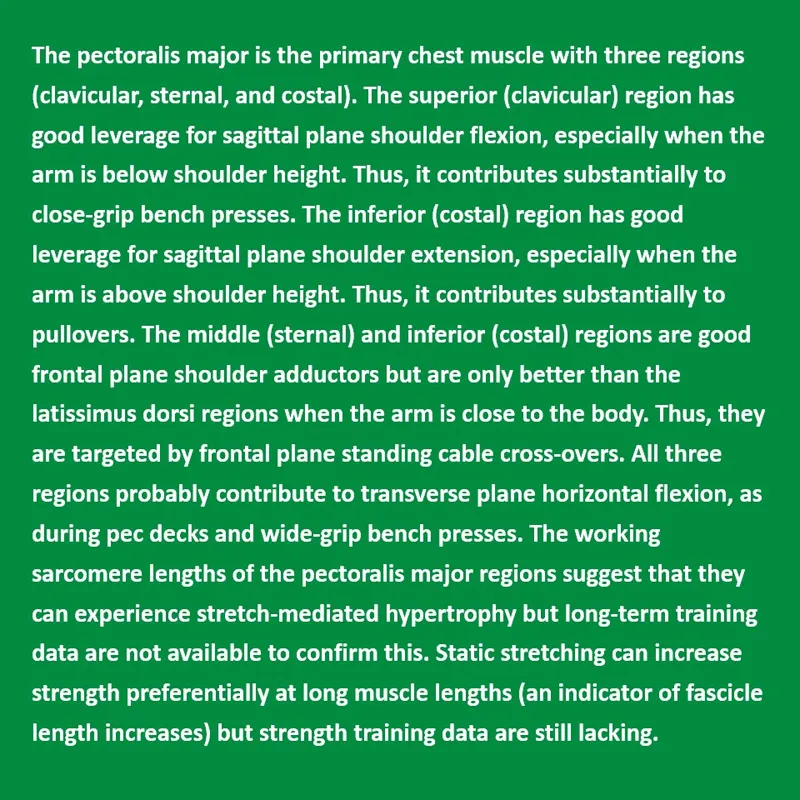
The pectoralis major is the primary chest muscle with three regions (clavicular, sternal, and costal). The superior (clavicular) region has good leverage for sagittal plane shoulder flexion, especially when the arm is below shoulder height. Thus, it contributes substantially to close-grip bench presses. The inferior (costal) region has good leverage for sagittal plane shoulder extension, especially when the arm is above shoulder height. Thus, it contributes substantially to pullovers. The middle (sternal) and inferior (costal) regions are good frontal plane shoulder adductors but are only better than the latissimus dorsi regions when the arm is close to the body. Thus, they are probably best targeted by frontal plane standing cable cross-overs. All three regions probably contribute to transverse plane horizontal flexion, as during pec decks and wide-grip bench presses. The working sarcomere lengths of the pectoralis major regions suggest that they can experience stretch-mediated hypertrophy but long-term training data are not available to confirm this. Static stretching can increase strength preferentially at long muscle lengths (an indicator of muscle fascicle length increases) but strength training data are still lacking.
Comments (6)
Hey Chris, in your conclusion, you state that greater external rotation leads to more activation of the clavicular region of the pectoralis major. However, this does not align with #3, where the highest clavicular-to-sternocostal activation ratio is observed in the neutral shoulder position, not in external rotation. Could you clarify this discrepancy?
Hey Chris - could you clarify - in section #3 you wrote that external rotation increases clavicular pec major activation but in the study is just says a more oblique and upward action would cause this. In the study as external rotation increases (bar the H0 position), clavicular pec activation goes down. Is it because the externally rotated position would better allow that force direction when using weights?
Hey, Chris! I love these practical applications of muscle training. But I did not understand the part about training the upper portion of the pec major. At first you say that close grip bench press is better for clavicular activation but at the end of the post you say that incline with more externally rotated shoulders is more effective for that region. As I understood, by saying "greater external rotation" you mean more abducted arms? But that contradicts with close grip bench press where there is more internal rotation. Could you please explain?
Shoulder external rotation is not the same as shoulder abduction. We can externally rotate the shoulder to perform a close grip incline press. In a flat bench press, the shoulder is not more internally rotated with a close grip than with a wide grip.
Great article! May I ask you; Is there any data regarding the degree of the adducted position of an elbow during a pressing (horizontal flexion) movement and its influence on the pec activation? Some people suggest that you need to have a more adducted position during pressing if you want to activate your pecs the most, others suggest the contrary (90 degrees between your humerus and torso).
Do you mean the degree of shoulder horizontal flexion? If so, it's not completely clear. But in pressing, the pectoralis major is definitely more involved in the lower half of the concentric phase.