






Pressing variations
Pressing variations (bench presses, incline bench presses, and overhead presses) are often used to develop the pectoralis major, anterior deltoid, and triceps brachii. But how does the pressing variation affect which of the prime movers contributes the most?
.
#1. Bench incline
Using a steeper bench incline shifts the focus of the press away from the pectoralis major and towards the anterior deltoid. Thus, horizontal bench presses are better for training the pectoralis major, while vertical presses are best for training the anterior deltoid. Sometimes (but not always) the clavicular head of the pectoralis major is activated more by steeper bench inclines, while the sternal and costal heads of the pectoralis major are sometimes activated more by horizontal (or a decline) bench inclines.
.
Moreover, long-term training studies have shown that there are differences in the regional hypertrophy that occurs after strength training with different bench press inclines. The steeper bench press inclines are associated with greater clavicular (upper) pectoralis major muscle growth, while the horizontal bench press tends to produce proportionally more sternal (middle) and lower (costal) pectoralis major muscle growth.
.
#2. Range of motion
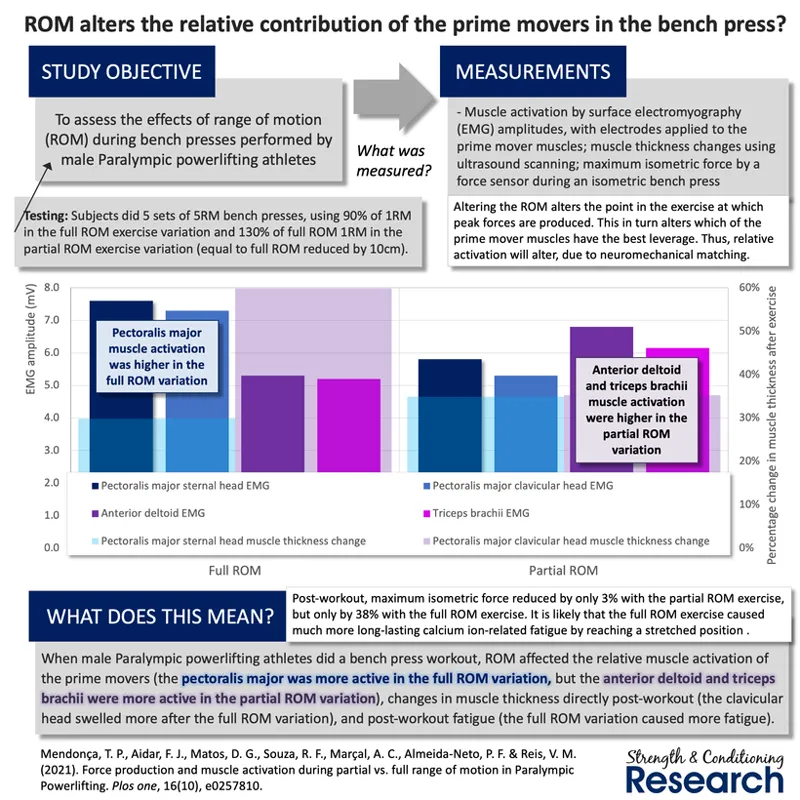
Working in the range of motion closest to the body shifts the focus of the press towards the pectoralis major and away from the anterior deltoid. Thus, full ranges of motion or working in the bottom half of the normal bench press range of motion (such as when performing a reverse pin press) are better for training the pectoralis major, while partial range of motion bench presses are better for training the anterior deltoid.
.
#3. Grip width (wide or narrow)
When lifters use a wider grip in the bench press, this tends to increase the muscle activation of the sternal head of the pectoralis major and of the anterior deltoid, while also reducing the clavicular head of the pectoralis major.
.
Moreover, the triceps brachii is also increased when using narrow grip bench presses (in addition to the anterior deltoid). This appears to be because the narrow grip involves a greater elbow extension net joint moment, while the wide grip involves a greater shoulder flexion net joint moment. These net joint moments are caused by differences in the external moment arm lengths of the barbell due to the differing hand positions.
.
#4. Forearm position (supinated or pronated)
Although the reverse grip bench press is much less popular than the standard grip bench press, research has demonstrated that it can increase the contribution of the clavicular head of the pectoralis major during wide grip bench presses, while leaving the activation of the sternocostal head unchanged.
.
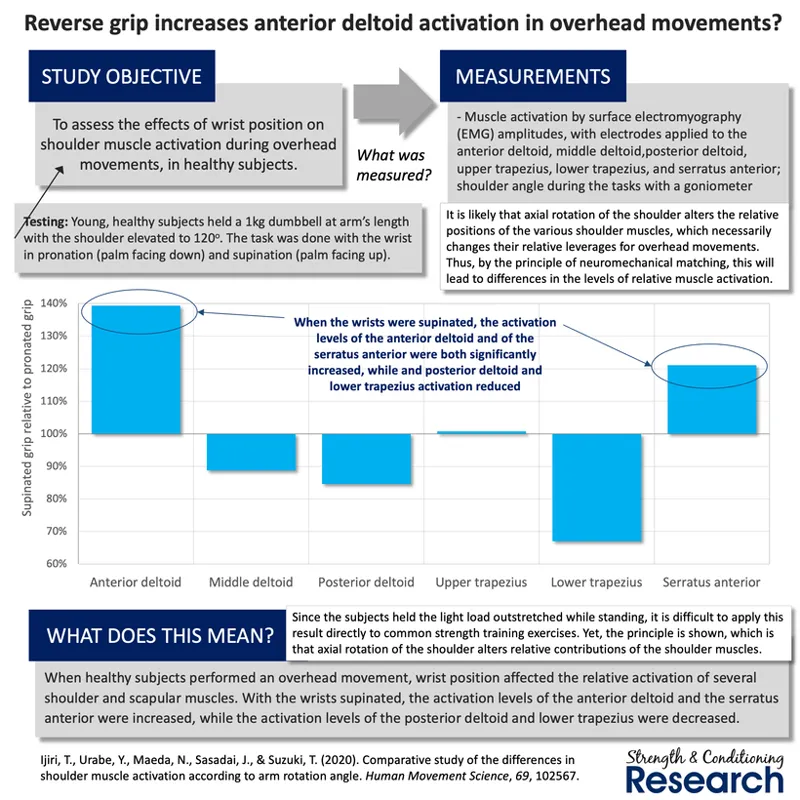
Additionally, some more recent research has suggested that using the reverse grip may also increase the relative contribution of the anterior deltoid during overhead movements. Whether this applies to pressing variations of all inclines has yet to be confirmed.
.
#5. Stability
Pressing variations can be performed in various ways, with varying degrees of stability. Some of those variations involve more externally-provided stability than others. For example, machine exercises and push ups involve much more stability than free weight bench presses, even though the movement pattern itself is very similar. The nature of the stability seems to affect the relative involvement of the prime movers, because some of the prime movers (or their antagonists) can help provide stability as well as producing the movement itself. In the case of the bench press, the anterior deltoid is a prime mover that provides stability in the sagittal plane, and therefore it is more active in the free weight bench press than in the push up.
.
Nevertheless, the nature of the stability is important and it affects which muscle is more strongly activated. For example, when bench presses are done with an unstable, flexible bar load, there is an increase in the activation of the middle deltoid and of the biceps brachii, but there is no similar increase in the activation of the anterior deltoid. Thus, which direction requires stabilization (sagittal plane or frontal plane) probably affects which muscle is called upon to provide stability.
.
Conclusions
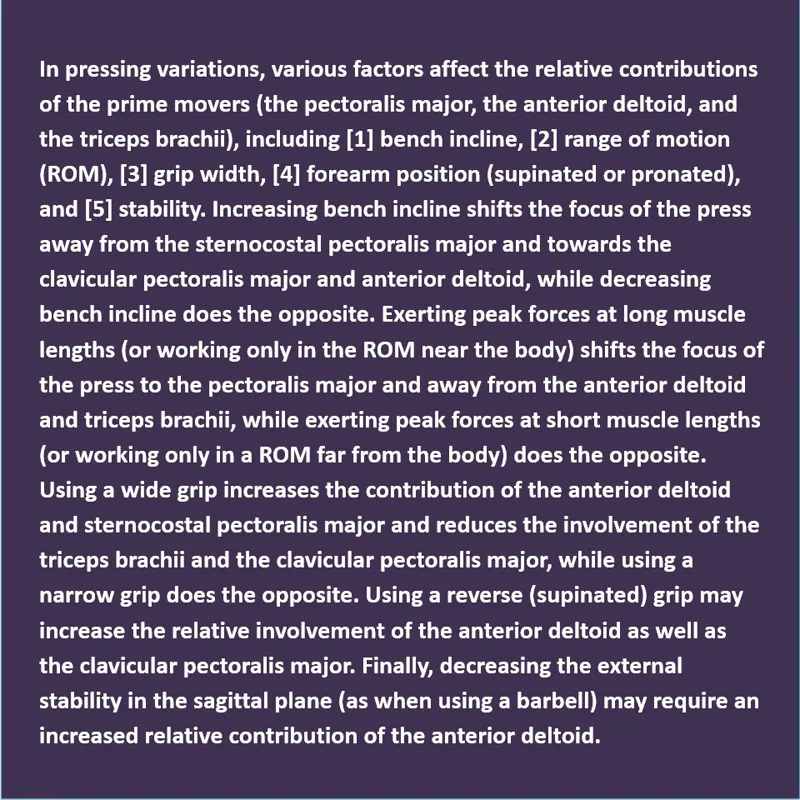
In pressing variations, various factors affect the relative contributions of the prime movers (the pectoralis major, the anterior deltoid, and the triceps brachii), including [1] bench incline, [2] range of motion (ROM), [3] grip width, [4] forearm position (supinated or pronated), and [5] stability. Increasing bench incline shifts the focus of the press away from the sternocostal pectoralis major and towards the clavicular pectoralis major and anterior deltoid, while decreasing bench incline does the opposite. Exerting peak forces at long muscle lengths (or working only in the ROM near the body) shifts the focus of the press to the pectoralis major and away from the anterior deltoid and triceps brachii, while exerting peak forces at short muscle lengths (or working only in a ROM far from the body) does the opposite. Using a wide grip increases the contribution of the anterior deltoid and sternocostal pectoralis major and reduces the involvement of the triceps brachii and the clavicular pectoralis major, while using a narrow grip does the opposite. Using a reverse (supinated) grip may increase the relative involvement of the anterior deltoid as well as the clavicular pectoralis major. Finally, decreasing the external stability in the sagittal plane (as when using a barbell) may require an increased relative contribution of the anterior deltoid.