




Post-workout inflammation
After a strength training workout, there is often an inflammatory response. This inflammatory response plays an important role in post-workout fatigue. It also plays a key role in muscle damage repair, which impacts on hypertrophy.
.
#1. After muscle-damaging exercise, there is an inflammatory response
Many studies have described an inflammatory response after muscle-damaging exercise that is related to the amount of muscle damage (and post-workout fatigue) that is experienced. The inflammatory response begins a couple of hours after exercise, and can last for several days.
.
The inflammatory response comprises multiple phases involving different immune cells. First of all, there is an influx of neutrophils. Secondly, these neutrophils then trigger the release of lysosomal enzymes and macrophages. Some research has linked the inflammatory response to the sensation of delayed onset muscle soreness (DOMS) but this is by no means a universal finding.
.
#2. The post-workout inflammatory response causes supraspinal CNS fatigue
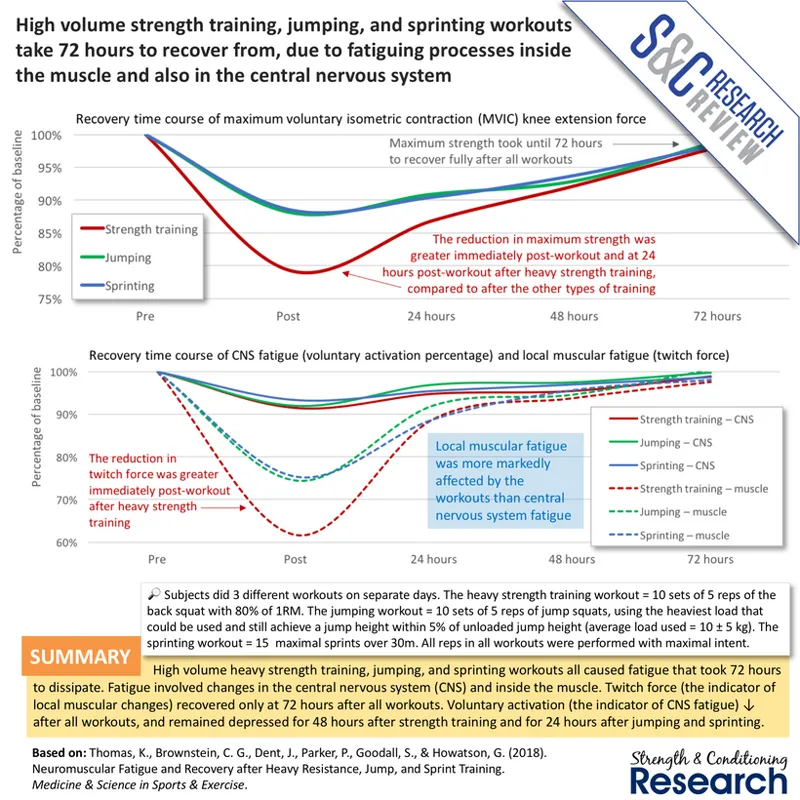
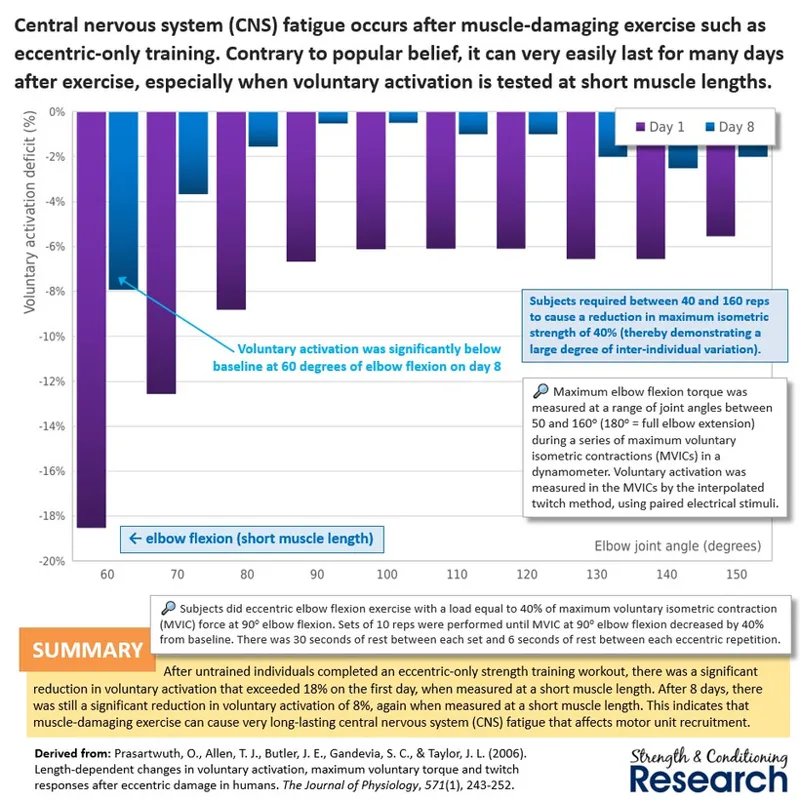
This inflammatory response appears to be the cause of the post-workout supraspinal central nervous system (CNS) fatigue that has been observed for several days after conventional strength training workouts (and for even longer after more muscle-damaging eccentric training workouts).
.
This happens because there are various feedback pathways through which the inflammatory response can provide information to the brain and thereby increase the perceived level of effort. By doing this, they reduce the amount of corollary discharge that can be produced by the central motor command, which in turn reduces the central motor command itself. This phenomenon has been well-described during aerobic exercise, but the same thing can easily occur after muscle-damaging exercise as well, since the inflammatory responses are very similar.
.
#3. The post-workout inflammatory response causes more muscle damage
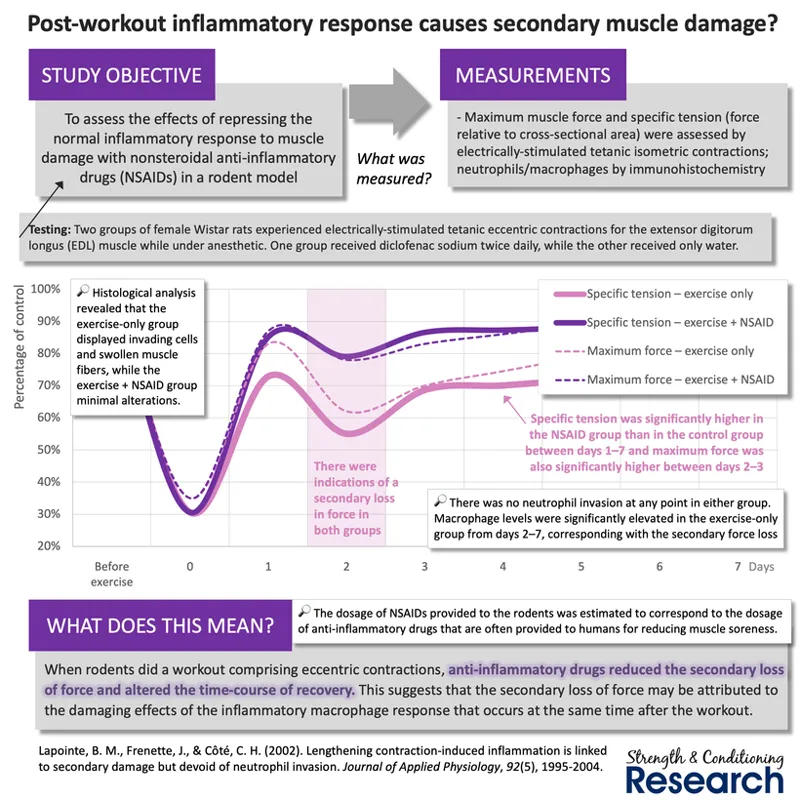
The post-workout inflammatory response causes a second wave of muscle damage. The initial neutrophil response triggers the release of lysosomal enzymes and macrophages. These act to remove damaged areas of the muscle fiber, and in this way cause further muscle damage.
.
In this respect, the macrophage response appears to be particularly important. Researchers have shown that when the macrophage response is suppressed by NSAID drugs, this causes a much more rapid recovery of strength after an eccentric training workout. Moreover, the secondary loss of strength is much smaller when this macrophage response is suppressed, indicating that the macrophages are likely the major player in this additional fatigue.
.
As well as stimulating the release of lysosomal enzymes and macrophages, neutrophils are also able to stimulate the release of reactive oxygen species (ROS), which can damage the muscle fiber cell membrane. Thus, there are several key components of the secondary loss in strength after exercise.
.
Indeed, a close relationship between the production of ROS and muscle damage has been observed in several studies. Thus, to the extent that the inflammatory response causes the production of oxidative stress, this could lead to additional muscle damage.
.
#4. Inflammation is also a key phase in the muscle damage repair process
The inflammatory response appears to be important for the repair of muscle damage. Additionally, it seems to be necessary for muscle damage repair to occur before hypertrophy can occur. When the macrophage response is prevented prior to a period of reloading after deloading (which would typically cause both muscle damage and hypertrophy), the rate of muscle cell membrane repairs is reduced and the rate of hypertrophy is also reduced.
.
And this would then explain why anti-inflammatory pharmaceuticals can reduce the amount of hypertrophy that occurs after strength training. They stop the inflammatory response from performing its customary roles in removing damaged areas of the muscle fiber and subsequently repairing it. For this reason, the affected muscle fibers cannot then respond normally to the hypertrophic stimulus, and they therefore fail to grow to the same extent.
.
#5. Post-workout CNS fatigue is linked to post-workout muscle damage
Given that the inflammatory response to muscle damage appears to be the driver of post-workout CNS fatigue, we would therefore expect overall post-workout fatigue and post-workout CNS fatigue to be very closely linked. Indeed, workouts that produce a couple of days of post-workout fatigue also always produce a couple of days of post-workout CNS fatigue.
.
Conversely, eccentric workouts that are extremely muscle-damaging and therefore produce a week's worth of post-workout fatigue also produce a week's worth of post-workout CNS fatigue.
.
Conclusions
After muscle-damaging exercise, there is an inflammatory response that begins a couple of hours post-workout. While it is unclear whether this inflammatory response is involved in producing delayed onset muscle soreness (DOMS), it does seem to be the cause of the post-workout central nervous system (CNS) fatigue that can occur for days after strength training workouts. The inflammatory response provides feedback to the brain (possibly via the bloodstream) and increases the perception of effort that corresponds to a given level of central motor command, thereby creating supraspinal CNS fatigue. The inflammatory response also seems to cause a second wave of damage. Lysosomal enzymes, macrophages, and oxidative stress (likely partly stimulated by neutrophils) attack or degrade muscle fiber proteins. Consequently, suppressing the inflammatory response can lead to quicker post-workout strength recovery, as the size of the secondary muscle damage is reduced. Nevertheless, the inflammatory process is also key to the process of muscle damage repair and hence affects the extent to which hypertrophy can occur. Suppressing the inflammatory response by means of anti-inflammatory drugs does reduce the muscle growth that occurs during a period of reloading following deloading.
Comments (4)
how can we maximise the inflammatory response post exercise in our favor
Hey Chris! Do you include "Cold Therapy" by means of icing an "anti-inflammatory" of similar hypertrophic inhibition as "anti-inflammatory drugs"? The reason i ask is because you mention "anti-inflammatory drugs" as the source here. If I understand correctly, ANY anti-inflammatory technique would mess with the repair process, limiting hypertrophic benefits, but could possibly increase output in the short term if that's the prioritized goal (if the training frequency or other variables couldn't be adjusted in the scenario), right? Thank you!
Hello Chris - you've stated that muscle damage and metabolic stress are irrelevant to hypertrophy - does this mean I can reach my muscular genetic potential without soreness/damage? So maybe attempt to stop all sets 2 or 3 repetitions before task failure?
Yes, we can reach our maximum muscular potential without producing lots of muscle soreness or muscle damage. Training with 2RIR most of the time is a great way to reduce muscle soreness and muscle damage.