






Time course of strength gains
Gains in maximum strength occur due to multiple different adaptations. These adaptations occur at different rates, which means that they contribute to a greater or lesser extent at different points in time. Indeed, for example, it is quite widely-accepted that coordination contributes substantially in the early phases of a training program, but contributes to a much smaller extent later on, once the relevant exercises or movement patterns have been mastered.
.
#1. Coordination improvements
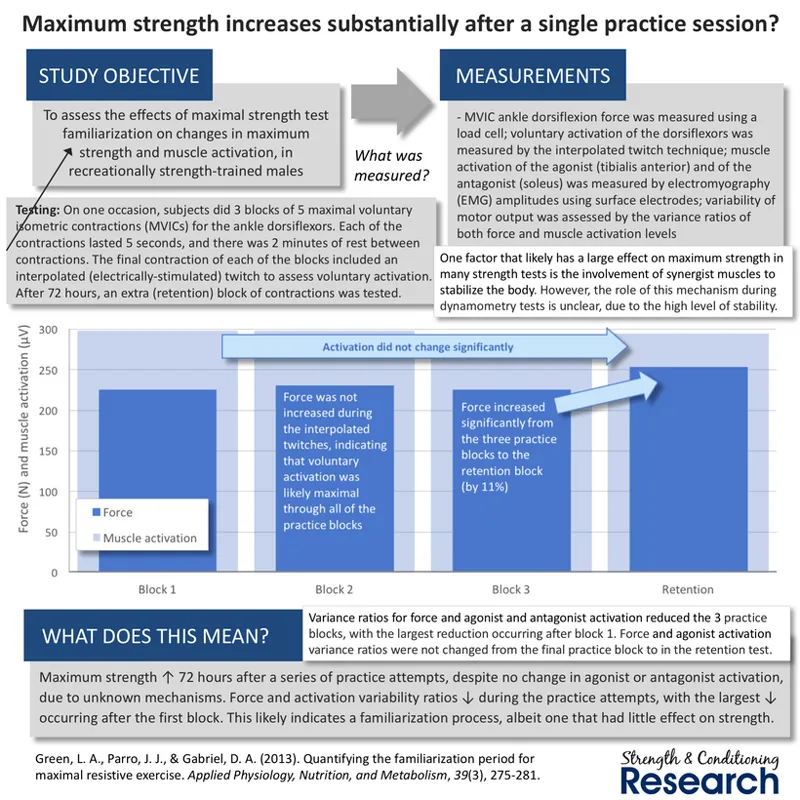
Gains in maximum strength due to improved coordination occur very rapidly. In fact, they have even been identified as occurring after a single practice session. Such improvements in coordination likely continue for days and even weeks thereafter (and almost certainly for even longer when an exercise is very complex). However, the greatest impact of changes in coordination on gains in maximum strength seems to be in the first week or two of training.
.
#2. Increases in motor unit recruitment
Maximum strength can be increased by an increase in the ability to recruit high-threshold motor units (which is measured by reference to changes in voluntary activation). Increases in the ability to recruit high-threshold motor units increase strength because they allow more muscle fibers to contribute to a muscular contraction. An increase in the ability to recruit high-threshold motor units is very different from an improvement in coordination. Changes in coordination are rapid and very task-specific. In contrast, increases in the ability to recruit high-threshold motor units are slightly slower and not at all task-specific. This is why the strength gains that occur at the very start of a strength training program are extremely task-specific, and gains in strength in untrained exercises that use the same muscle group are often not observed.
.
Nevertheless, after strength training programs lasting >4 weeks, there are almost always increases in the ability to recruit high-threshold motor units, as measured by changes in voluntary activation. This leads to gains in strength in other exercises that use the same muscle group, since improvements in voluntary activation produce strength gains that are not at all task-specific.
.
#3. Reductions in antagonist coactivation
Antagonist coactivation is the extent to which the antagonist (opposing) muscle produces a braking force while the agonist (working) muscle is producing a movement. Reductions in antagonist coactivation can therefore contribute to strength gains. Curiously, antagonist coactivation rarely alters after short-term training, but there is evidence that it may be reduced in individuals with a long history of strength training. This suggests that this adaptation might be a very slow one that takes years to occur.
.
#4. Increases in tendon stiffness
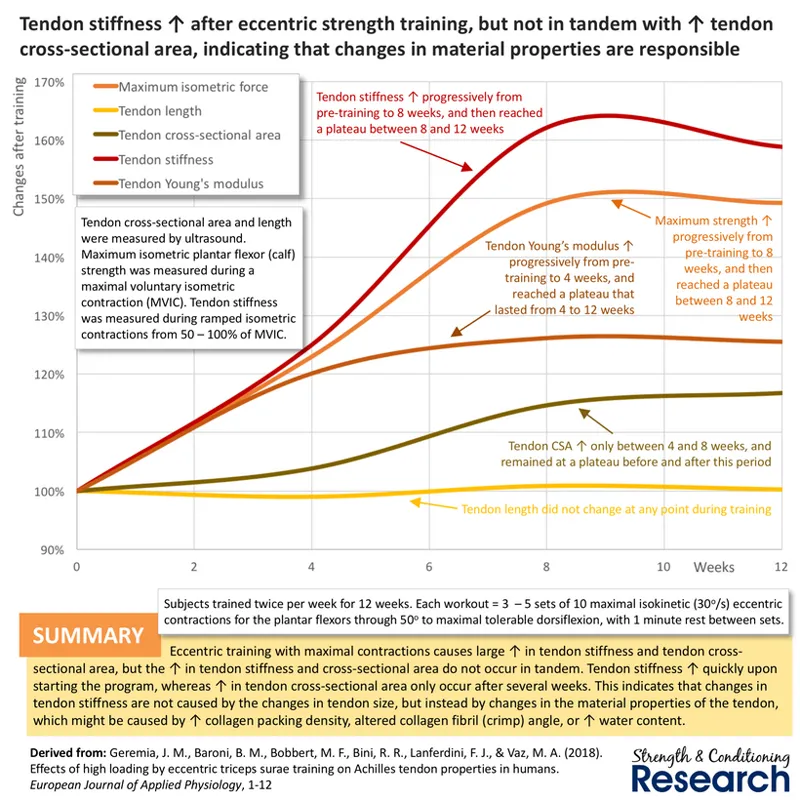
In isometric and concentric-only contractions, a higher level of tendon stiffness is beneficial for force production. When the tendon is very stiff, the muscle shortens in tandem with the joint angular movement. In contrast, when the tendon is more compliant, it lengthens at the start of the muscular contraction. Consequently, the muscle shortens faster than the joint angular movement. This faster muscle shortening leads to reduced force production, because of the force-velocity relationship. Interestingly, tendon stiffness increases relatively rapidly during strength training, and reaches a plateau after only a couple of months of training.
.
#5. Increases in lateral force transmission capacity
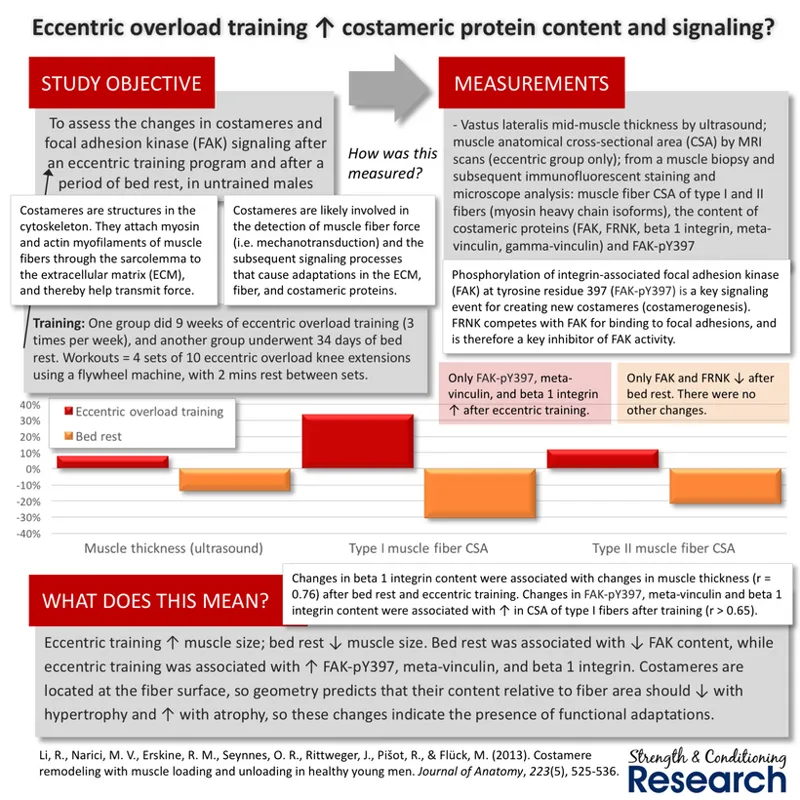
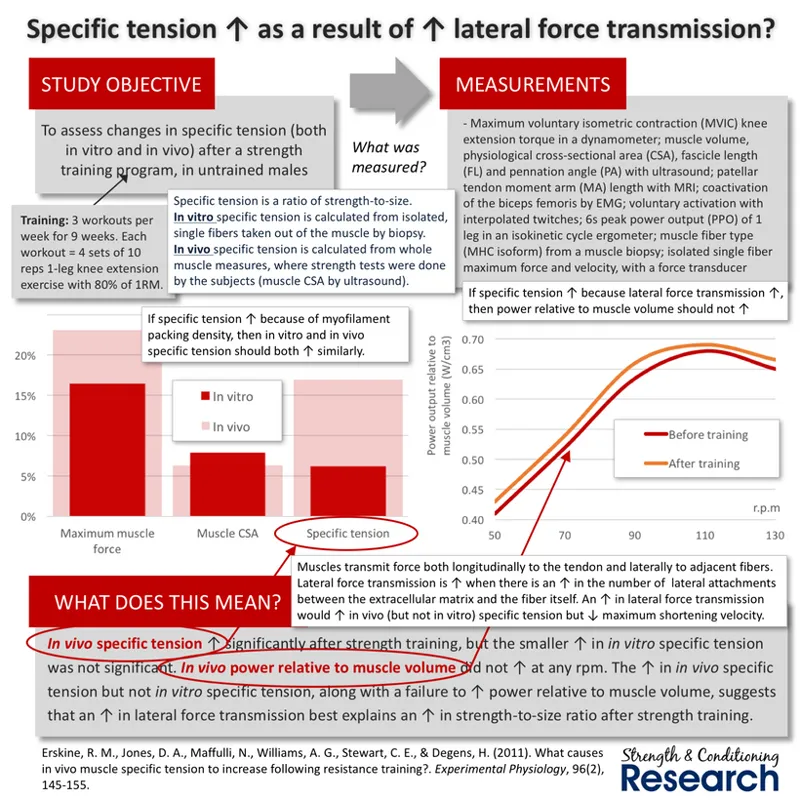
Muscle fibers transmit most of their force laterally to the surrounding collagen layer, rather than longitudinally to the tendon. The surrounding collagen layer then transmits the force longitudinally to the tendon. Yet, not all sarcomeres inside the muscle fiber transmit this force laterally. By increasing the number of costameres that connect the sarcomeres to the surrounding collagen layer, the amount of lateral force transmission can be increased, which in turn increases maximum strength.
.
Costameres are known to increase after strength training programs lasting for a couple of months, but it is unknown whether such changes occur quickly or slowly during this period. Also, it is unknown whether the changes reach a plateau or whether they continue to increase after the first few months of training.
.
Like the number of costameres attaching the sarcomeres to the surrounding collagen, specific tension also increases after a couple of months of training, indicating an increase in the amount of lateral force transmission. Again, however, it is not known whether such changes occur slowly or quickly during this period. And it is unknown whether a plateau is reached after a few weeks or months of training.
.
#6. Hypertrophy
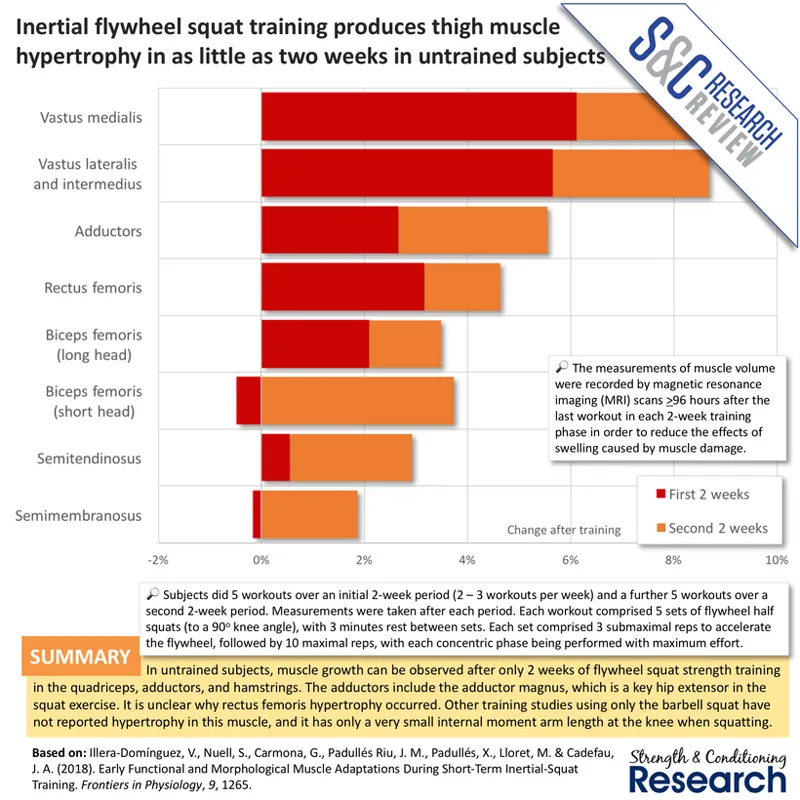
Traditionally, it was believed that hypertrophy did not occur in the first few weeks of a strength training program (because it was not visible). However, more recent research has found evidence of hypertrophy relatively soon after starting a training program, which suggests that the previous lack of evidence was simply caused by insufficiently accurate measurement methods.
.
Even so, it is likely that hypertrophy contributes substantially to gains in maximum strength. Hypertrophy involves an increase in the number of myofibrils, which allows more actin-myosin crossbridges to form during a muscular contraction. Since the active force that is exerted by a muscle is equal to the total number of actin-myosin crossbridges that are formed at any one point in time, hypertrophy leads to increased force production. Yet, the relationship between hypertrophy and the gains in maximum strength that occur after a strength training program depends upon the relative importance of other factors. When coordination is important, the relative importance of coordination is high, so the proportional contribution of hypertrophy is low. Conversely, when coordination is unimportant (as when performing an exercise in a dynamometer), the proportional contribution of hypertrophy is much higher.
.
#7. Increases in myofibrillar density
Early researchers proposed that greater gains in strength after training with heavier loads might be caused by an increase in myofibrillar density. Later investigations into this hypothesis suggested that this was not the case. More recently, researchers have revisited the question, and have shown that sarcoplasmic hypertrophy might predominate over short periods of time, while myofibrillar hypertrophy might predominate over the longer-term. This suggests that very well-trained lifters might display some superior strength relative to muscle size compared to lifters with a shorter training history.
.
#8. Relative contributions to strength gains
The following infographic illustrates how the mechanisms underpinning strength gains might occur at different rates. Changes in coordination are the most rapid, and probably account for the majority of strength gains in the first week or two. Changes in motor unit recruitment are slower, and are probably only apparent after several weeks and months. Peripheral adaptations start to become relevant after a month, and then progress slowly thereafter. Alterations in antagonist coactivation may take years to become apparent.
.
Conclusions
Gains in maximum strength occur due to multiple adaptations, including [1] improvements in coordination, [2] increases in the ability to recruit motor units, [3] reductions in antagonist coactivation, [4] hypertrophy, [5] increases in tendon stiffness, and [6] increases in lateral force transmission capacity. Each of these adaptations progresses at a different rate during a strength training program. Improvements in coordination occur extremely quickly and are noticeable within a couple of workouts. Increases in the ability to recruit motor units occur slightly less quickly, taking several weeks to become apparent. Oddly, reductions in antagonist coactivation seem to occur very slowly, being only noticeable in lifters with several years of lifting experience. The rate at which each local adaption occurs is less clear, but tendon stiffness appears to increase and reach a plateau more rapidly than muscle size and lateral force transmission capacity. Since every single neural and peripheral adaptation is produced by a unique stimulus, different training methods are appropriate for maximizing each individual adaptation. Therefore, maximizing strength gains might require different strategies for lifters of differing training status.