





Light load strength training (fatigue)
Fatigue is a temporary, reversible reduction in exercise performance as a result of a previous bout of exercise. Exercise often causes a period of sustained fatigue that lasts for a couple of days. This period of sustained fatigue impairs performance in future workouts (and can therefore impair the adaptations that are produced by those future workouts). Workouts involving lighter loads cause longer periods of sustained fatigue than workouts involving heavier loads. So why does this happen?
.
#1. How does repetition range affect post-workout fatigue?
Generally speaking, the amount of post-workout fatigue is greater when training with lighter loads compared to when training with heavier loads, so long as the same proximity to failure is used. For example, here we can see that a workout comprising four sets to failure with 30% of 1RM produces more post-workout fatigue than a workout comprising four sets to failure with 80% of 1RM.
.
In this study, doing three sets with 60% of 1RM produced more fatigue than three sets of 80% of 1RM when velocity loss was matched (which is not the same thing as matching proximity to failure, since lighter loads cause greater losses in velocity for the same proximity to failure). Therefore, even when the lighter load sets are stopped further from failure, they still cause more post-workout fatigue.
.
Additionally, here we can see that a workout comprising eight sets of 70% of 1RM caused much more post-workout fatigue than a workout comprising eight sets of 90% of 1RM, even though once again the heavier load group was doing sets closer to failure than the lighter load group.
.
Looking at the whole spectrum of repetition ranges, there is an approximately linear relationship between the number of reps per set and the amount of post-workout fatigue, with increasing amounts of post-workout fatigue being caused by lighter load training than by heavier load training.
.
#2. Why do some studies not show greater post-workout fatigue with lighter loads?
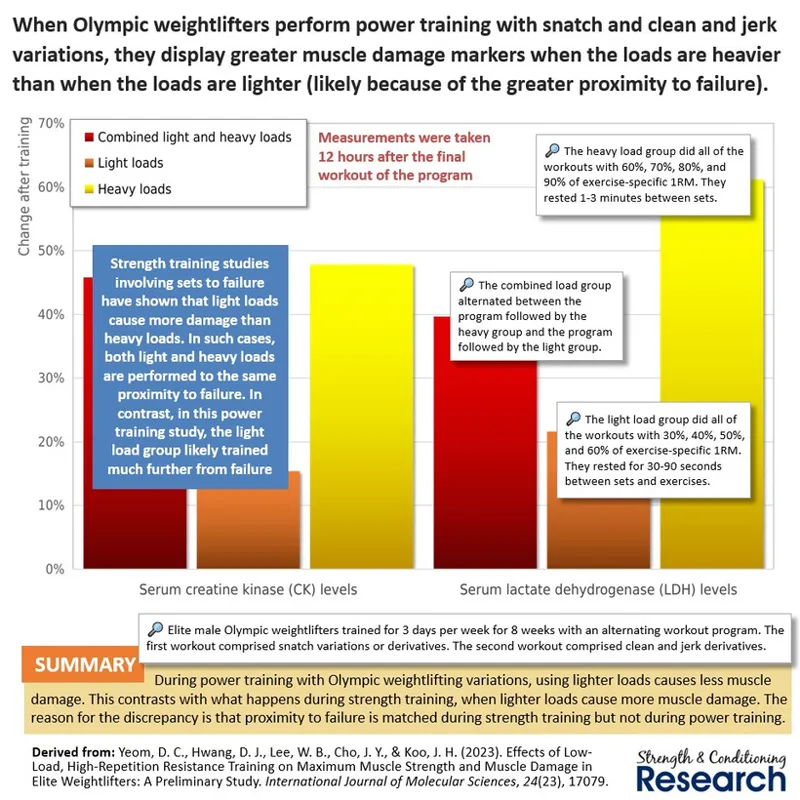
Some studies have reported less post-workout fatigue after workouts of lighter loads. Yet, these studies have compared power training (a long way away from failure) with heavy strength training (relatively close to failure). Many fitness influencers cite these studies without disclosing that the lighter load group trained quite a long way away from failure, which is unhelpful (putting it mildly).
.
Indeed, there are so many of these studies that some fitness influencers have managed to persuade themselves that the relationship between repetition range and post-workout fatigue is "complicated" and "unclear". Nevertheless, there is nothing unclear about the literature if we simply read the methods to see how the studies were performed.
.
#3. How does post-workout fatigue happen?
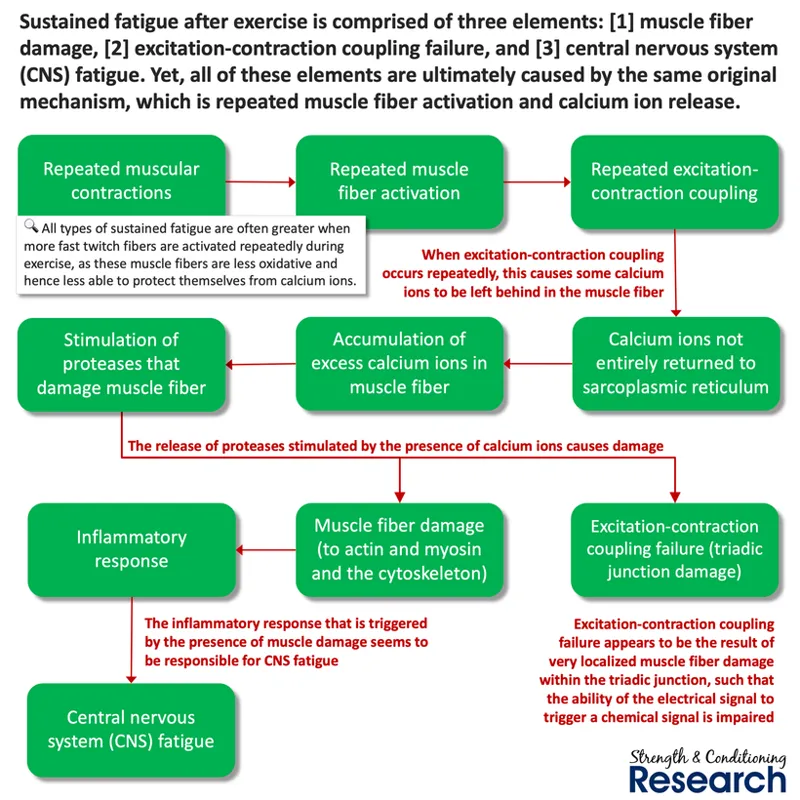
All of the post-workout fatigue mechanisms are caused by the same phenomenon, which is the accumulation of calcium ions during a workout. The diagram below shows exactly how this happens. Understanding this is essential for appreciating how post-workout fatigue is greater when training with lighter loads compared to when training with heavier loads.
.
#3. Why do light loads cause longer periods of post-workout fatigue than heavy loads?
The three main types of post-workout fatigue are [1] excitation-contraction coupling failure, [2] muscle damage, and [3] supraspinal central nervous system fatigue. All three mechanisms are caused by calcium ion accumulation during a workout. Therefore, if we see greater calcium ion accumulation during a workout with lighter loads, this will tell us that we should expect greater levels of all three post-workout fatigue mechanisms after workouts of lighter loads. Importantly, we can see that total fatigue is greater during a workout when using lighter loads, as indicated by losses in bar speed. This strongly indicates that calcium ion accumulation is similarly greater when using lighter loads.
Additionally, studies have shown repeatedly that excitation-contraction coupling failure is greater after isometric contractions involving low forces than after similar isometric contractions involving high forces. And since all post-workout fatigue mechanisms are produced by the same underlying cause, we should expect that both muscle damage and supraspinal central nervous system fatigue should also be greater when training with lighter loads.
.
Indeed, we have data showing that light load sets cause more non-local fatigue in the post-workout recovery period than moderate load sets. Non-local fatigue is a good measurement for supraspinal central nervous system fatigue.
.
Conclusions
Fatigue is a temporary, reversible reduction in exercise performance that occurs a result of a previous bout of exercise. Strength training workouts often cause post-workout fatigue that lasts for a couple of days. Repetition range is a key factor that affects the amount of post-workout fatigue. The higher the repetition range (and the lighter the load), the more post-workout fatigue occurs. The only exception to this observation is when the lighter load sets are performed much, much further from failure than the heavier load sets (as when comparing power training workouts with heavy strength training workouts). Post-workout fatigue mechanisms are all ultimately caused by calcium ion accumulation during the workout itself. Repeated muscle fiber activation causes calcium ions to build up inside the cytoplasm, which ultimately leads to [1] excitation-contraction coupling failure, [2] muscle damage, and also [3] supraspinal central nervous system fatigue (due to the inflammatory response to the muscle damage). Obviously, lighter loads involve a longer duration of muscle fiber activation, a greater accumulation of calcium ions, and greater post-workout fatigue mechanisms. Indeed, studies have reported evidence showing greater excitation-contraction coupling failure after training with lighter loads (in the form of more low-frequency fatigue) and greater supraspinal central nervous system fatigue after training with lighter loads (in the form of greater non-local fatigue). In practice, this means that training frequency cannot be as high when training with lighter loads as when training with heavier loads, at least when proximity to failure is similar.
Comments (2)
Thanks Chris. What is your recommendation regarding performing sets. Should I never go to fatigue? Would it be best to always stop the set 2 repetitions short of fatigue? It seems there is no benefit only more potential calcium ion accumulation (even during a heavy load strength training workout). Thanks.
I think there are now some strong arguments for avoiding failure, especially when lifting lighter loads. I have started writing a Patreon post about training to failure, which should be published in a few weeks. The main problem is the need to observe progressive overload, which is easiest to track when reaching muscular failure at least once during a workout.