



Light load training (strength gains)
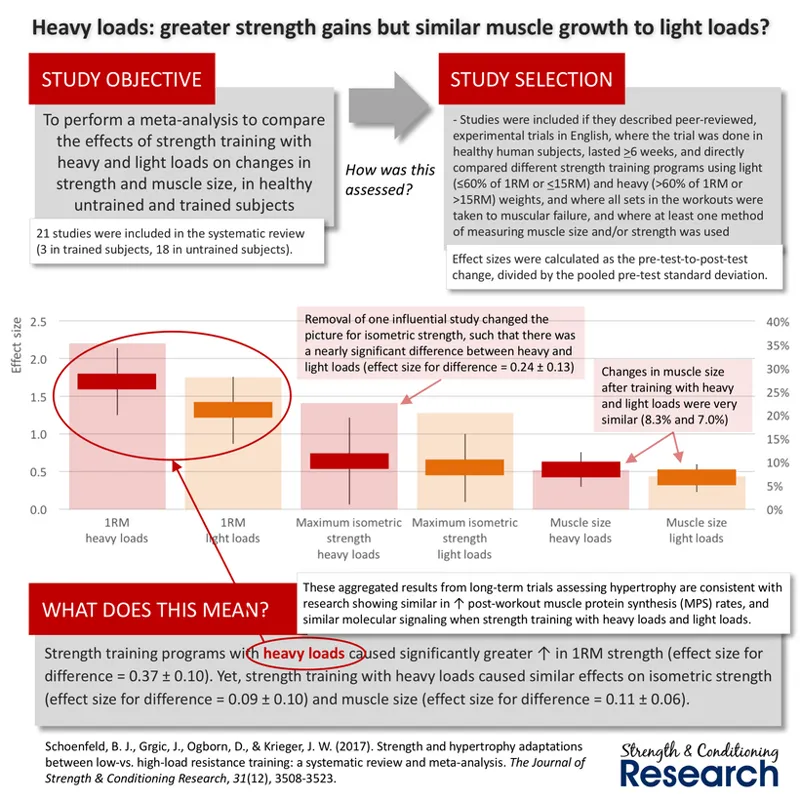
Strength training with light loads causes smaller strength gains than training with moderate or heavy loads, even when it produces the same amount of muscle growth. Why does this happen?
.
#1. Strength gains are smaller when loads are lighter
Meta-analyses have shown that strength gains are smaller when light loads are used for the majority of the workouts in the program.
.
#2. Coordination improvements
It is very likely that lighter load strength training causes smaller improvements in coordination. Indeed, while gains in task-specific strength and non task-specific strength are both greater after heavier load strength training than after lighter load strength training, the difference between loads is more noticeable in respect of task-specific strength. This suggests that coordination is improved more after heavier load strength training.
.
#3. Increases in motor unit recruitment
Compared to heavier load strength training, lighter load strength training is much less effective at increasing the ability to recruit high-threshold motor units (as measured by changes in voluntary activation).
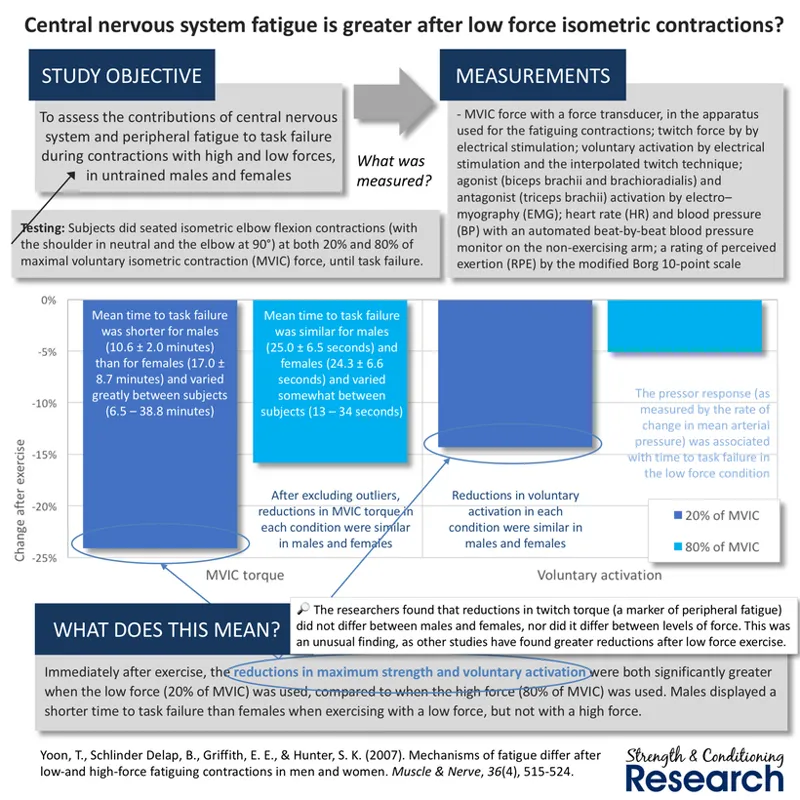
The stimulus for increasing the ability to recruit high-threshold motor units is most likely achieving a very high level of central motor command. Compared to lifting heavier loads, lifting lighter loads involves a higher level of central nervous system (CNS) fatigue and therefore cannot produce the same degree of central motor command even at muscular failure.
.
Many studies have recorded that CNS fatigue is higher when we perform fatiguing muscular contractions with lower forces in comparison with fatiguing muscular contractions with higher forces.
.
The majority of the studies have employed isometric contractions because this contraction mode is the easiest one to use when assessing voluntary activation levels. Even so, various muscle groups have been tested with similar results.
.
While the early studies tested only upper body muscle groups, the most recent investigations have extended the findings to the lower body.
.
#4. Increases in tendon stiffness
It is well-established that tendon stiffness increases in response to exercise, and that these increases are dependent upon the load that is used. Moderate (and heavy) load strength training increases tendon stiffness, while light load strength training does not.
.
Although both heavy and light loads can produce large tendon strains, depending on the type of movement, only heavy loads can produce a large tendon stress, which is the stimulus for increasing tendon stiffness.
.
During isometric and concentric-only contractions, muscle-tendon units produce more force when the tendon is stiffer and less force when the tendon is more compliant. When a tendon is more compliant, it actually lengthens slightly once a muscle begins producing force in series with it. Consequently, the muscle shortens faster than would be expected. The faster shortening speed means that it produces less force due to the force-velocity relationship (since fewer actin-myosin crossbridges can form at faster shortening speeds).
.
#5. Increases in specific tension
Specific tension refers to the strength of a muscle fiber relative to its size. Lighter load strength training seems to cause smaller increases in specific tension than heavier load strength training. This could theoretically occur either due to [1] smaller increases in lateral force transmission or [2] smaller increases in myofibrillar density.
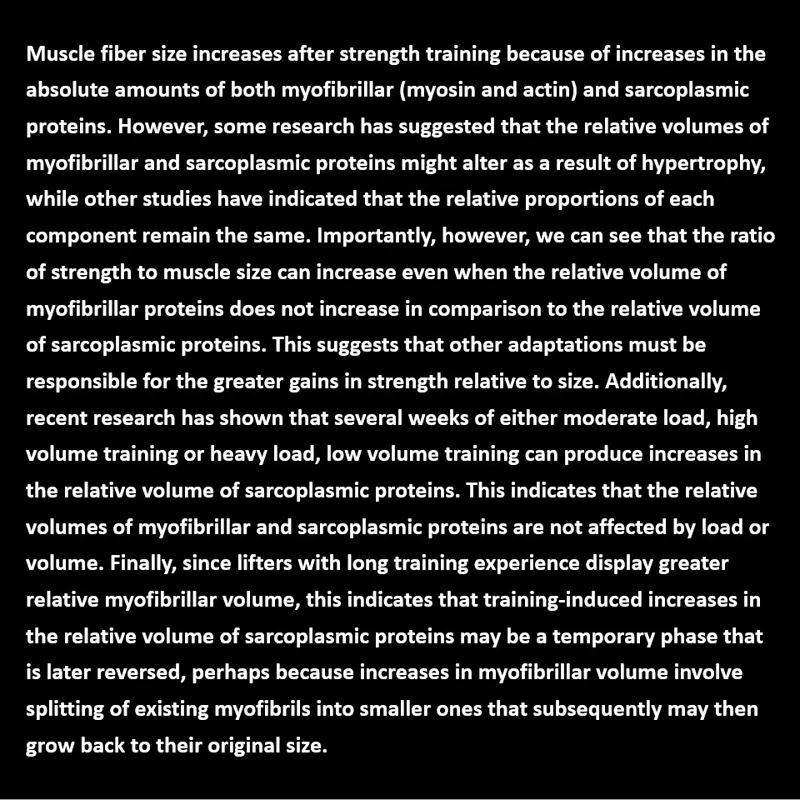
Older textbooks often state that heavier load training causes larger increases in myofibrillar density. Yet, this does not seem to be the case (read more).
.
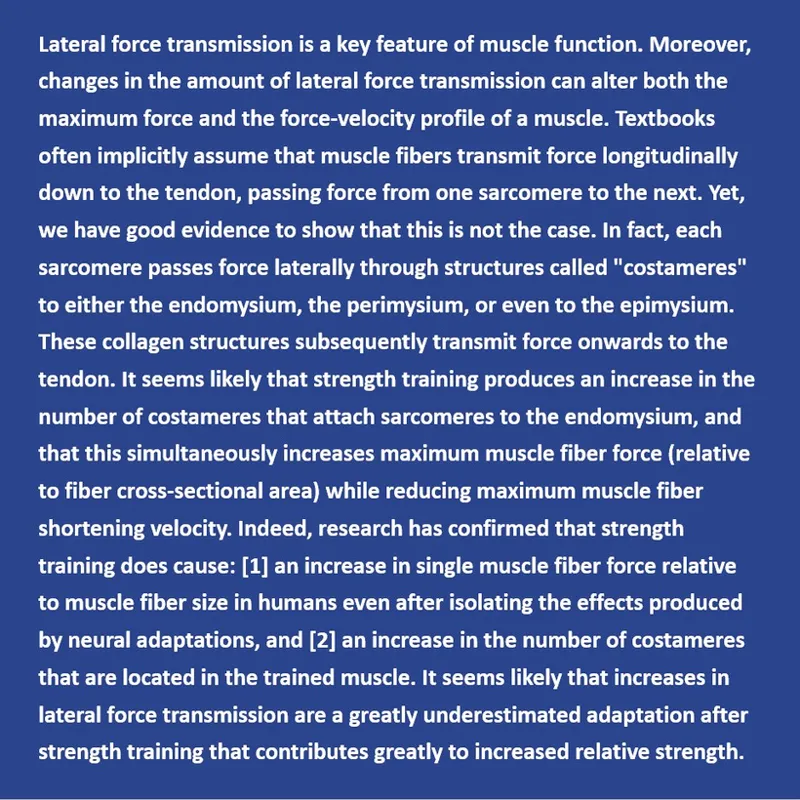
Therefore, it seems more likely that lighter load training is less effective at increasing lateral force transmission than heavier load training. Nevertheless, there is no direct evidence that this happens but very few training studies have assessed changes in lateral force transmission or changes in the number of costameres (read more).
.
Conclusions
Meta-analyses have confirmed that training with lighter loads causes smaller gains in maximum strength than training with heavier loads, even when the same amount of hypertrophy occurs. These smaller gains in maximum strength might be attributed to differences in various underlying adaptations, including: [1] smaller improvements in coordination of the trained and tested exercise (since coordination is load-specific); [2] smaller increases in the ability to recruit high-threshold motor units (since lighter load sets reliably involve more central nervous system fatigue and therefore involve lower levels of central motor command at muscular failure, which means that they are less effective at stimulating adaptations in the magnitude of the central motor command that generates motor unit recruitment); [3] smaller increases in tendon stiffness (since lifting a lighter load creates a smaller amount of tendon stress, which is most likely what stimulates tendons to adapt by increasing in stiffness), and finally [4] smaller increases in specific tension because of smaller increases in lateral force transmission (perhaps because the stimulus for adding costameres is related to the magnitude of the intramuscular forces rather than the amount of muscle fiber mechanical tension).