



Velocity-based training
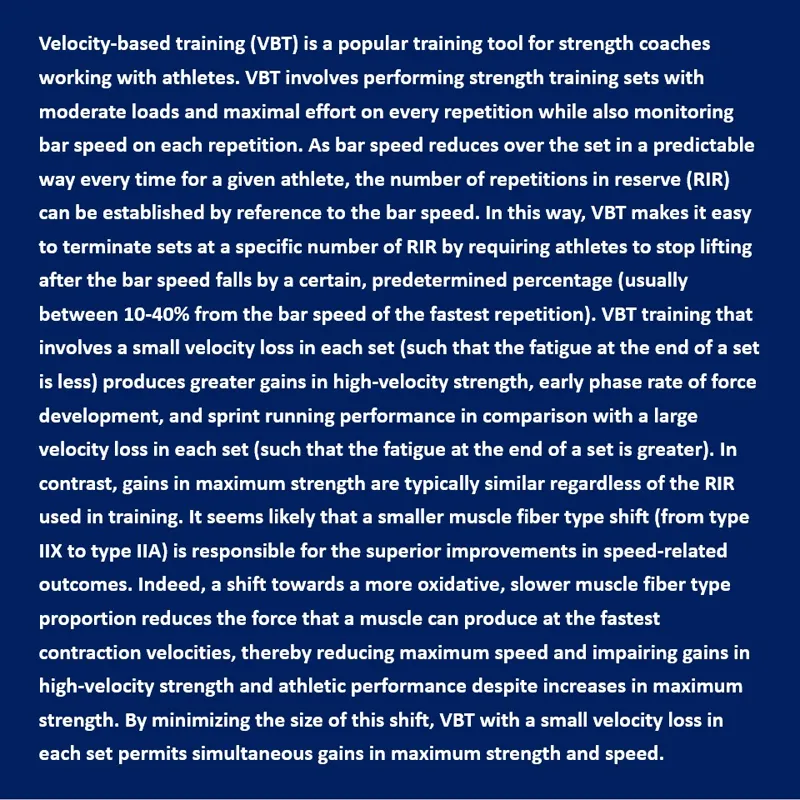
Velocity-based training (VBT) is a popular training tool for strength coaches working with athletes. VBT involves performing strength training sets with moderate loads and maximal effort on every repetition while also monitoring bar speed on each repetition. As bar speed reduces over the set in a predictable way every time for a given athlete, the number of repetitions in reserve (RIR) can be established by reference to the bar speed. In this way, VBT makes it easy to terminate sets at a specific number of RIR by requiring athletes to stop lifting after the bar speed falls by a certain, predetermined percentage (usually between 10-40% from the bar speed of the fastest repetition).
.
#1. High-velocity strength is improved more when velocity losses are smaller
When performing VBT with smaller losses in velocity over the course of each set (such that the accumulated fatigue at the end of a set is less and the set is stopped further from failure), this leads to greater improvements in high-velocity strength (but not maximum strength or low-velocity strength).
.
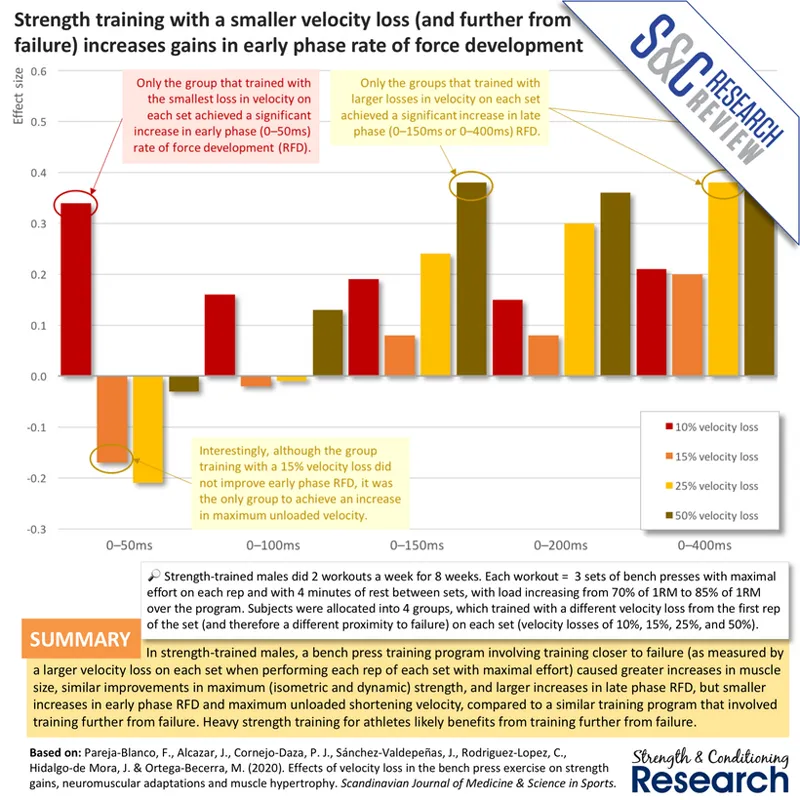
#2. Early phase rate of force development (RFD) is improved more when velocity losses are smaller
When performing VBT with smaller losses in velocity over the course of each set (such that the accumulated fatigue at the end of a set is less and the set is stopped further from failure), this leads to greater improvements in early phase rate of force development (RFD), which is critical for sports movements that occur in short durations of time. This greater improvement in early phase RFD is probably mediated by the same mechanisms as produce the greater increases in maximum speed.
.
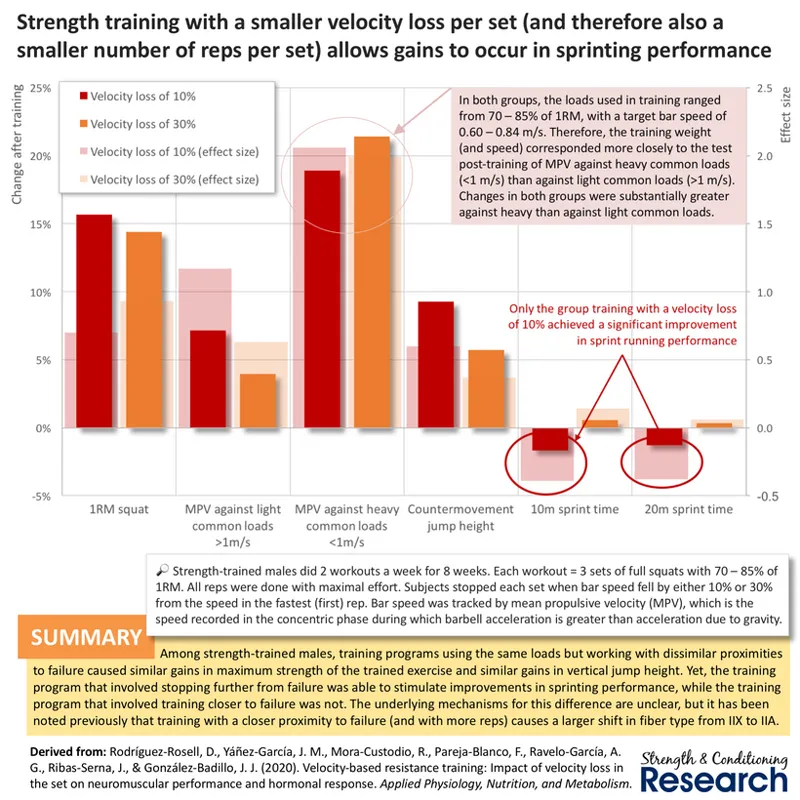
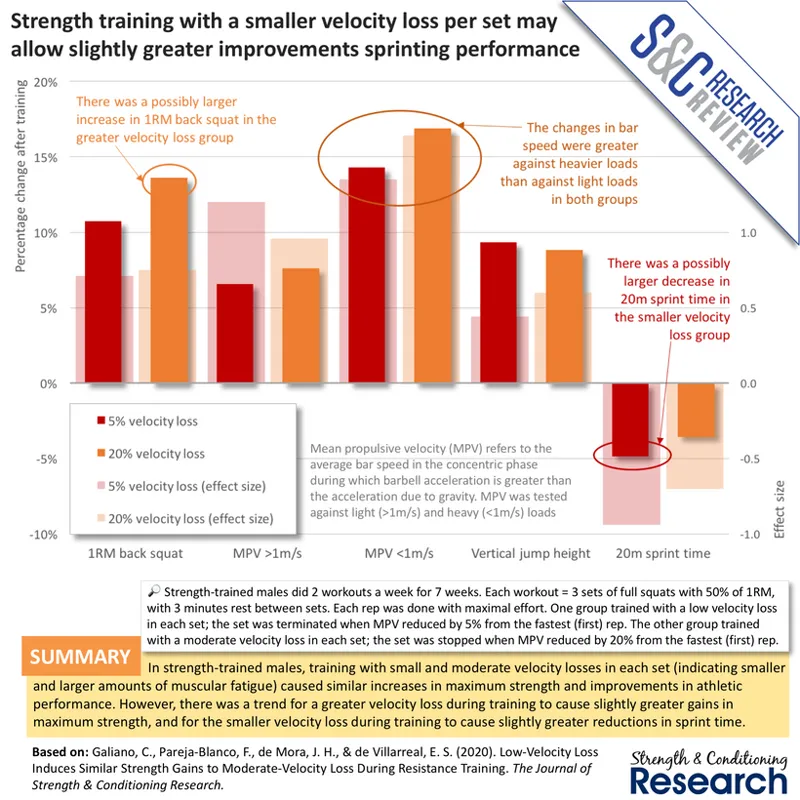
#3. Sporting movement performance is improved to a greater extent when velocity losses are smaller
When performing VBT with smaller losses in velocity over the course of each set (such that the accumulated fatigue at the end of a set is less and the set is stopped further from failure), this leads to greater improvements in measures of high-velocity sports performance, including sprint running.
.
This observation has been made in more than one study.
.
#4. Smaller fiber type shifts underpin the superior effect of stopping further from failure
Training closer to failure appears to cause more type IIX fibers to convert to IIA fibers. Since type IIA muscle fibers are slower than type IIX fibers, losing type IIX fibers means that athletes produce less force at the fastest contraction velocities.
.
Indeed, case studies of elite sprinters have reported that they display extremely high proportions of type IIX muscle fibers. Such high proportions of type IIX fibers probably contribute to their success.
.
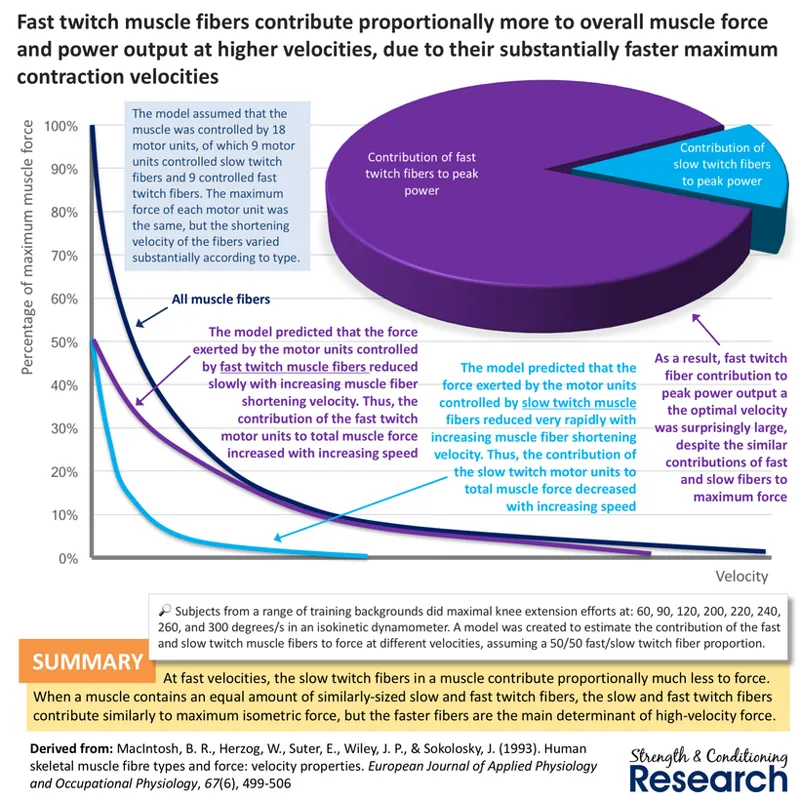
The importance of type IIX fibers is often dismissed by some researchers because of the relatively small number of these fibers in the muscles of most athletes. However, when muscle fibers are unable to contract at a certain velocity, they do not contribute to force production at that velocity. Most slow twitch muscle fibers do not contribute to force production during fast movements at all. They are still activated, but they do not produce force. Similarly, when moving at the fastest possible speeds, the type IIA fibers probably do not contribute very much (if at all) to force production, while the type IIX fibers produce most of the force. Consequently, losing type IIX fibers by converting them into type IIA fibers can substantially reduce high-velocity force production.
.
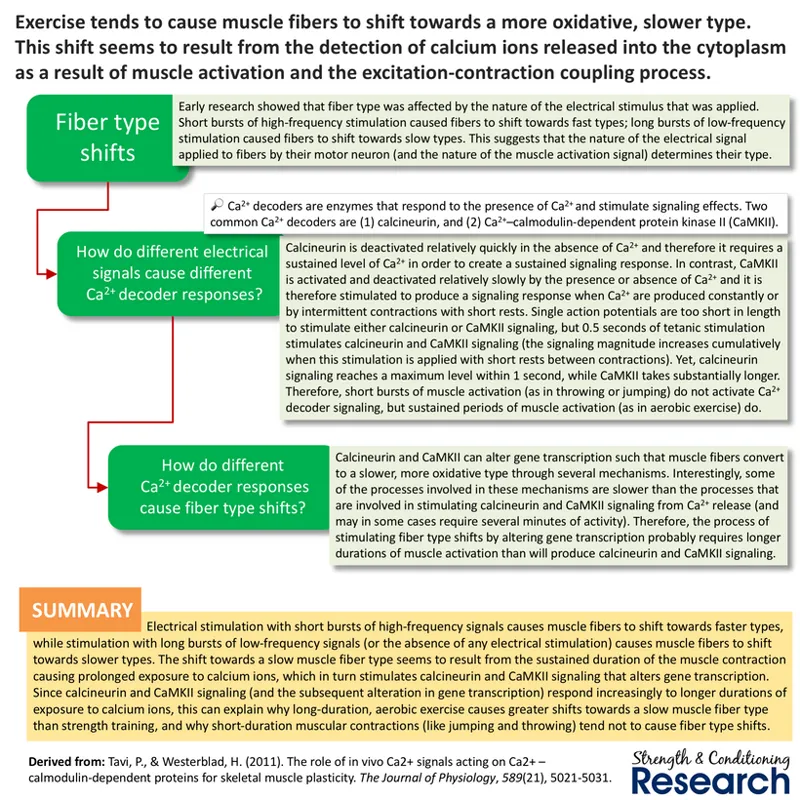
The mechanism that converts type IIX muscle fibers into type IIA muscle fibers is probably stimulated by calcium ions entering the muscle fiber (as a result of the excitation-contraction coupling process), and then remaining in the muscle fiber (and causing excitation-contraction coupling failure). This mechanism is dose-responsive, such that the stimulus to convert muscle fibers from type IIX to type IIA is increased as the muscle fiber is exposed to greater accumulations of calcium ions. Greater accumulations of calcium ions occur both with longer durations of exercise and also as fatigue increases (because a key fatigue mechanism involves calcium ions remaining inside the muscle fiber instead of being taken back up into the sarcoplasmic reticulum). Thus, when muscle fibers are only exposed to calcium ions and calcium ion-related fatigue for a short period of time (as when training with a small number of reps in a set, when training further from failure, or with cluster sets), the stimulus to convert muscle fibers into more oxidative types is smaller than when training closer to failure.
.
#5. What underpins the similar gains in maximum strength?
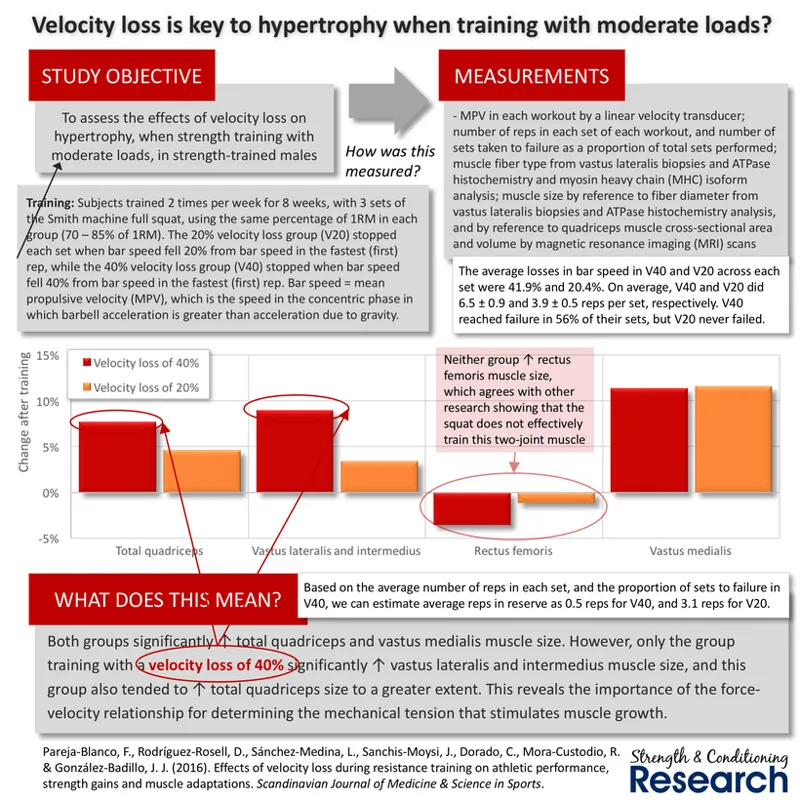
Most VBT studies have found similar gains in maximum strength, regardless of the velocity loss implemented during training. This is actually unexpected, because hypertrophy is typically greater when training with a larger velocity loss, due to the greater mechanical tension permitted by the slower contraction velocities.
.
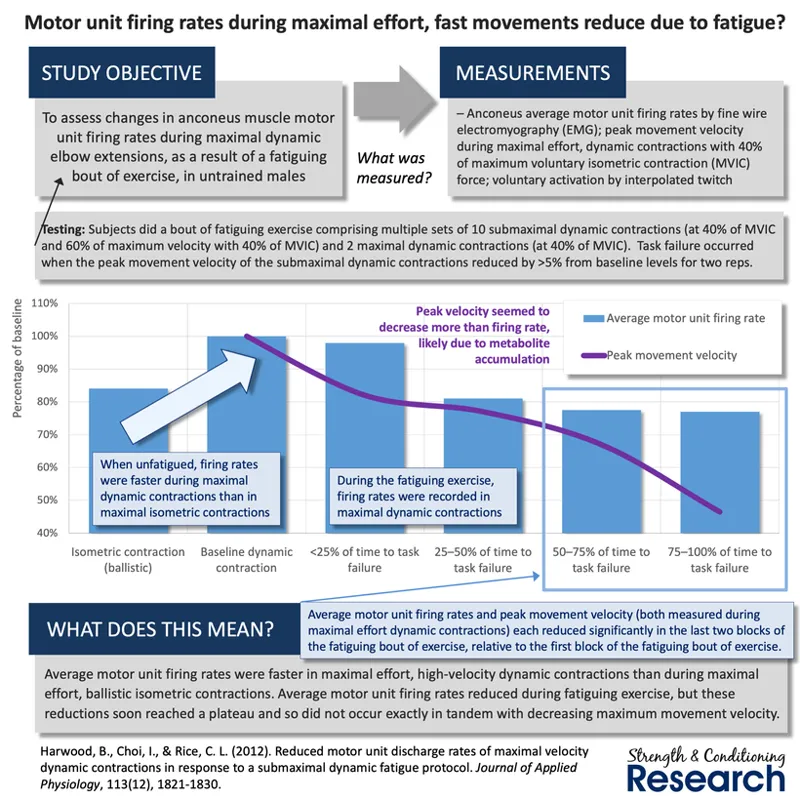
However, researchers have shown that higher levels of fatigue are associated with reductions in motor unit recruitment and motor unit firing frequency, which may impair neural adaptations in subsequent sets. By training with multiple sets with minimal fatigue avoiding velocity loss may actually permit more reps that stimulate increases in motor unit recruitment (and possibly also motor unit firing frequency, albeit to a lesser degree).
.
Conclusions
Velocity-based training (VBT) is a popular training tool for strength coaches working with athletes. VBT involves performing strength training sets with moderate loads and maximal effort on every repetition while also monitoring bar speed on each repetition. As bar speed reduces over the set in a predictable way every time for a given athlete, the number of repetitions in reserve (RIR) can be established by reference to the bar speed. In this way, VBT makes it easy to terminate sets at a specific number of RIR by requiring athletes to stop lifting after the bar speed falls by a certain, predetermined percentage (usually between 10-40% from the bar speed of the fastest repetition). VBT training that involves a small velocity loss in each set (such that the fatigue at the end of a set is less) produces greater gains in high-velocity strength, early phase rate of force development, and sprint running performance in comparison with a large velocity loss in each set (such that the fatigue at the end of a set is greater). In contrast, gains in maximum strength are typically similar regardless of the RIR used in training. It seems likely that a smaller muscle fiber type shift (from type IIX to type IIA) is responsible for the superior improvements in speed-related outcomes. Indeed, a shift towards a more oxidative, slower muscle fiber type proportion reduces the force that a muscle can produce at the fastest contraction velocities, thereby reducing maximum speed and impairing gains in high-velocity strength and athletic performance despite increases in maximum strength. By minimizing the size of this shift, VBT with a small velocity loss in each set permits simultaneous gains in maximum strength and speed.
Comments (5)
Hi Chris, in a practical setting how likely is it for athletes to keep improving strength in the long term if they are always training with small velocity loses / very far away from failure?
Improvements in maximum strength can occur for a very long time with small velocity losses, so long as the weight is heavy (1–5RM), while the gains would probably be much harder to achieve with a moderate load (6–15RM).
Hello Chris. I would like to ask: Understanding that training closer to failure tends to be superior for 1- Hypertrophy 2- Maximum strength, how come training less close to failure would end up providing the same amount of Maximum strength gains as training to failure? Would a smaller transition of Type IIX to IIAX/IIA muscle fibers be a possible reason?
No, the shift from type IIX to type IIA doesn't affect the ability to produce force at slow speeds. In fact, muscle fibers of all types (I, IIA, and IIX) all produce similar forces per unit cross-sectional area at slow speeds. I suspect that the main reason for the similar strength gains is that the biggest contributors to strength gains over short periods of time are (1) coordination, and (2) voluntary activation, both of which change by similar amounts regardless of the hypertrophy/proximity to failure. Over longer periods of time, I would expect training closer to failure to produce larger increases in maximum strength, but obviously even larger impairments in maximum speed and therefore very small increases in high-velocity strength.
Love this! I have found this to be one of the biggest helps for fitting strength training into programs. Great post Chris!