


Lateral force transmission
Lateral force transmission is a key factor that determines muscle function. Changes in the amount of lateral force transmission can alter both the maximum force and the force-velocity profile of a muscle.
.
#1. How do muscle fibers transmit force to the tendon?
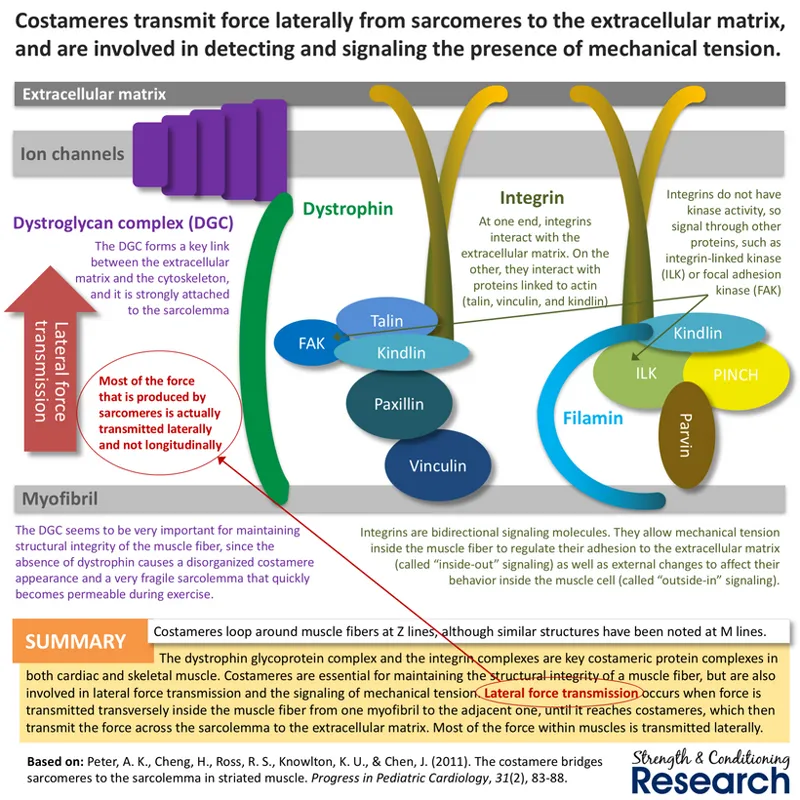
Textbooks often implicitly assume that muscle fibers transmit force longitudinally down to the tendon, passing force from one sarcomere to the next. Nevertheless, we have good evidence to show that this is not the case. In fact, each sarcomere passes force laterally to either the endomysium, the perimysium, or even to the epimysium and these structures then transmit force down to the tendon.
.
#2. How could the amount of force transmitted laterally increase?
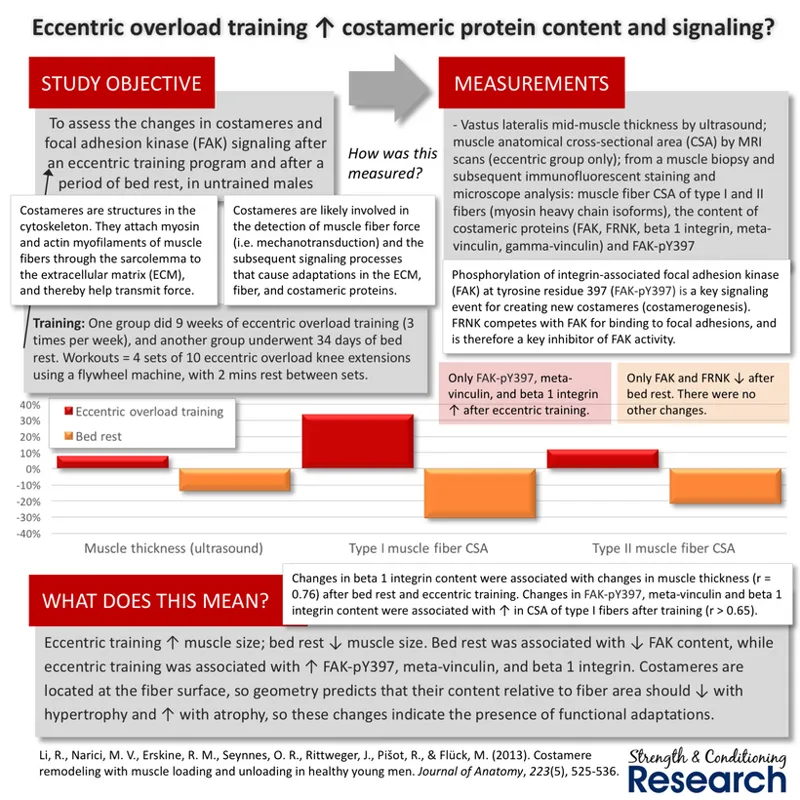
It seems likely that strength training produces an increase in the number of costameres that attach sarcomeres to the endomysium, and that this simultaneously increases maximum muscle fiber force (relative to cross-sectional area) while reducing maximum muscle fiber shortening velocity.
.
Costameres are the structures that connect the individual sarcomeres of a muscle fiber to the surrounding collagen of the extracellular matrix (the endomysium, perimysium, and the epimysium).
.
Importantly, research has shown that the number of costameres inside a muscle can be altered after strength training (especially strength training that involves high effort eccentric contractions).
.
#3. Do muscles increase in strength relative to size after strength training?
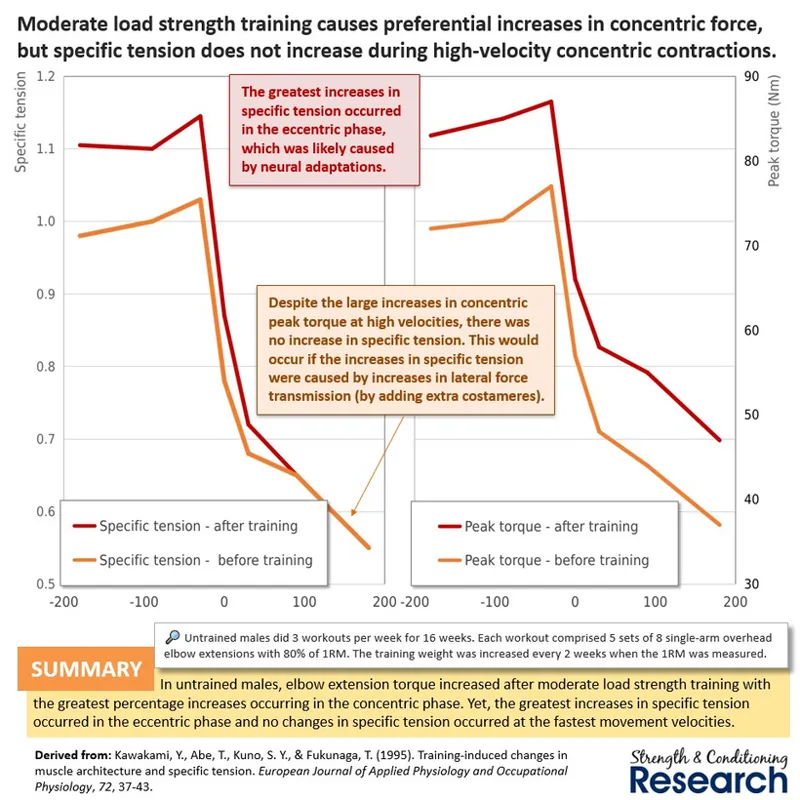
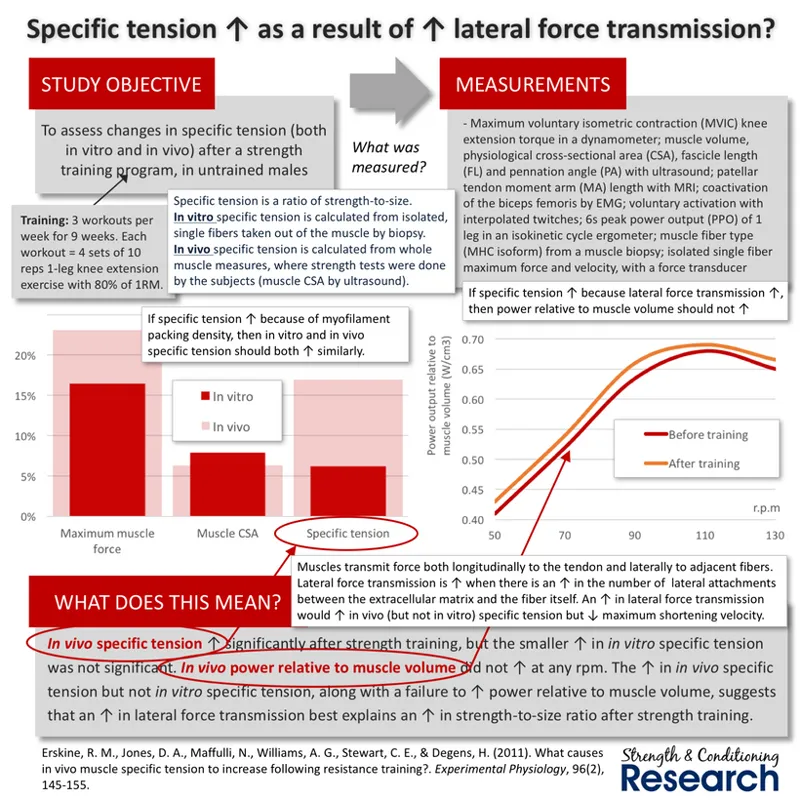
Yes, muscles do increase in strength relative to size after strength training. When this is measured in either involuntary contractions or in isolated muscle fibers, it is called specific tension.
.
Research suggests that the increase in (involuntary) muscle strength relative to size after heavy strength training is caused by an increase in lateral force transmission, likely due to the addition of costameres.
.
Conclusions
Lateral force transmission is a key feature of muscle function. Moreover, changes in the amount of lateral force transmission can alter both the maximum force and the force-velocity profile of a muscle. Textbooks often implicitly assume that muscle fibers transmit force longitudinally down to the tendon, passing force from one sarcomere to the next. Yet, we have good evidence to show that this is not the case. In fact, each sarcomere passes force laterally through structures called "costameres" to either the endomysium, the perimysium, or even to the epimysium. These collagen structures subsequently transmit force onwards to the tendon. It seems likely that strength training produces an increase in the number of costameres that attach sarcomeres to the endomysium, and that this simultaneously increases maximum muscle fiber force (relative to cross-sectional area) while reducing maximum muscle fiber shortening velocity. Indeed, research has confirmed that strength training does cause: [1] an increase in single muscle fiber force relative to muscle fiber size in humans even after isolating the effects produced by neural adaptations, and [2] an increase in the number of costameres that are located in the trained muscle. It seems likely that increases in lateral force transmission are a greatly underestimated adaptation after strength training that contributes greatly to increased relative strength.
Comments (1)
Hey Chris, first of all, great article. I understand the effect of higher lateral force transmission (due to more costameres) on maximum strength, but not exactly on contraction velocity.. In the study they say: „It has been suggested that in vivo, a training-induced increase in muscle specific tension might occur due to an increased number of lateral attachments between the extracellular matrix and intermediate sarcomeres that would serve to effectively increase the number of parallel sarcomeres per PCSA while reducing the functional length of the muscle fibre” Pretty much the same is written in “Jones 1989” and also in your book, if I remember correctly. But what exactly is the “functional length”? You wrote, the velocity gets lower for the same reason a short muscle fibre contracts slower. But even with more costameres the amount of serial sarkomeres stays the same, so how is it the same?