



Low training volumes for athletes
Training volume is most commonly-discussed in the context of bodybuilding. Even so, it is important to consider the effects of training volume for athletes.
.
#1. Low volumes are better for increasing speed
There is evidence that lower training volumes are better when working with athletes who need to improve speed, or the ability produce force at very fast speeds.
.
#2. High volumes enhance hypertrophy, and this may reduce high-velocity strength
Many studies have shown that higher training volumes enhance muscle growth (at least up to a point). This has been confirmed by meta-analyses combining the results of many studies. Nevertheless, the success of higher volumes in this respect might be one reason why low volumes are better for speed.
.
Indeed, an increase in the size of the muscle also causes an increase in the internal moment arm length. The internal moment arm length is the leverage of the muscle at the joint, and it can be visualized by considering the distance that the muscle bulges outwards from the bone that it rests against. When the leverage is large, this enhances force production at slow speeds. However, the longer leverage actually has a negative effect on force production at fast speeds, because it makes the muscle fibers shorten more for the same joint angle range of motion, which means that they must shorten faster for the same joint angular velocity. Consequently, the force-velocity relationship requires them to produce a smaller force when shortening at a given (fast) speed.
.
#3. High volumes enhance fiber type shifts, which reduces high-velocity strength
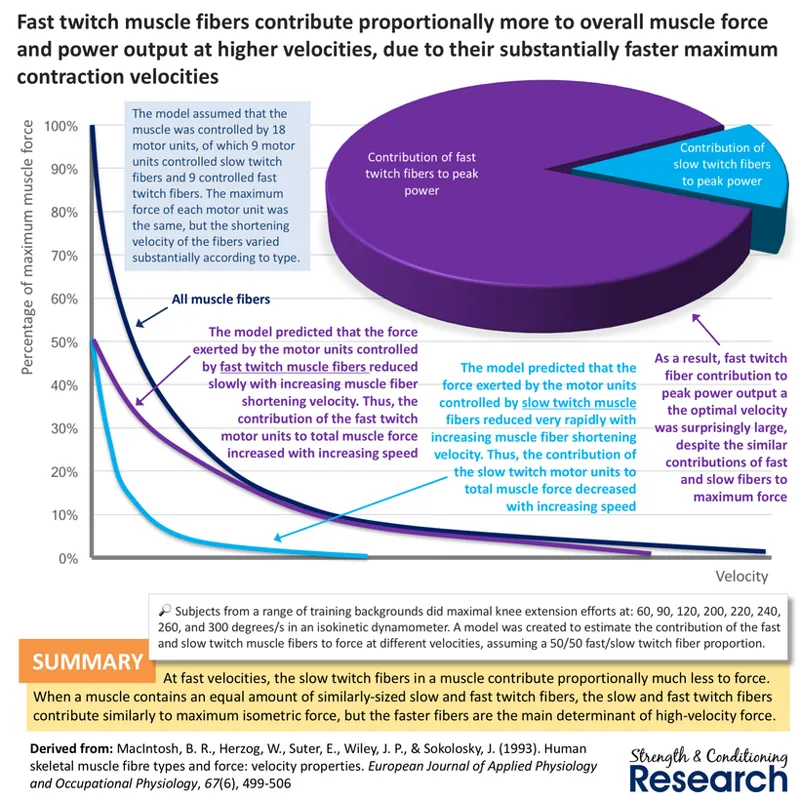
Maximum muscle fiber shortening speed is closely related to the proportion of type IIX fibers, and athletes with very high proportions of type IIX fibers tend to be very successful at sports that require fast movement speeds, such as sprinting.
.
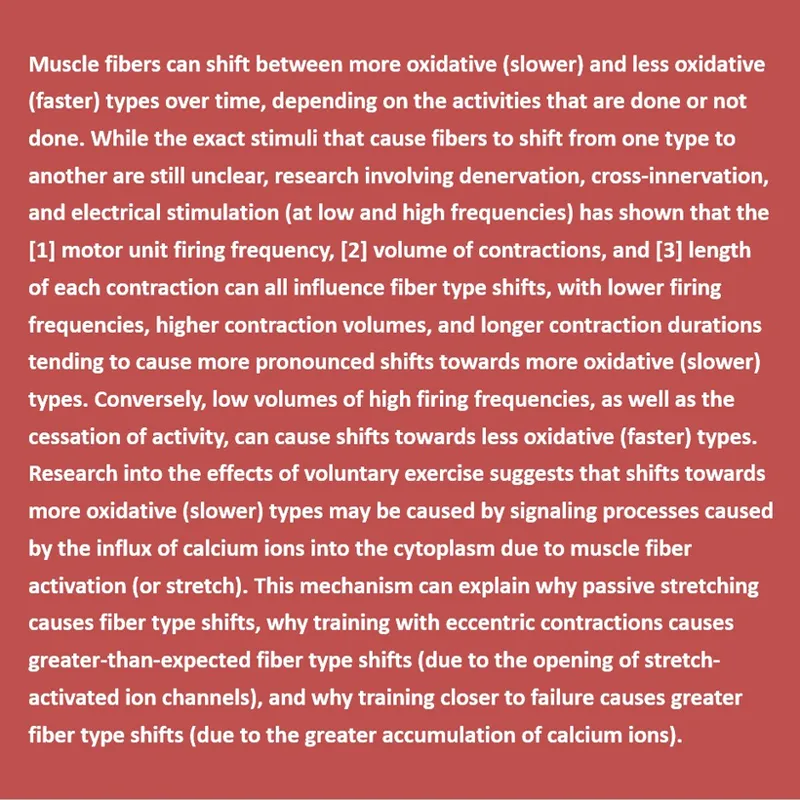
Unfortunately, strength training typically causes muscle fiber type shifts from type IIX to type IIA. This is is a very rapid adaptation that can even be noted after single workouts.
.
While the number of muscle fibers that convert from type IIX to type IIA might seem small in the context of the whole muscle, they actually exert a very large effect on speed. This is because only the fastest muscle fibers within a muscle contribute to force production at very fast movement speeds.
.
The extent to which fiber type shifts happen after strength training is greater when training with higher training volumes. Therefore, we might expect the negative impact on speed to be greater as well.
.
The underlying mechanism that causes muscle fiber type shifts is an accumulation of calcium ions in the cytoplasm, which is obviously enhanced by higher training volumes (read more).
.
Conclusions
Training volume is most commonly-discussed in the context of bodybuilding. Even so, it is important to consider the effects of training volume for athletes. Importantly, there is evidence that lower training volumes are better for athletes who need to improve speed, or the ability to produce force at very fast speeds. Lower volumes might be superior to higher volumes for this particular outcome because of two adaptations that are enhanced by training with higher strength training volumes: [1] hypertrophy, and [2] muscle fiber type shifts. Regarding hypertrophy: higher training volumes have been shown to increase muscle growth during strength training (up to a point). Yet, a larger muscle inevitably also has a longer moment arm and longer moment arms require faster muscle fiber shortening velocities for the same joint angular velocity because of the greater excursions that the muscle fibers must travel through for the same joint angular range of motion. This means that the maximum joint angular velocity that can be achieved is reduced, which means that movement speed in athletic activities is reduced. Regarding muscle fiber type shifts: higher training volumes have been shown to cause a larger shift in fiber type proportion (from the very fast type IIX to the moderately fast type IIA). This reduces maximum muscle shortening speed. Of course, this means that the maximum joint angular velocity that can be achieved is reduced, which means that movement speed in athletic activities is also reduced.

Comments (7)
Hi chris, hope you are doing great. Recently, i have read a lot of your articles about the volume range and your model about the net stimulus for hypertrophy. But for maximal strength, what is your take/ or do tou have any idea about the volume range / workout that is best suited for that type of goal? Should we keep the same range of volume as hypertrophy (but with a bigger RIR per set) or shift toward a higher volume approach ? Thx in advance
What's your best recommendation for what constitutes the best volume range that is considered "high" for pure bidybuilding? Mayne in the context of #stimulating reps per session.
I wrote this article a while back, and the recommendations are probably still about right. Since then, there has been another study done (which I need to go back and include) and at least one of the low volume studies has been withdrawn (maybe two by this point) because of concerns about the statistics. https://medium.com/@SandCResearch/what-is-the-maximum-number-of-stimulating-reps-that-we-can-do-in-a-workout-for-a-muscle-group-9379d91bf2c?source=friends_link&sk=5957ed63dd8b218aa1c4abfe93431cb7
What do you think of fast eccentric overload? I think since they tend to hypertrophy the type 2 by more, it might potentially negate the effect of less type 2x fibers to some point and the increase in length would help with contraction velocity. Longer MAL would allow it to experience greater stretch and therefore increase in length, negating the effect of increased MAL to some point compared with concentrics (heavy) which is gonna bring negative effect to high vel strength. Therefore like you, i don't see much benefit of involving exercises like SDL or squats that isn't performed at high velocity or eccentrically which then leads to SDL and squats as inferior choice to kettlebell swing and squat jumps for high vel strength and nordics and reverse nordics for eccentric strength for the knee.
I am just about to write a few articles about eccentrics, including talking about (1) velocity-specific adaptations and (2) the differences between eccentric-only and eccentric overload training. Certainly, eccentrics are going to be better than conventional strength training for athletes when hypertrophy or maximum strength gains are the intended goal.
For the past 4-5 months, I have put this idea of keeping fatigue low/speed per rep high into practice for the baseball players I train and the results have been outstanding. I think this concept is one of the most important factors to training athletes
I would love to see the data if you have but the testimony is enough tho lol.