









Muscle damage is delayed
We often hear fitness influencers talk about muscle damage occurring during a workout in the form of "micro-tears" and yet the physiology literature is extremely clear that muscle damage does not happen during a workout but rather in the hours and days afterwards.
.
#1. Muscle damage is delayed in animal studies
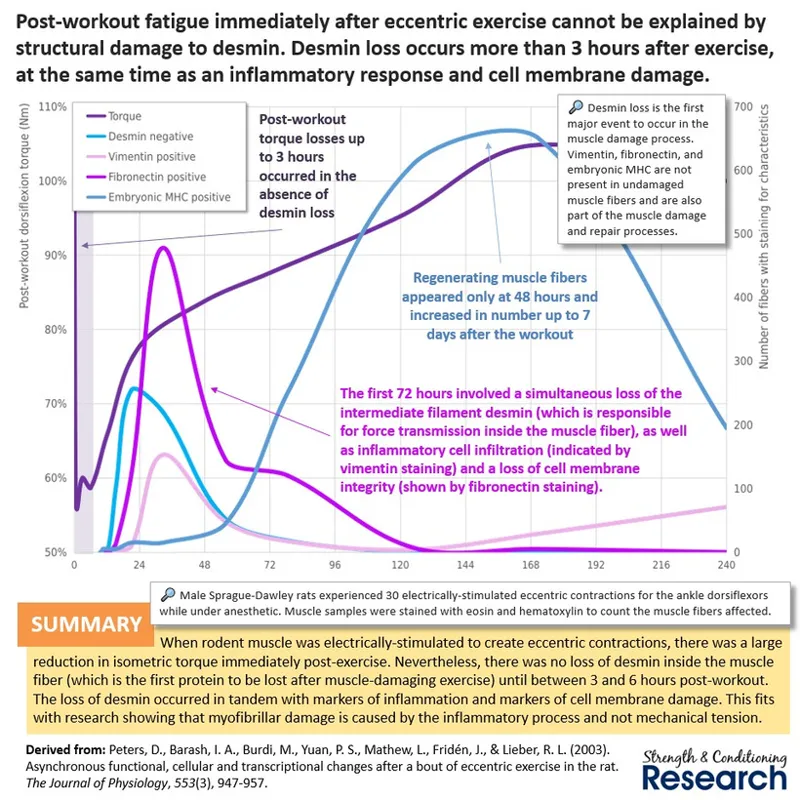
There are various proxy measurements for muscle damage. Some research has shown that structures like desmin experience steadily increasing damage over the course of the post-workout period. Indicators of regenerating muscle fibers only appear days post-workout, which is logical because it is not possible to regenerate a muscle fiber until the inflammatory processes have cleared away all of the damage.
.
The exact time course of the muscle damage probably varies between the individual structures inside the muscle fibers as well as the magnitude of the damage caused by the workout itself. Overall, the literature seems to indicate that the greater the damage, the more delayed the repair and regeneration processes become.
.
Other research has shown that protein degradation and a loss of myofibrillar proteins only starts one day after a strength training workout analogue has been performed in rodents.
.
Some research shows an even more-delayed time-course, with protein degradation and a loss of myofibrillar proteins only starting five days after a strength training workout analogue.
.
When reviewing the literature overall, researchers have concluded that a loss of myofibrillar proteins in rodent investigations only starts on the third day after the workout.
.
#2. Muscle damage is delayed in human studies
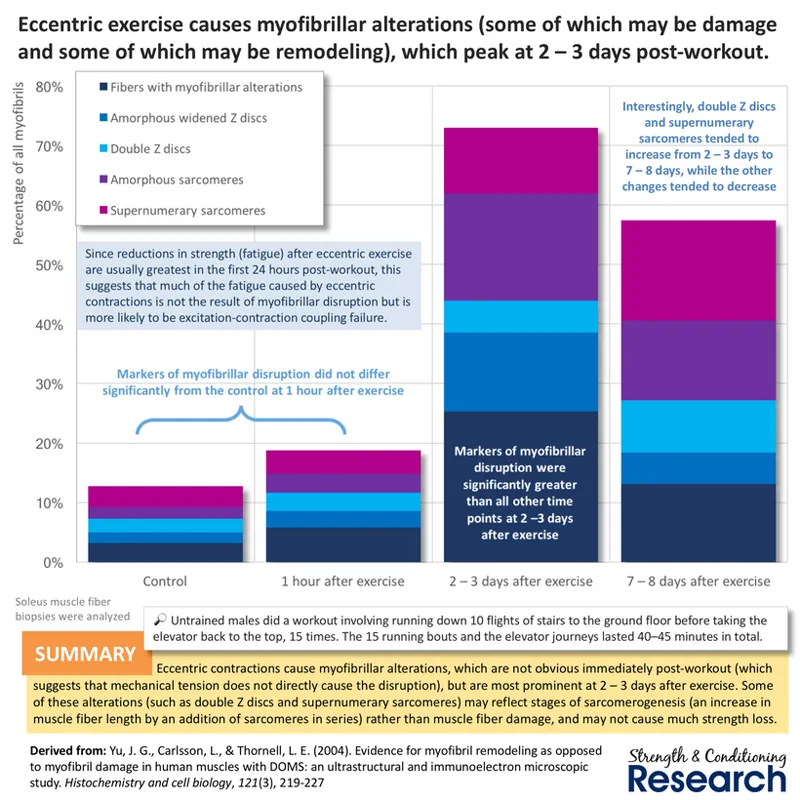
Muscle damage studies in humans have tended to focus more on signs of structural damage, such as disrupted sarcomeres and cytoskeletal changes. Such changes also take a couple of days to appear.
.
#3. Muscle damage is a two-phase biochemical process
The reason why muscle damage is delayed is that it is caused by two separate phenomena, both of which are biochemical in nature. The first phase involves damage to the inside of the muscle fiber caused by the production of proteases (enzymes) called calpains. These proteases are produced in response to the accumulation of calcium ions (subsequent to muscle fiber activation and/or stretch) and directly damage the myofibrils and the other structures inside the muscle fiber.
.
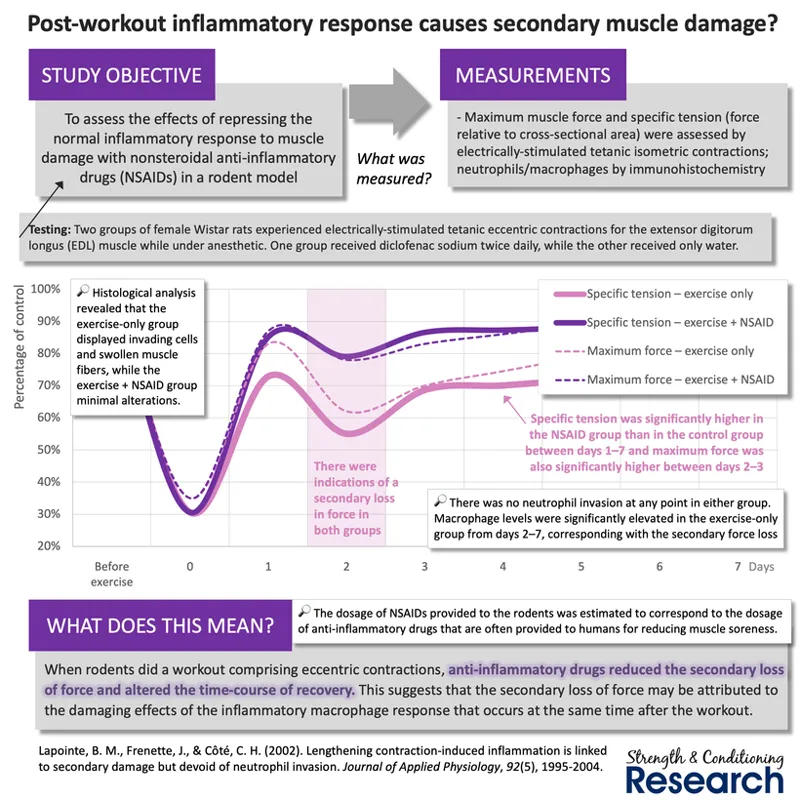
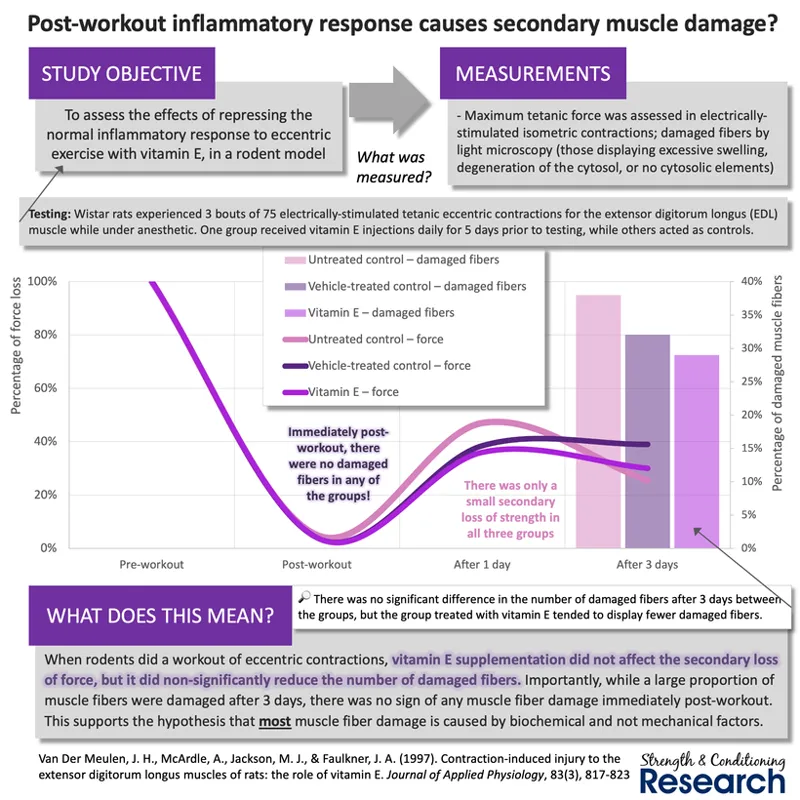
The second phase involves damage to the inside of the muscle fiber by means of an inflammatory process, which is often called the "secondary muscle damage effect" and has been well-documented. It typically occurs between hours and days after a very muscle-damaging workout. Various elements of the inflammatory process have been implicated, including neutrophils.
.
However, other research indicates that macrophages are more likely to be the key muscle-damaging element of the post-workout inflammatory process.
.
Macrophages are sometimes referred to more generally as mononuclear cells in this context.
.
Indeed, there are so many similar studies that they frequently get referred to as "the secondary muscle damage" literature by physiologists who are reviewing the findings. Many investigations show a lack of structural damage until several days post-workout as well as the secondary drop in strength.
.
#3. Eccentric contractions cause more damage by greater calcium ion accumulation
It is commonly-assumed that eccentric contractions cause more damage than concentric contractions because they cause muscle fibers to tear and become damaged. Since muscle damage is not always visible immediately after a workout, this cannot be true. In fact, eccentric contractions cause extra calcium ion accumulation inside muscle fibers by opening stretch-activated ion channels between the extracellular space around the muscle fiber and the cytoplasm.
.
This additional calcium ion accumulation causes post-workout fatigue mechanisms through a number of mechanisms, including the formation of muscle damage itself.
.
Conclusions
We often hear fitness influencers talk about muscle damage occurring during a workout in the form of "micro-tears" and yet the physiology literature is extremely clear that muscle damage does not happen during a workout but rather takes place during the hours and days following a workout. Indeed, studies in both animals and humans have shown that direct and indirect indications of muscle damage (such as increased rate of muscle protein breakdown, loss of myofibrils, and markers of sarcomere, myofibril, and cytoskeletal disruption) are absent immediately post-workout and are only detected after hours or even days of recovery. Clearly, the absence of muscle damage markers immediately post-workout tells us [1] that muscle damage does not occur during a workout and instead develops in the post-workout period, and [2] that muscle damage cannot be caused by mechanical tearing forces. Indeed, there is a well-established two-part biochemical mechanism that has been put forward to explain how muscle damage is generated by a bout of exercise. Firstly, when calcium ions accumulate in the cytoplasm of the muscle fiber (either due to muscle fiber activation or due to muscle fiber stretch), they stimulate the production of proteases (enzymes) called calpains that attack myofibrils and other structures inside the muscle fiber. Secondly, an inflammatory process comprising neutrophils and macrophages arises after these proteases have damaged the muscle fiber and clears away the damage, removing many myofibrils and other proteins in the process.