




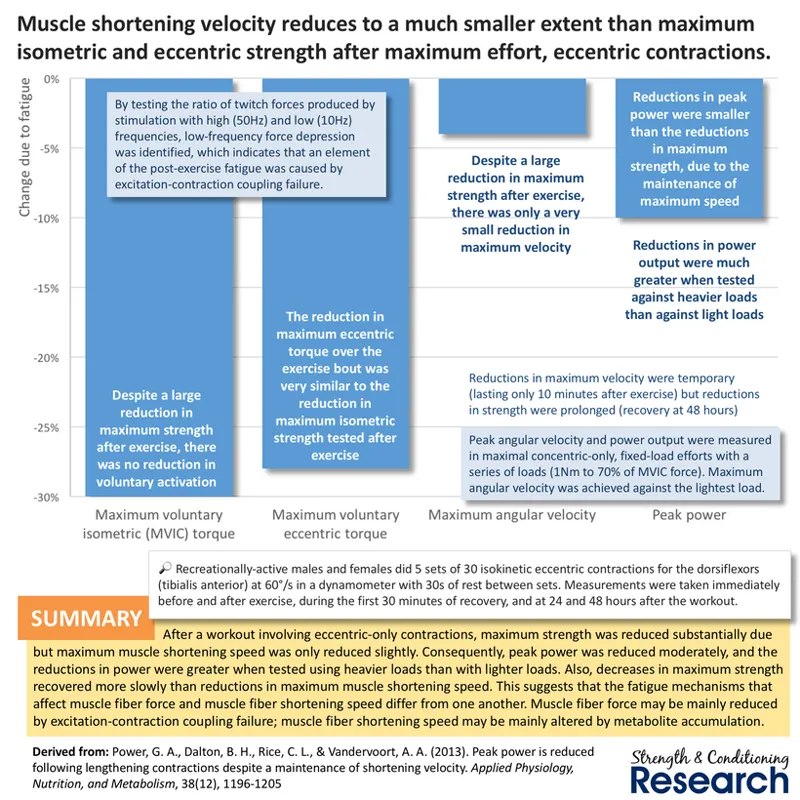


Fatigue is contraction mode-specific
Fatigue can be defined as a temporary and reversible reduction in exercise performance. There are many underlying mechanisms of fatigue and they differ between contraction modes.
.
#1. Introduction to peripheral mechanisms of fatigue
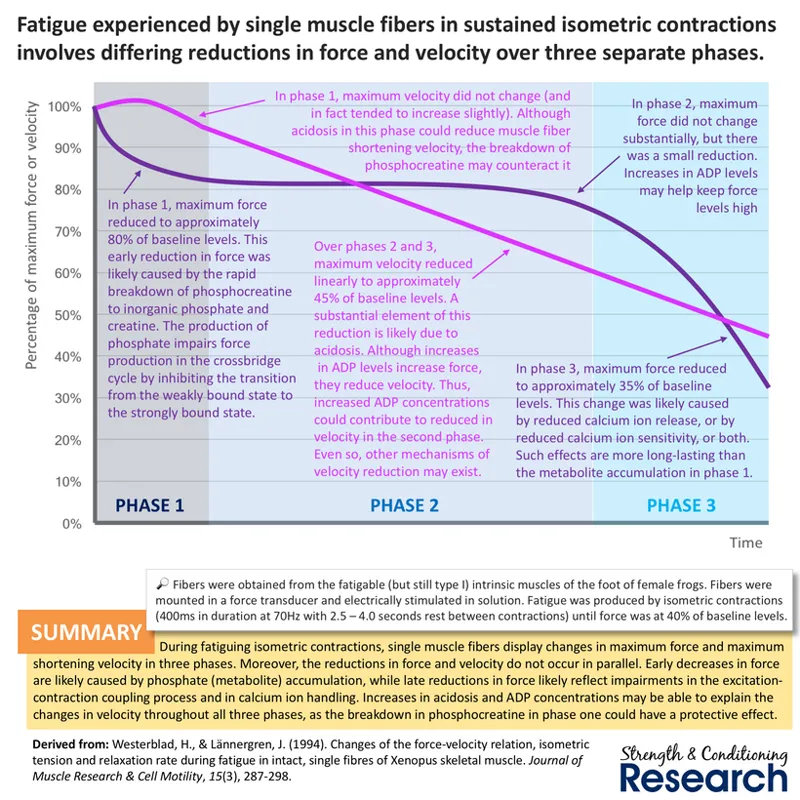
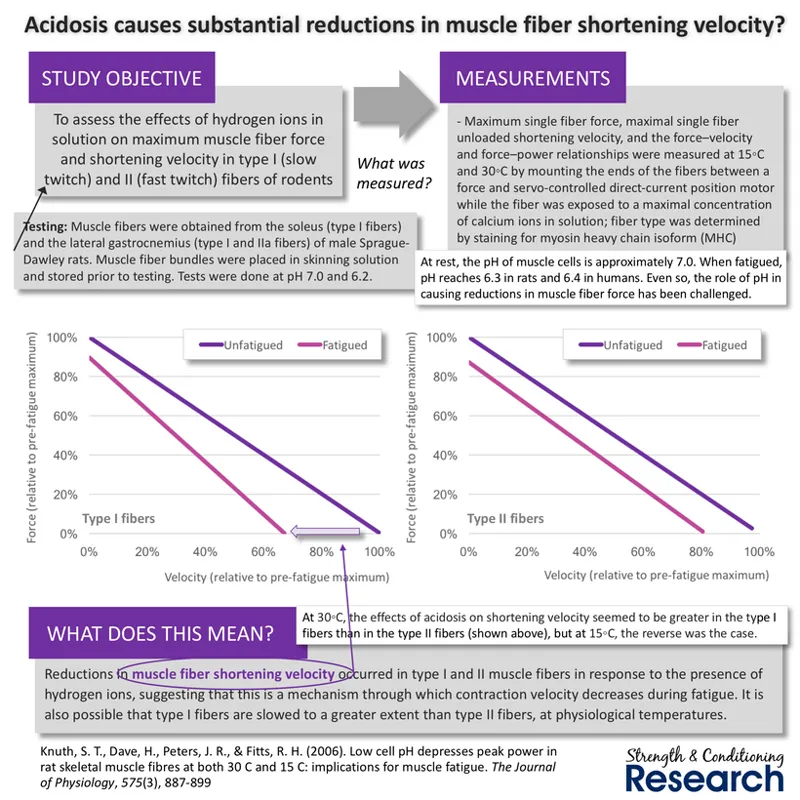
Perhaps the two most important peripheral fatigue mechanisms are [1] the accumulation of metabolites, and [2] excitation-contraction coupling failure. Acidosis due to metabolite accumulation mainly reduces muscle fiber shortening velocity, and excitation-contraction coupling failure mainly reduces muscle fiber force. In isometric contractions, acidosis occurs quickly (most likely because of the total occlusion of blood flow from the muscle that occurs in this contraction type, which prevents metabolites from leaving the muscle) and this leads to a very fast reduction in muscle fiber shortening velocity. Only later is there a substantial reduction in muscle fiber force, and this likely occurs because of excitation-contraction coupling failure.
.
Indeed, a number of studies have linked acidosis with reductions in muscle fiber shortening velocity. The mechanism appears to involve a reduction in the detachment rate of myosin heads from actin myofilaments.
.
Excitation-contraction coupling failure occurs when muscle fibers are activated but this activation does not lead to the influx of calcium ions into the cytoplasm. The influx of calcium ions is necessary for force production because it signals crossbridges to form.
.
#2. Introduction to central nervous system mechanisms of fatigue
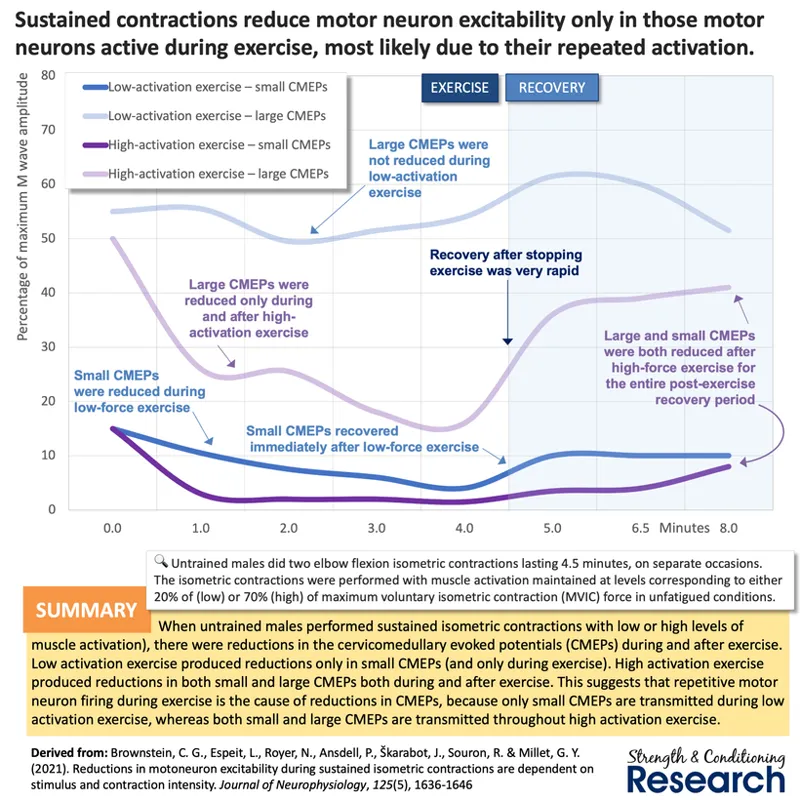
The two main central nervous system (CNS) fatigue mechanisms are: [1] supraspinal CNS fatigue and [2] spinal CNS fatigue. Supraspinal CNS fatigue during strength training is typically caused by afferent feedback from metabolite accumulation. Since supraspinal CNS fatigue works by limiting the output from the motor cortex, it has a systemic effect and reduces central motor command in all muscles.
.
In contrast, spinal CNS fatigue seems to be caused by the repetitive firing of motor neurons and is therefore extremely specific to the motor units that are working during the exercise bout. Thus, it likely does not affect muscles that were not recently involved in a strength training set.
.
#3. Fatigue mechanisms during concentric contractions
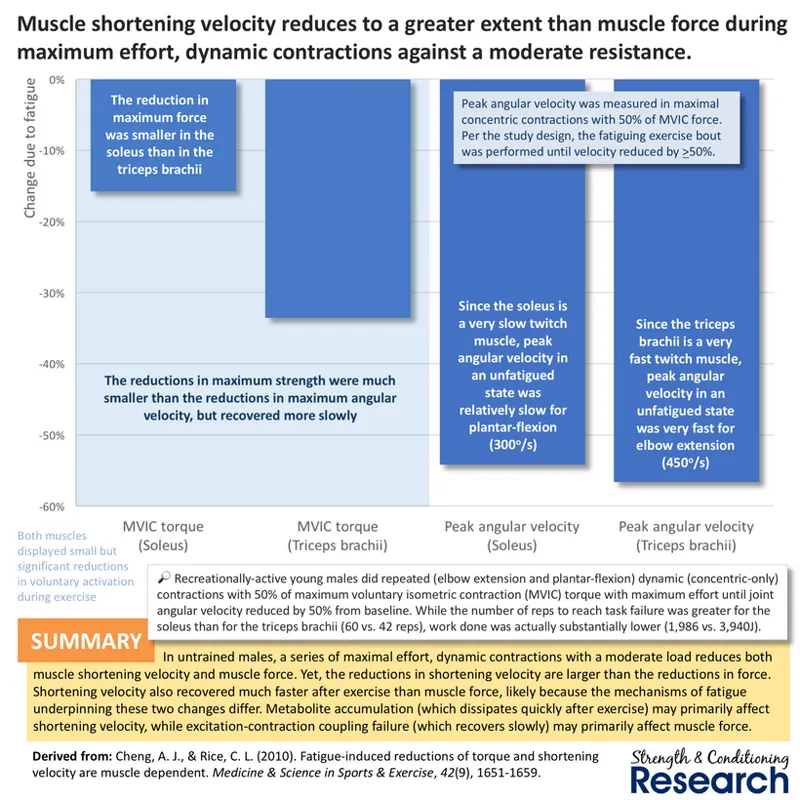
In fatiguing concentric contractions, there is a large accumulation of metabolites, owing to the large energy demand by the actin-myosin crossbridges in this contraction mode. Consequently, acidosis causes muscle fiber contraction velocity to reduce substantially. Since excitation-contraction coupling failure is less pronounced during this contraction mode (since there is no active stretch of the muscle fibers to trigger additional calcium ion influxes), the effect on muscle fiber force is far smaller. This can be observed as a larger reduction in maximum velocity than in maximum force.
.
Since the majority of the fatigue experienced during concentric contractions is metabolite-related fatigue, it dissipates quickly and therefore strength recovery after concentric-only training is rapid. This is in contrast to the slower recovery that occurs after eccentric contractions.
.
#4. Fatigue mechanisms during eccentric contractions
In fatiguing eccentric contractions, there is no real accumulation of metabolites, because the energy demand of the actin-myosin crossbridge binding process is small. Consequently, muscle fiber contraction velocity does not reduce very much. However, since eccentric contractions do cause a lot of excitation-contraction coupling failure, muscle fiber force is reduced substantially. This larger amount of excitation-contraction coupling failure is probably partly the result of eccentrics requiring proportionally more energy for the excitation-contraction coupling process, and partly the result of active stretch causing the opening of stretch-activated ion channels that allow additional calcium ions to enter the muscle fiber.
.
Since the majority of the fatigue experienced during eccentric contractions is calcium ion-related fatigue, it dissipates very slowly and therefore strength recovery after eccentric-only training is slow. This is in contrast to the much faster recovery that occurs after concentric contractions.
.
#5. Fatigue mechanisms during isometric contractions
In fatiguing isometric contractions, the most prevalent form of fatigue is actually CNS fatigue, which may be spinal in nature. This can be seen from the fact that reductions in maximum force and muscle activation occur more-or-less in parallel during fatiguing isometric contractions, while reductions in muscle activation are smaller after eccentric contractions and concentric contractions in comparison with the reductions in maximum strength. Curiously, this causes more rapid fatigue to occur than during either eccentric or concentric contractions.
.
Conclusions
Fatigue can be defined as a temporary and reversible reduction in exercise performance. There are many underlying mechanisms of fatigue and they differ between contraction modes (eccentric, isometric, and concentric). During concentric contractions (and also during normal strength training, since that is mainly limited by the concentric phase of the lift), the main fatigue mechanisms are metabolite-related. Since metabolite-related fatigue mechanisms primarily produce reductions in muscle fiber shortening velocity rather than in either muscle fiber force or motor unit recruitment, the development of fatigue mechanisms during concentric contractions is not very problematic for the hypertrophy stimulus. During eccentric contractions, the main fatigue mechanisms are calcium ion-related. Calcium ion-related fatigue mechanisms cause large (and long-lasting) reductions in muscle fiber force, which obviously has a negative impact on the stimulus for hypertrophy. It also explains why eccentric-only training workouts cause the most post-workout fatigue. During isometric contractions, the main fatigue mechanism is central nervous system fatigue, which reduces the level of motor unit recruitment and has a negative impact on the stimulus for hypertrophy. This explains why maximal isometric contractions involve the development of fatigue at a faster rate than maximal concentric or eccentric contractions (despite almost certainly producing less metabolite accumulation and much less calcium ion accumulation).
Comments (7)
Excellent, makes a lot of sense. Thanks for taking the time to respond!
That's great and exactly what i was looking for. Thanks for helping me understand 🙏🏼 Regarding the concentric/metabolites, we know with BFR that hypertrophy can occur due to the increase voulantary effort and (i think) the reduction in muscle shortening speed. Is there a point with metabolites (with or without BFR) where it would hinder hypertrophy?
When metabolite accumulation gets high enough, it causes afferent feedback to the brain that increases perception of effort, thereby causing supraspinal CNS fatigue. That does impair the stimulus for hypertrophy.
Hi Chris, I'm new here and already enjoying all this info! I'd love if you could clear something up for me as I'm confused regarding ECCF. When we say ECCF is present, does that mean calcium ions cannot enter the cytoplasm to facilitate crossbridging or does it mean too much calcium ions are in the cytoplasm? Any help would be greatly appreciated.
It means that an excess of calcium ions built up in the cytoplasm, which then signaled the production of proteases called calpains. These then damaged the minor triadic proteins that hold the voltage sensor of the transverse tubule next to the sarcoplasmic reticulum, causing the two structures to separate. After this point, electrical signals arriving at the voltage sensor can no longer cause calcium ions to leave the sarcoplasmic reticulum to enter the cytoplasm. Thus, the level of calcium ions drops to zero. Essentially, an excess of calcium ions in the cytoplasm causes an absence of calcium ions.
Great article! Some questions: 1. Does the excitation-coupling failure in the eccentric phase during a concentric-weight set affect the force production in the concentric phase as well? Or does it differ, considering also that a concentric set is using weight that is too light to fully activate all motor units / muscle fibers in the eccentric phase and thus more type 1 fibers there. 2. Could the velocity decrease in the concentric phase (but not the force production decrease) with the rapid recovery afterwards explain partially the effectiveness of cluster sets? Like I do 3 reps in a squat with X weight where the fourth rep would be a failure, rack the weight and walk around for 20 seconds, then I can do a couple of more reps with good velocity again and without any apparent force decrease.
[1] Does the excitation-coupling failure in the eccentric phase during a concentric-weight set affect the force production in the concentric phase as well? => yes, but only for the muscle fibers that are active in that phase (which are the slow twitch muscle fibers controlled by the low-threshold motor units). These fatiguing effects are all muscle fiber-specific in nature.