


Principle of specificity
Fitness influencers often reference the principle of specificity as an explanation for why different strength training programs produce different performance improvements. However, the principle of specificity is a description of a commonly-recurring observation and not an explanation.
.
#1. What does the principle of specificity tell us?
The principle of specificity tells us that any given type of exercise tends to produce improvements in performance in that particular type of exercise, rather than in any other type of exercise. Yet, it is not an explanation for WHY that happens. For example, a strength training program that involves training at long muscle lengths might cause a greater increase in maximum voluntary isometric contraction (MVIC) force measured at a long muscle length compared to MVIC force measured at a short muscle length. But if you try to use the principle of specificity to explain this observation, you will end up using circular reasoning.
.
#2. How can we explain velocity-specificity during strength training? (slow speeds)
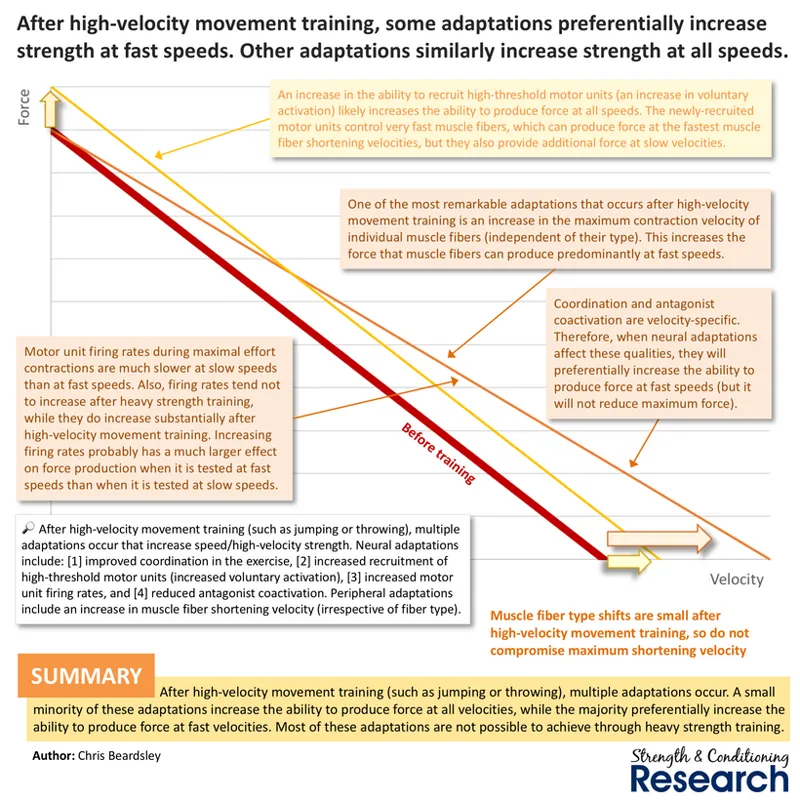
Strength training performed with maximal efforts and heavy loads (and therefore at slow speeds) produces increases in the ability to produce force primarily at slow speeds. This can be measured as maximum dynamic or maximum isometric strength, both of which involve contractions at slow speeds. The strength gains that occur are the result of multiple adaptations (read more).
.
#3. How can we explain velocity-specificity during strength training? (fast speeds)
Conversely, strength training performed with maximal efforts and light loads (and therefore at fast speeds) produces increases in the ability to produce force primarily at fast speeds. This can be measured as maximum velocity during movements performed as fast as possible. The strength gains that occur are the result of multiple adaptations (read more).
.
#4. Why are different adaptations stimulated?
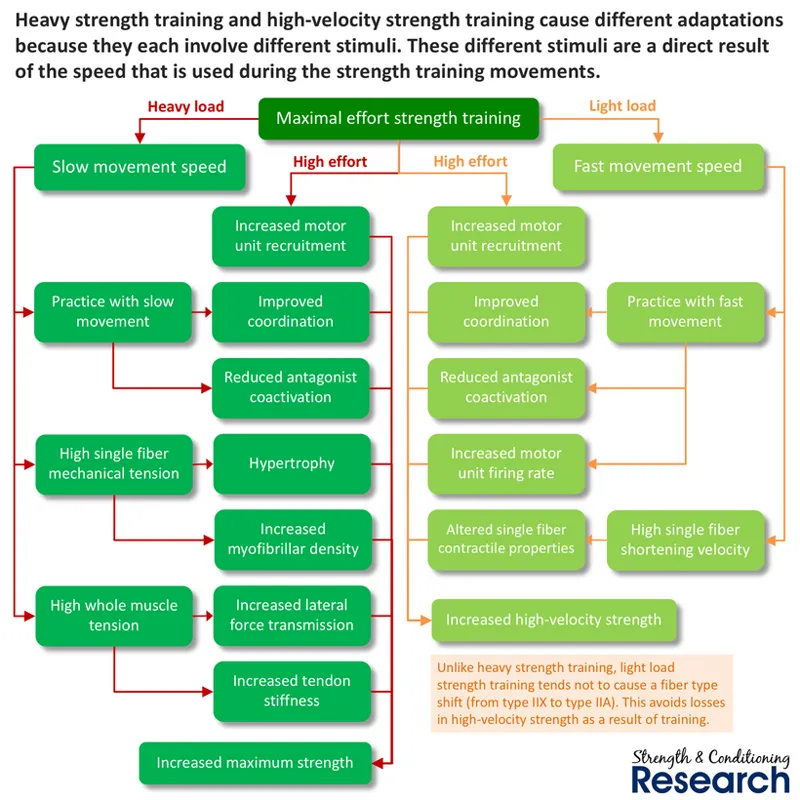
In both cases, these different adaptations are each caused by specific stimuli. These stimuli are states or events that occur during a strength training exercise. There are a number of stimuli that cause different adaptions after both heavy strength training and after high-velocity strength training.
.
Conclusions
Different strength training programs tend to produce different performance improvements from one another. For example, a program that involves training at long muscle lengths might cause a greater increase in maximum voluntary isometric contraction (MVIC) force measured at a long muscle length compared to MVIC force measured at a short muscle length, while a program that involves training at short muscle lengths might cause the opposite effect. Fitness influencers commonly refer to the principle of specificity as an explanation of such phenomena. However, the principle of specificity is a description of this observation, and not an explanation for it. Indeed, if you try to explain such an observation by reference to the principle of specificity, then you are going to end up using circular reasoning, because the observations were the reason for us coining the principle in the first place. The velocity-specificity of strength training is a good case study for what we should do instead. Strength training with maximal efforts and heavy loads (and hence slow speeds) increases the ability to produce force primarily at slow speeds. Conversely, strength training with maximal efforts and light loads (and hence fast speeds) increases the ability to produce force primarily at fast speeds. Importantly, the prevailing adaptations are different after each training program, and the reason for the difference in adaptations is the different stimuli that are experienced during the slow or the fast movements that were used during training.


Comments (1)
hello chris i have a question about strength training fiber type shift, it is mentioned that training with heavy load strength training we shift or might shift fiber type from 2x to 2a but isn't the heavy load strength training supposed to increase type x knowing their history of fast twitch and strength thank you in advance