





Speed
Fast movement training (including plyometrics) is commonly used by athletes to improve athletic performance by increasing speed. This happens by means of specific adaptations that increase speed to a greater extent than strength.
.
#1. Improvements in coordination
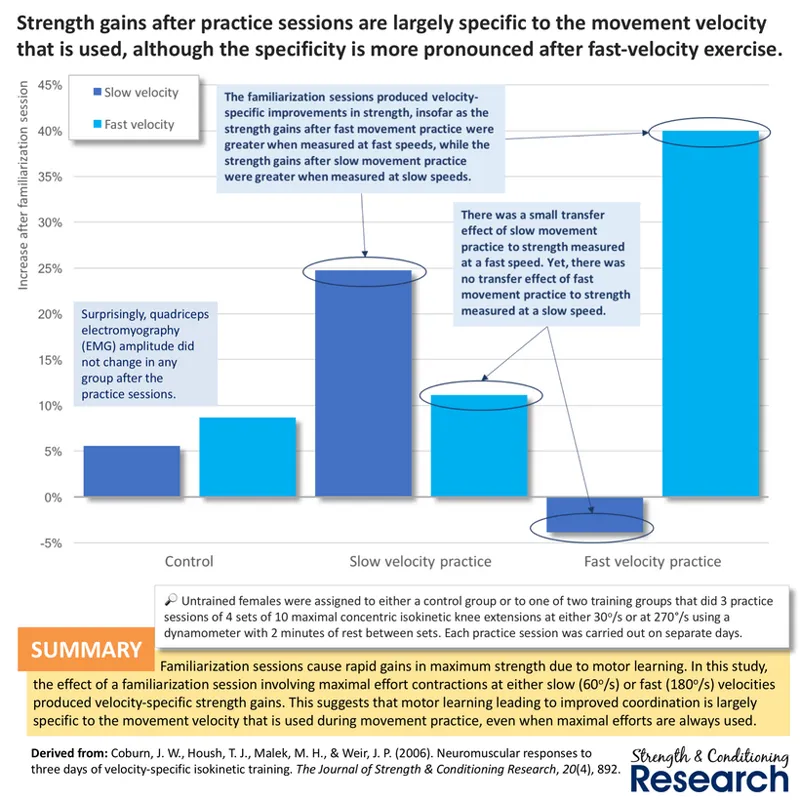
Improvements in coordination obviously contribute to strength gains and are very velocity-specific. For this reason, coordination changes after strength training with a light load and a fast speed will cause greater improvements in speed compared to in strength.
.
#2. Increases in the ability to recruit high-threshold motor units of the agonist muscle
Improvements in the ability to recruit high-threshold motor units of the prime mover contribute to increases in maximum strength, because they lead to new high-threshold motor units being recruited. This adaptation also causes an increase in maximum speed, because newly-recruited high-threshold motor units will necessarily mainly control muscle fibers of the fastest fiber type (type IIX).
.
Fast movement training with light loads can also increase the ability to recruit high-threshold motor units in any movement involving the same muscle group, including isometric contractions.
.
#3. Increases in agonist motor unit firing rate (velocity-specific)
The amount of force that muscle fibers produce at a given contraction velocity when they are activated depends on their motor unit firing rate. Even so, at a certain motor unit firing rate, the muscle fiber achieves tetanus, at which point no further increases in motor unit firing rate have any effect on the force that it produces. The motor unit firing rate at which this happens depends on muscle fiber type (and therefore the position in Henneman's size principle sequence, as shown below).
.
Importantly, muscle fibers achieve tetanus at low motor unit firing rates when they are contracting slowly, and at high motor unit firing rates when they are contracting quickly. When producing force in an isometric contraction or during heavy strength training, muscle fibers tend to reach tetanus at approximately 30Hz. In contrast, when producing force during fast movements, they can reach firing rates of 200Hz. The motor unit firing rate that is reached during a contraction is likely the stimulus that causes motor unit firing rates to increase in subsequent contractions. Thus, fast movement training is more effective for increasing motor unit firing rates than heavy strength training, and increases in motor unit firing rates have a much larger impact on speed than on strength.
.
#4. Reductions in antagonist muscle activation
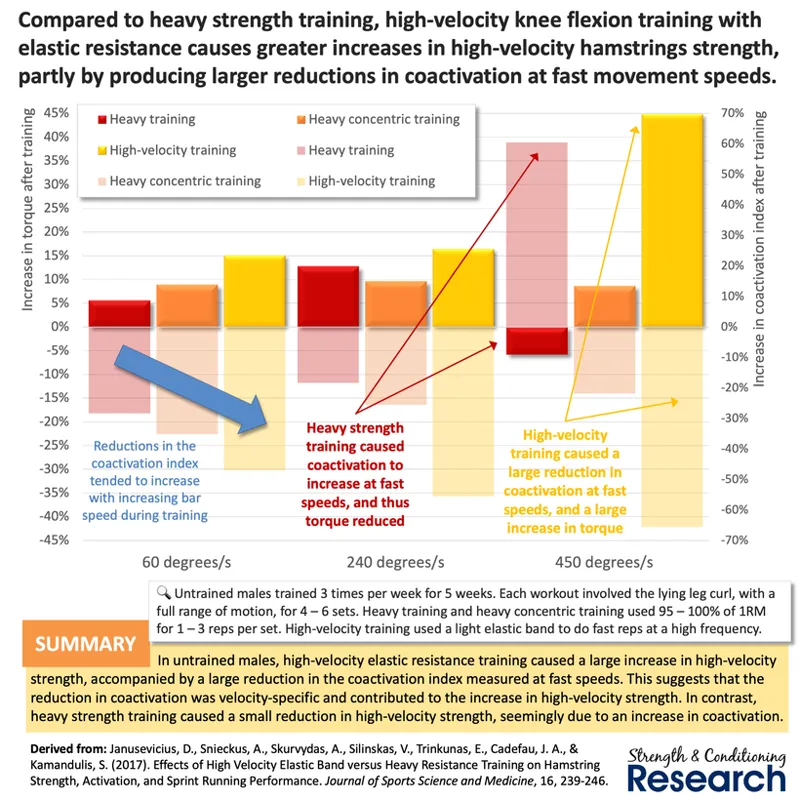
A reduction in the force produced by the antagonist muscle during an exercise reduces the braking force at the joint, and thereby increases the external force that is exerted during an exercise, even without the force of the agonist muscle itself increasing. If this reduction in antagonist muscle activation occurs primarily at slow speeds, then it will have a preferential effect on strength. Alternatively, if the reduction in antagonist muscle activation occurs primarily at fast speeds, then it will have a preferential effect on speeds. Short-term training studies have shown that fast movement training causes much larger reductions in antagonist coactivation when strength is measured at fast speeds than when strength is measured at slow speeds.
.
#5. Increases in muscle fiber contractile velocity
One very surprising adaptation that occurs after fast movement training is an increase in maximum muscle fiber shortening velocity. This adaptation is surprising because it occurs in all fiber types, without a change in fiber type. Exactly what alterations occur inside the muscle fiber to cause this adaptation are unfortunately unclear. Even so, since it is exclusively a change in speed and not in strength, it contributes to increases in speed and not strength after strength training with a light load and a fast bar speed.
.
#6. Summary of effects on the force-velocity profile
Fast movement training causes improvements in coordination, increases in motor unit firing rate, reductions in antagonist coactivation, and increases in maximum muscle fiber shortening speed, all of which cause large increases in speed but minimal changes in strength. Additionally, fast movement training causes increases in the ability to recruit high-threshold motor units, which cause increases in both strength and speed.
.
Conclusions
Fast movement training (including plyometrics) is commonly used by athletes to improve athletic performance. Fast movement training produces specific adaptations that increase maximum speed without changing maximum strength, and this alters the force-velocity profile. Yet, fast movement training also causes an adaptation that increases both maximum speed and maximum strength, which means that it can produce a transfer effect on heavy strength training performance. Fast movement training causes four velocity-specific adaptations, which are: [1] improvements in coordination, [2] increases in motor unit firing rate, [3] reductions in antagonist coactivation, and [4] increases in maximum muscle fiber shortening speed. All of these four adaptations cause large increases in speed but minimal changes in strength. Therefore, they contribute greatly to the velocity-specificity of strength gains after fast movement training and alter the force-velocity profile to become more velocity-dominant. However, fast movement training also causes one adaptation that is not velocity-specific, which is an increase in the ability to recruit high-threshold motor units. This adaptation causes an increase in both strength and speed. The exact effects of fast movement training on any given athletic performance outcome will vary depending on the individual training status for each of these adaptations, and the extent to which the program is optimized to produce each adaptation (according to its own unique stimulus).
Comments (8)
Hi chris, hope you are doing great. I got a question regarding the relevance of doing speed work or SSC type training for young athletes or novice trainees. I read in a book written by vladimir zatsiorsky about the explosive strength deficit « ESD ». He explain in this book that he used this measure for selecting the right type of program (strength or high velocity training) for his athletes. If someone doesn’t have a good base of strenght, the emphasis of the workout should be spent on improving strength since the trainee wouldn’t benefits from SSC or high velocity workout. But in your 5th infographics, it suggest that SSC training reduce the shortening velocity of the muscle fibers, irespective of the fiber type. My question is, would you recommend the use of SSC or high velocity training to young of novice trainees even if they dont have a good base of strength or a poor ESD score)? Or you follow the same logic as zatsiorsky on this topic ?Thanks for your time as always
There is no physiological foundation for having a "base of strength" but obviously having higher strength and higher maximum velocity will both contribute to power outputs during fast movements like jumping etc. And athletes could either be force dominant or velocity dominant so will need more of one characteristic or more of the other. I would rather identify that using a force-velocity profile test, however.
Hi Chris. I have read your book and attended your recent maximum velocity webinar. Huge fan. I am curious to what extent the different adaptations you talk about have on force production at high velocities. Are some making a much bigger difference than others? Or are they similarly important? I haven’t seen anything about that. Thank you.
It really depends on the individual and their training status, both in relation to high-velocity movements in general and in relation to the exercise/movement pattern in particular. Coordination is a huge factor, but if the individual is well-practiced in that movement for many years, it will be very minor. Conversely, an athlete who has played other sports will see most of their gains in a new sport come from coordination.
Incredible article Chris - thanks! Does this mean sprinting will enhance my ability to recruit high-threshold motor units when I leg press? My question is do we need to use loads for the fast movement training? Would all of the adaptations be conferred by body weight training at fast velocity? So jumping and sprinting? Or does the light load have to be incorporated? Thanks
Sprinting probably does increase the ability to recruit motor units in the hip extensors, yes, and this improved ability would be accessible in any other movement, including the leg press. No, it is not necessary to use loads to achieve improvements in voluntary activation. As long as the effort is maximal and there is minimal fatigue, there will be maximal motor unit recruitment.
Great article thanks. So when you hear of people saying things like voluntary activation percentage increased from 90-93%, after training this refers to the percentage of motor units rather than the total muscle activation? So in this example someone could have the ability to activate 84% of the motor units (which from what I understand isn't abnormal for someone untrained) and yet only be activating 50% of the muscle?
Voluntary activation is essentially the ratio of voluntary force to involuntary force. So if we assume that all muscle fibers are the same length and produce the same force relative to their cross-sectional area (which is not a bad assumption), then voluntary activation tells us the percentage of the muscle that is activated, by volume. Practically speaking, voluntary activation tells us how much of the muscle we are actually using when we exert a maximal effort, and therefore how much of it we can train. Voluntary activation differs from muscle activation measurements with EMG because EMG records an electrical signal (which can vary according to a range of factors) whereas voluntary activation just measures forces.