


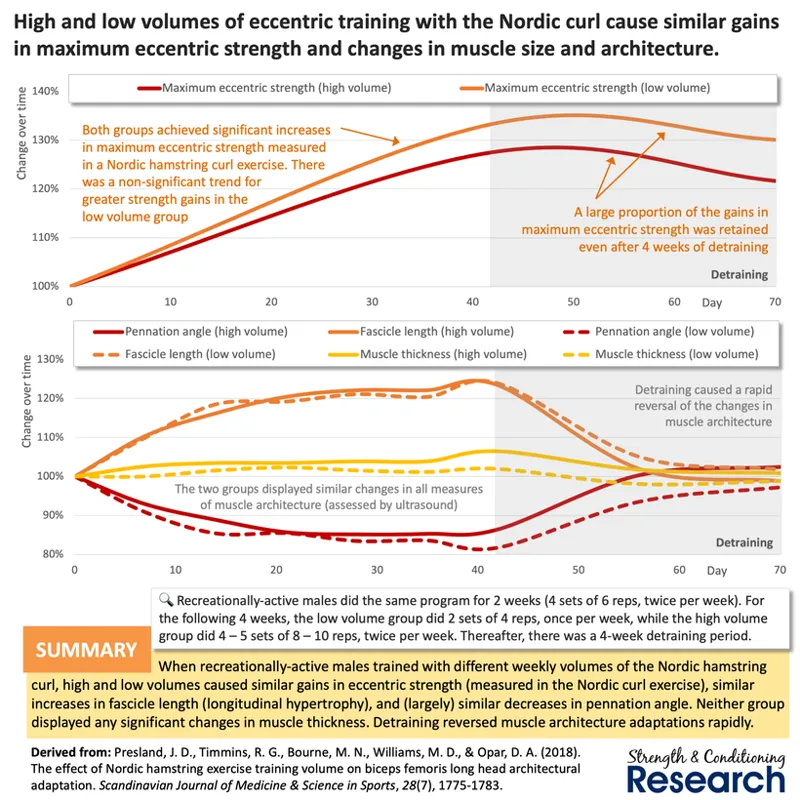


Eccentric training volume
During normal strength training, increases in training volume seem to cause greater gains in strength and size (at least up to a point). During eccentric training, volume appears to play a much smaller role, however.
.
#1. Greater gains in maximum strength and size with higher volumes
Some research has identified a dose-response of both strength and size to increasing volumes of eccentric training. Based on such studies, eccentric training appears to behave in a similar way to conventional strength training, with higher volumes producing greater adaptations, up to a point.
.
#2. Similar gains in maximum strength and size with low and high volumes
Nevertheless, other research studies have not identified a clear dose-response of maximum strength and muscle size to eccentric training volume.
.
In fact, at least one study has reported that lower weekly training volumes may be more effective for increasing maximum eccentric strength, while longitudinal hypertrophy occurs to a similar extent after training with high or low volumes.
.
#3. Why might higher volumes of eccentric training fail to produce greater adaptations? (part one: peripheral fatigue)
Fatigue can create an interference effect on the hypertrophy stimulus. Moreover, the nature of the peripheral fatigue in eccentric training is different from the peripheral fatigue in normal strength training. The peripheral fatigue that occurs during conventional strength training is predominantly metabolite-related, which reduces muscle fiber shortening velocity to a much greater extent than muscle fiber force, and lasts for a very short period of time. The peripheral fatigue that occurs during eccentric contractions is predominantly calcium ion-related, and this reduces muscle fiber force (affecting muscle fiber shortening velocity) and lasts for a long period of time.
.
Since normal strength training involves mainly metabolite-related fatigue, each set does not greatly reduce the ability of muscle fibers to produce mechanical tension. In contrast, eccentric training involves mainly calcium ion-related fatigue. This type of peripheral fatigue substantially reduces the ability of muscle fibers to produce force (and therefore their ability to experience mechanical tension). Also, such reductions in muscle fiber force occur after only a very small number of maximal effort eccentric contractions, and the fatiguing effects often take a long time to dissipate.
.
#4. Why might higher volumes of eccentric training fail to produce greater adaptations? (part two: CNS fatigue)
Eccentric contractions cause more CNS fatigue than concentric contractions. To the extent that this CNS fatigue lasts for several minutes or more, it could easily prevent subsequent sets within a workout from accessing high-threshold motor units and thereby producing gains in strength and size.
.
Conclusions
During normal strength training, increases in training volume seem to cause greater gains in strength and size (at least up to a point). During eccentric training, training volume seems to play a much smaller role, however. It seems likely that differences in fatigue mechanisms are responsible for this difference in the dose-responses of strength gains and hypertrophy to training volume during eccentric training. Indeed, the main type of peripheral fatigue during normal strength training is metabolite accumulation, which primarily reduces muscle fiber shortening velocity rather than muscle fiber mechanical tension and also recovers quite quickly between sets. In contrast, the main type of peripheral fatigue during normal strength training is caused by calcium ion accumulation, which primarily reduces muscle fiber mechanical tension and also recovers extremely slowly between sets (if it recovers at all). Therefore, each extra set will involve a progressively lower and lower amount of single muscle fiber mechanical tension during eccentric training, which obviously creates a much smaller hypertrophy stimulus. Furthermore, central nervous system (CNS) fatigue is greater and longer-lasting after each set during eccentric training. When CNS fatigue develops during an earlier set, this reduces motor unit recruitment in later sets, which then reduces the ability of those later sets to stimulate hypertrophy.
Comments (2)
Great article Chris - thanks - in your review this month you said the stimulating repetitions model may need to be expanded to beyond the final 5 repetitions in a set. In this article muscle damage related to calcium ion influx creates CNS fatigue interfering with high-threshold motor unit recruitment/high levels of mechanical tension to activated fibers. So is it fair to say training close to fatigue with 1 or 2 repetitions in reserve is superior to as many repetitions as possible? Thanks!
Eccentric training is different from normal strength training, because it's not possible to reach a point that is clearly failure. With eccentrics, force can be very low and the eccentric phase can still be accomplished. We can introduce parameters (such as the speed of the lowering phase must be a certain tempo, when using weight) but we can't really see a clear point at which failure occurs. However, yes, I think there will be a certain number of reps in an eccentric training set after which no further stimulating reps occur. Whether this is the same number as during normal strength training is hard to say. In theory, it might be slightly fewer because the stimulus caused by each individual rep is likely slightly higher.