




Maximizing hypertrophy by minimizing fatigue
Higher weekly training volumes (up to a point) are associated with more hypertrophy. The amount of volume that can be achieved each week is very likely limited by the amount of post-workout fatigue that each workout causes, since training while fatigued probably does not cause the same stimulus as training while unfatigued (indeed, post-workout fatigue mechanisms reduce both single muscle fiber mechanical tension and motor unit recruitment).
.
#1. High repetition ranges increase post-workout fatigue
Although both light (16 – 30RM) and moderate (6 – 15RM) loads can produce similar hypertrophy when the same number of sets are performed to muscular failure, training with a lighter load also causes more sustained fatigue after a workout than training with a heavier load. This suggests that moderate loads are superior for hypertrophy, when attempting to maximize weekly training volume.
.
Traditionally, sustained fatigue after a workout has been ascribed solely to muscle damage. However, there are also other mechanisms of fatigue (including excitation-contraction coupling failure and central nervous system fatigue), and these have been shown to be greater after training with light loads compared to moderate loads. Indeed, low-frequency fatigue (a marker for excitation-contraction coupling failure) is greater after training with light loads.
.
Similarly, central nervous system fatigue in the days following a workout is also greater after training with light loads compared to moderate loads.
.
#2. Training closer to failure increases post-workout fatigue
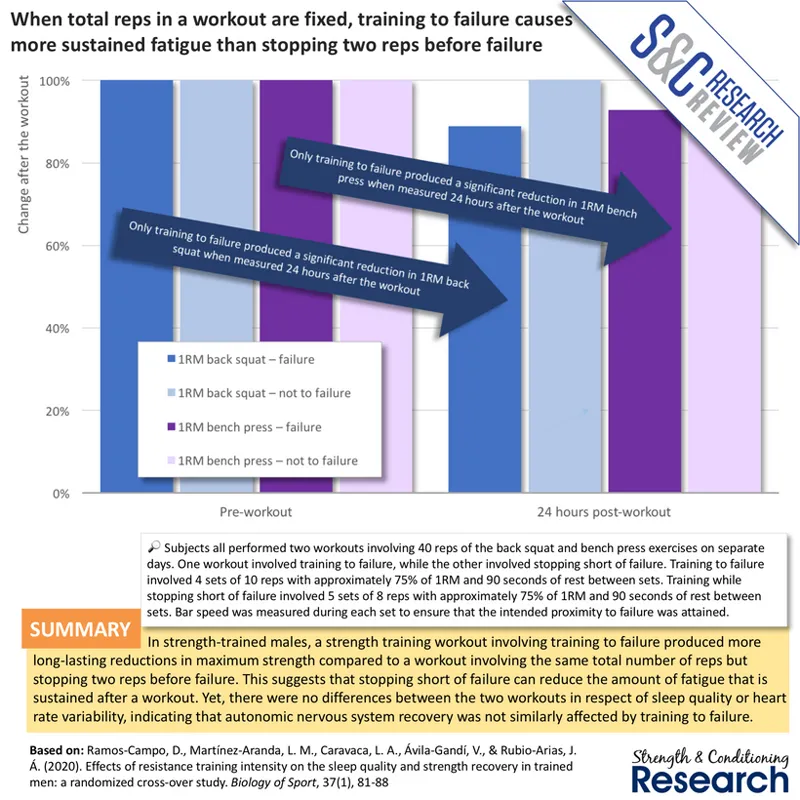
Although training to failure and stopping short of failure can produce similar hypertrophy when the same number of stimulating reps are performed, training to failure causes more sustained fatigue after a workout than training while stopping before reaching failure. Importantly, it is only necessary to stop one or two reps before reaching failure in order to reduce the sustained fatigue that is caused by training closer to failure. This suggests that stopping one or two reps before failure on most sets of a workout is superior for hypertrophy, at least when the goal is to maximize weekly training volume.
.
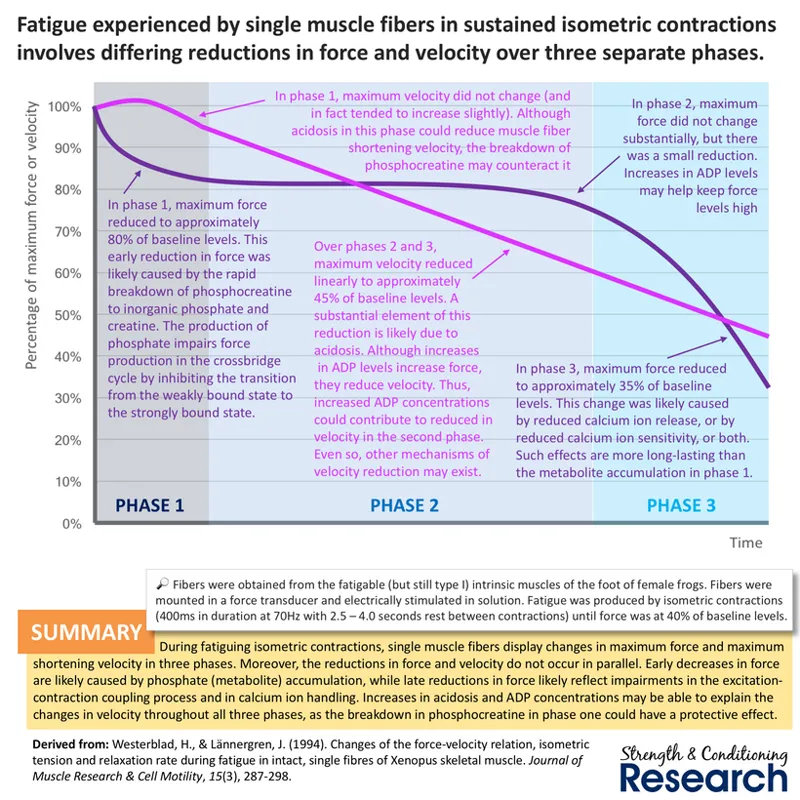
The reason that stopping one or two reps before reaching muscular failure has such a substantial effect on the amount of sustained fatigue that occurs is because of the nature of fatigue during each set of a workout. When training to failure, most of the fatigue that occurs in the set is caused by metabolite-related processes. These processes do not contribute to sustained fatigue after the workout. However, right at the very end of each set, calcium ion-related processes begin to contribute to fatigue, and these processes do contribute substantially to sustained fatigue after the workout. Therefore, stopping a set one or two reps before failure can avoid incurring this type of fatigue, and thereby allow faster recovery.
.
#3. Exercises that reach a longer maximum muscle length increase post-workout fatigue
Although with a larger range of motion (ROM) or a longer maximum muscle length can often cause more hypertrophy, training through a larger ROM also causes more post-workout fatigue.
.
The greater muscle damage that is experienced after training through a full ROM or to a longer maximum muscle length is probably caused by the stretching of stretch-activated ion channels. When the muscle fibers are stretched to longer lengths, they cause more calcium ions to enter the muscle fiber through these channels, and this causes greater damage.
.
Indeed, this idea is supported by the fact that excitation-contraction coupling failure (which is also caused by greater calcium ion accumulation) is greater after strength training with longer maximum muscle lengths.
.
#4. Eccentric overload causes more post-workout fatigue
Increasing the intensity of the lowering (eccentric) phase of a strength training set by using a form of eccentric overload increases the amount of post-workout fatigue. Again, this works by increasing the opening of stretch-activated ion channels, albeit this time by increasing the number of muscle fibers that are activated in the lowering (eccentric) phase of each repetition.
.
Conclusions
Higher weekly training volumes are (up to a point) associated with more hypertrophy. Nevertheless, the amount of training volume that can be performed each week is very likely limited by the amount of post-workout fatigue that each workout causes, because doing workouts while fatigued probably does not cause the same stimulus as training while unfatigued (indeed, post-workout fatigue mechanisms reduce single muscle fiber mechanical tension and motor unit recruitment, so this should be obvious). Therefore, it is useful to consider those factors that will cause each strength training set in a workout to produce more post-workout fatigue such that more volume can be performed. In this respect, there are four key factors that modulate post-workout fatigue in addition to volume itself: [1] repetition range, since training with light loads causes more post-workout fatigue compared to training with moderate loads; [2] proximity to failure, because training to failure causes more post-workout fatigue compared to stopping one or two reps before failure; [3] maximum muscle length, because training with a full range of motion causes more post-workout fatigue compared to training with a partial range of motion; and [4] the intensity of the lowering (eccentric) phase because training with eccentric overload causes more post-workout fatigue than training without eccentric overload.
Comments (6)
Hot topic article, dear Chris, would you dare to provide a general "in practice" as to what would be good set ranges in a session for muscle groups? Maximising hypertrophy whilst minimising fatigue with the above guidelines. I also wonder when choosing these different exercises for different muscle regions, would it mean that you apply the set volume needed to that region? For example, quads, maybe I chose a squat for VL and need 4 sets for good stimulus, if I wanted to work the RF, I might need another of 4 sets of leg extension, but I can't really say I did 8 sets for quads in the round? Should volume be counted more to the specific region?
IMO, it is a very individual thing. Some lifters can train with much higher volumes than others. I am not sure that providing general guidelines is helpful. However, we can say that some muscles will respond better to higher volumes than others. I will write something up about this soon.
Thank you very much - Chris do you have any thoughts/information on how best to train the transverse abdominis? Bodybuilding is about bigger muscles but also a smaller waistline. Is there a way to reduce the size of the waist other than losing fat? Or is it just the size of the pelvis. Obviously many bodybuilders have distension and is this just bad luck or a poor choice of exercises/training? Thank you
I haven't written an article about training the abdominals yet, no.
Hi Chris - great article - thanks - however am a little confused. I've always thought exercise variety was overrated or possibly unnecessary. However your writings have made me reconsider dramatically. Neuromechanical matching/regional anatomy in conjunction with the studies on triceps/quadriceps made me think I definitely overlooked this. I also recall a recent post where you finished by noting variety was best or necessary for bodybuilders unless I'm overstating. However in this article it sounds like variety has to be cautiously approached and administered on a case by case basis. And we really have limited evidence (long term) to support it. Or am I wrong? Thanks!
Yes, exercise variety is very important for hypertrophy. Some regions of a muscle cannot be trained effectively with some exercises. However, that does not mean that it is optimal to use a dozen different exercises for every muscle group. Most of the time, three or four carefully chosen exercises are better.