



Fatigue reduces motor unit recruitment
It is often assumed that fatigue is helpful for achieving high levels of motor unit recruitment and consequently for increasing the ability to recruit high-threshold motor units after training. Nevertheless, this is not true. In fact, fatigue is actually unhelpful in both respects.
.
#1. Maximal motor unit recruitment can be achieved voluntarily in an unfatigued state, even with light loads
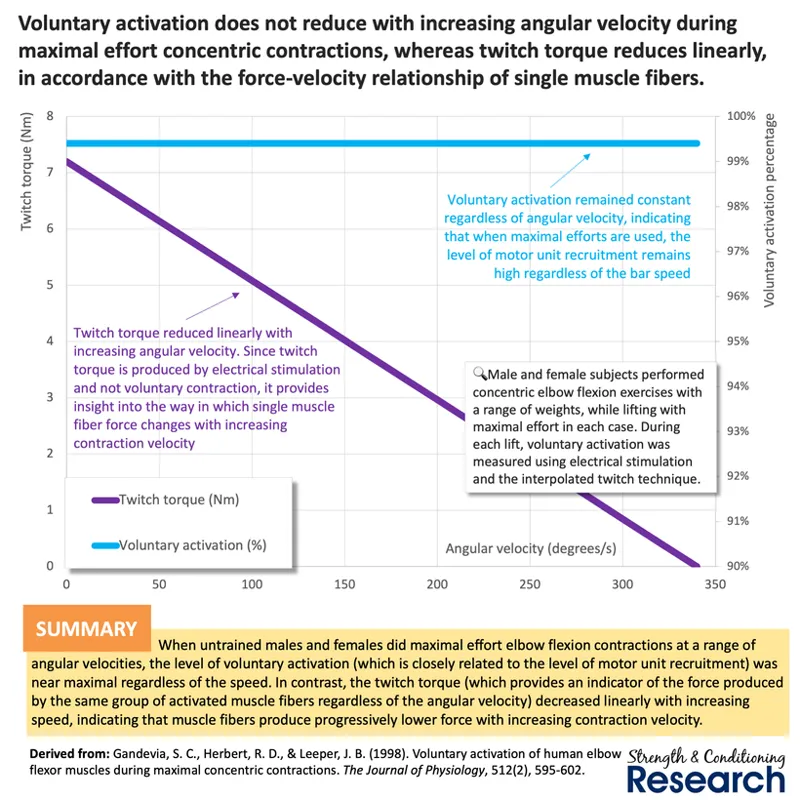
Maximal levels of motor unit recruitment (as measured by the gold standard method of voluntary activation) can be achieved without any fatigue being present (and against any load), simply by exerting a maximal effort during a rep. This is because the number of motor units that are recruited in any given contraction is determined voluntarily. We choose how much effort to exert, and this in turn determines how many motor units are recruited. The actual force that is produced in response to our effort is variable, since it depends on the movement velocity that we achieve.
.
#2. The ability to increase motor unit recruitment levels after training can be achieved without fatigue, even with light loads
The ability to recruit high-threshold motor units (as measured by the gold standard method of voluntary activation) increases after certain types of training. The recruitment of additional high-threshold motor units allows a greater force to be produced, since each new motor unit controls a certain number of muscle fibers. While it is often assumed that heavy strength training is necessary to produce increases in the ability to recruit high-threshold motor units, increases also occur after fast movement training with maximal efforts and in an unfatigued state, such as vertical jumping programs.
.
#3. Fatigue reduces improvements in the ability to recruit high-threshold motor units
Interestingly, the ability to recruit additional high-threshold motor units does not increase after bodybuilding-style light load strength training to (or very close to) muscular failure, even though maximal efforts are used at the end of the set. This tells us that the presence of fatigue stops increases in the ability to recruit additional high-threshold motor units from happening.
.
It seems likely that the stimulus for increasing the ability to recruit high-threshold motor units is the achievement of a high level of motor unit recruitment during reps that are performed with a maximal effort. Fatigue reduces the levels of motor unit recruitment that can be achieved in such reps. Indeed, when training to failure, the ability to recruit high-threshold motor units is typically impaired substantially immediately after strength training with light loads, but not after strength training with moderate loads. This phenomenon is known as "central nervous system fatigue" and it indicates that maximal motor unit recruitment is not actually reached at the end of a set to failure with light loads, even though maximal efforts are used.
.
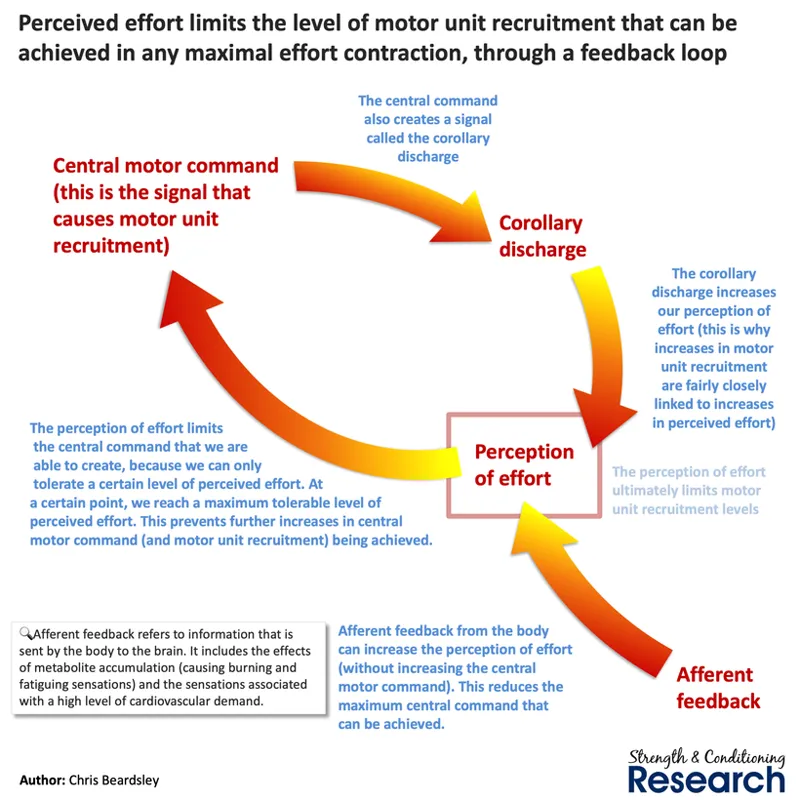
The CNS fatigue that prevents high levels of motor unit recruitment from occurring during light load strength training to failure is likely caused by several disagreeable sensations, including afferent feedback from metabolite accumulation causing burning feelings in the muscles as well as the feeling of being out-of-breath that occurs when higher repetitions are performed.
.
The maximal level of motor unit recruitment that can be achieved in any given muscular contraction is ultimately limited by the maximum tolerable perception of effort. In an unfatigued contraction, the perception of effort is caused by the sensation of innervation, which is a mirror signal of the central motor command that produces motor unit recruitment. In a fatigued contraction, the perception of effort is caused by the sensation of innervation in addition to pain and any perceptions of fatigue. Thus, the maximum central motor command (and therefore the maximum level of motor unit recruitment that can be achieved) is reduced when fatigue is present.
.
Conclusions
It is frequently assumed that fatigue is helpful for [1] achieving high levels of motor unit recruitment (MUR), and consequently also for [2] increasing the ability to recruit high-threshold motor units after training. Yet, this is not true. Fatigue is actually unhelpful in both respects. Maximal levels of MUR can in fact be achieved during unfatigued reps (even when lifting light loads), by exerting a maximal effort. Moreover, increases in the ability to recruit high-threshold motor units (HTMUs) can be attained by training with unfatigued reps (even when lifting light loads, if maximal efforts are used). Thus, fatigue is unnecessary for either [1] achieving high levels of MUR or for [2] stimulating increases in the ability to recruit HTMUs. It seems likely that an increase in the ability to recruit HTMUs is stimulated simply by achieving high levels of MUR on single reps, and this is largely determined by the level of effort applied, which is entirely under voluntary control. Additionally, the presence of fatigue impairs both [1] the levels of motor unit recruitment that are achieved when exerting maximal efforts, and also [2] increases in the ability to recruit HTMUs that occur after training with maximal efforts. In both cases, it seems very likely that supraspinal central nervous system (CNS) fatigue mechanisms are responsible. Indeed, supraspinal CNS fatigue reduces the levels of MUR that can be attained for a given level of effort. Supraspinal CNS fatigue is caused by experiencing disagreeable feelings that contribute to the perception of effort and cause us to reach our maximum tolerable perception of effort at a lower level of central motor command. By reducing the level of MUR that can be obtained, this likely also prevents increases in the ability to recruit HTMUs from happening.
Comments (12)
Chris, in the Eichelberger study showing significant decrement in voluntary activation (proxy for CNS fatigue), isn't the finger different due to the greater proportion of MUs per fiber versus, say, the quadricep, in that rate coding becomes substantially relevant and the measure of voluntary activation may become less meaningful? I wonder if this is actually measuring peripheral fatigue more than central?
Yes, there are differences between smaller muscles and larger muscles in terms of how maximum force is reached. Smaller muscles tend to reach maximum motor unit recruitment earlier and achieve higher levels of voluntary activation by means of increased rate coding. Although these smaller muscles do tend to also display a higher proportion of slow twitch fibers, I am not sure that this is the characteristic that causes them to employ rate coding to a greater degree. Indeed, slow twitch muscle fibers actually reach tetanus at lower firing frequencies than fast twitch fibers (I have a Patreon article scheduled about this phenomenon), which would suggest that they would naturally tend to employ rate coding less rather than more.
But the strength gains with light weights are less, even with full HTMU recruitment, due to less mechanical tension, right?
Yes, there are a couple of reasons why strength gains are less after training with lighter loads, including (1) smaller improvements in coordination when lifting heavy loads, (2) smaller increases in the ability to recruit high-threshold motor units (due to the greater CNS fatigue during exercise), and probably also (3) smaller increases in lateral force transmission and therefore specific tension.
Superb article - Chris I've heard that the presence of pain reduces muscular activation. Is this true? So would pain inhibit a high level of motor unit recruitment? This would seem to be the same as discomfort from metabolite accumulation.
Yes, I have an infographic somewhere about this phenomenon. Pain does reduce motor unit recruitment levels.
Interesting stuff. A common training plan that you hear of in combat sports and perhaps other sports involves training twice a day 6 days a week. With this in mind if you have a guy who trained twice on Monday coming into a “strength” workout Tuesday morning, would be in reality be doing something more akin to a “muscular endurance” workout regardless of whether or not they worked in the 1-5 rep range? If that is true, then if a mixed quality/team sport athlete is lacking in the ability to recruit high threshold motor units, is the issue best remedied with periodisation?
Certainly, if the goal of a specific workout is to improve motor unit recruitment levels, then it is important to make sure that there is minimal residual central nervous system (CNS) fatigue from previous workouts. This can be most easily done by placing a rest day prior to the workout. Block periodization is also an option, although I have reservations about that way of training because it makes long-term progress extremely difficult to track. Not all types of training cause a lot of sustained fatigue, however, and it is possible to do one or two workouts a day and still be able to produce high levels of motor unit recruitment the following day. It really depends on what is done during the workout, and the susceptibility of the individual to the various kinds of fatigue. Tracking countermovement jump heights before workouts is a good way to see what readiness is like, at least for the lower body, and it's now fairly easy to do this with phone apps.
Great article Chris. I am curious, assuming intent is maximal what you feel the RIR threshold is for maximizing motor unit recruitment? As is what is the cutoff point for RIR where beyond that fatigue starts to inhibit maximal motor unit recruitment? Like 3 RIR or less?. Thanks!
First of all, I would note that it is very load-dependent. So when training with heavy (1–5RM) loads, there isn't going to be much interference at all. With moderate (6–15RM) loads, there might be some interference after 2 RIR. And when training with light loads (15–30RM) I would expect interference from further out than that. I have never really put much thought into the question of exactly how many RIR.
Thanks Chris - I must say your articles continue to amuse. Have we not heard in the industry for decades the necessity for failure? Most of the studies have subjects train to failure. If it interferes with high threshold motor unit recruitment, threatens type 2x fiber, and is unnecessary to produce stimulating repetitions why even bother. That doesn't even touch on the elevated potential injury risk. Do you personally program fatigue? Is there a time and place for it? Thanks!
Regarding programming, proximity to failure really depends on the goals of the program. For athletes, I think that maximal intent is much more important than fatigue. For bodybuilders, the question is more difficult, because it is important to see progression over time, which necessitates training reasonably close to failure. I will try and put together some sort of practical guide for bodybuilders at some point. I do have a very clear program model that I use.