






Increasing motor unit recruitment
In order to stimulate hypertrophy, we need to experience high levels of motor unit recruitment. Therefore, it is important to consider [1] what the levels of motor unit recruitment are in untrained lifters, and [2] how we can increase the number of high-threshold motor units that can be accessed.
.
#1. Motor unit recruitment levels are quite low in untrained people
Untrained individuals typically have a fairly limited ability to recruit motor units. Thus, many of their high-threshold motor units are not recruited even when they exert a maximal effort. Even so, this does vary between muscles. Larger muscles tend to display lower levels of motor unit recruitment than the smaller muscles (measured by the gold standard interpolated twitch method for voluntary activation).
.
More well-trained individuals tend to display higher levels of motor unit recruitment, although it is still quite unlikely that they are able to recruit every single muscle fiber in the larger muscles. This shows us that it is possible to increase the number of motor units that we can recruit during a maximal effort.
.
#2. Increases in motor unit recruitment do happen after strength training
As we might expect, strength training programs can increase our ability to recruit high-threshold motor units, by increasing the size of the motor unit action potentials.
.
#3. Increases in motor unit recruitment are not immediate
After starting a strength training program, we do not immediately increase our ability to recruit high-threshold motor units. Indeed, strength training programs that last only 4 weeks do not lead to any transferable strength gains from the squat to the knee extension, which indicates that there were no increases in motor unit recruitment. Rather, the neural adaptations must have comprised increases in coordination. It seems likely that we must achieve coordination improvements before we are able to produce increases in motor unit recruitment.
.
When exercises tasks are perceived to be more complicated, they involve a higher level of perceived effort than when they are less complicated, even when motor unit recruitment is similar. In other words, we cannot hit our current maximal levels of motor unit recruitment until we have achieved a relatively high level of coordination in the exercise we are using. This observation suggests that the stimulus for increasing motor unit recruitment is achieving a very high level of motor unit recruitment. Obviously, this cannot be achieved until we have attained a sufficiently high level of coordination in the exercise.
.
#3. Increases in motor unit recruitment are NOT velocity-specific
Increases in the ability to recruit high-threshold motor units do not seem to be velocity-specific. Indeed, vertical jumping training without an external load increases voluntary activation during isometric contractions. This means that we can stimulate an increase in our ability to recruit motor units at any movement velocity by training at any other movement velocity. We could increase our ability to recruit motor units in a heavy load by training with a light load and vice versa.
.
#4. Increases in motor unit recruitment are impaired by the presence of fatigue
Although increases in the ability to recruit high-threshold motor units can be achieved by plyometrics (which involve moving a light load quickly in an unfatigued state), it is much more difficult to achieve an an increase in motor unit recruitment levels by performing strength training to failure with a light load.
.
Light load strength training to failure does not allow us to reach as high levels of motor unit recruitment as heavy strength training because of supraspinal central nervous system fatigue mechanisms caused by the afferent feedback from the muscles and the cardiovascular system. This observation also suggests that the stimulus for increasing motor unit recruitment is achieving a very high level of motor unit recruitment. Obviously, this can be achieved at any velocity, simply by moving as fast as possible. Yet, it is much harder to achieve during a highly-fatiguing contraction.
.
#5. Increases in motor unit recruitment are NOT joint-specific
Increases in the ability to recruit high-threshold motor units can be achieved in two-joint muscles (such as the rectus femoris, semitendinosus, and the long head of the biceps femoris) as well as in single-joint muscles. The rectus femoris is a hip flexor as well as a knee extensor. Interestingly, when voluntary activation of the rectus femoris is increased by hip flexion strength training, this increases the voluntary activation recorded during knee extension efforts. Thus, the ability to recruit high-threshold motor units is not joint-specific in two-joint muscles.
.
#6. Increases in motor unit recruitment appear to be contraction mode-specific
The ability to recruit high-threshold motor units is well-known to differ between eccentric contractions and the other two contraction modes (isometric and concentric). Indeed, voluntary activation levels are very often lower when measured in eccentric contractions than when they are measured in isometric or concentric contractions.
.
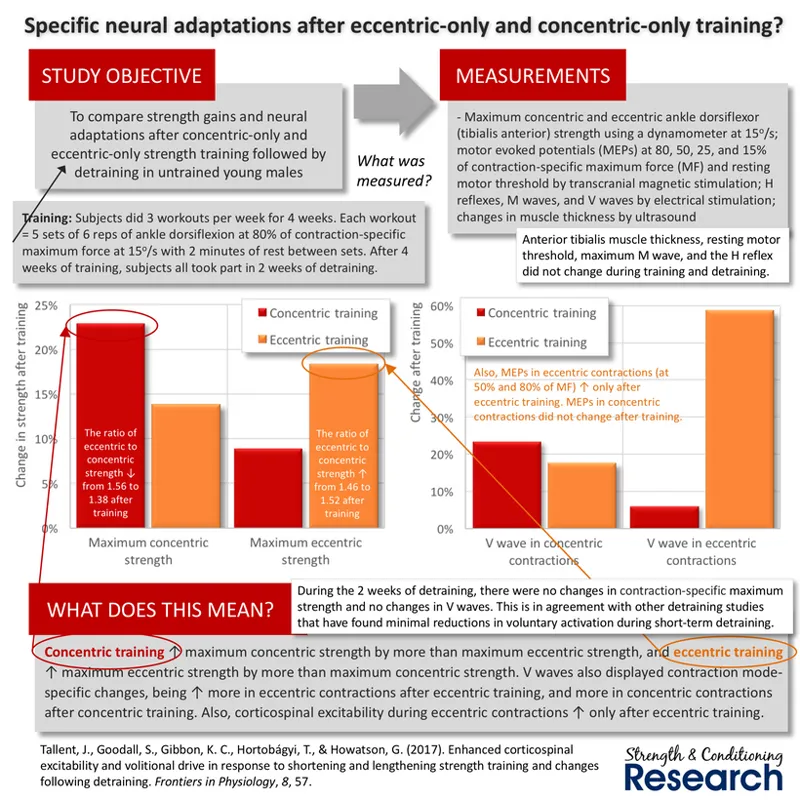
Moreover, there are indications that eccentric training causes greater increases in the ability to recruit high-threshold motor units during eccentric contractions, and that concentric training causes greater increases in the ability to recruit high-threshold motor units during concentric contractions. Hence, it appears that increases in the ability to recruit high-threshold motor units are to a certain extent contraction mode-specific.
.
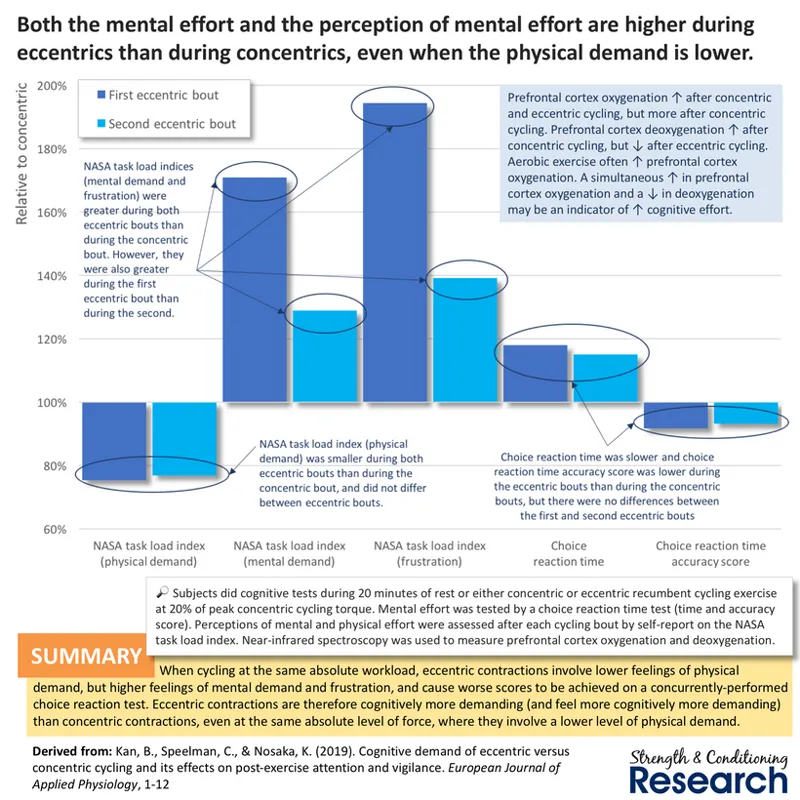
We may be able to explain this phenomenon by reference to the presence of contraction mode-specific supraspinal central nervous system fatigue due to mental effort perceptions (read more).
.
#7. Increases in motor unit recruitment are somewhat muscle length-specific
The ability to recruit high-threshold motor units also differs somewhat between contractions performed at short muscle lengths (or through partial ranges of motion) and contractions performed at long muscle lengths. Also, increases in voluntary activation may be joint angle-specific, such that contractions performed at short muscle lengths preferentially increase the ability to recruit high-threshold motor units at short muscle lengths, while contractions done at long muscle lengths preferentially increase the ability to recruit high-threshold motor units at long muscle lengths.
.
#8. How should we target increases in motor unit recruitment?
In practice, we can probably increase our ability to recruit high-threshold motor units by maximizing the level of motor unit recruitment during the maximal efforts that we use in a workout. There are various ways of doing this (read more).
.
Conclusions
In order to stimulate hypertrophy, we must experience high levels of motor unit recruitment (MUR). Additionally, greater muscle force can be generated when MUR levels are higher. Therefore, achieving high MUR is important for both bodybuilders and strength athletes. Untrained people tend to display quite low MUR levels. Fortunately, certain types of exercise can produce adaptations in MUR levels, such that higher levels can be attained. Most probably, the stimulus for increasing MUR is achieving a high level of MUR at some point during a workout. We can deduce this from two observations. Firstly, while heavy strength training and fast movement training (such as plyometrics) increase MUR levels, light load strength training to failure, despite also involving maximal efforts, does not. Importantly, light load strength training to failure does not involve as high levels of MUR at muscular failure as a result of supraspinal central nervous system (CNS) fatigue mechanisms. Secondly, strength training programs involving multi-joint, free-weight exercises do not immediately stimulate increases in MUR levels. This is likely the fault of inadequate levels of MUR during the early workouts of a training program, owing to supraspinal CNS fatigue caused by mental effort during exercises that are still difficult to coordinate. Importantly, increases in MUR are extremely transferable, with indications of specificity only occurring in relation to muscle length and contraction mode. Achieving an increase in the MUR levels of a muscle will therefore likely benefit bodybuilders in all exercises for that muscle and similarly strength athletes in all movements that involve that muscle.


Comments (5)
Hey Chris, Question, If Single limb exercises have increase in MUR because lack of bilateral deficit. Would that therefore create an adaption of increases in voluntary activation to the same muscle group in Two-joint exercises? Or Would MUR remain the same in two joint exercises? In addition, this imply that in order to maintain growth from single- limb exercises you must continue to train single - limb exercises?
Thanks Chris for another great article - it seems from your writings that voluntary activation is more important then electromyography. However from following the journals and industry the past 10 - 20 years EMG was the gold standard for determining which muscle is working the hardest. Is VA paramount? Thanks!
Yes, voluntary activation is a much more important quantity for us to measure than EMG. TBH, I don't think that EMG is widely regarded as the gold standard for assessing muscle activation levels. It is certainly more commonly used (because it is easier to use). In fact, I think it is easier to argue that voluntary activation is the gold standard measurement.
Great article. Does #4 explain why quarter squats may improve performance in more advanced sprinters? Getting higher levels of voluntary activation in the trained muscles at short muscle lengths? I have to say I find it a bit confusing that it is not joint specific and yet it is muscle length specific. Is It also possible that "unlocking" the final couple of high threshold motor units requires greater specificity?
Yes, I think that the joint angle-specificity of strength gains in athletes is almost certainly attributable to changes in motor unit recruitment, especially when this involves short muscle lengths (as is the case for the transfer of partial squats to sprinting performance).