





Isometric training
Isometric training is less common than conventional strength training but it clearly produces very similar adaptations when the required stimuli are present.
.
#1. Does isometric training cause hypertrophy?
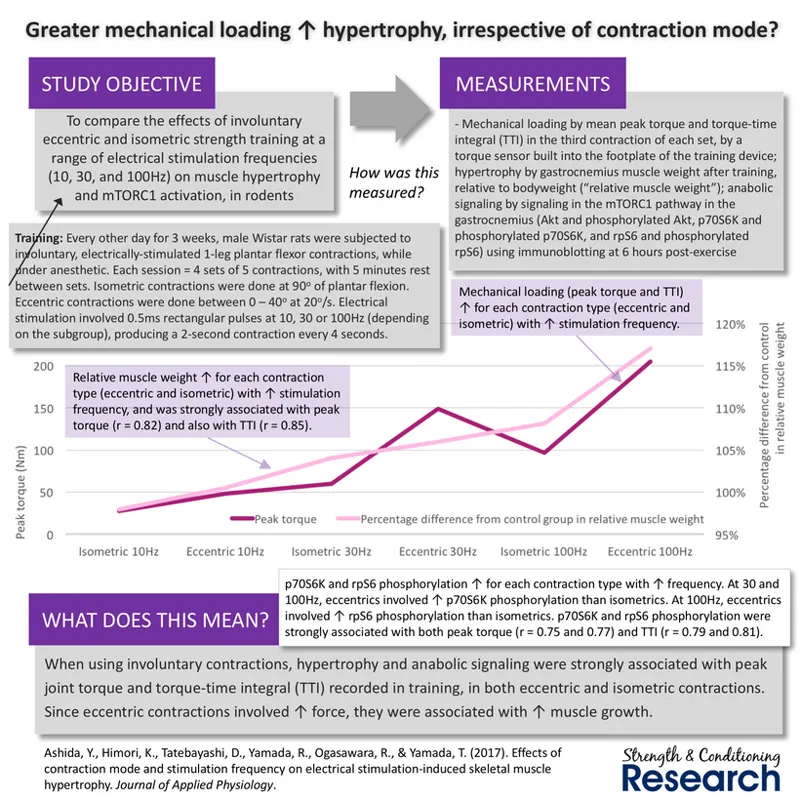
Yes, isometric training does indeed cause hypertrophy. There is nothing inherently special about the dynamic movements that comprise conventional strength training in that respect. Muscle fibers generate very high levels of active mechanical tension when they are moving at a slow velocity. Isometric contractions involve zero velocity, which is the slowest possible velocity at which the muscle fiber can move. Therefore, a large number of actin-myosin crossbridges can form and exert high levels of active mechanical tension.
.
Isometric training is capable of producing a similar amount of hypertrophy to conventional strength training, if the muscle fiber forces and time under tension are equated. Irrespective of contraction mode, muscle growth in rodent models is closely related to the magnitude and duration of mechanical tension provided, at least when central nervous system (CNS) fatigue is prevented by the use of involuntary contractions.
.
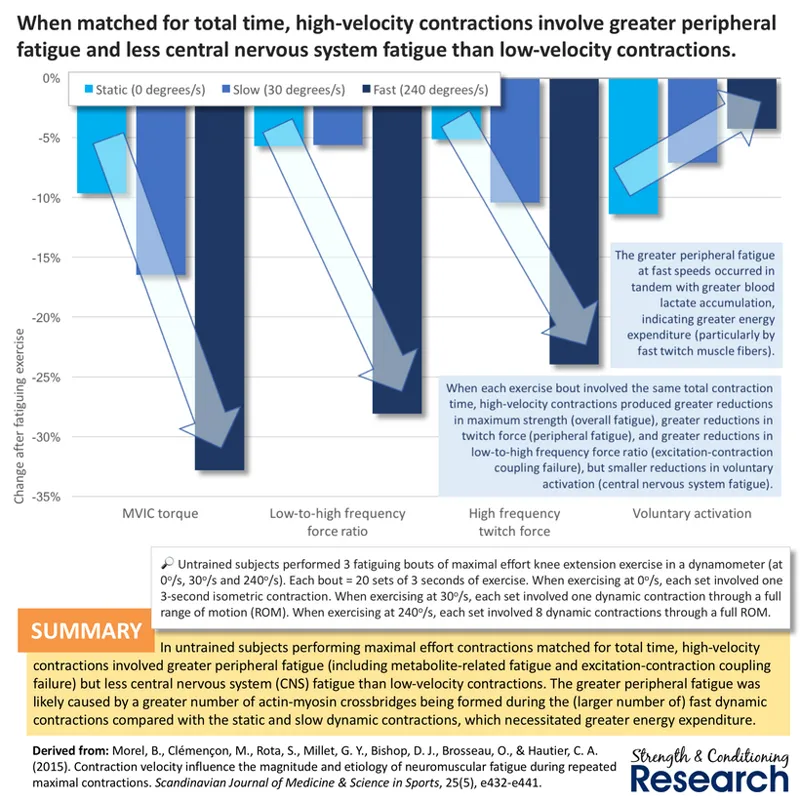
Yet, isometric training likely produces CNS fatigue more rapidly than conventional strength training. For this reason, it is possible that isometric training may not be quite as effective during voluntary exercise in humans, when comparing similar magnitudes and durations of mechanical tension.
.
As a general observation, CNS fatigue contributes proportionally less to fatigue when movement speeds are faster, compared to when movement speeds are slower (obviously, isometric contractions involve the slowest possible speeds).
.
#2. Does isometric training cause sarcomerogenesis?
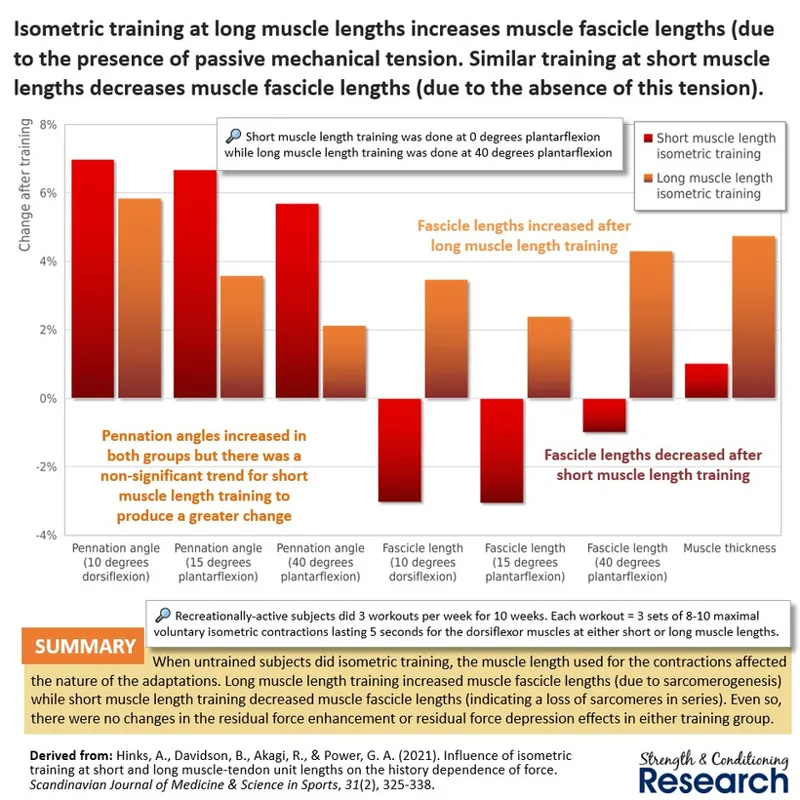
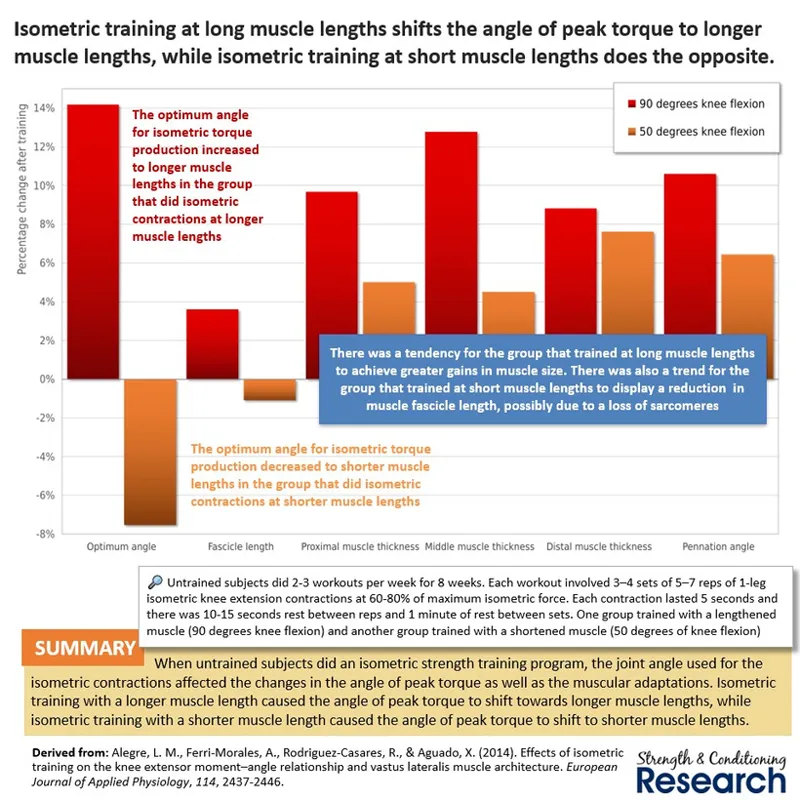
When performed at long muscle lengths, isometric training does stimulate increases in muscle fascicle length, which most likely arises because of an increase in sarcomeres in series. Conversely, when performed at short muscle lengths, isometric training facilitates decreases in muscle fascicle length, which most likely arises because of a reduction in sarcomeres in series. In this way, it behaves exactly like conventional strength training.
.
In support of the proposal that the changes in muscle fascicle length after isometric training are the result of sarcomeres being added or subtracted, we can observe that the angle of peak torque also changes after isometric training (and in the direction expected based on the fascicle length changes).
.
#3. Does isometric training cause gains in strength?
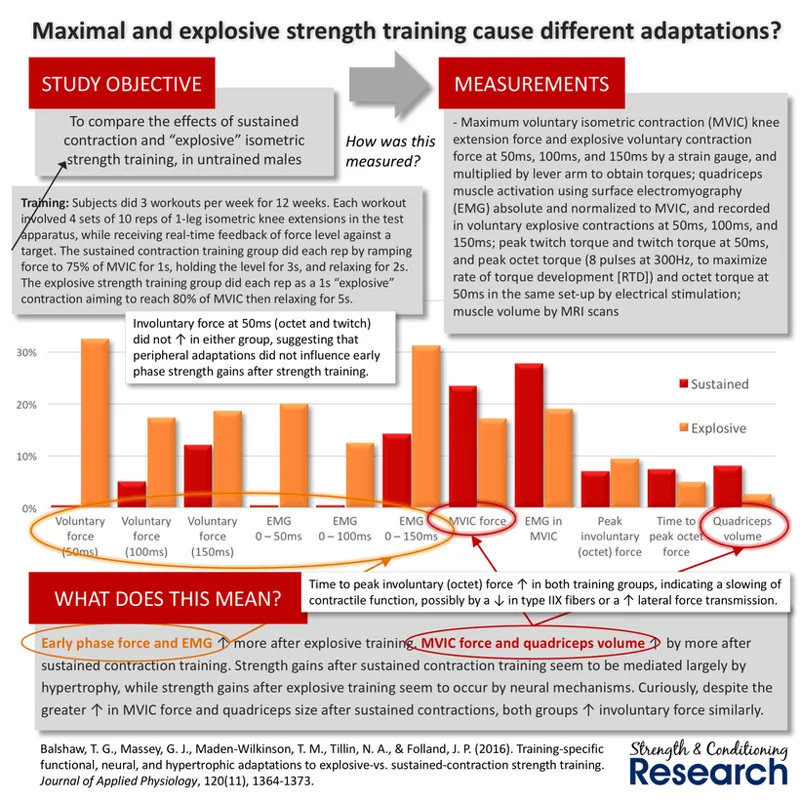
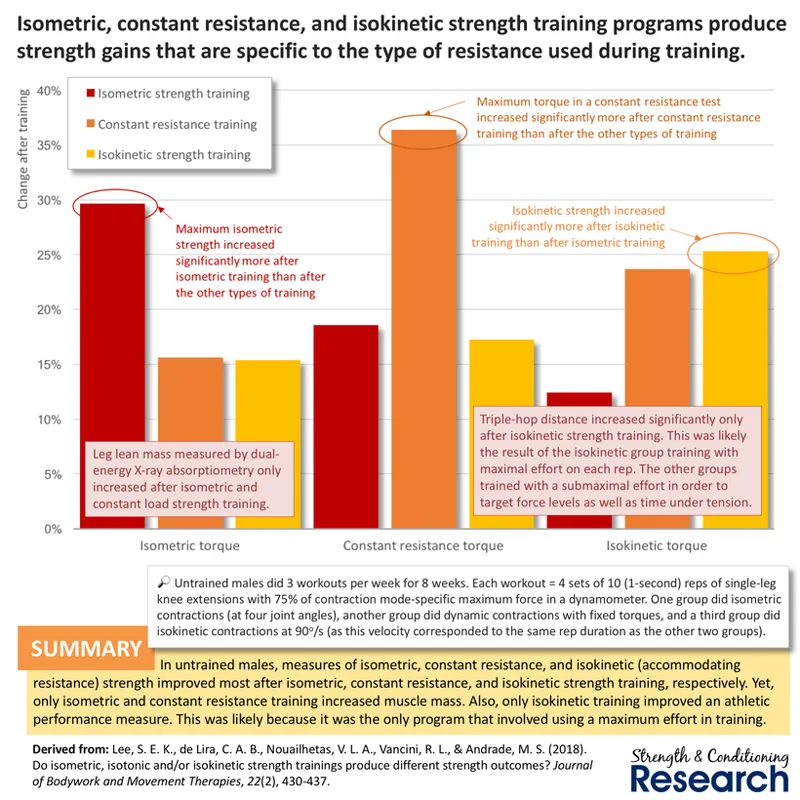
Obviously, isometric training causes large increases in maximum isometric strength. Yet, it is less effective at increasing measures of maximum dynamic strength in comparison with conventional strength training, even when training is performed at multiple joint angles. In this way, strength gains are very specific to the type of external resistance that is used during training.
.
This observation has been made in a number of different studies. It is particularly noticeable when short-term strength training programs are followed, indicating that neural adaptations are a key mechanism by which this contraction mode-specificity occurs.
.
The gains in maximum isometric strength that occur after isometric training are joint angle-specific. In other words, isometric strength increases most at the joint angle used during training. Thus, isometric training can be used to increase strength at a specific point in a joint angle range of motion. This joint angle-specific strength gain occurs due to several different adaptations, including neural changes.
.
#4. Does isometric training cause gains in speed?
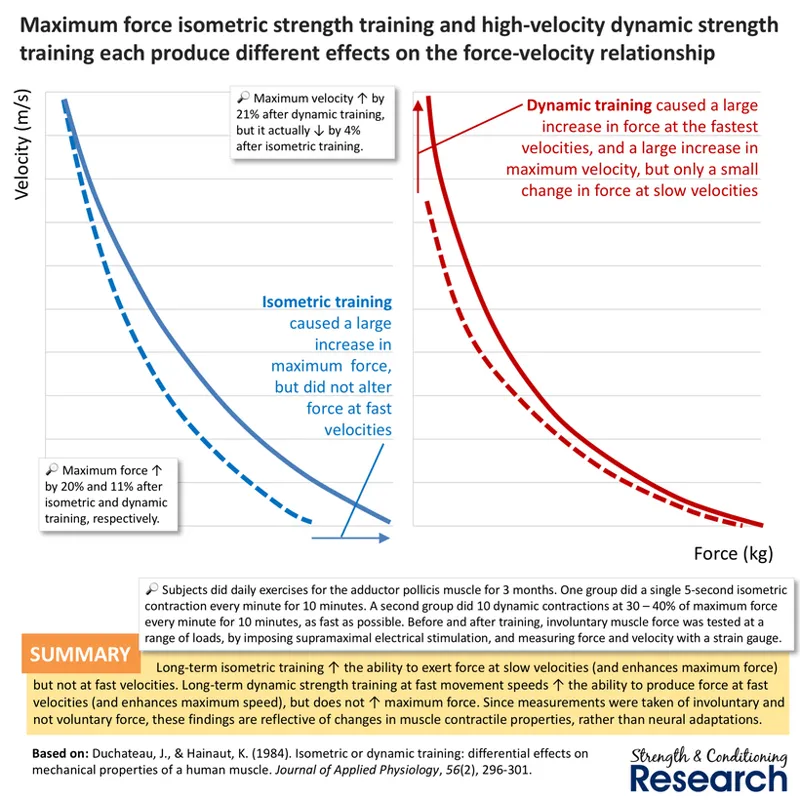
Despite being very effective for increasing maximum strength, isometric training does not increase speed. This makes it less valuable for improving athletic performance in comparison with conventional strength training.
.
When researchers have compared the effects of isometric training with plyometric training, they have often discovered that isometric training fails to improve measures of athletic performance, even when it increases maximum strength. This is likely in part due to its failure to increase speed. However, it may also involve the rather pronounced effects that isometric training has on tendon stiffness.
.
Indeed, several studies have shown that tendon stiffness increases more after isometric training compared to after conventional (dynamic) strength training.
.
The large increase in tendon stiffness that occurs after isometric training (relative to eccentric muscle strength) can likely impair stretch-shortening cycle function in fast movements, thereby reducing athletic performance. Indeed, this is the exact opposite of what happens after plyometric training, wherein eccentric muscle strength is increased relative to tendon stiffness (read more).
.
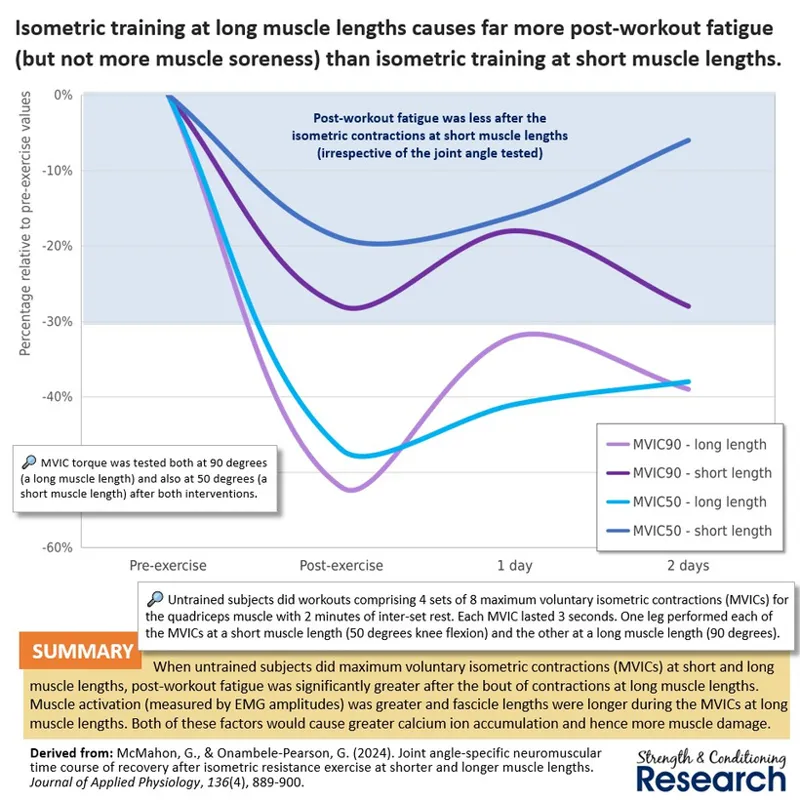
#5. Does isometric training cause post-workout fatigue?
Although it is often claimed that isometric training does not cause sustained fatigue after a workout due to muscle damage, this is not necessarily the case. While it is true that isometric training causes less muscle damage than eccentric training, it does still cause muscle damage, and the magnitude of this effect is greater when training is performed at longer muscle lengths.
.
This finding has been made repeatedly in a number of research investigations, including very recently.
.
Conclusions
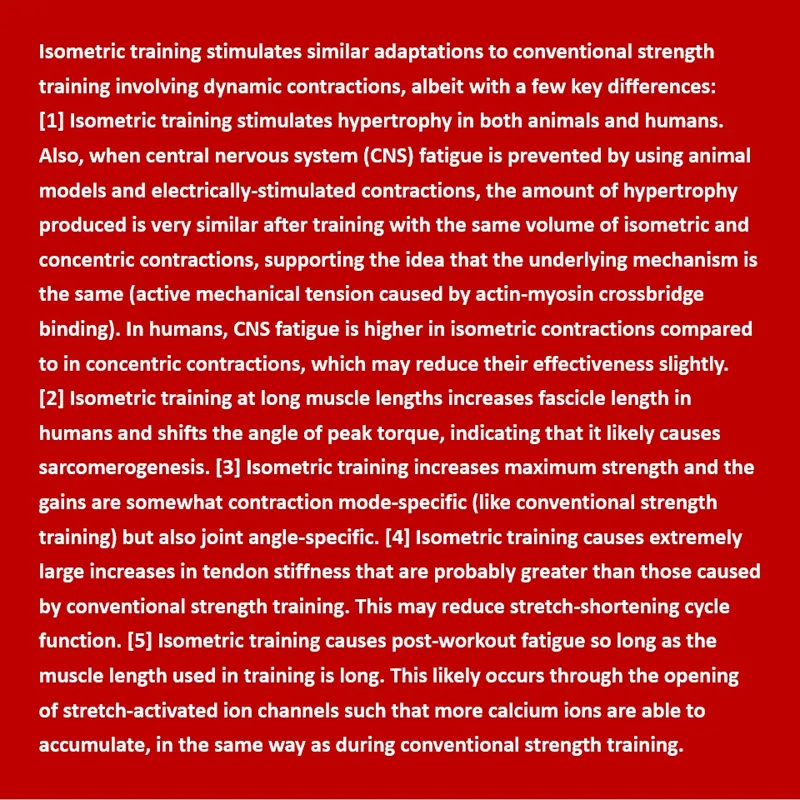
Isometric training stimulates similar adaptations to conventional strength training involving dynamic contractions, albeit with a few key differences: [1] Isometric training stimulates hypertrophy in both animals and humans. Also, when central nervous system (CNS) fatigue is prevented by using animal models and electrically-stimulated contractions, the amount of hypertrophy produced is very similar after training with the same volume of isometric and concentric contractions, supporting the idea that the underlying mechanism is the same (active mechanical tension caused by actin-myosin crossbridge binding). In humans, CNS fatigue is higher in isometric contractions compared to in concentric contractions, which may reduce their effectiveness slightly. [2] Isometric training at long muscle lengths increases fascicle length in humans and shifts the angle of peak torque, indicating that it likely causes sarcomerogenesis. [3] Isometric training increases maximum strength and the gains are somewhat contraction mode-specific (like conventional strength training) but also joint angle-specific. [4] Isometric training causes extremely large increases in tendon stiffness that are probably greater than those caused by conventional strength training. This may reduce stretch-shortening cycle function. [5] Isometric training causes post-workout fatigue so long as the muscle length used in training is long. This likely occurs through the opening of stretch-activated ion channels such that more calcium ions are able to accumulate, in the same way as during conventional strength training.

Comments (5)
Is the increased tendon stiffness in part due to growth adaptations in the tendon? I've heard and seen lots on how heavy isonetrics and eccentrics could build tendon tissue and stiffness. Though you say it could impair athletic performance, could it not serve to improve it in some faculties like injury prevention, strength, or explosive capacity?
Do you feel that done in the right way yielding or holding isos could be valuable to athletes? I perform them from pins at different joint angles throughout a movement, such as in the bottom, mid, and top range of a squat and bench press, and do not do them to failure. I was curious if even though they wouldn't provide as strong as an eccentric strength increase as eccentric only and might increase tendon stiffness more, that they still would increase eccentric strength greater than conventional training and tendon stiffness less, and if not taken to failure would cause less relative muscle damage/fatigue compared to both eccentric and convectional training. I thought this combo of increased eccentric strength and less fatigue thus better maintenance of faster fiber types might be of benefit.
It is difficult to say, owing to the lack of literature (of any kind) at the moment. All I can do is draw inferences based on my understanding of the physiology. I would agree that a holding or yielding isometric would display slightly more features of an eccentric (and therefore more adaptations associated with eccentrics) than a pushing or fixed isometric. Equally, I would agree that a holding or yielding isometric would tend to increase tendon stiffness more than a true eccentric.
Hey Chris, Is this pertaining to overcoming or yielding isos(I am assuming overcoming) and if so are the adaptations different for the other form? Thanks!
This article only really describes isometrics in general terms. Researchers generally use fixed isometrics and define them as either holding or pushing (or pulling). Although there is often little discussion of which is being used, it is usually fairly clear that a pushing isometric is being used. Pushing, fixed isometrics are essentially the same as what is termed overcoming in the wider fitness industry, yes.