





Titin
Titin is a molecule that runs longitudinally down the length of individual muscle fibers. Titin produces passive mechanical tension when muscle fibers are stretched. Understanding how titin behaves in various situations is essential for understanding sarcomerogenesis and therefore stretch-mediated hypertrophy.
.
#1. Titin generates passive mechanical tension
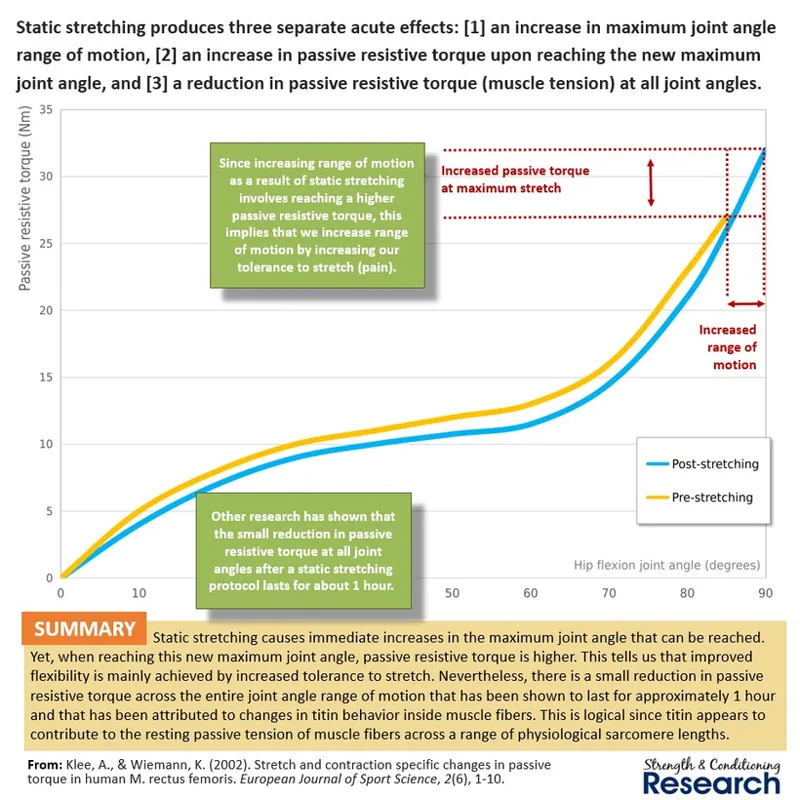
Researchers have known for many years that muscles resist being stretched even when they are not activated. This is known as passive resistive torque when measured in vivo, as during static stretching investigations.
.
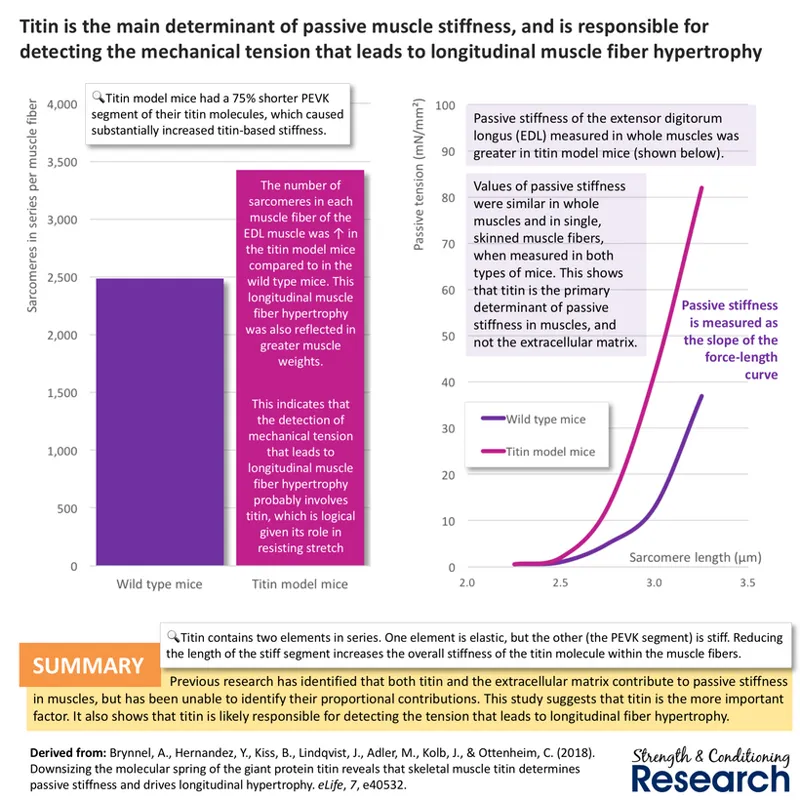
Although it is often believed that this passive resistive torque is provided by a range of structures, including collagen, the literature is relatively clear that the contents of individual sarcomeres (and not the surrounding endomysium) are responsible for producing the vast majority of the passive mechanical tension in whole muscles and single muscle fibers.
.
Rodent studies have shown that titin is the main structure inside muscle fibers that contributes to passive tension during stretch. When the passive stiffness of titin molecules is increased, this leads to longitudinal hypertrophy but not transverse hypertrophy. In other words, muscle fibers are stimulated to increase in length but not in diameter. This links the generation of passive mechanical tension by titin to the sarcomerogenesis adaptation.
.
#2. The function of titin changes with muscle activation
Importantly, titin provides passive stiffness differently during static stretching (without muscle activation) from during strength training (with muscle activation). Specifically, titin produces a larger force when the muscle fiber is activated and stretched compared to when it is not activated. and stretched In practice, this means that large stretch amplitudes are required to generate a high level of passive mechanical tension by titin during passive static stretching, while much smaller stretch amplitudes are required to generate a high level of passive mechanical tension by titin during eccentric contractions.
.
#3. Passive mechanical tension only produces sarcomerogenesis
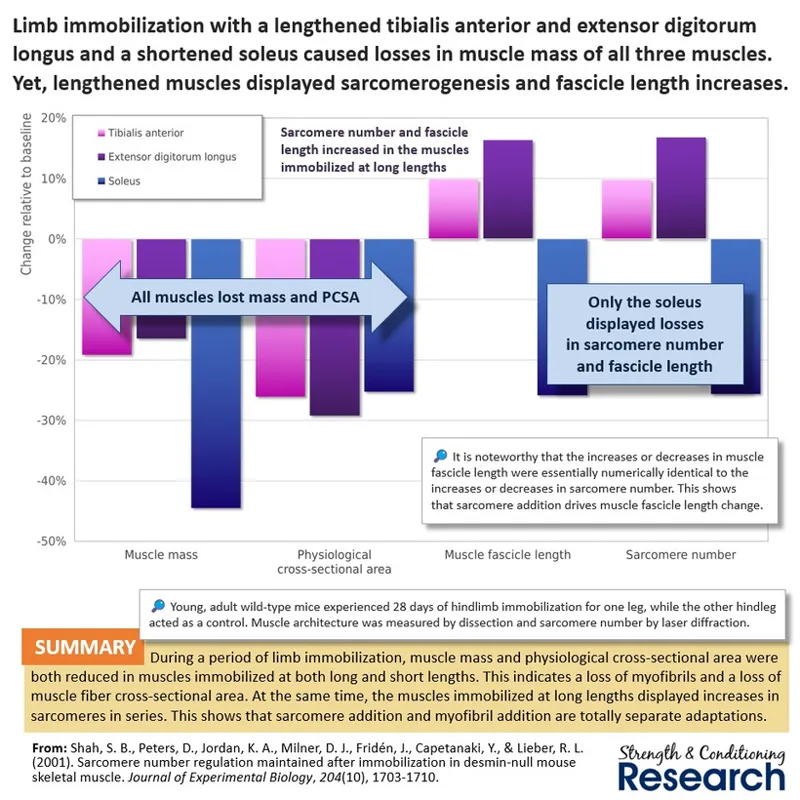
We know that passive mechanical tension only stimulates the addition of sarcomeres in series (and does not add myofibrils in parallel) because immobilization of a muscle in a stretched position causes the addition of sarcomeres leading to an increase in muscle fiber length even while myofibrils are lost leading to a reduction in muscle fiber cross-sectional area. If passive mechanical tension could cause the addition of myofibrils, there would be no loss of muscle fiber cross-sectional area in such studies.
.
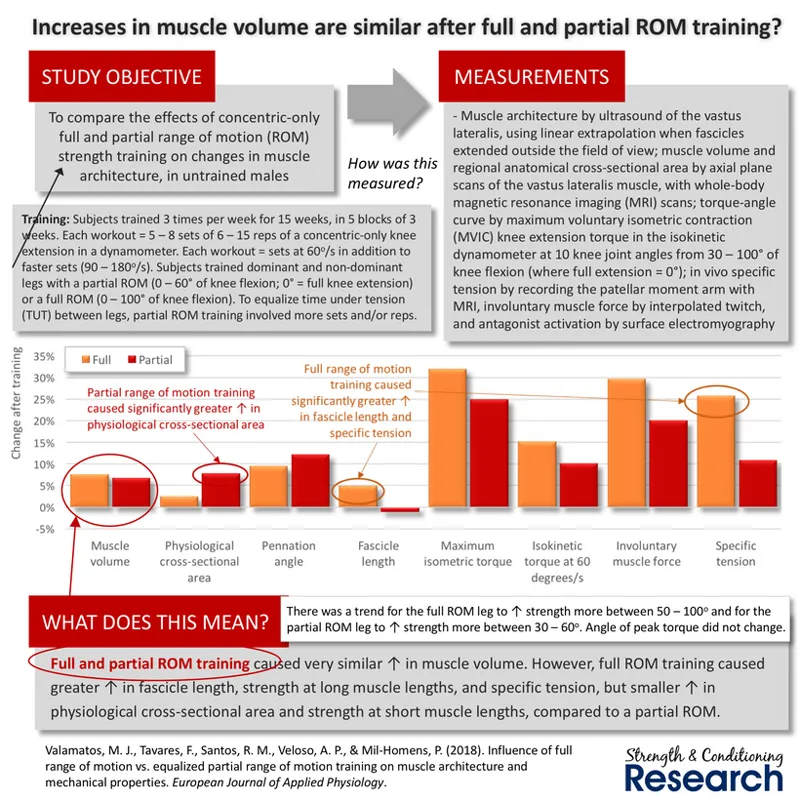
Indeed, this is why static stretching programs in humans cause quite large increases in muscle fascicle length but only more rarely cause meaningful changes in other measurements of muscle size. Fascicle length is the proxy measurement we use in humans for detecting sarcomerogenesis.
.
#4. Relative effects of active and passive mechanical tension
Strength training typically involves both active and passive mechanical tension from both contractions and from stretch. Eccentric training involves relatively more passive mechanical tension, however, so it causes greater increases in muscle fascicle length (indicating more sarcomerogenesis). Concentric training involves relatively less passive mechanical tension, however, so it causes smaller increases in muscle fascicle length (indicating less sarcomerogenesis).
.
The exact same phenomenon can be observed when comparing exercises that reach long and short maximum muscle lengths. Reaching a longer maximum muscle length allows much more passive mechanical tension to be experienced and therefore causes more sarcomerogenesis, as indicated by the much greater increases in muscle fascicle length.
.
#5. Viscoelasticity of titin
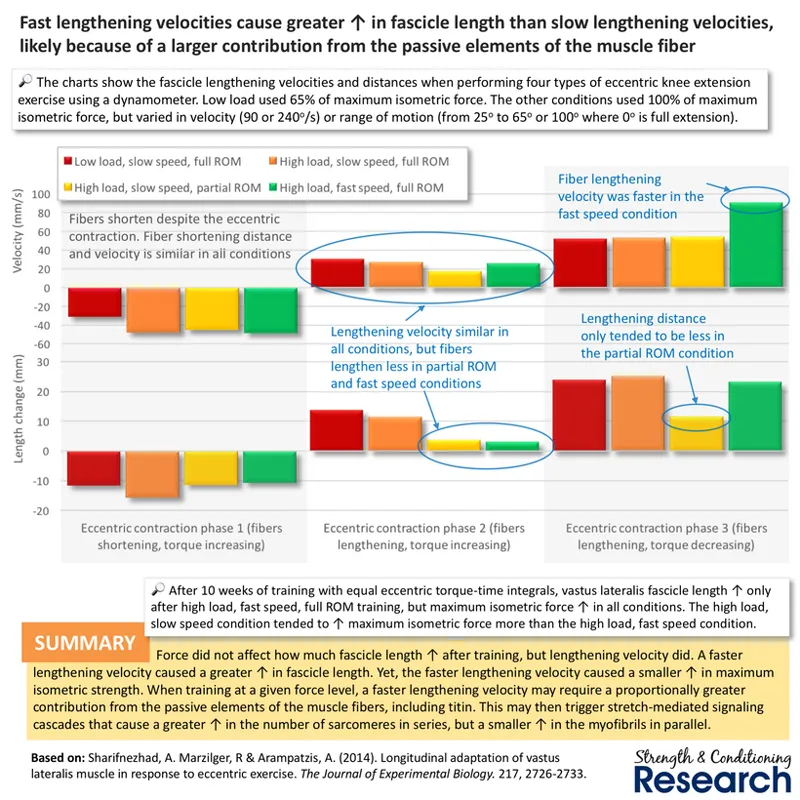
Titin is a viscoelastic structure and therefore produces a higher force when it is lengthened quickly than when it is lengthened slowly. This is why the eccentric force velocity relationship has an unusual shape compared to the concentric force velocity relationship.
.
This is why fast eccentric training causes greater increases in muscle fascicle length than slow eccentric training, when maximal efforts are exerted in both cases.
.
Conclusions
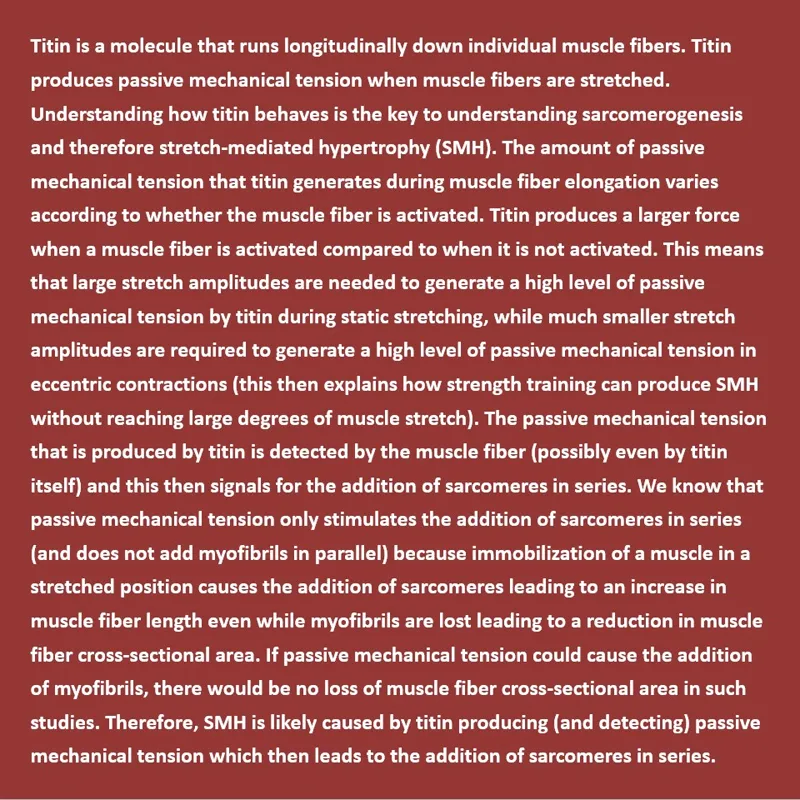
Titin is a molecule that runs longitudinally down individual muscle fibers. Titin produces passive mechanical tension when muscle fibers are stretched. Understanding how titin behaves is the key to understanding sarcomerogenesis and therefore stretch-mediated hypertrophy (SMH). The amount of passive mechanical tension that titin generates during muscle fiber elongation varies according to whether the muscle fiber is activated. Titin produces a larger force when a muscle fiber is activated compared to when it is not activated. This means that large stretch amplitudes are needed to generate a high level of passive mechanical tension by titin during static stretching, while much smaller stretch amplitudes are required to generate a high level of passive mechanical tension in eccentric contractions (this then explains how strength training can produce SMH without reaching large degrees of muscle stretch). The passive mechanical tension that is produced by titin is detected by the muscle fiber (possibly even by titin itself) and this then signals for the addition of sarcomeres in series. We know that passive mechanical tension only stimulates the addition of sarcomeres in series (and does not add myofibrils in parallel) because immobilization of a muscle in a stretched position causes the addition of sarcomeres leading to an increase in muscle fiber length even while myofibrils are lost leading to a reduction in muscle fiber cross-sectional area. If passive mechanical tension could cause the addition of myofibrils, there would be no loss of muscle fiber cross-sectional area in such studies. Therefore, SMH is likely caused by titin producing (and detecting) passive mechanical tension which then leads to the addition of sarcomeres in series.
Comments (8)
Thanks for the response. Given the nature of fatigue from eccentric contractions occurring with VERY LOW volume, do you think that spreading that volume over a higher frequency would lead to superior results? I remember from your article on eccentric training volume the low volume group did 2 sets of 4 reps once per week. Given that there are already high levels of fatigue after only 3 eccentric contractions, what do you think would happen if instead of doing 2 sets of 4 reps they did 1 set of 2 reps 3x a week instead?
Fatigue is extremely variable depending on the individual. However, unlike fatigue during normal strength training (which is caused mainly by metabolite during exercise and mainly by muscle damage after exercise), fatigue during eccentric training is caused by the same mechanisms during and after exercise. This makes monitoring fatigue during eccentric training workouts much more useful than monitoring fatigue during normal strength training workouts. So I would instead monitor force changes during the eccentric contractions and stop the set as soon as force started to reduce. For some people that might be 3 reps, but for others it might be 4 or even 5 reps. Then, I would test on subsequent days to see when strength recovery was achieved (and ideally super–compensation), which would then give me the ideal combination of volume and frequency. I realize that doesn't answer your question, but fatigue is so variable between individuals that I am not sure it is possible to provide volume/frequency guidelines.
Interesting article. I have a question regarding increases in muscle diameter and eccentric training. Suppose an athlete has achieved muscle diameter size gains from normal strength training and starts a period of training ONLY eccentric training. Also, suppose that the athlete is doing only a few maximal eccentric reps per each one of these eccentric training workouts. (Since you mentioned in a previous article that eccentric reps cause very high levels of fatigue even after 3 contractions or so). Would these eccentric contractions (say 3 eccentric reps per workout, 3 workouts per week) be enough to maintain the size gained in muscle diameter from the previous normal strength training experience?
That is a very good question, and I cannot think of any research that might help answer it. It might depend upon the type of eccentric. If the eccentric was fast and directed almost all of the muscle protein synthesis (MPS) response towards longitudinal hypertrophy, perhaps not. Alternatively, if the eccentric was slow and directed some of the MPS response to transverse hypertrophy and some towards longitudinal hypertrophy, then probably yes. It is fairly well-established that very little stimulus is necessary to maintain hypertrophy, in comparison with causing it in the first place.
Thank you, Chris! I know that eccentric contractions may be used in tendinopathy rehabilitation; does the same principle apply to a strained muscle (after sufficient rest to be able to safely perform concentric-eccentric exercise but in order to more quickly progress back to plyometrics)? Also, can you think of examples in training where an athlete may actually prefer slow eccentric+fast concentric besides the potentiation of the concentric (stretch-shortening)? I can think of the proprioception aspect with a slow lowering in the deadlift or pull (cuing to the central motor command of the position of the hips and back, shoulders- hopefully this is the correct concept, as afferent signaling?), is there any other use case for slow eccentrics (between each fast concentric)? I’m thinking that overloading the eccentric portion by 25-30% and training eccentric contractions exclusively, or using an intentionally fast eccentric, has some real utility now.
Muscle strains are an interesting problem. On the one hand muscles are very resilient and capable of repair and regeneration (two different processes). On the other hand they can sometimes display failures in the regenerative process, leading to atrophy and fibrosis. I recently found a group of studies in this area that I was not previously aware of that I will be reviewing and writing about. Hopefully, that will provide some new insights into this area.
Great information Chris - thanks - you made a comment in one of your articles that seems to run counter to the norm. I believe you said that research with untrained participants is as legitimate as with resistance trained. I always hear the opposite or the notion that whatever happens to "newbies" can at best be chalked up as interesting but has to be tested with a trained population. How much weight do you afford to both? Is the distinction important? Thanks.
Yes, I will expand on that argument in an article soon. My point is that many people have an unnecessarily negative reaction to studies performed in untrained individuals. In reality, most animals (including humans of varying degrees of strength training experience) respond very similarly to resistance exercise. Of course, the exact responses will differ slightly, but they also differ between two individuals. In fact, I would argue that in many situations, the difference in training responses between two very well-trained individuals could easily be greater than the difference between a trained individual and an untrained individual, if we were to deliberately select the pairs based on fiber type. For that reason, I think it helps to have a strong physiological reason *why* we might expect the results of a study to differ between trained and untrained individuals. For example, we might note that untrained individuals have lower levels of motor unit recruitment at the outset, and are therefore capable of different increases in voluntary activation after training. Thus, we might expect training programs that causes very large increases in voluntary activation in untrained lifters to have more muted effects in well-trained lifters. This would be a physiologically valid reason to expect different results due to training status.