






Motor unit firing rates
Increases in motor unit firing rates are a key adaptation that benefits increases in speed. In this article, I will explain why increases in motor unit firing rates are greater after fast movement training, and why fatigue during exercise has a negative effect on these improvements.
.
#1. Fast movements involve higher firing rates than slow movements
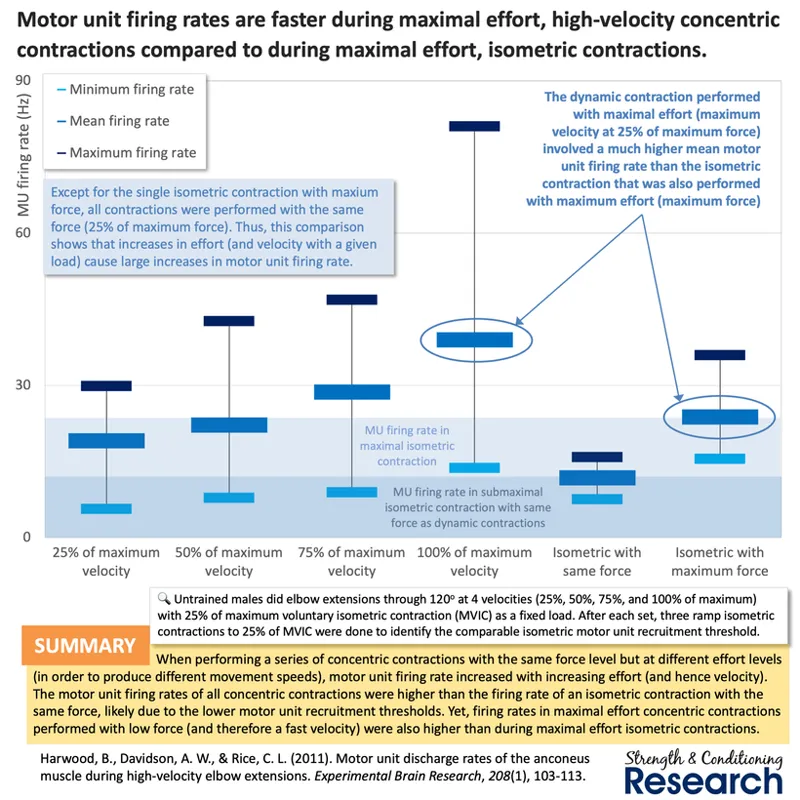
Motor unit firing rates are faster during (slow) concentric contractions compared to during isometric contractions, even when exactly the same percentage of maximum, contraction mode-specific force is being used. This suggests that when motor unit firing rates are inherently faster when muscle fibers are shortening compared to when they are producing force statically.
.
When comparing maximal effort isometric contractions and maximal effort concentric contractions with a relatively low force (25% of maximum isometric force), we can see that motor unit firing rates are higher in the maximal effort concentric contractions than in the maximal effort isometric contractions. This confirms that when faster movements are performed, motor unit firing rates are higher than during slow movements, even when efforts are maximal in both movements.
.
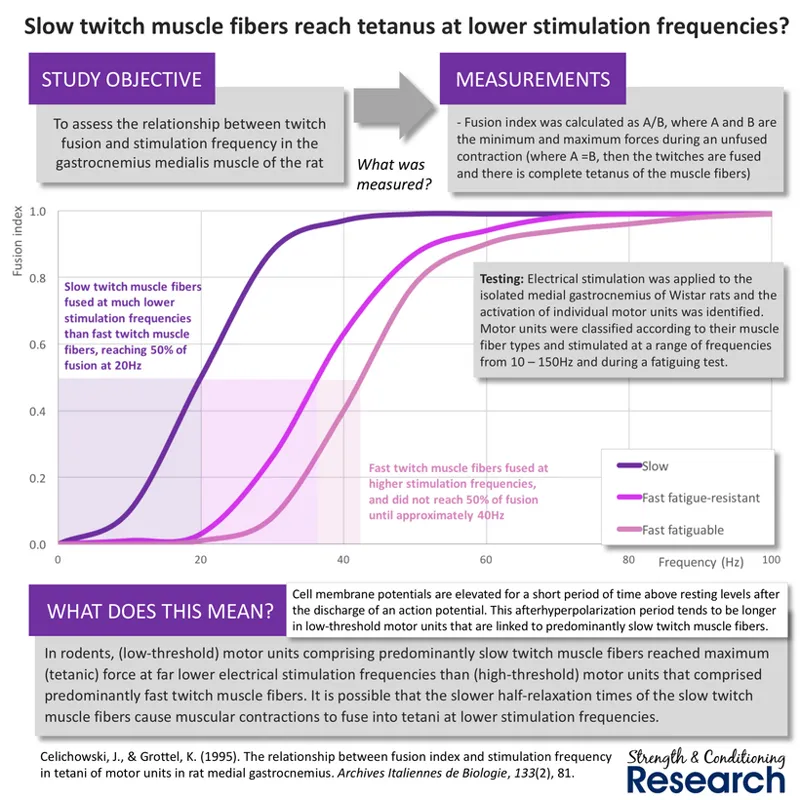
We can make sense of this observation by looking at rodent research that has tested the effects of electrical stimulation frequency on force production during involuntary contractions at a range of muscle shortening speeds. This research has shown that faster motor unit firing rates are necessary to produce tetanus at fast muscle shortening speeds compared to at slow muscle shortening speeds.
.
#2. Fast movement training causes an increases in motor unit firing rates, whereas heavy strength training does not
As a result of experiencing faster motor unit firing rates during workouts, fast movement training causes large improvements in motor unit firing rates after training, and this contributes to increases in high-velocity strength, speed, and rate of force development (RFD).
.
In contrast, heavy strength training does not increase motor unit firing rate despite increasing proxy markers of motor unit recruitment (the motor unit action potential).
.
#3. Fatigue impairs firing rates during fast movements
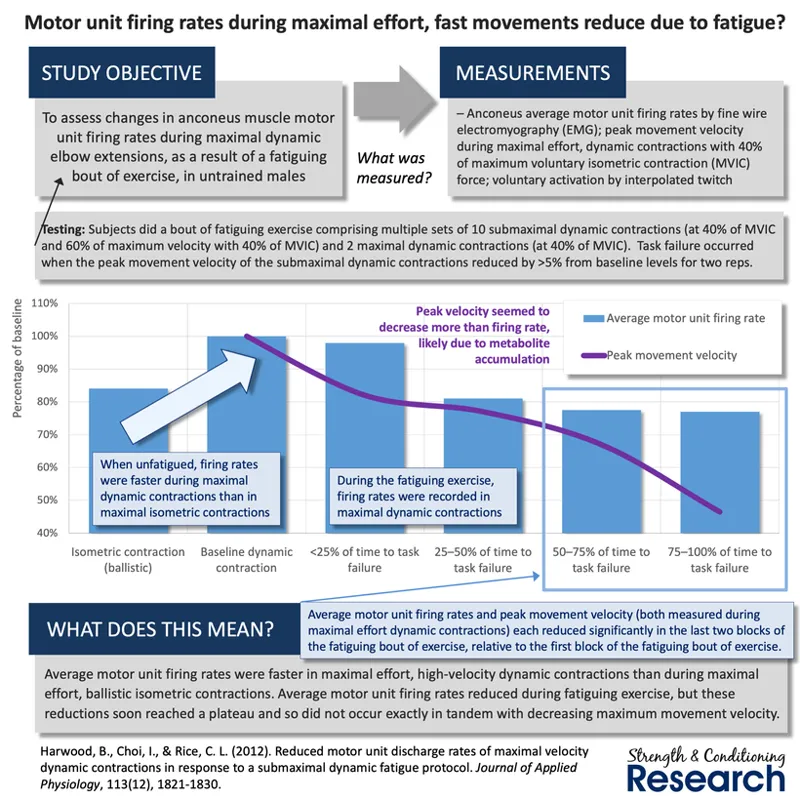
Fatigue in a workout impairs adaptations that underpin improvements in speed. While this likely occurs through several mechanisms, including a reduced improvement in coordination (read more) and muscle fiber type shifts (read more), it may also occur due to the suppression of motor unit firing rates during exercise. Indeed, our motor unit firing rates are slower when we are fatigued compared to when we are unfatigued.
.
#4. Slow twitch muscle fibers reach maximal forces at slower firing rates
An interesting observation is that muscles that contain a higher proportion of slow twitch muscle fibers display lower average motor unit firing rates during maximal effort contractions in comparison with muscles that contain a higher proportion of fast twitch muscle fibers.
.
This makes sense, because a fast twitch muscle fiber requires a higher stimulation frequency (motor unit firing rate) in order to reach its maximal possible (tetanic) force.
.
#5. Firing rate may be an important determinant of muscle fiber type
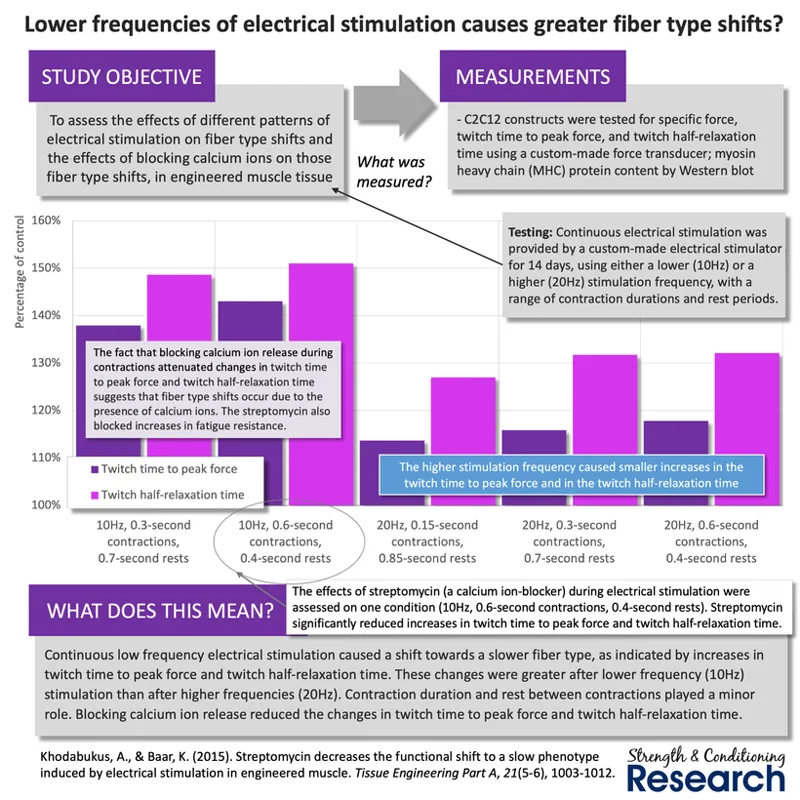
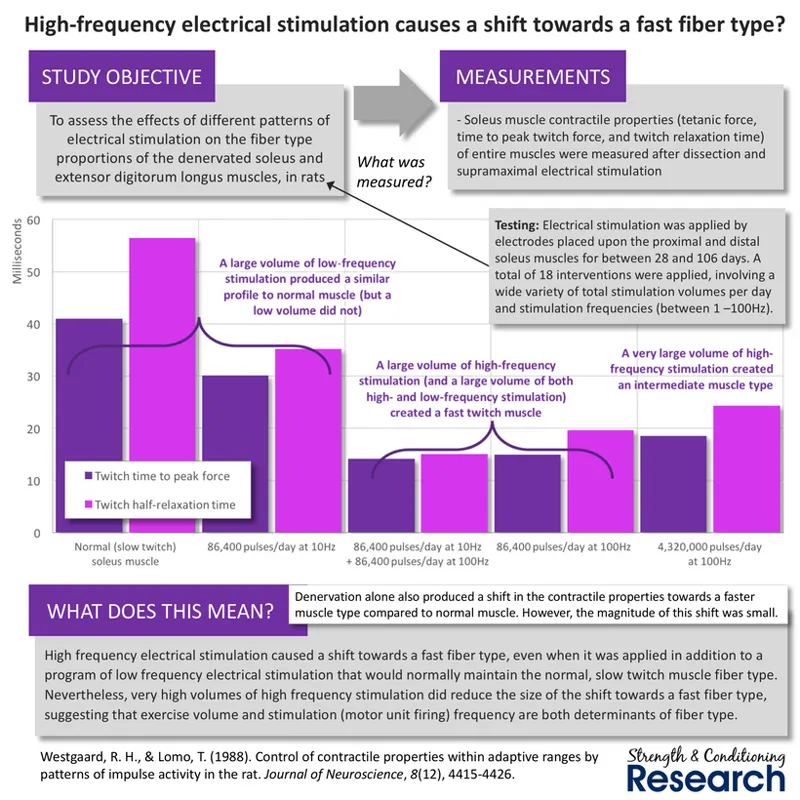
There are indications that motor unit firing rate (or electrical stimulation frequency in animal models) influences muscle fiber type. For example, when muscle fibers are stimulated with lower electrical stimulation frequencies (corresponding to slower motor unit firing rates), they tend to experience greater shifts towards more oxidative (slow twitch) muscle fiber types.
.
Conversely, when muscle fibers are stimulated with higher electrical stimulation frequencies (corresponding to higher motor unit firing rates), they tend to display shifts towards a faster (more glycolytic) type. While some researchers have argued that this occurs due to the reduced fatigue or volume of work done that is experienced during the high electrical stimulation frequency conditions, this is probably not true. Indeed, research has shown that while denervation itself causes a shift towards a faster (more glycolytic) type, higher electrical stimulation frequencies cause greater shifts.
.
Shifts towards a faster (more glycolytic) type after stimulation with a high electrical stimulation frequency occur even when performed in addition to stimulation with a low electrical stimulation frequency. This shows that it is the stimulation that causes the shift and not the absence of activity.
.
Conclusions
An increase in motor unit firing rate (MUFR) after training is a key adaptation that underpins increases in speed. Increases in MUFR commonly occur after fast movement training, and do not appear to occur after heavy strength training and isometric training. It seems likely that the stimulus for increasing MUFR is reaching a very high MUFR during a bout of exercise and this seems to require a very fast movement speed. Indeed, MUFRs are much lower during eccentric, isometric, and slow concentric contractions compared to during fast concentric contractions, even when exerting maximal efforts. Consequently, it is necessary to perform fast movements in training in order to achieve this adaptation that contributes to increases in speed. Importantly, the presence of fatigue suppresses MUFR during muscular contractions. Thus, it is likely helpful to minimize fatigue during fast movement workouts, if an increase in MUFR is desired after training. Finally, some research has linked electrical stimulation frequency to fiber type shifts. This suggests that frequently training with muscular contractions that involve a high MUFR may be helpful for retaining a fast fiber type proportion during training.


Comments (14)
In this case, would playing small-sided games that cause fatigue after plyometrics nagatively affect RFD and fiber contraction speed? Should a training session be dedicated solely to sprinting, power, or plyometrics?
Also I realize my questions here were out of context. I was skimming quickly and got mixed up between increasing motor unit recruit and increasing firing frequency. Thank you.
Thank you for the answers, Chris. This resource is fantastic. Do you still offer consultation calls? I have a number of questions related to increasing swing speed in golf.
Currently, I am not advertising consultancy calls because I am focusing on the pilot scheme for the mentorship program, which runs until the end of March. But if you send me a message here on Patreon, we can certainly work something out.
Thanks Chris. So can we maximally improve HTMU with a variety of loads? Whilst avoiding too much fatigue build up.
Yes, as long as [1] effort is high, and [2] fatigue is minimal, then we can cause an increase in HTMU recruitment with any load.
Great article, Chris. How do moderate loads compare to heavy loads for improving the ability to recruit HTMU’s, assuming max effort on each rep with the moderate loads. Thank you!
The load does not really affect the adaptation. The presence of fatigue can reduce the stimulus that produces the adaptation. So the first reps of a set of heavy, moderate, or light loads will all stimulate similar increases in motor unit recruitment, so long as they are performed with maximal efforts.
Thanks Chris - when you say fatigue resistance adaptations that reminds me of what the old school bodybuilders would say. i can recall in hard core gyms I attended the big guys having a negative take on high repetition sets. They would say that was just endurance. As they would say very low repetition sets were neural. So back to the classic hypertrophy zone of moderate repetitions for size. Except they would push to fatigue. So based upon your writings it seems like they were correct except not necessary to go to fatigue, Due to your influence I find myself basically selecting loads that I could lift to fatigue 10-12 times but then performing multiple sets of 6-8. It feels great and seems to be working for me. Does this make sense or am I being overly simplistic? Thanks!
Yes, there are definitely load-specific adaptations that cause greater increases in muscular endurance when lifting light loads (fatigue resistance) and greater increases in maximum strength when lifting heavy loads. I would argue that the both sets of different adaptations that occur in each case include both neural and peripheral changes, but essentially the conclusion is the same.
This might be quite a basic question that requires an excessively long answer but I am trying to get my head around what an increases in motor unit firing means exactly. For example in a max effort vertical jump as I understand it, motor unit recruitment is maximal yet it’s only the fast twitch muscle fibres which contribute to force production as the slow twitch muscle fibres take too long to shorten. So in this context would an increase in motor unit firing rate mean that each motor unit is innervating a greater percentage of the individual muscle fibres in a short time period or is there a different mechanism?
Here is how I generally think about it: muscle fibers are activated by the recruitment of motor units. The recruitment of motor units depends on the size of the central motor command. However, muscle fibers deactivate as soon as they are activated, which means that the central motor command must be sent repeatedly to the muscle, if force is to be maintained for more than a handful of milliseconds. The rate at which the signal is sent to the muscle is the motor unit firing frequency, also called motor unit firing rate, or rate coding.
Great article Chris - thanks - so if a powerful athlete is force and velocity or I guess big, strong, fast, and flexible (mobile probably more accurate) then really fatigue contributes to none of the attributes. It always seems to be a nuisance. I notice the calcium ions again that already interfere with a high level of crossbridge formation due to excitation contraction coupling failure are also involved with negative fiber type shifts. Is this well accepted in the upper echelon athletic training world? In gyms exhaustion seems to be the goal - or is this really your theory that you seem to be making a strong case for? Thanks
The mechanisms of fatigue are not widely known or understood in our industry. Indeed, outside of a small group of fatigue researchers, there is little attention paid to the fact that fatigue comprises multiple different components, all of which do slightly different things. In general, fatigue is treated as a positive thing that implies the stimulation of adaptations (which is true for some adaptations, such as fatigue resistance, but not others). The velocity-based training research has done much to reverse this misconception, but it still exists.