




Improving coordination
Improvements in coordination (by way of motor learning) are an important mechanism through which athletes increase their sporting performance. As a result, sports practices are dedicated to making such improvements. How can we maximize this adaptation?
.
#1. Fatigue during exercise impairs coordination
Fatigue affects movement patterns when it is induced immediately before a movement test. We can therefore say that the presence of fatigue alters our motor pattern and our degree of coordination.
.
Similarly, fatigue has been shown to affect movement patterns when it is present from a workout performed on a previous day or days, as is commonly the case after eccentric training workouts.
.
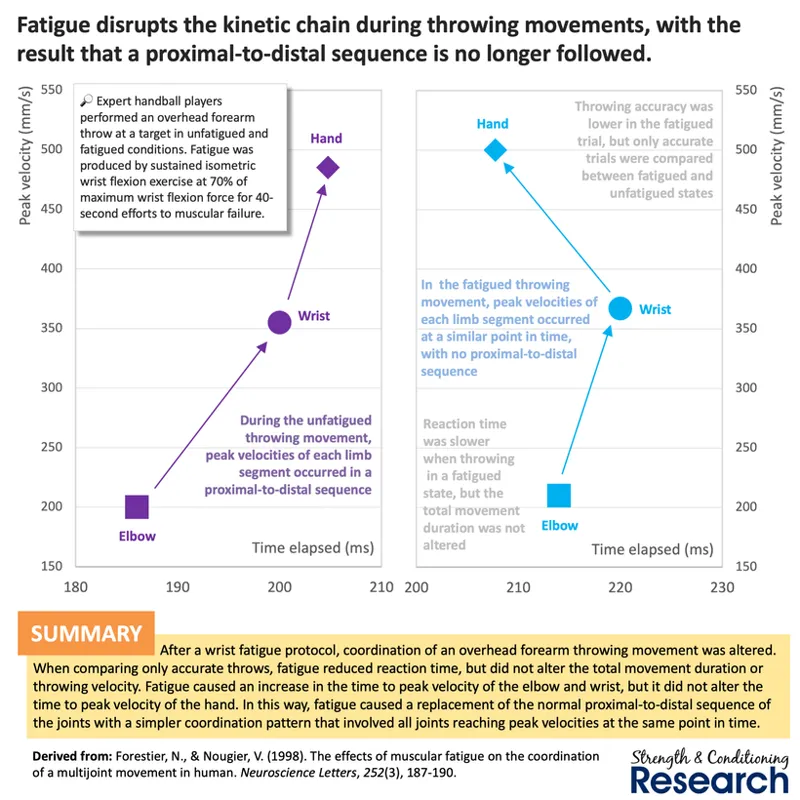
Importantly, we can be certain that the degree of coordination is reduced by fatigue and not just altered. The proximal-to-distal sequence is an essential feature of any well-coordinated multi-joint movement. Fatigue disrupts our ability to create this sequence and reduces our movement efficiency.
.
#2. Fatigue during exercise impairs coordination improvements
When we practice a physical task in a fatigued state, improvements in coordination are reduced. Moreover, practising a physical task in an acutely fatigued state reduces the extent to which further improvements in coordination in the same physical task can be achieved by a second practice session. This suggests that learning a movement task in a fatigued state [1] reduces improvements in coordination, and also [2] produces adaptations that then interfere with our ability to learn that same movement task in an unfatigued state.
.
#3. Fatigue from previous workout impairs motor learning
Similar results have been observed when practising movement skills while experiencing sustained fatigue (from a previous workout). This suggests that the negative effects of fatigue are not limited to acute fatigue (caused by metabolite accumulation and excitation-contraction coupling failure) but also occur as a result of post-workout fatigue (caused by muscle damage, excitation-contraction coupling failure, and central nervous system fatigue).
.
#4. An external focus of attention improves movement patterns
In contrast to fatigue, using an external focus of attention has been shown to improve coordination when it is applied in a movement test. We can see this by reference to the immediate improvement in the take-off angle during a horizontal jump when using an external focus of attention.
.
This immediate improvement in coordination likely causes a greater stimulus for an adaptation in the motor program of the trained movement.
.
Conclusions
Improvements in coordination are an important mechanism by which athletes increase sporting performance. So how can we maximize this adaptation? One key observation is that the presence of fatigue (either produced by the workout itself or carried over from a prior workout) disrupts motor patterns and reduces coordination. For example, multi-joint movements usually involve proximal-to-distal sequences of joint actions that maximise efficiency. However, when we perform multi-joint movements in a fatigued state, this highly-efficient pattern is replaced with a simplified coordination pattern that is much less efficient. This disruption in motor patterns seems to [1] prevent improvements in coordination from being stimulated by that practice session, and also seems to [2] impair future improvements in coordination that would normally occur in the same movement as a result of subsequent practice sessions. It seems likely that we upgrade our existing motor programs by showing the brain superior ways of coordinating those movements and the presence of fatigue stops that from happening by degrading our capacity to move well. While fatigue has a negative effect, using an external focus has a positive effect and seems to instantaneously improve coordination when implemented. As we might expect, the exposure to an improved level of coordination has a stimulating effect that causes adaptations in coordination and likely explains why using an external focus of attention during training causes greater improvements in strength and sports performance.
Comments (11)
Hey Chris, thanks for this article. Do you think it could be possible that a reduction in glycogen levels in the brain after resistance training could also play a role in reduced motor learning of a new skill?
Yes, since it causes fatigue by means of [1] increased supraspinal CNS fatigue, and [2] excitation-contraction coupling failure. Links below.
That’s very interesting!!! Thanks Chris!
On the topic of fatigue, have you found any research out there showing any sort of training modalities that could improve resistance to fatigue in explosive movements such as jumping/sprinting? I’d assume the principle of specificity would point to “doing X training modality at gradually higher frequency over time would improve your ability to resist fatigue in that modality”...But I haven’t found any literature on that yet
The two main mechanisms that allow us to resist fatigue are: (1) improved efficiency in the movement (due to superior coordination), and (2) improved peripheral fatigue resistance in the working muscles (largely due to altered muscle fiber properties). We could therefore train to improve fatigue resistance by (1) becoming more coordinated in the specific movement pattern (by chance, I have an upcoming Patreon article about some techniques to maximize coordination improvements through training), and (2) training the muscle fibers of the muscles that are used in the movement. Importantly, this need not be done using the movement pattern itself. For example, for improving fatigue resistance of the upper body for a throwing movement, we would not need to use the throwing movement itself. We could use ergometer rowing, or arm cycling, or something similar.
So is the implication to increase recovery (using something like HRV to guide days for skill training) or to reduce load when the skill training allows for it?
I think the key is to avoid fatigue when practicing a movement that requires improvements in coordination. This will differ between athletes, depending on their sport. For example, a powerlifter may want to avoid too much fatigue while performing back squats, bench presses, and deadlifts (because they want to maximize coordination improvements in those exercises), but a team sports athlete who uses squats will not need to avoid fatigue in that exercise, since they don't compete at squats, but instead just use squats to develop lower body strength.
But don’t you want to have good coordination when in a fatigue state? Thus practicing near perfect coordination during fatigued state may have its place.... thoughts?
Indeed, we might want to have good coordination in a fatigued state, but that doesn't mean that we can achieve this goal by training in a fatigued state. Physiology doesn't always work the way that we might want it to.
Important implications for us calisthenic practitioners. Don't practice handstands and things like that at the end of a workout after all the strength sets have already robbed you of most of your energy. Keep it fresh!
Exactly!